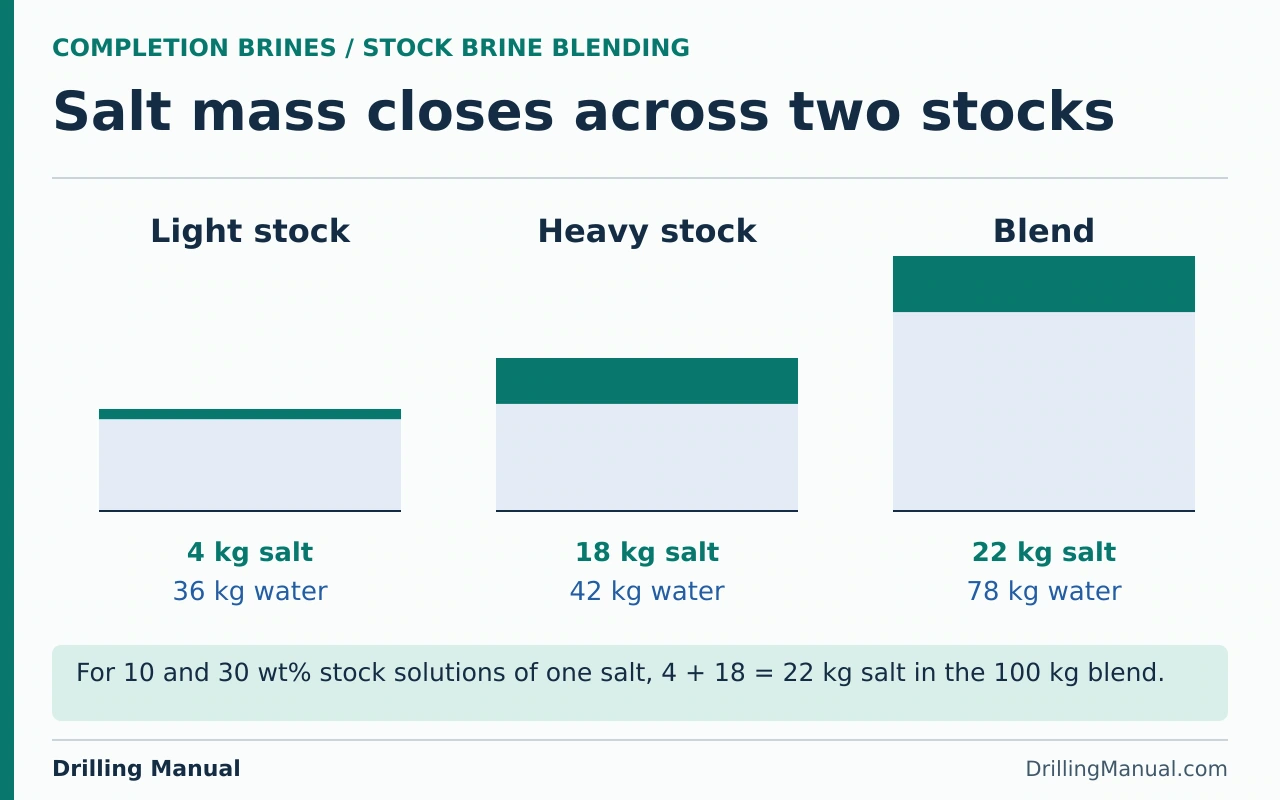
To blend two compatible stocks containing the same salt, balance salt mass against total solution mass. A 10 wt% stock and a 30 wt% stock can make 22 wt% by mixing 40 mass units of the lighter concentration with 60 mass units of the stronger concentration. A weight percentage always uses solution mass as the denominator. Applying those fractions directly to tank volumes changes the recipe.
Put every input on the same basis
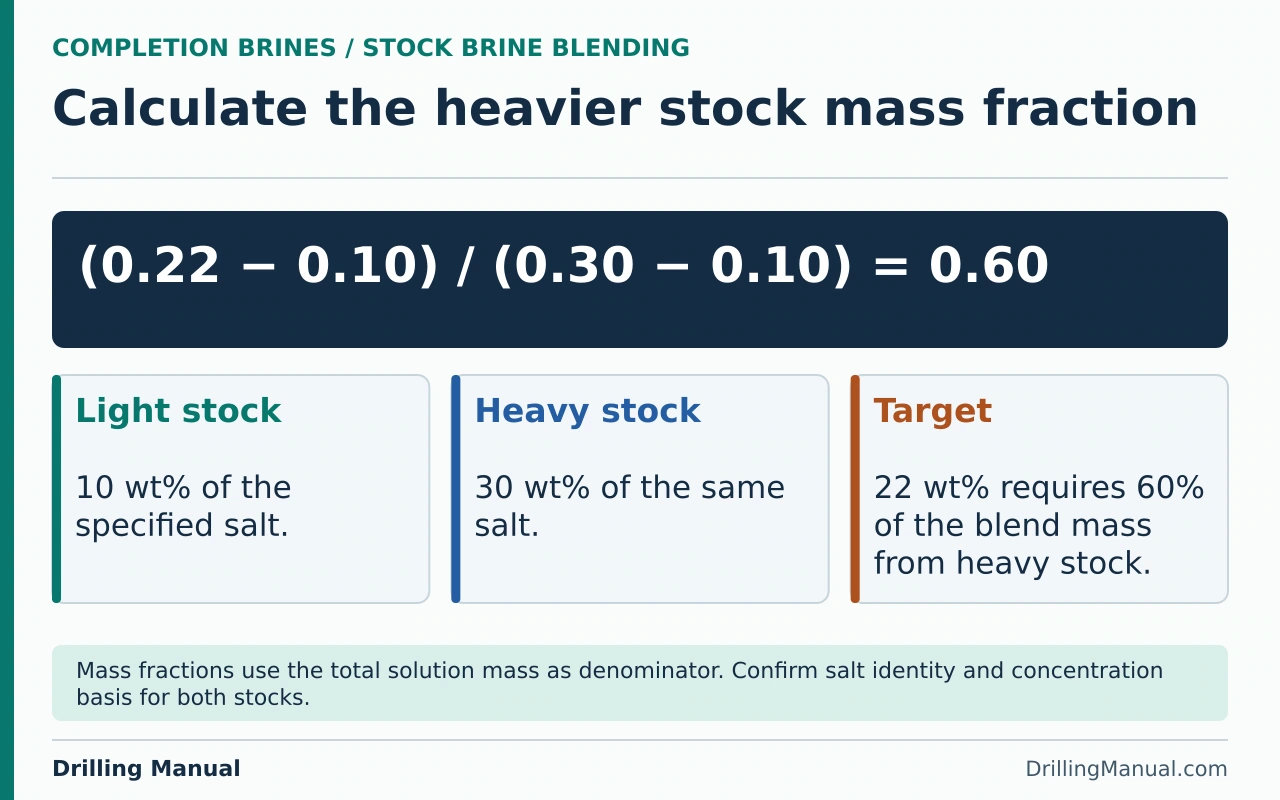
Write each stock composition as salt mass divided by solution mass. Verify whether a supplier reports weight percent of salt, a product equivalent or a different assay basis. For a target brine mass M, the mass of stronger stock is M × (target fraction − weaker fraction)/(stronger fraction − weaker fraction). The weaker stock supplies the remaining mass. This calculation assumes compatible stocks, a common solute basis and no material loss.
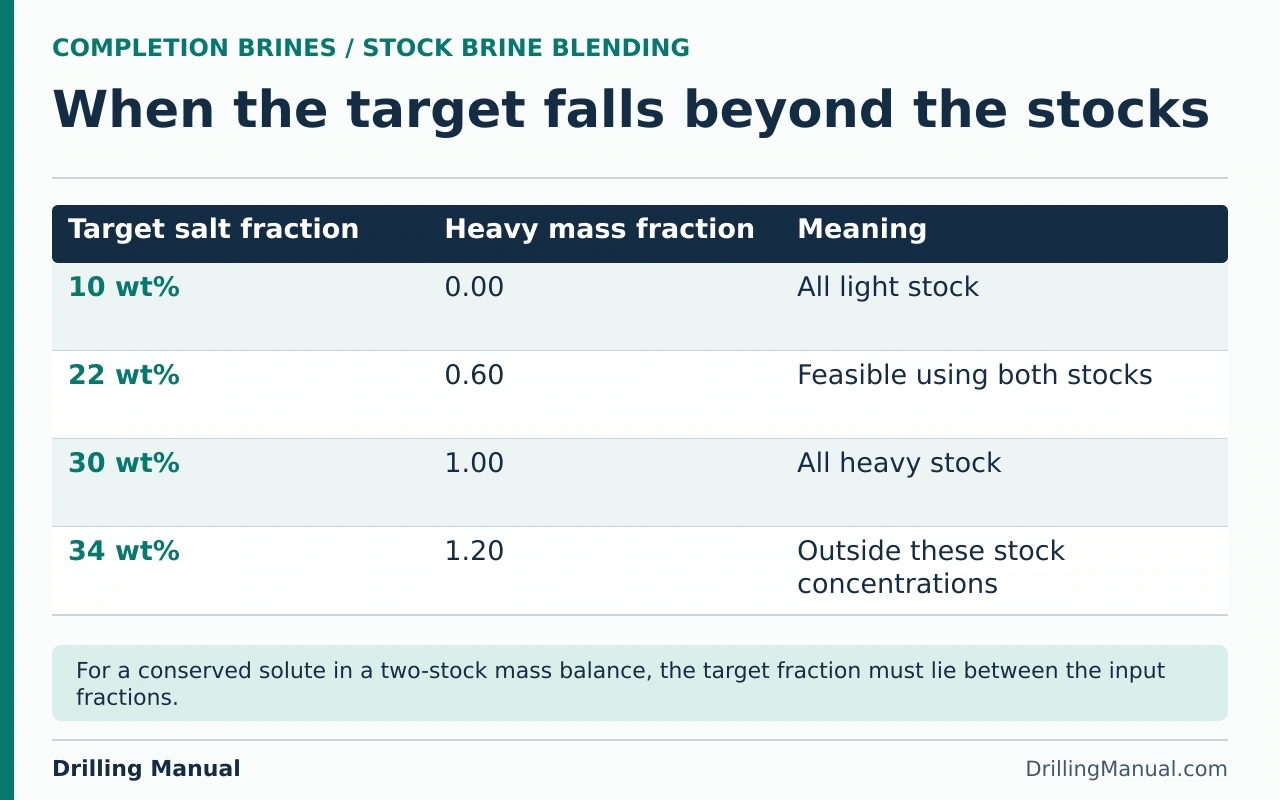
A blend of two stocks can attain only a concentration between their two values when no other material enters. If the target is above both, the equation returns a negative amount of the weaker stock. Treat that as an infeasible two-stock specification. Do not turn a negative amount into a positive order.

| Stock | Solution mass | Salt mass | Water mass |
|---|---|---|---|
| 10 wt% | 40 kg | 4 kg | 36 kg |
| 30 wt% | 60 kg | 18 kg | 42 kg |
| Total | 100 kg | 22 kg | 78 kg |
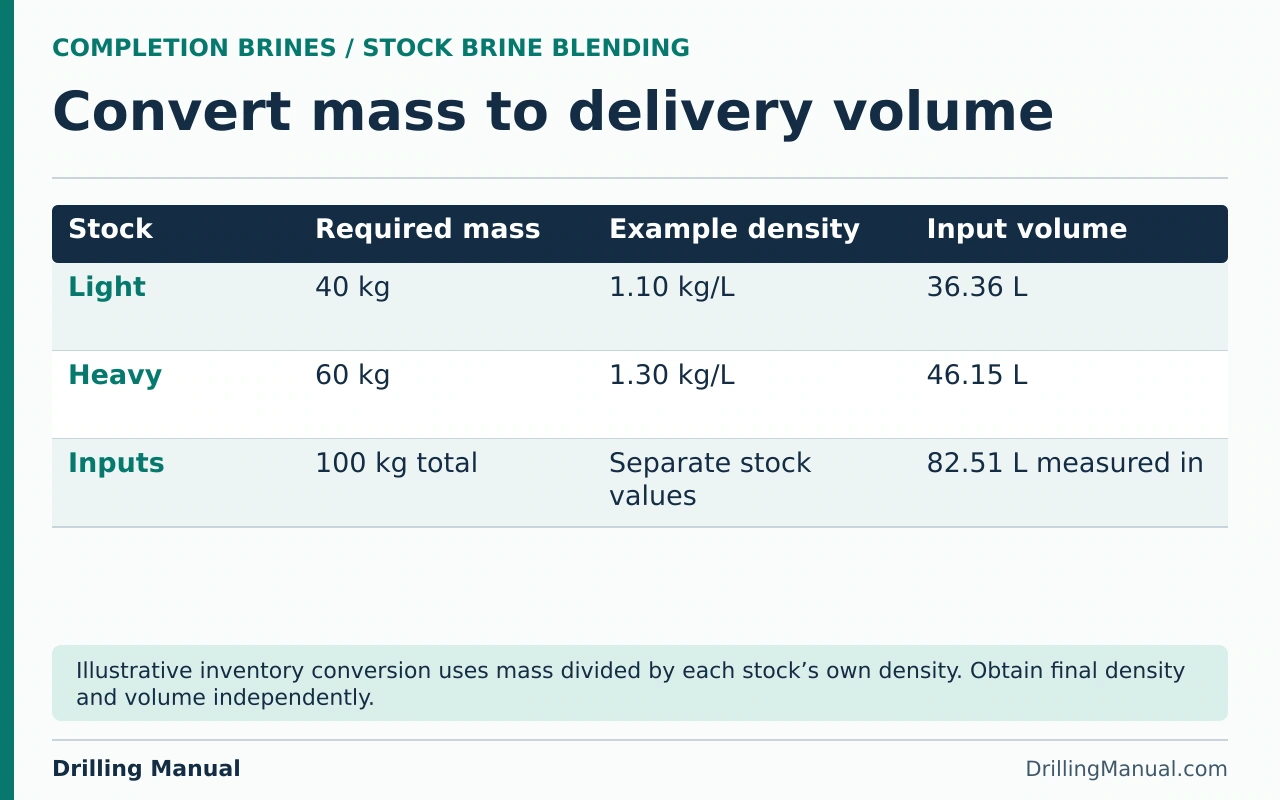
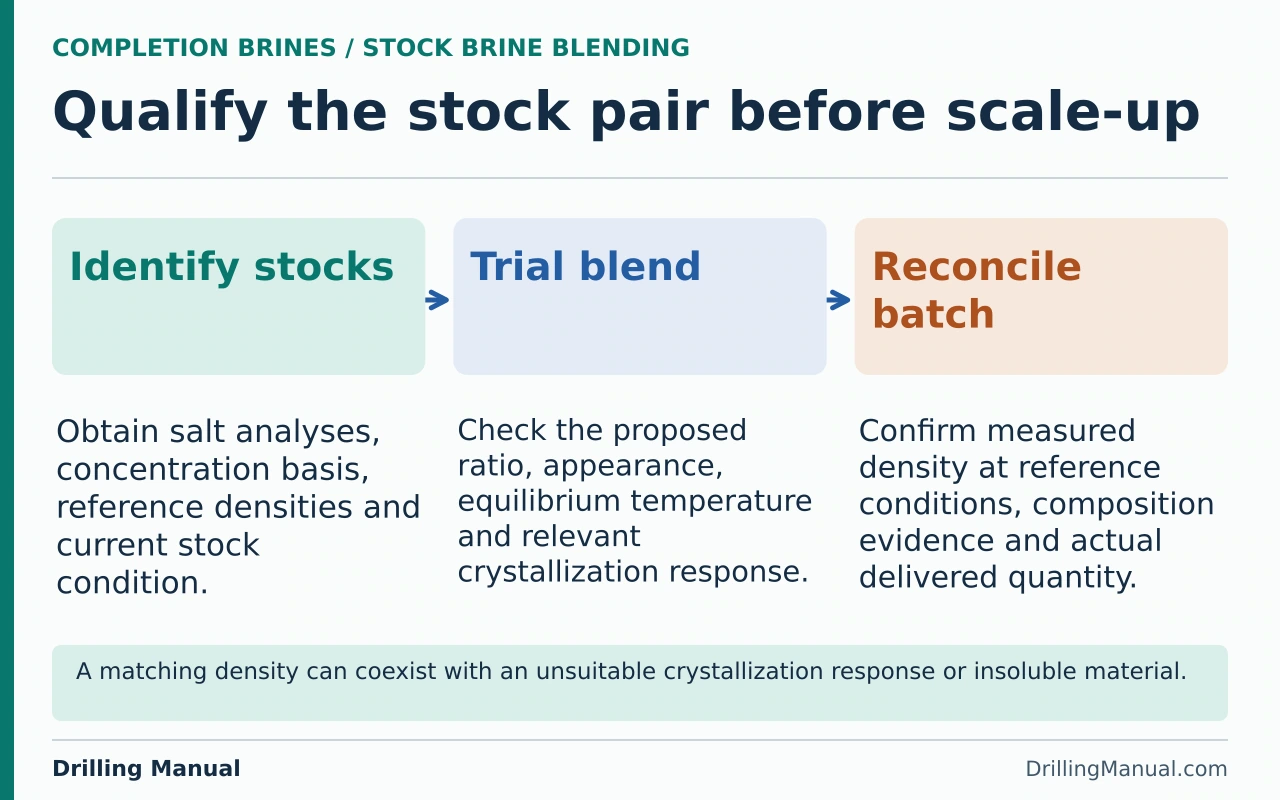
The balance closes on both salt and water. For a larger batch, scale every mass by the same factor. If the rig receives stock by volume, convert each required stock mass using the density of that stock at the relevant temperature. Use consistent mass and volume units. A supplier’s density for the final blend is not a substitute for either individual stock density.
Why the density shortcut answers a different question
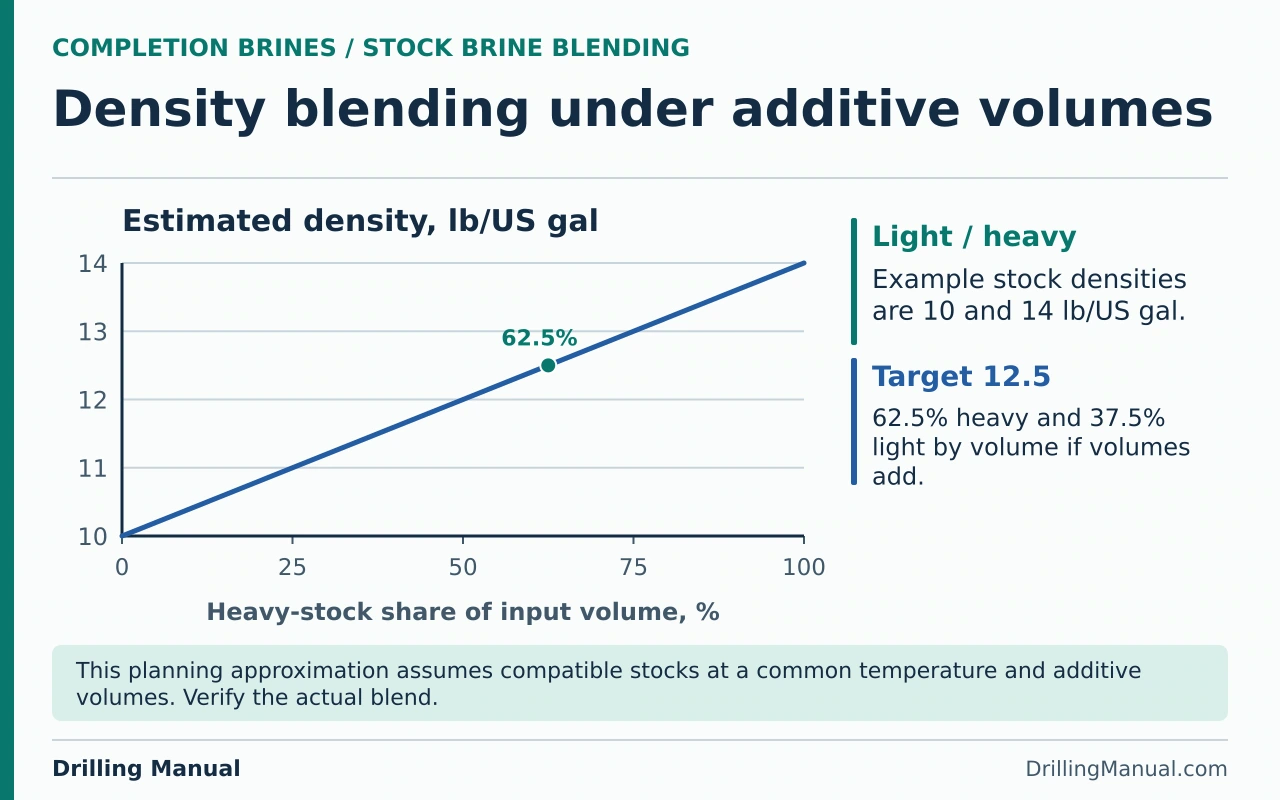
A volume-weighted blend of 10 and 14 ppg fluids predicts 12.5 ppg at 37.5% lighter and 62.5% heavier stock by volume, if liquid volumes are additive at the same reference conditions. For example, 37.5 bbl plus 62.5 bbl gives 100 bbl under that assumption. This calculation uses a target density. It does not certify a 22 wt% solution, an individual ion concentration or a crystallization temperature.

Brine composition and volume can change the accuracy of a simple density interpolation. Weighing stocks and balancing their salt masses avoids relying on final volume additivity to establish a mass fraction. To convert the resulting mass to final deliverable volume, use validated composition-specific density information at the stated reference condition, then confirm the finished fluid.
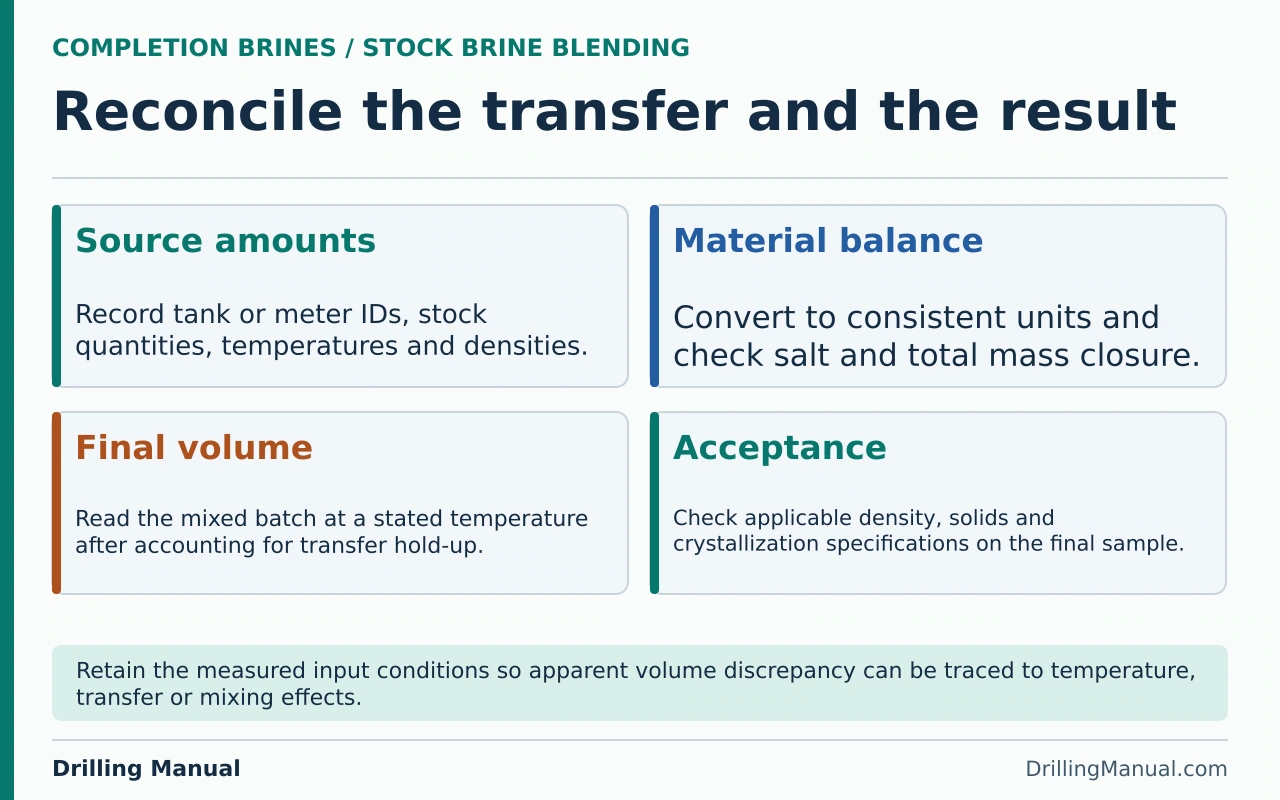
Account for a tank heel before calculating the order
Suppose a tank already contains 20 kg of verified 22 wt% product and the target is 100 kg at that composition. The new stocks must supply 80 kg of solution and 17.6 kg of salt. Applying the same 40:60 mass split gives 32 kg of weaker and 48 kg of stronger stock. If the heel concentration is unknown, treating it as product merely hides the missing input. Sample it or carry a documented range through the calculation.


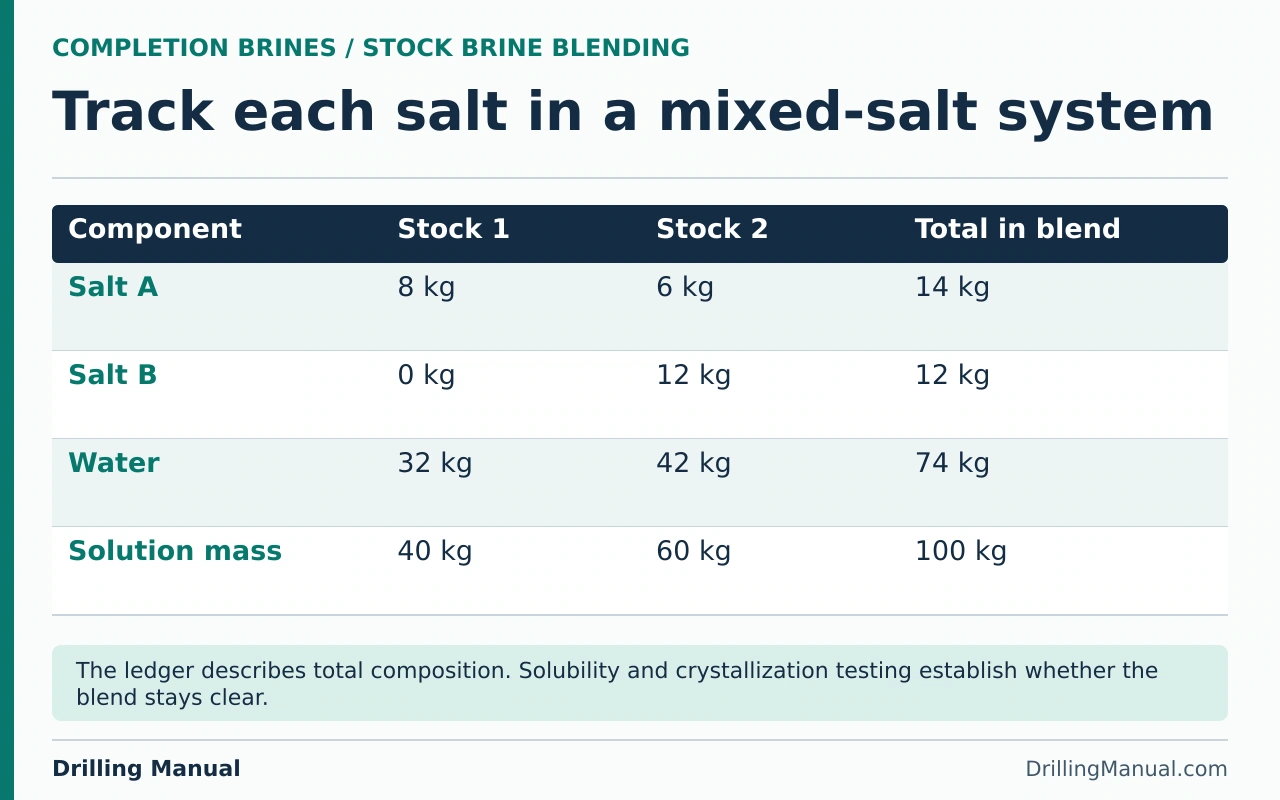
A second salt introduces a second component balance. Several blends can share a density while having different chloride/bromide composition and crystallization behaviour. For a specified mixed-salt product, retain a row for each required component. Actual products also need compatibility and crystallization evidence appropriate to the use. A mathematically closed blend can still fail the fluid specification.
See mixed-salt and delivered-volume checks
Field or laboratory record
Download the editable stock-brine blend sheet (TXT).
Frequently asked questions
Can I use percentages as whole numbers in the blend equation?
Yes, if all three concentrations use the same percent scale and basis in the ratio. Convert to fractions before calculating salt mass from solution mass.
What if both stocks have the same concentration?
They can maintain that concentration in any proportion. They cannot produce a different target concentration on their own.
What should accompany the volume sent to logistics?
Give the mass requirement, the stock density and reference temperature used for conversion, the stock identity and how the finished blend will be verified.
Further reading and technical references
For fluid selection and compatibility, see Choosing Workover Fluids: Density and Compatibility. For the measurements to repeat on the finished batch, see Completion And Workover Fluids Testing Procedures.
Halliburton Baroid. The Baroid CFS Fluids Handbook (Completion Fluid Services), April 2002 PDF. Printed pp. 37–38 (PDF pp. 38–39), Brine Density Adjustment and Brine Blend Equations.
R. Caenn, H. C. H. Darley and G. R. Gray. Composition and Properties of Drilling and Completion Fluids, 7th ed. Gulf Professional Publishing, 2017. Printed pp. 45–48, 493 (PDF pp. 51–54, 495).