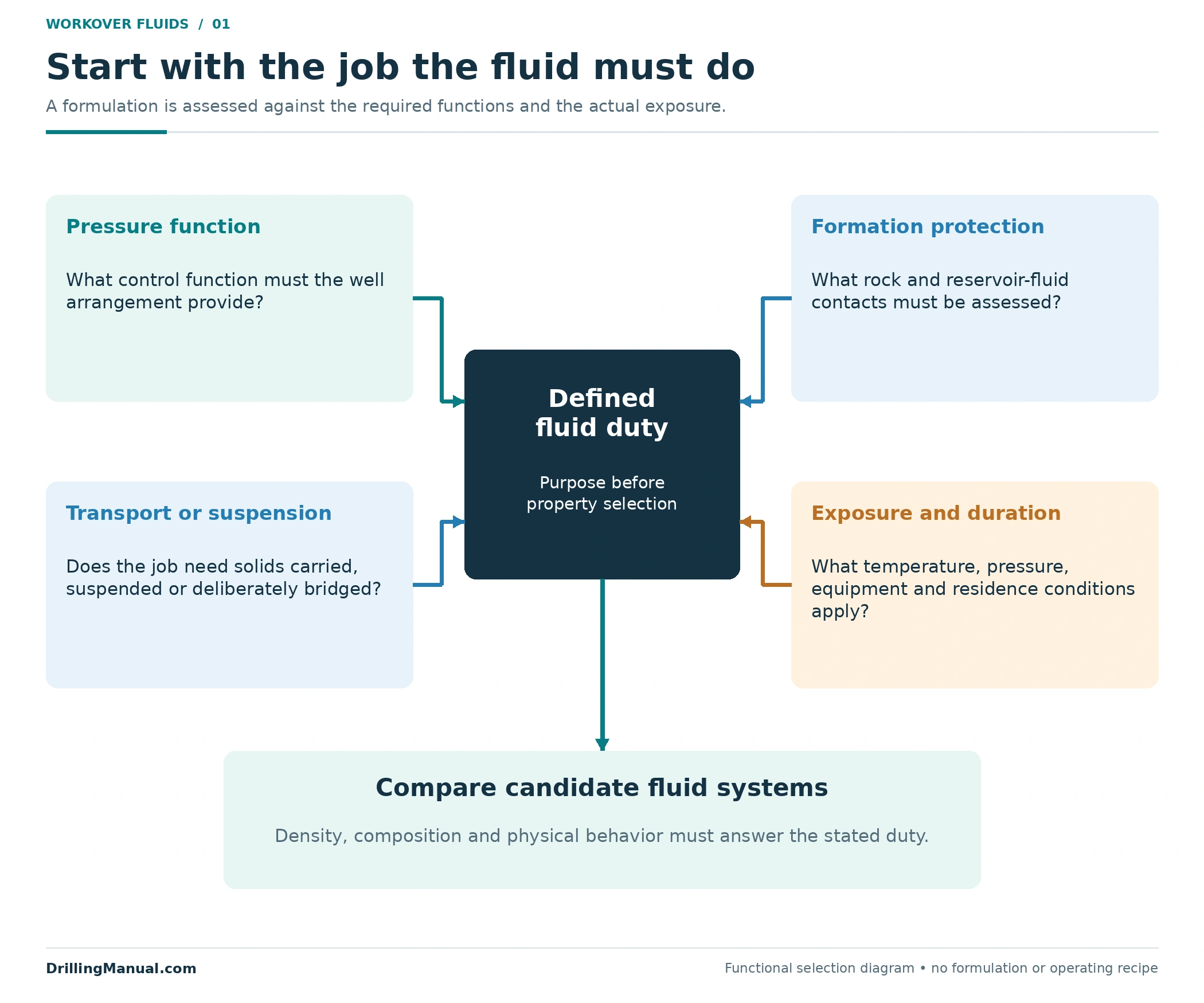
Choosing workover fluids starts with the functions the well requires. Density must address the pressure-control objective, but the same fluid also contacts the formation, mixes with other fluids, encounters changing temperatures and may have to carry solids. A choice that satisfies only its surface density can leave important compatibility, loss and restart questions unresolved. [1, pp. 39–43, 45]
This guide develops a selection framework rather than a mixing or laboratory procedure. Two hypothetical wells show how different conditions change the questions asked of a fluid. The examples contain no recommended density, additive concentration, operating pressure or product ranking.
Define What the Workover Fluids Must Do
Lyons distinguishes fluids used during reworking from those used to establish final contact with the productive formation, and from fluids retained in the tubing-casing annulus. Those applications can share fluid families while placing different demands on them. The selection must begin with the intended duty and exposure, not simply with a familiar fluid name. [1, pp. 39–40, 45]
For example, a fluid used during a cleanout may need to transport solids. A fluid left in an annulus has a different residence time and stability requirement. A fluid contacting an exposed producing interval must be assessed for its effect on that formation. These functions can occur at different stages of the same intervention, so describe the stage as well as the fluid. [1, pp. 39, 43]
The book’s selection principle is direct: establish the required functions and then choose a base fluid and additives suited to them. Reversing that order can produce a poor match. In practical terms, a fluid specification should explain what each important property is intended to achieve in this particular well. [1, p. 45]
Revisit the selection when the proposed job changes. An equipment-focused intervention and a cleanout with an exposed solids-removal duty may not ask the same things of workover fluids. Keep the actual fluid contact and required transport function visible when comparing options, rather than carrying a specification forward because it was suitable for an earlier scope. [1, pp. 39, 43, 45]
Density Is One Requirement for Workover Fluids
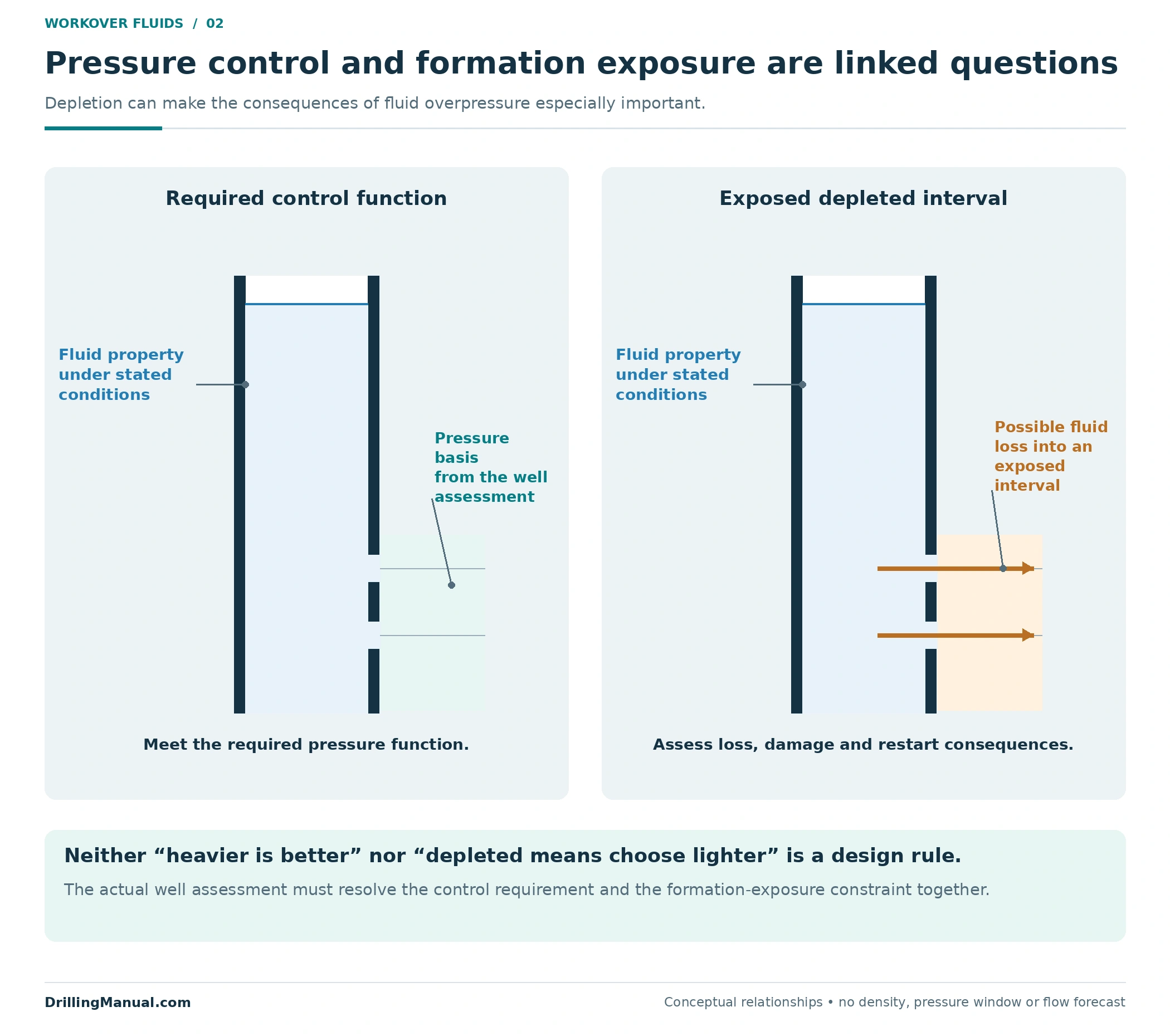
The source identifies formation-pressure control as the first fluid function and says density should not exceed what is needed for that purpose. This is a design principle, not permission to choose a density from a generic article. The required pressure basis must come from the well assessment and its intended operating condition. [1, p. 42]
Excess pressure against a vulnerable formation can create another problem. Perrin describes depleted reservoirs in which conventional fluids exert substantial overpressure, leading to losses or formation damage and difficulty restarting afterward. The pressure-control requirement and formation-exposure consequence must therefore be considered together. [2, pp. 298–299]
A simple “heavier is better” rule misses that relationship. Equally, the presence of depletion does not authorize an arbitrary lighter fluid. It identifies a constraint that the well design must resolve. The selection question is which fluid and intervention arrangement can meet the required control function while managing the expected exposure and losses. [1, pp. 42, 45] [2, pp. 298–299]
Keep the pressure requirement separate from the density measurement. The former is a well condition or design requirement; the latter is a property of the fluid under stated conditions. The separate hydrostatic-pressure guide covers that relationship. This article supplies no well-specific pressure window or density calculation.
Solids-Free Brine and Suspended-Solids Systems Serve Different Needs
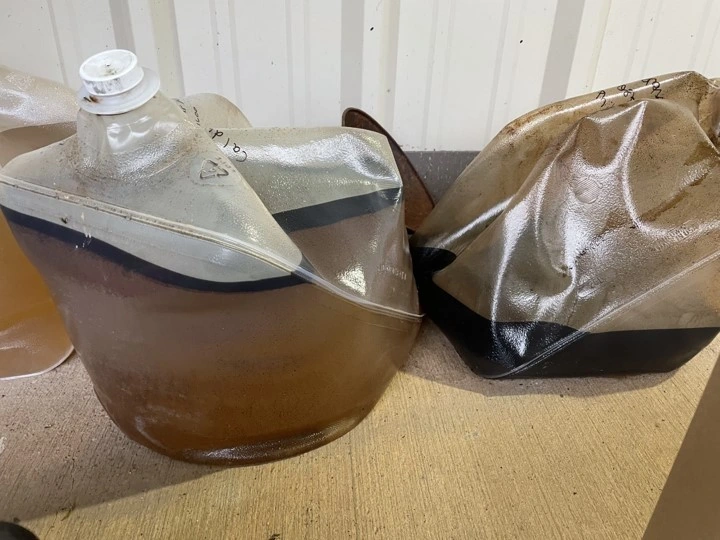
Lyons distinguishes clear liquids containing dissolved salts from weighted suspensions containing particles. The clear liquids are described as solids-free because they have no suspended solids. Weighted systems may use solids to provide additional density or bridging. These are functional distinctions; they do not make one family the universal choice for every intervention. [1, pp. 40–43]
| Fluid characteristic | Potential purpose | Question that remains |
|---|---|---|
| Dissolved salts in a clear brine. | Provide the required fluid density without suspended weighting particles. | Is the composition compatible with the exposure, temperature and other fluids? |
| Purpose-selected suspended solids. | Provide weighting or a designed bridging function. | Where will the solids go, and how will their effect be removed or managed? |
| Adjusted viscosity or suspension behavior. | Carry sand or cuttings, or retain solids under the relevant conditions. | Does the selected property support the actual transport or suspension duty? |
| Fluid-loss-control provision. | Limit invasion into an exposed interval. | Does the placement and cleanup plan protect the intended production function? |
Clear appearance is not a complete compatibility result. A fluid can contain no visible suspended weighting solids and still face a crystallization, corrosion or mixing problem. The source discusses these as separate properties of brine systems. Selecting workover fluids by clarity alone leaves those properties unevaluated. [1, pp. 41–45]
Conversely, deliberately added solids should have a stated job. Their presence should be evaluated against the formation and cleanup objective, not treated as an incidental way to reach a density. The book describes weighting and bridging roles separately, which is a useful distinction when comparing proposed systems. [1, pp. 40, 42–43, 45–46]
Assess Workover Fluids Across Their Temperature Exposure
Brine density is temperature dependent. Lyons specifically notes that density measured at atmospheric pressure decreases as temperature rises. Its property discussion also includes pressure effects. A reported density therefore needs its measurement conditions and the appropriate relationship to the conditions being evaluated; one unlabeled number cannot describe the whole fluid path. [1, p. 42]
Cold exposure presents a different question. A selected brine may crystallize or freeze if its temperature falls too far. The source distinguishes the appearance of the first crystal during cooling from the disappearance of the last crystal during warming, and notes that pressure can materially alter crystal formation. An atmospheric observation alone does not establish every downhole condition. [1, p. 43]
Describe the relevant exposure instead of assuming that the hottest location is the only important one. Storage, handling and the well can present different conditions. The original diagram uses a conditional crystal symbol to show why a fluid that is clear at one state may need reassessment at another. It supplies no crystallization curve, temperature margin or acceptance threshold.
The selection implication is to compare a formulation with the expected conditions over its intended duty. The source’s seasonal discussion illustrates why different temperature exposures can change the formulation question. Its historical blend ranges are not used here as current product specifications. [1, pp. 43–44]

Compatibility Must Accompany Workover Fluids Selection
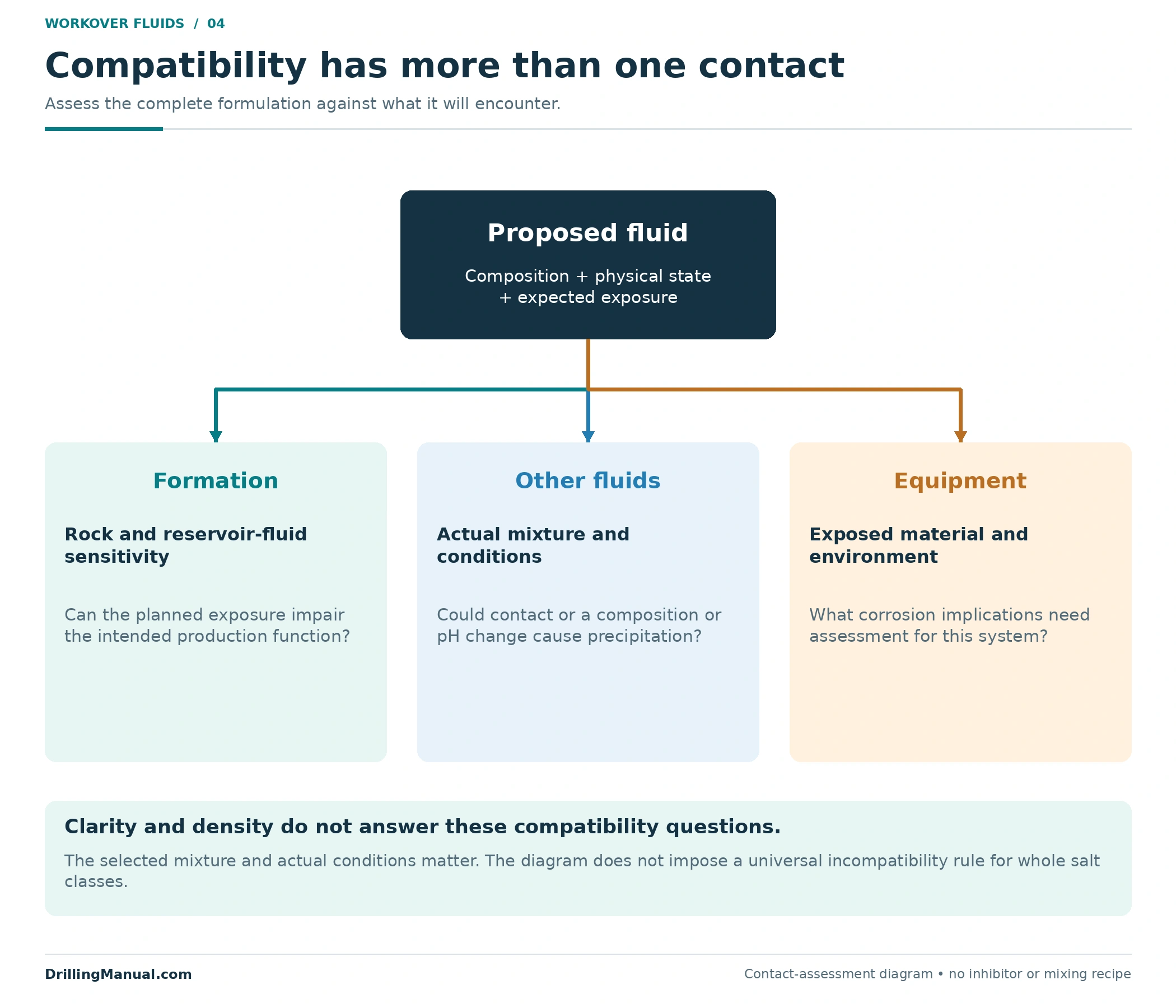
Separate three compatibility questions. How will the fluid interact with the formation? What happens when it meets other fluids in the job? How does its chemical environment affect the equipment exposed to it? The book’s discussions of water-sensitive formations, precipitation during mixing and corrosion show why those questions cannot be answered by density alone. [1, pp. 41–45]
For the formation, identify the relevant rock and fluid sensitivity before selecting the brine family. The source presents single-salt and blended brines with different applications and limitations. Those examples are evidence that composition matters; they are not a universal instruction to choose a particular salt whenever one reservoir description appears. [1, pp. 41–42]
For fluid mixing, consider what the selected fluid will actually encounter. The source warns about precipitation associated with changes in composition and pH in particular brine systems. The article does not turn those historical cautions into a blanket rule that all salts of one ion class are incompatible with another. The actual mixture and conditions need an appropriate compatibility assessment. [1, pp. 44–45]
For equipment exposure, retain the corrosion question alongside the fluid’s hydraulic role. Lyons describes high-temperature corrosion concerns for some heavy-brine compositions. This supports assessing the chosen system under its intended exposure; it does not supply a generic acceptable corrosion rate or an inhibitor recipe for this well. [1, pp. 41–42]
The formation-damage guide provides broader diagnostic context. Here, the task is to prevent a fluid-selection label such as “clear brine” or “compatible base fluid” from standing in for evidence about the complete proposed formulation and its contacts.
Connect Solids Transport, Loss Control and Cleanup
A cleanout duty may require enough carrying capacity to bring sand or cuttings to surface. The source discusses viscosity for that purpose and separately discusses suspension under low-shear or static conditions. Transport during circulation and suspension while conditions change are different requirements; a fluid should be evaluated against the one the job actually needs. [1, p. 43]
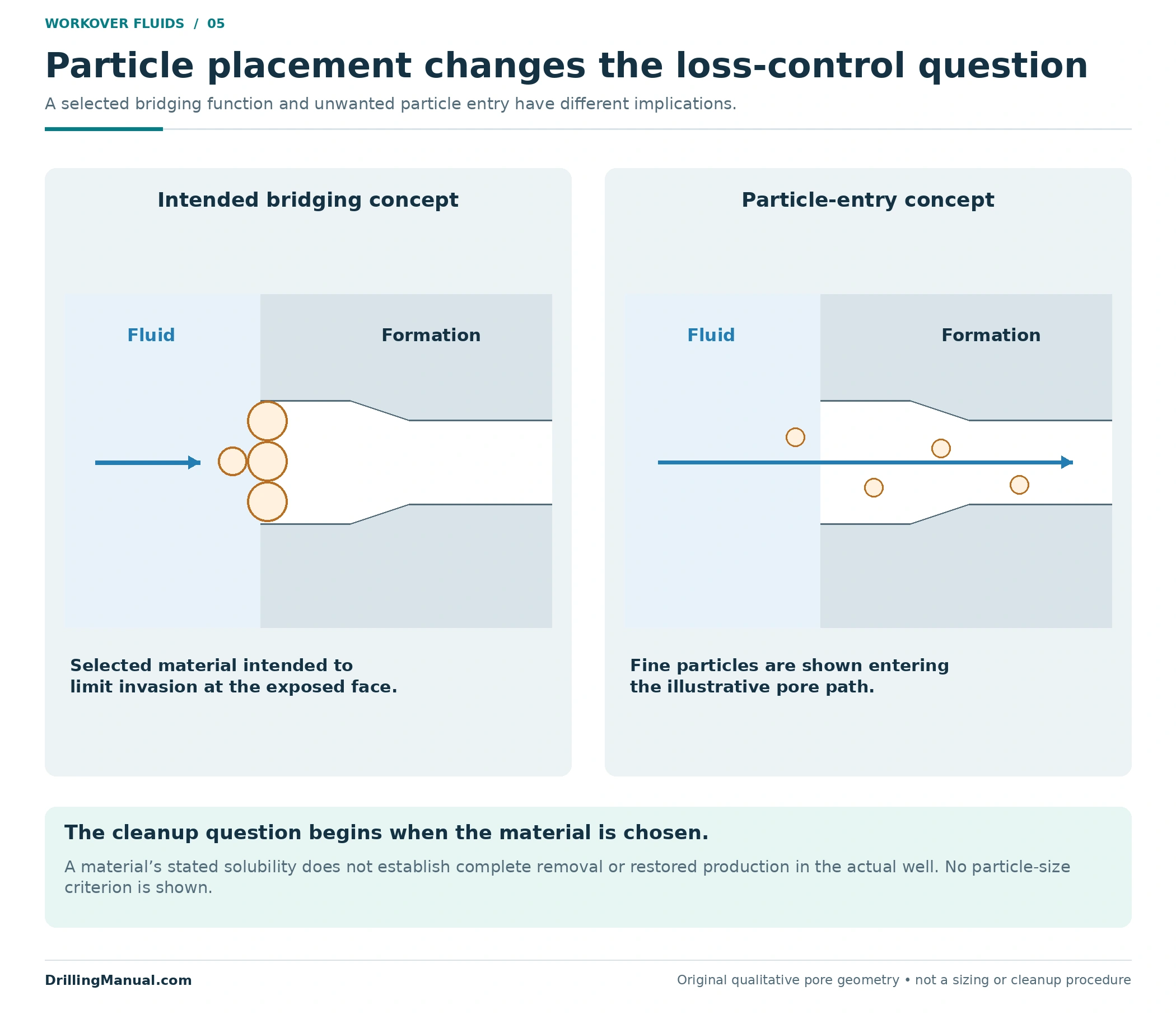
Loss control introduces another function. Lyons describes sized bridging materials and associated filtration-control components intended to limit invasion. Figure 5 shows only the concept of selected particles bridging at an exposed face, with a separate illustration of particles entering a pore. No particle-size rule, permeability value or additive concentration is implied. [1, pp. 43, 45–46]
Cleanup must be part of that choice. A material described as soluble is not evidence that all of its effect will disappear in the actual well. Perrin explicitly cautions that temporary blocking agents are not completely destructible. A proposal should therefore state how the blocking or solids function relates to the eventual production objective rather than assume complete restoration afterward. [2, p. 299]
Workover fluids can thus create a tradeoff between limiting immediate losses and preserving the later flow path. The answer depends on the exposed formation, the selected material, its placement and the feasible cleanup. The source principles justify asking those questions, but they do not provide a universal cleanup program. [1, pp. 43, 45–46] [2, pp. 298–299]
Density and viscosity are not interchangeable specifications. A proposal can address the pressure function while leaving carrying capacity unresolved, or describe good suspension behavior without establishing the required pressure function. The book treats these properties separately. Record the purpose of each adjustment to workover fluids so that solving one problem does not conceal another. [1, pp. 42–43]

Compare Workover Fluids for Two Hypothetical Wells
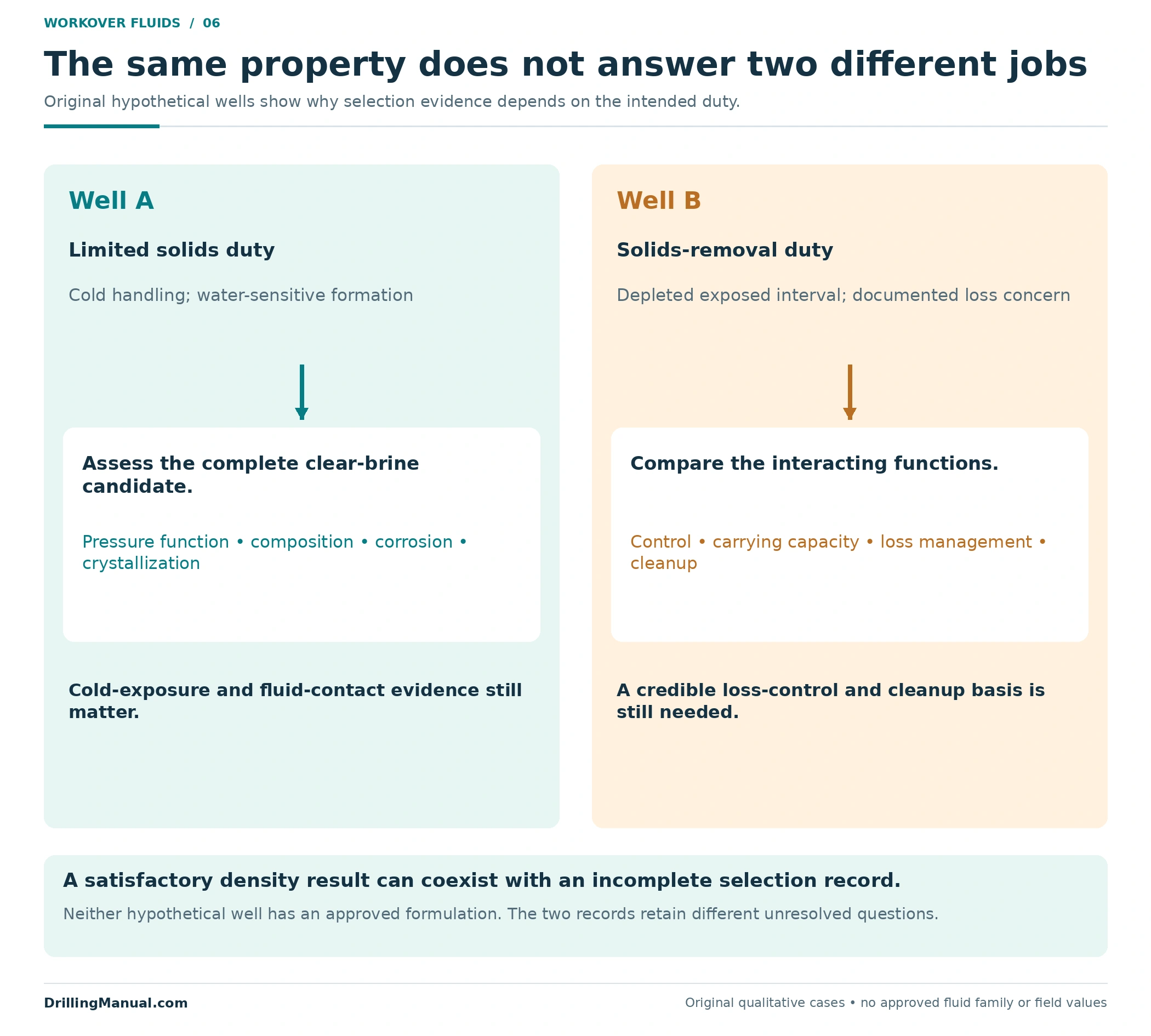
The following cases are original selection exercises. They intentionally omit numerical pressure and density values, because their purpose is to show how the evidence changes the comparison. Neither case identifies an approved fluid or a field operating arrangement.
| Selection input | Well A: limited solids duty, temperature concern | Well B: depleted interval, solids-removal duty |
|---|---|---|
| Stated objective. | Provide the required pressure function during an intervention with little expected solids transport. | Support the required control function while removing solids from a well with a vulnerable exposed interval. |
| Important exposure. | The fluid is handled in a cold environment; the producing formation is water-sensitive. | The interval is depleted and has a documented loss concern; later production must be restored. |
| Initial comparison. | Assess a compatible clear-brine candidate against pressure, composition, corrosion and crystallization requirements. | Compare control, carrying capacity, loss management and cleanup together before choosing the fluid family. |
| Unresolved evidence. | Whether the complete formulation remains suitable under the actual temperature and fluid-contact conditions. | Whether a proposed bridging or other loss-control function can be placed and later managed without unacceptable impairment. |
| What cannot be concluded. | That a clear sample or a familiar salt name establishes suitability. | That adding density or a temporary blocking material resolves the whole depleted-well problem. |
For Well A, low solids duty makes a clear-brine candidate worth assessing, but it does not remove the formation and temperature questions. For Well B, a density-first choice omits the very issues that distinguish the job: exposure to a depleted formation, solids transport and the route back to production. The underlying principles come from Lyons’s functional selection approach and Perrin’s depleted-reservoir discussion. [1, pp. 42–45] [2, pp. 298–299]
The comparison is useful even before a formulation is chosen. It tells the team which missing evidence could change the selection. It also prevents an assumption from one well, such as limited solids loading or tolerable loss behavior, from silently entering the other well’s proposal.
Suppose both proposals identify a satisfactory density measurement, but Well A still lacks an assessment of its cold exposure and Well B still lacks a credible cleanup basis. Neither record is complete for its stated objective. The density results remain useful evidence; they answer only one part of the selection. A comparison of workover fluids should preserve those different unresolved questions instead of treating the same measured property as a complete approval.
Make the Selection Record Reviewable
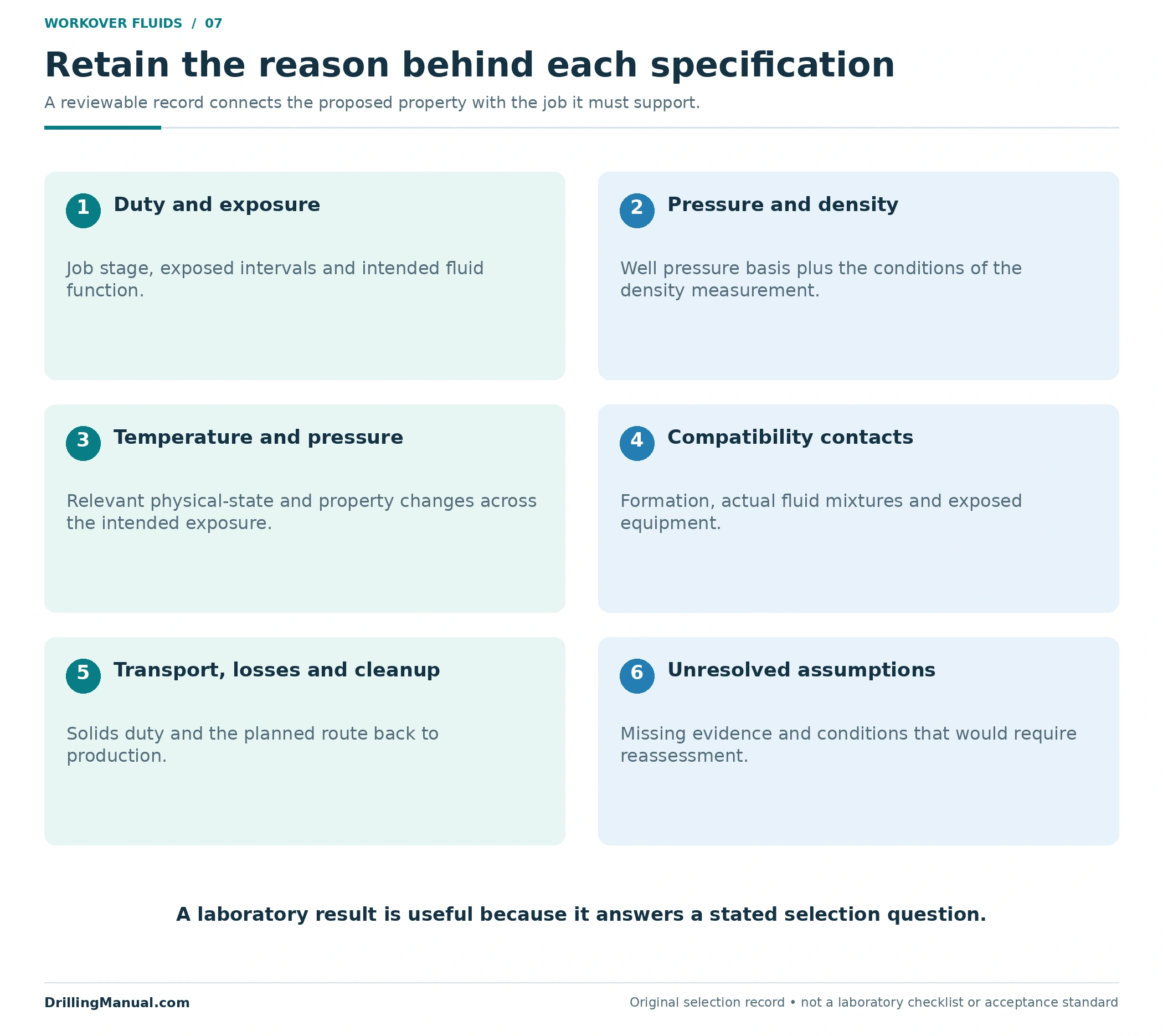
A workover fluids proposal should retain the purpose behind its specifications. The following original record applies the book’s selection logic without reproducing laboratory instructions. It helps the reviewer see how a proposed property answers a well requirement, and where the answer still depends on an unverified assumption. [1, p. 45]
| Record item | Reason to retain it |
|---|---|
| Job stage, exposed intervals and intended fluid duty. | Defines what the fluid contacts and what it must accomplish. |
| Pressure basis and density measurement conditions. | Connects the control objective with the property being specified. |
| Temperature exposure and relevant pressure effects. | Explains the density and physical-state assessment. |
| Formation, fluid-mixture and equipment compatibility. | Preserves the evidence behind the chemical choice. |
| Solids transport, loss control and cleanup provisions. | Connects the intervention duty with the later production objective. |
| Outstanding assumptions and conditions requiring reassessment. | Makes a change in well or job conditions visible to the next reviewer. |
The separate completion and workover fluids testing procedures article covers laboratory checks. A test result is useful here because it answers a stated selection question, not because a long list of tests automatically defines a suitable fluid.
Include the Return to Production
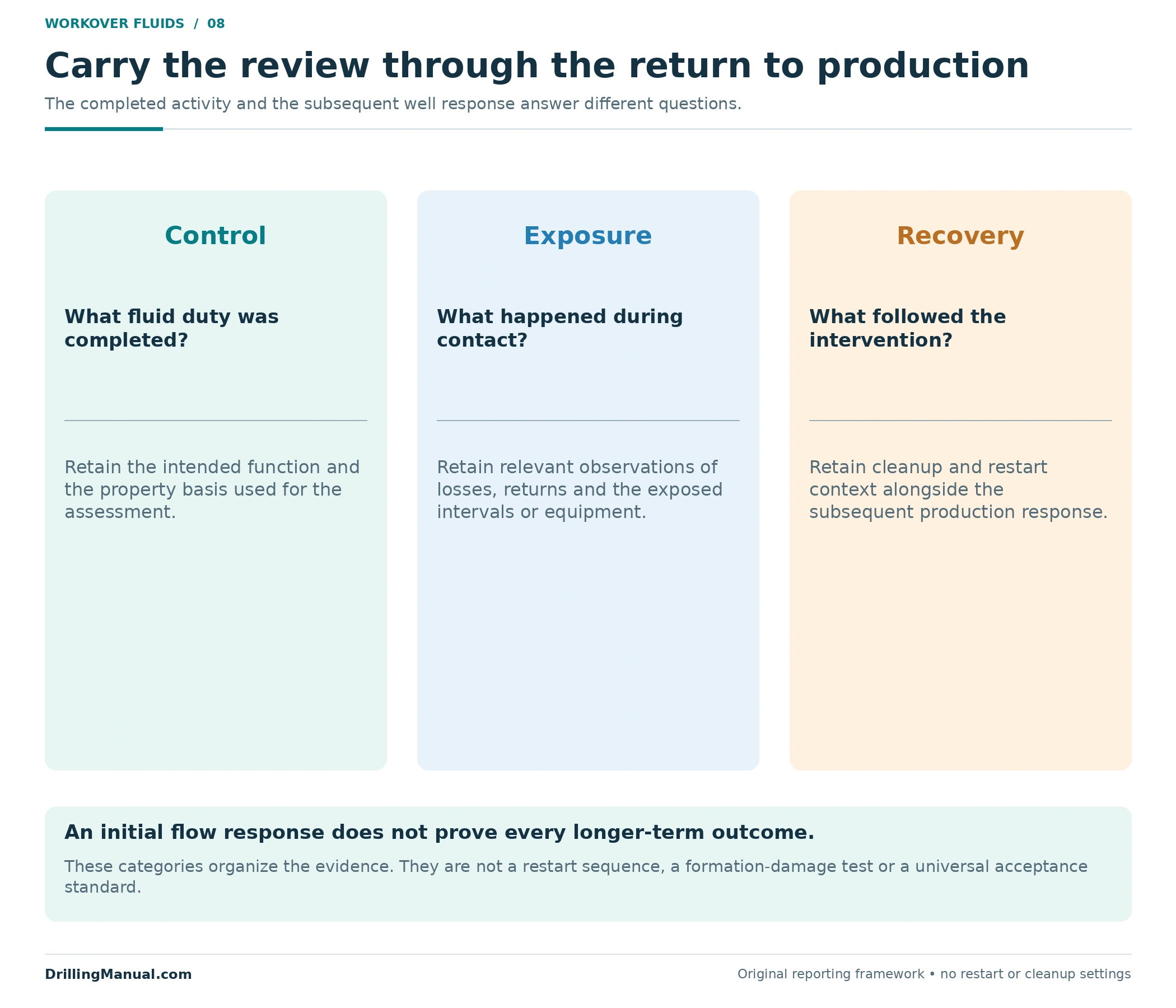
The fluid’s job does not end when the intervention activity stops. Perrin identifies startup as a separate difficulty in depleted reservoirs and discusses situations where the well needs assistance afterward. The selection review should therefore preserve the expected cleanup and restart context alongside the pressure-control function. [2, pp. 298–299]
A planned restart does not prove that the formation was undamaged, just as an initial flow response does not establish lasting production performance. Report the completed fluid duty, observed losses or returns, and subsequent response at the strength the evidence supports. These distinctions organize the report; they do not define an acceptance test.
The broader workover operations guide explains intervention objectives, while nitrogen lifting addresses one separate kickoff mechanism. Choosing workover fluids should account for the intended return to service without assuming that a particular assistance method will be suitable or necessary in every well.


Common Fluid-Selection Questions
What are the best workover fluids?
The suitable choice depends on the required functions and exposure. The source describes several fluid families and explicitly places functional requirements before formulation choice. It does not establish one universal best fluid. [1, pp. 39–45]
Is a heavier fluid always more suitable?
No. The required control function must be met, but unnecessary density can worsen the overpressure problem in a depleted formation. The well assessment must resolve both requirements. [1, p. 42] [2, p. 298]
Does a clear brine prove compatibility?
No. Absence of suspended solids does not answer the separate composition, mixing, corrosion and crystallization questions. Those properties require assessment under the intended conditions. [1, pp. 40–45]
Why state the temperature with density?
Because brine density depends on temperature, and the source also discusses pressure effects. A property measured under one condition must be related appropriately to the condition used in the well assessment. [1, p. 42]
Does an acid-soluble bridging material guarantee full cleanup?
No. Solubility is relevant to the material choice, but Perrin cautions that temporary blocking agents are not completely destructible. The actual removal and production consequences remain part of the evaluation. [1, pp. 43, 45–46] [2, p. 299]
Does this guide replace the laboratory procedures?
No. It defines the selection questions and the evidence they need. Laboratory methods and the actual formulation’s acceptance requirements remain separate from this conceptual comparison.
Book References
- Lyons, William C. Working Guide to Drilling Equipment and Operations. First edition, 2010; Elsevier, Gulf Publishing imprint as identified in the inspected copy. Chapter 1, section 1.4, “Completion and Workover Fluids,” printed pp. 39–46 / physical PDF pp. 54–61. The filename contains “2009,” but the copyright page states first edition 2010. Historical product ranges, blending recipes and laboratory settings are not adopted.
- Perrin, Denis, in collaboration with Michel Caron and Georges Gaillot. Well Completion and Servicing. Editions Technip, English edition, 1999. Chapter 5, printed pp. 298–299 / physical PDF pp. 310–311. Used for depleted-reservoir losses, formation damage, temporary blocking-agent limitations and startup concerns.