A well can drill steadily inside its pressure window and approach pore pressure when the pumps slow for a connection. The mud still weighs the same. The pressure contribution from circulating it up the annulus has changed. Constant-bottomhole-pressure managed pressure drilling (MPD) addresses that transition by controlling pressure on the returns. A pressure budget makes the job, and its limits, easier to understand.
When is managed pressure drilling a candidate?
Managed pressure drilling is a way to control the annular pressure profile while drilling. It becomes a candidate when a conventional mud weight that gives adequate pressure with pumps off leaves too little margin against losses with pumps on. Start with the depth-dependent pore-pressure and formation-strength estimates, the uncertainty in those estimates, and a credible return path. A narrow window on a planning slide is only the start of that assessment.
Different MPD methods address different well conditions. Surface-backpressure systems change the pressure applied to returns. Dual-gradient techniques change how pressure accumulates through different vertical intervals. Pressurized mud-cap drilling addresses severe losses through a different circulation concept. The connection example below applies to a closed-return, surface-backpressure system.
What the pressure budget contains
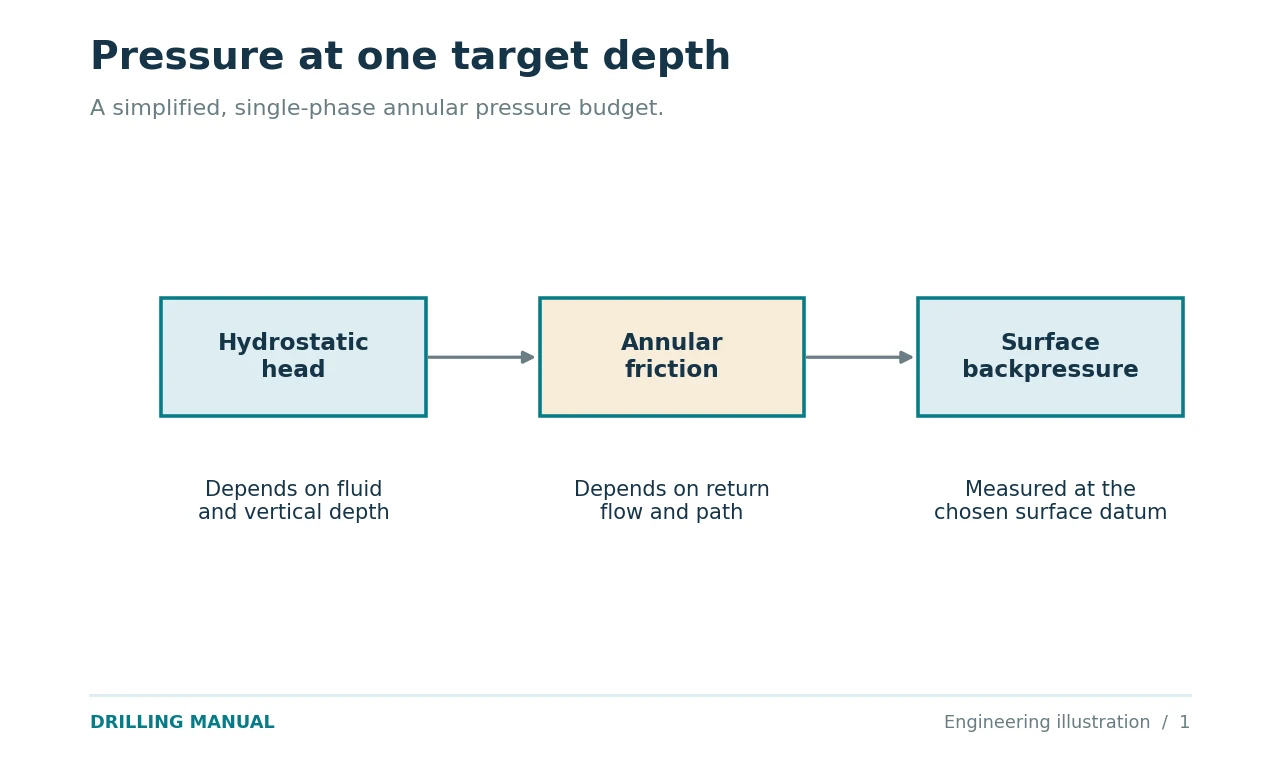
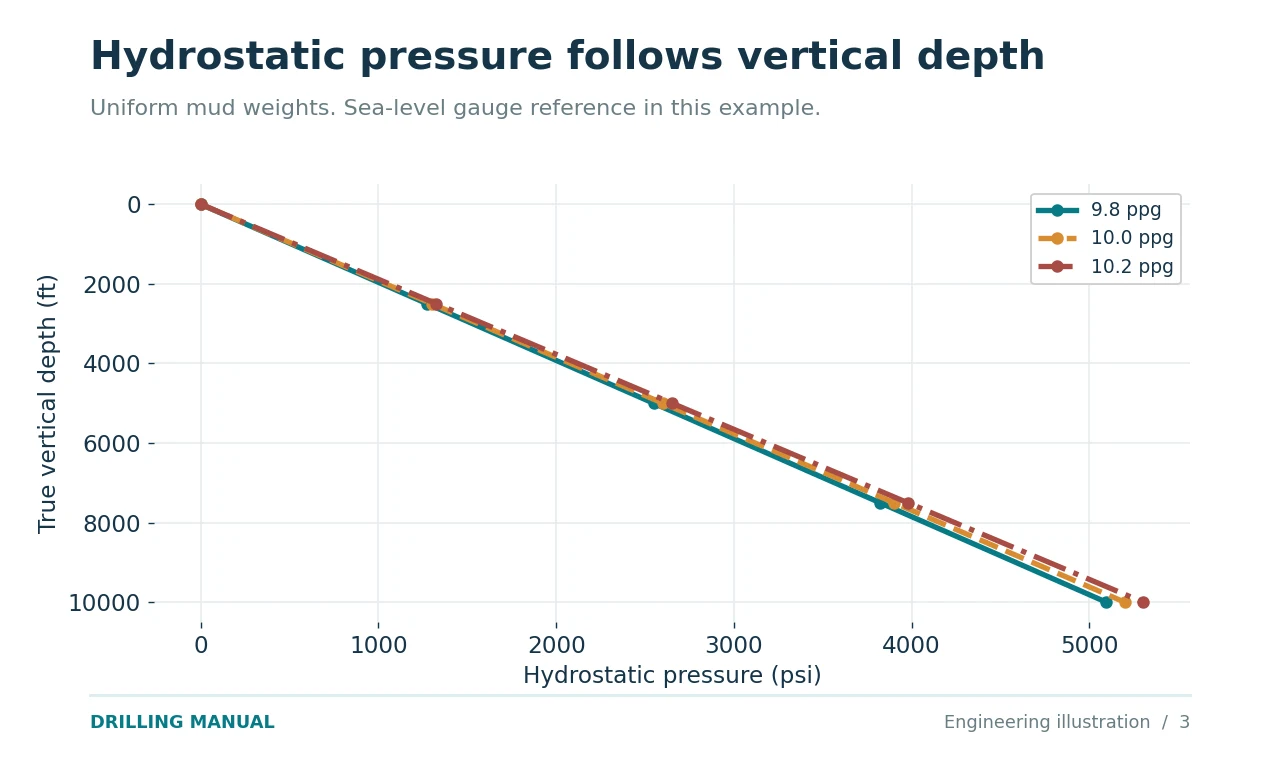
At a chosen depth, a simplified single-phase circulating pressure equals hydrostatic pressure plus friction from the return path above that point plus applied surface backpressure. For a uniform fluid, hydrostatic pressure in psi is approximately 0.052 × mud weight in ppg × true vertical depth in ft. Use the actual return-path datum. Measured depth matters to friction, while vertical depth determines the static head.
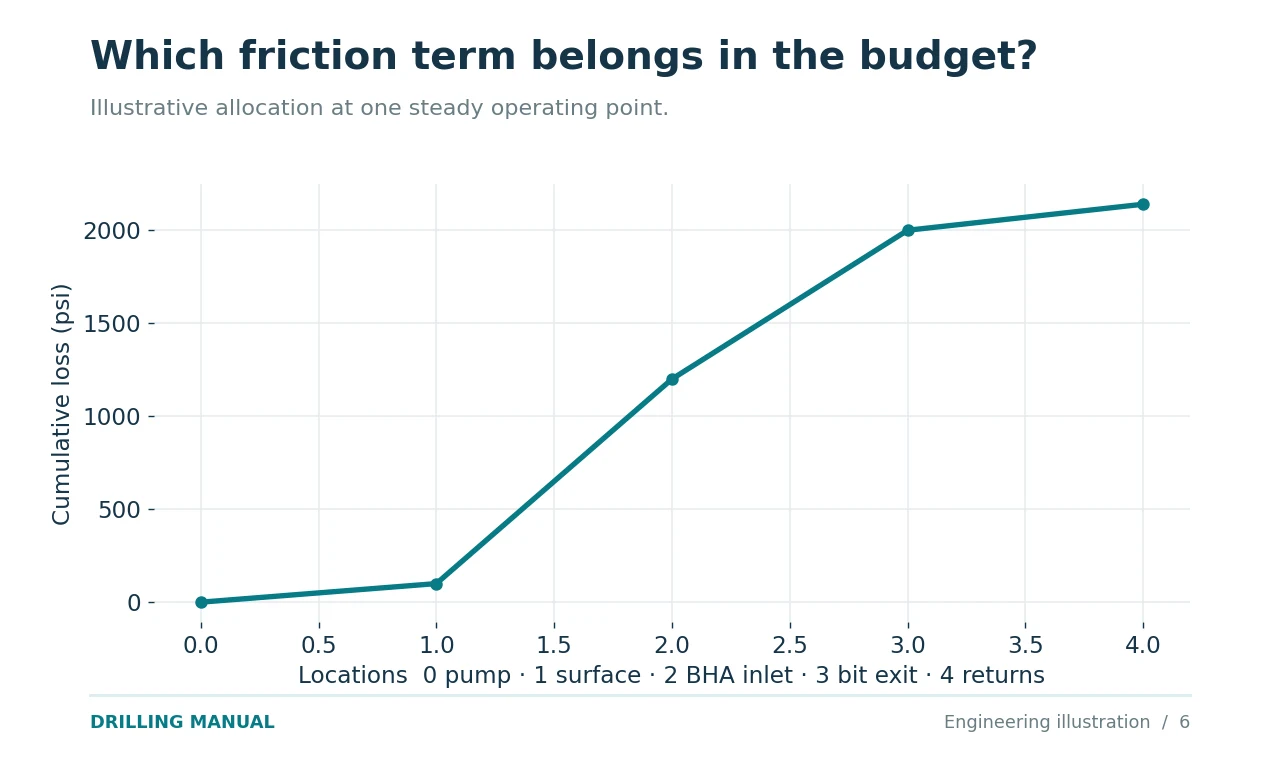
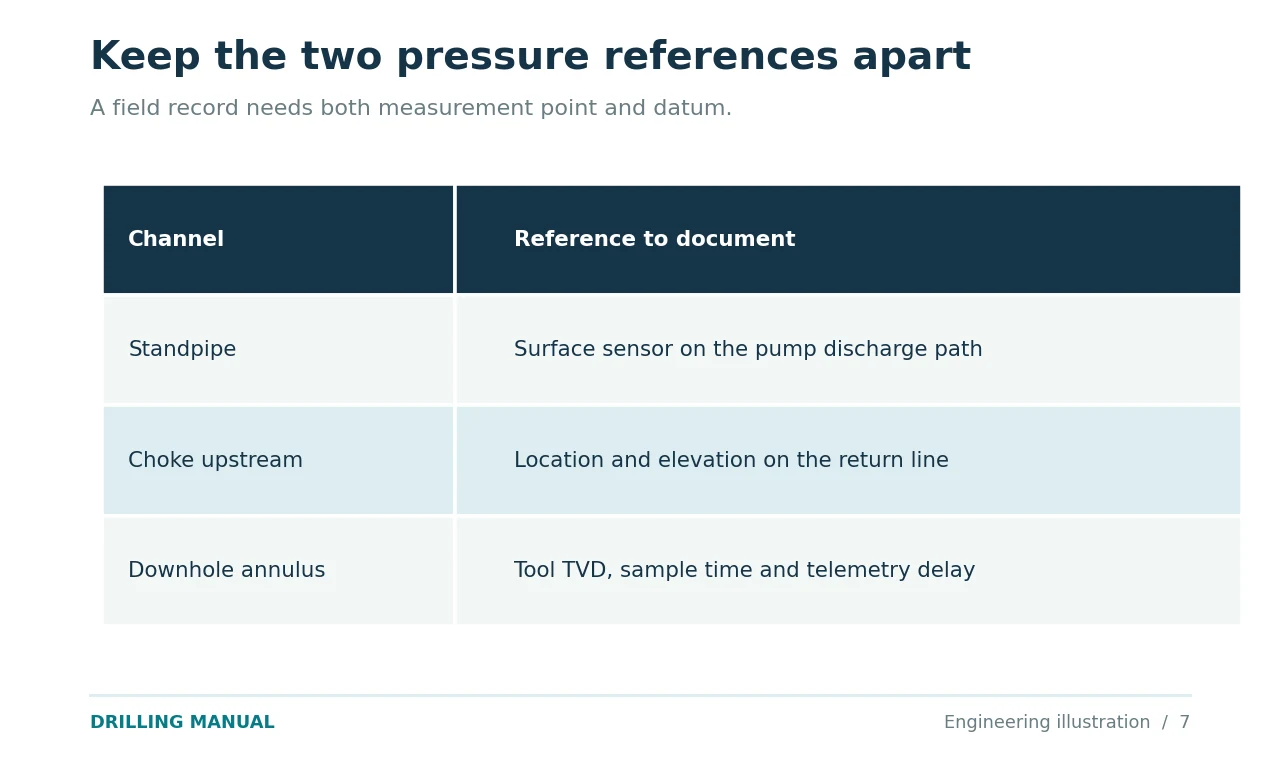
Standpipe pressure includes losses as fluid travels through the surface equipment, drillstring, downhole tools and bit. Adding the standpipe reading to hydrostatic pressure would count several losses on the wrong side of the circulating system. On a connection plot, identify the annular pressure channel and its reference before interpreting either trace.
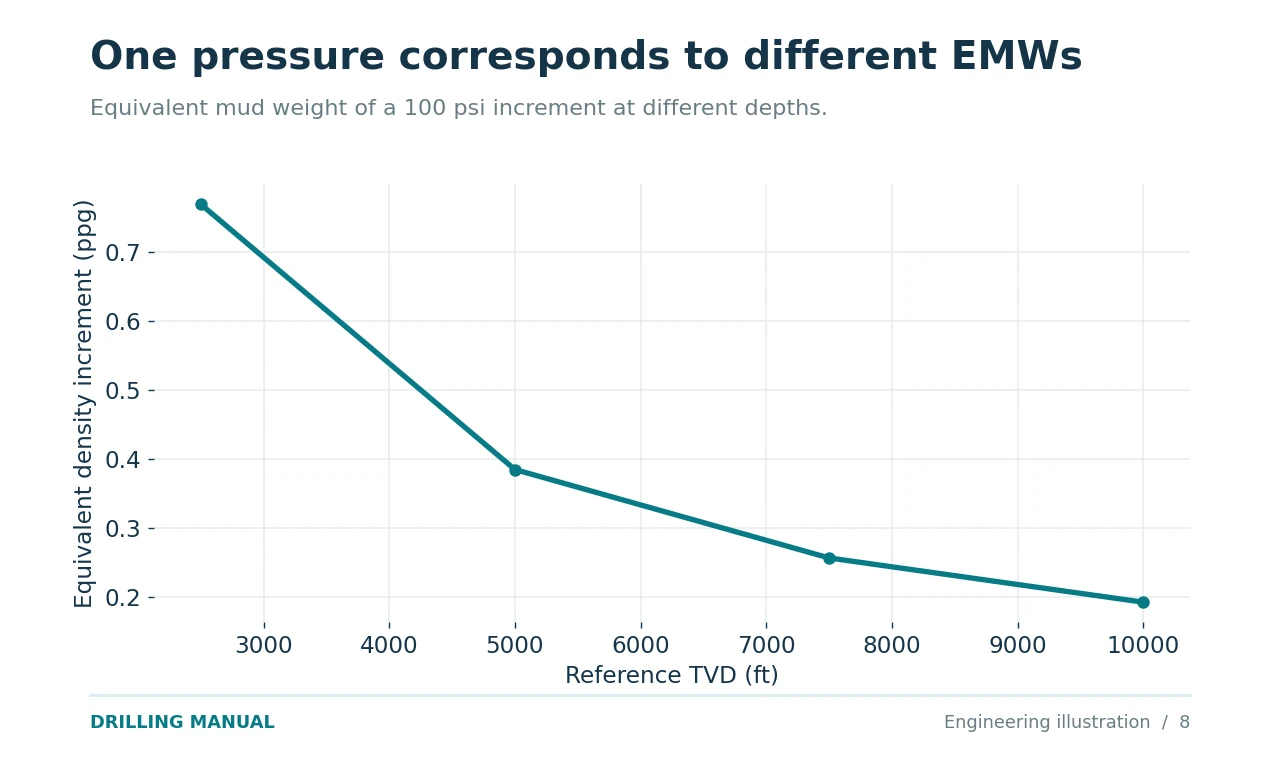
For a second check at the chosen depth, compare the pressure budget with the bottomhole pressure calculation. The equivalent circulating density guide explains how to express the circulating contribution in mud-weight units.
Work a connection at 10,000 ft TVD
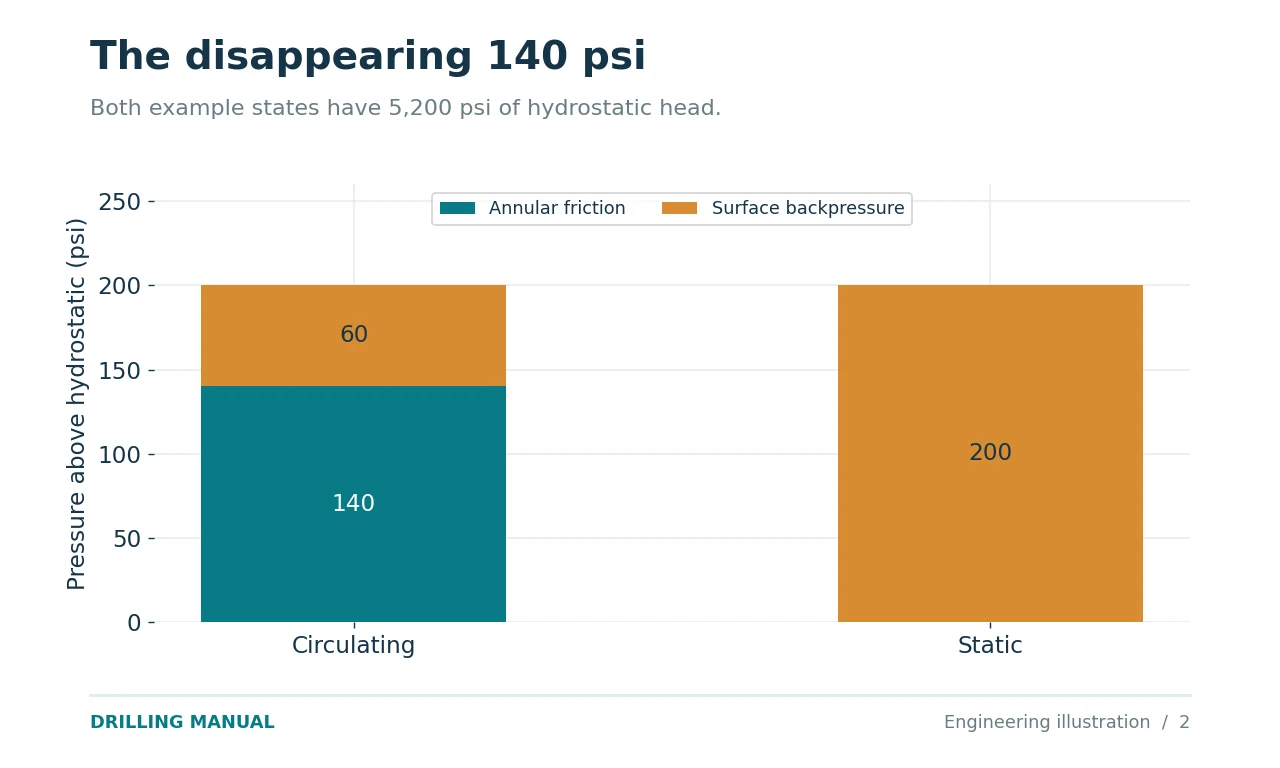
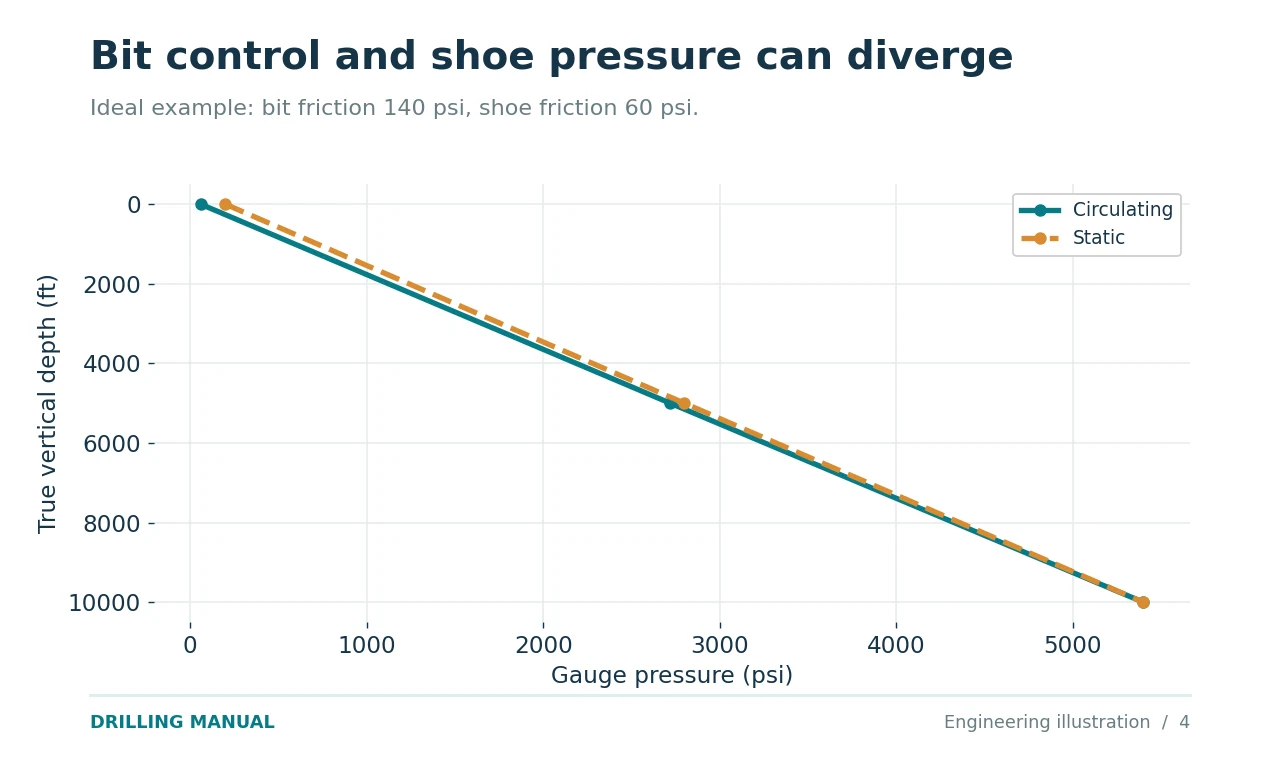
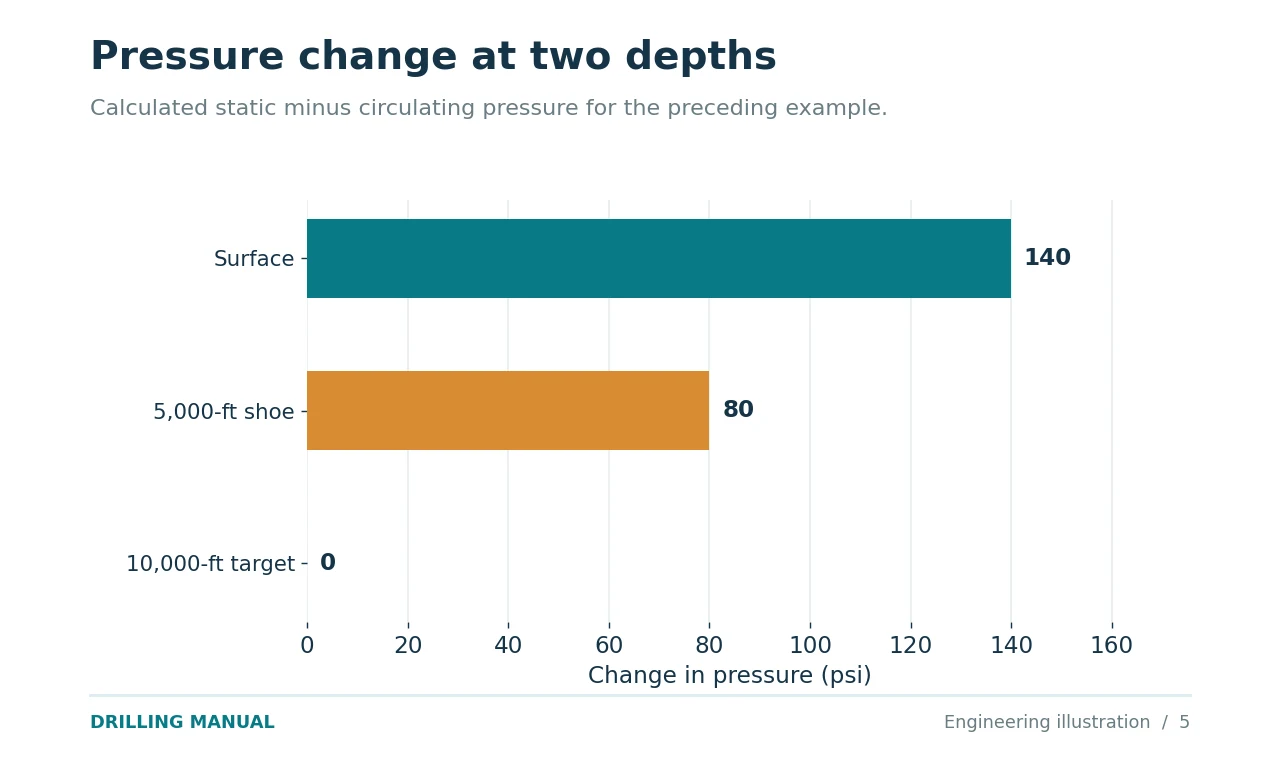
Consider an illustrative well with 10.0 ppg mud and a target of 5,400 psi at 10,000 ft TVD. Hydrostatic pressure is about 5,200 psi. If circulating annular friction above the target contributes 140 psi, 60 psi of surface backpressure completes the steady pressure budget. Once the fluid is static and friction decays to zero, the corresponding static budget needs 200 psi of surface pressure.
The 140 psi difference is the disappearing friction term. It does not specify choke position, timing or a field setpoint. During the transition, transients, changing slurry density and imperfect flow measurements can invalidate a steady calculation. Compare the model with time-aligned surface and available downhole data, including the sampling delay.

Why the casing shoe gets a separate line
Surface backpressure raises pressure throughout a hydraulically connected column. The circulating friction above the shoe, however, differs from that above the bit. Replacing all bit-depth friction with surface backpressure can increase pressure at the shoe during a connection even though modeled bottomhole pressure stays constant. Compute both profiles against their respective limits.
The limiting depth can change as the hole advances, mud properties shift or a weak zone is exposed. Label each limit with its depth, evidence and uncertainty. A single green bottomhole-pressure channel gives no direct indication of the remaining margin at a shallower formation.
What an MPD connection record should show
Capture the start and end of the pump ramp, the circulating rate and surface backpressure before and after it, and any changes in the active return route. If the return flow rises while pump delivery falls, check the well-control decision criteria and the independent volume measurements. A pressure budget describes expected behavior. The well-specific operations matrix governs the response to a deviation.
Test whether the bit and shoe can both stay inside their windows
Suppose the 5,000-ft shoe in the same 10.0-ppg column has an illustrative formation pressure ceiling of 2,780 psi at the shoe. Its static hydrostatic head is 2,600 psi, leaving at most 180 psi of surface backpressure in this simplified connected column. The bit budget calls for 200 psi with pumps off. The proposed static state would put the shoe at 2,800 psi, 20 psi above the assumed ceiling. Perfect control at the bit would still fail the shoe check.
For each exposed limiting depth, subtract hydrostatic head and local annular friction from the applicable lower and upper pressure bounds. Compare those allowable surface-pressure ranges at the same point in the pump cycle. If they do not overlap, the steady-state model has no common solution on those assumptions. Include transient and measurement allowances in the engineered review. These illustrative pressures are not field setpoints.
At zero rig-pump delivery, the 200 psi in this example still needs a physical source. One surface-backpressure design circulates auxiliary fluid through the choke without sending it down the drillstring. Another retains pressure already present in a closed annulus. A stationary choke with no flow through it cannot generate a new frictional pressure drop. The two cases can have the same annular pressure reading and different return-meter readings. Identify which arrangement the pressure budget assumes. Ambrus et al., §4.7.
Field comparison
| State | Hydrostatic | Annular friction | Surface backpressure | Target pressure |
|---|---|---|---|---|
| Circulating | 5,200 psi | 140 psi | 60 psi | 5,400 psi |
| Static idealization | 5,200 psi | 0 psi | 200 psi | 5,400 psi |

What to record in the field
| Check or record | Job-specific entry |
|---|---|
| Target depth, datum and required pressure range | |
| Shoe depth, allowable pressure basis and remaining margin | |
| Pump-rate, choke-pressure and flow-out channel names and clock offsets | |
| Expected pressure profile before and after the connection |
Additional technical figures (5)
Questions from the field
Is all managed pressure drilling constant-bottomhole-pressure drilling?
No. Constant bottomhole pressure is one application. Dual-gradient systems change the pressure profile using a different hydraulic arrangement.
Does MPD require planned formation flow?
Conventional MPD objectives avoid continuous formation influx. Planned production while drilling is characteristic of underbalanced drilling.
Why can a steady choke position give changing pressure?
Pressure drop across the restriction depends on flow and fluid conditions. During pump ramps, the same opening can produce a different upstream pressure.

Technical references
E. Tercan, Managed Pressure Drilling Techniques, Equipment & Applications (2010). §3.1, printed pp. 39–42.
Kenneth P. Malloy, Managed Pressure Drilling: What Is It Anyway? (World Oil, hosted by BSEE).