PAC vs CMC is a comparison of related cellulosic polymers, not a choice between two completely different mud functions. Both are used for filtration control in water-based drilling fluids. Their viscosity contribution and tolerance of the surrounding fluid depend on the grade, including molecular size, chemical substitution and product purity. A higher-viscosity grade may serve a useful second function, but it can also add viscosity that the fluid does not need. [1, pp. 128–129, 147–148]
The useful question is therefore: which product controls filtration in this fluid while preserving the required rheology? Start with the water chemistry and the performance gap, then compare grades on a consistent basis. The broader polymer mud system guide covers system architecture; this article concentrates on selecting and interpreting the cellulosic component.

What PAC and CMC have in common
CMC means carboxymethyl cellulose. PAC means polyanionic cellulose. Both belong to the modified natural-polymer family: cellulose is chemically altered so that it can disperse in water and perform useful functions. The resulting cellulosic polymers carry negative charges in solution. Their interaction with water, dissolved ions and solids helps explain why the same product can behave differently in different muds. [1, pp. 128–129]
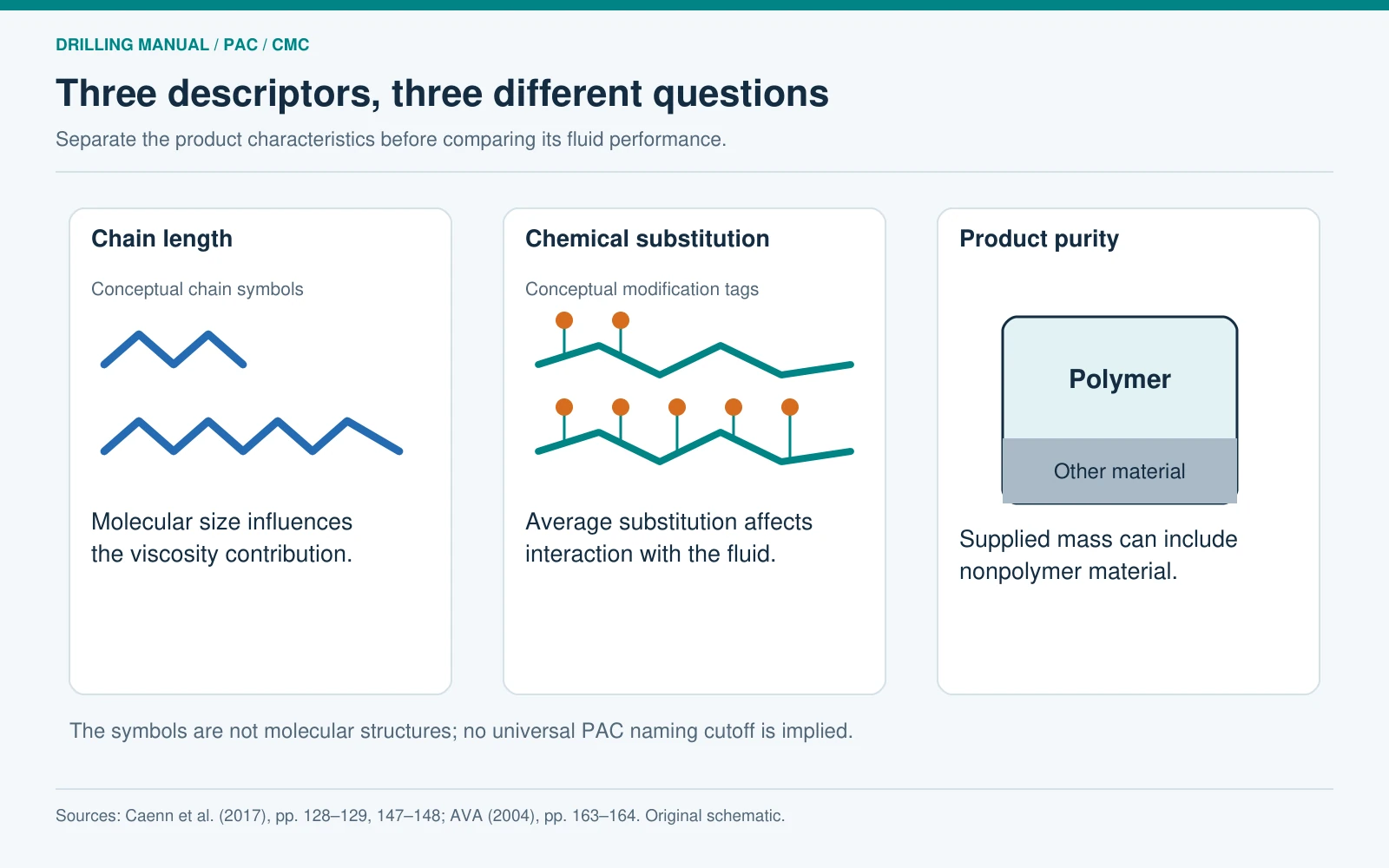
A PAC vs CMC comparison should keep three descriptors separate. Chain length, commonly discussed through degree of polymerization or molecular weight, influences the viscosity contribution. Degree of substitution is the average number of substituted hydroxyl sites per cellulose unit, which has three available sites. Purity describes how much of the supplied material is polymer rather than residual manufacturing material. Changing one descriptor does not automatically fix the other two. [2, pp. 163–164]
The books describe PAC as more highly substituted than conventional drilling-grade CMC, but their numerical naming boundaries differ. A universal degree-of-substitution cutoff would therefore give false precision. For a procurement comparison, use the product’s declared characteristics and relevant performance results instead of inferring an exact composition from the three-letter name. [1, pp. 147–148] [2, pp. 163–164]
PAC vs CMC: compare the function before the label
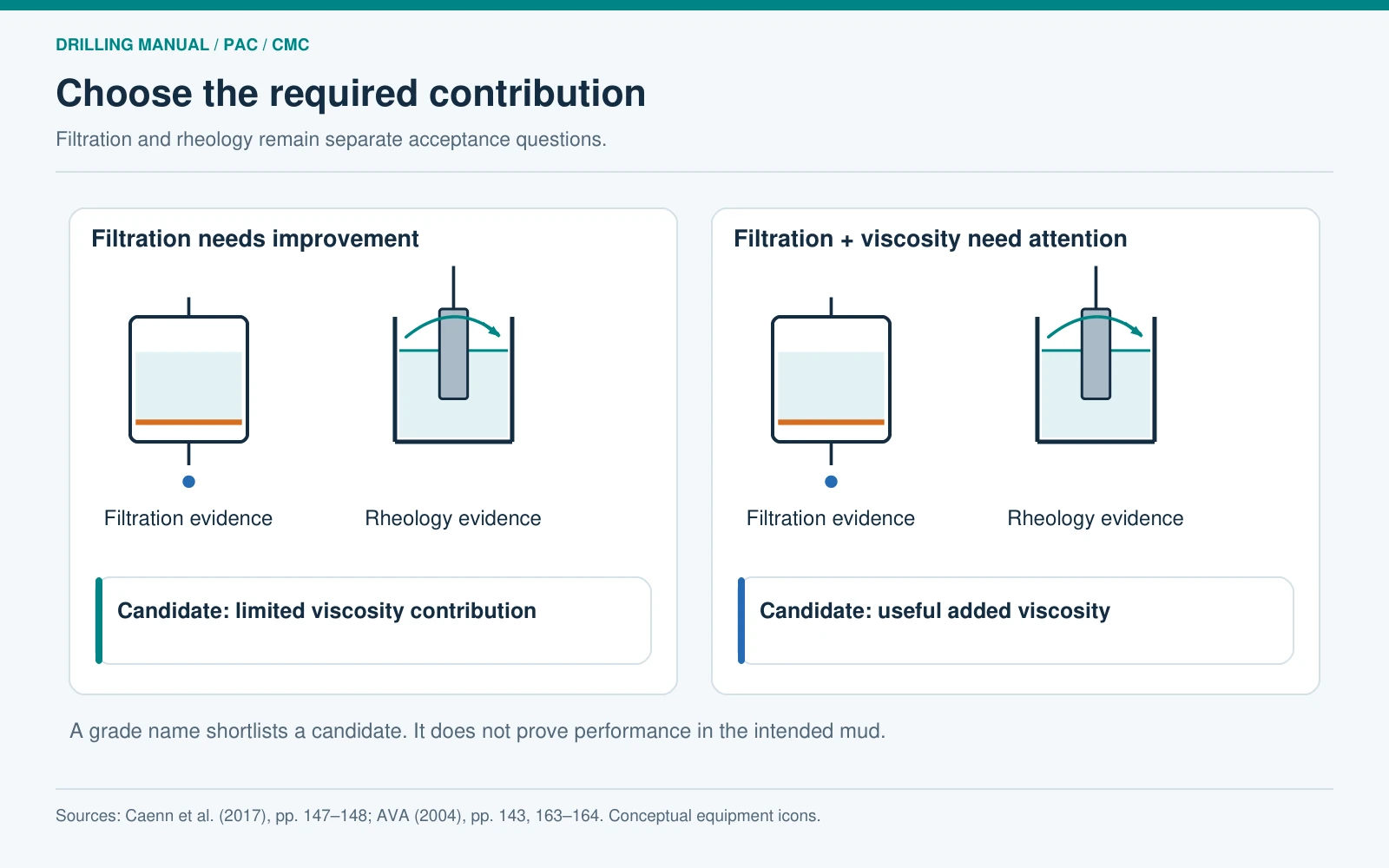
Low-viscosity cellulosic grades are useful when filtration needs improvement without a large additional viscosity contribution. Higher-viscosity grades can contribute to both properties. This is a relative grade distinction, not a promise of zero rheological effect from every low-viscosity product. The formulation and the amount of polymer present still matter. [1, pp. 147–148] [2, pp. 143, 163–164]
| Selection question | Relevant characteristic | What still needs evidence |
|---|---|---|
| Filtration is high, but rheology is already suitable | A grade with a limited viscosity contribution | Filtration and the full rheology response in the intended mud |
| Both filtration and viscosity need attention | A grade capable of contributing to both | Whether the added viscosity occurs in the useful shear-rate range |
| The aqueous phase is saline or hard | Substitution, solubility and chemical tolerance | Performance in the actual dissolved-ion environment |
| Two sacks have the same gross mass | Polymer content and reporting basis | Whether their composition and functional performance are comparable |
Regular, low-viscosity and high-viscosity designations help organize a shortlist. They do not establish that different suppliers’ grades are interchangeable. Nor does a viscosity grade describe shale inhibition, formation compatibility or the entire mud system. The existing water-based fluid systems overview supplies that wider context.
How a cellulosic polymer can reduce filtration
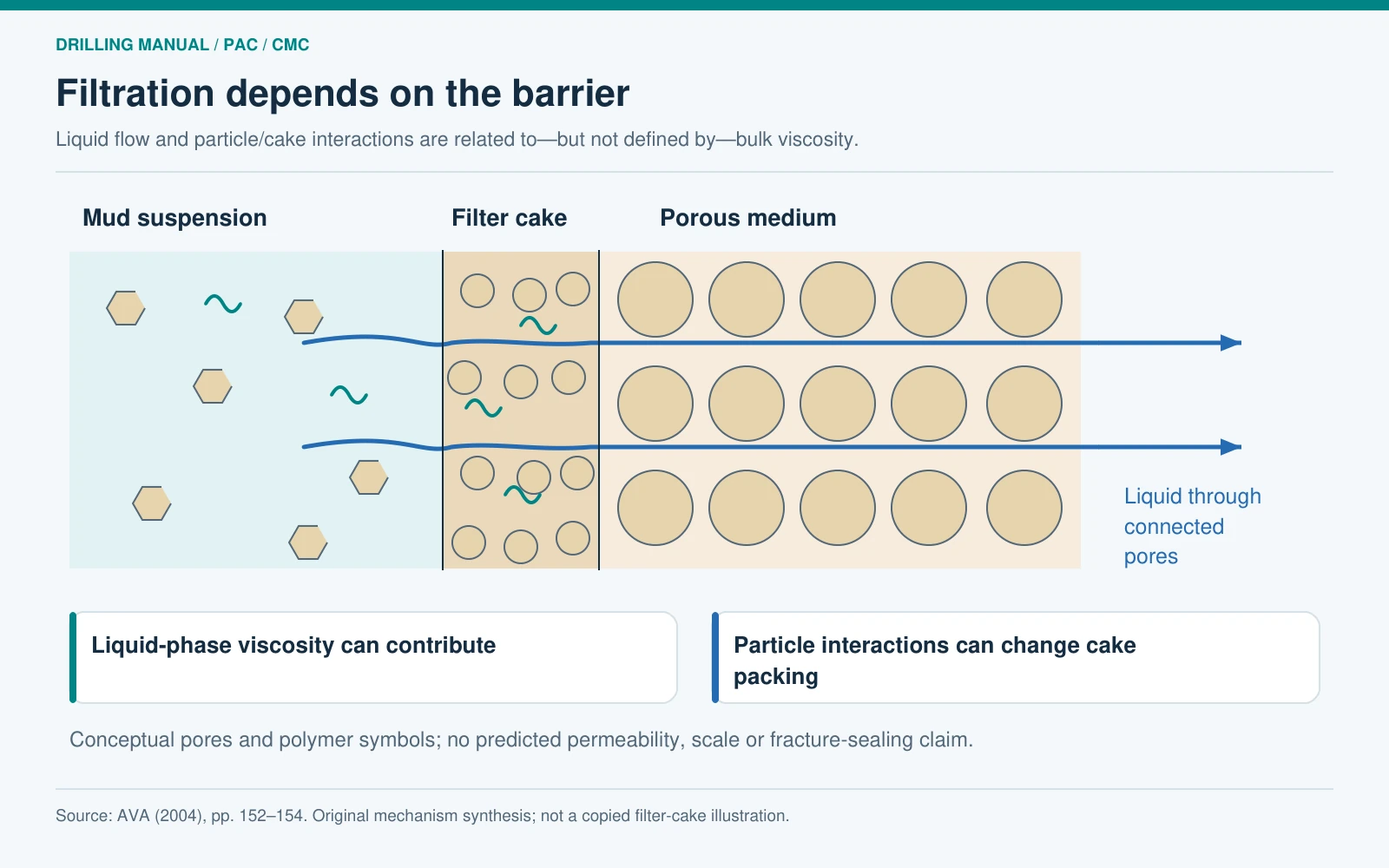
Filtration involves liquid moving through a porous barrier while solids build a cake. A cellulosic additive can influence that process through more than one mechanism. The AVA manual discusses changes in liquid-phase viscosity, interactions with colloidal particles and changes in particle packing within the cake. The importance of each mechanism depends on the polymer and the fluid. [2, pp. 152–154]
This explains why a useful filtrate result is not simply a report of how thick the whole mud feels. A fluid may have substantial bulk viscosity and still make an unsuitable cake. Conversely, a lower-viscosity grade may improve filtration without becoming the principal viscosifier. The cake, filtrate volume and rheology describe related but different parts of performance. [2, pp. 153–154]
Keep the test conditions attached to the result. A filtrate volume from one pressure, temperature, medium or exposure condition does not become a general formation-sealing specification. For the apparatus and measurement sequence, see the API filter press test guide. Here the selection task is to compare the resulting evidence, rather than repeat the test procedure.
PAC vs CMC in saline and hard water
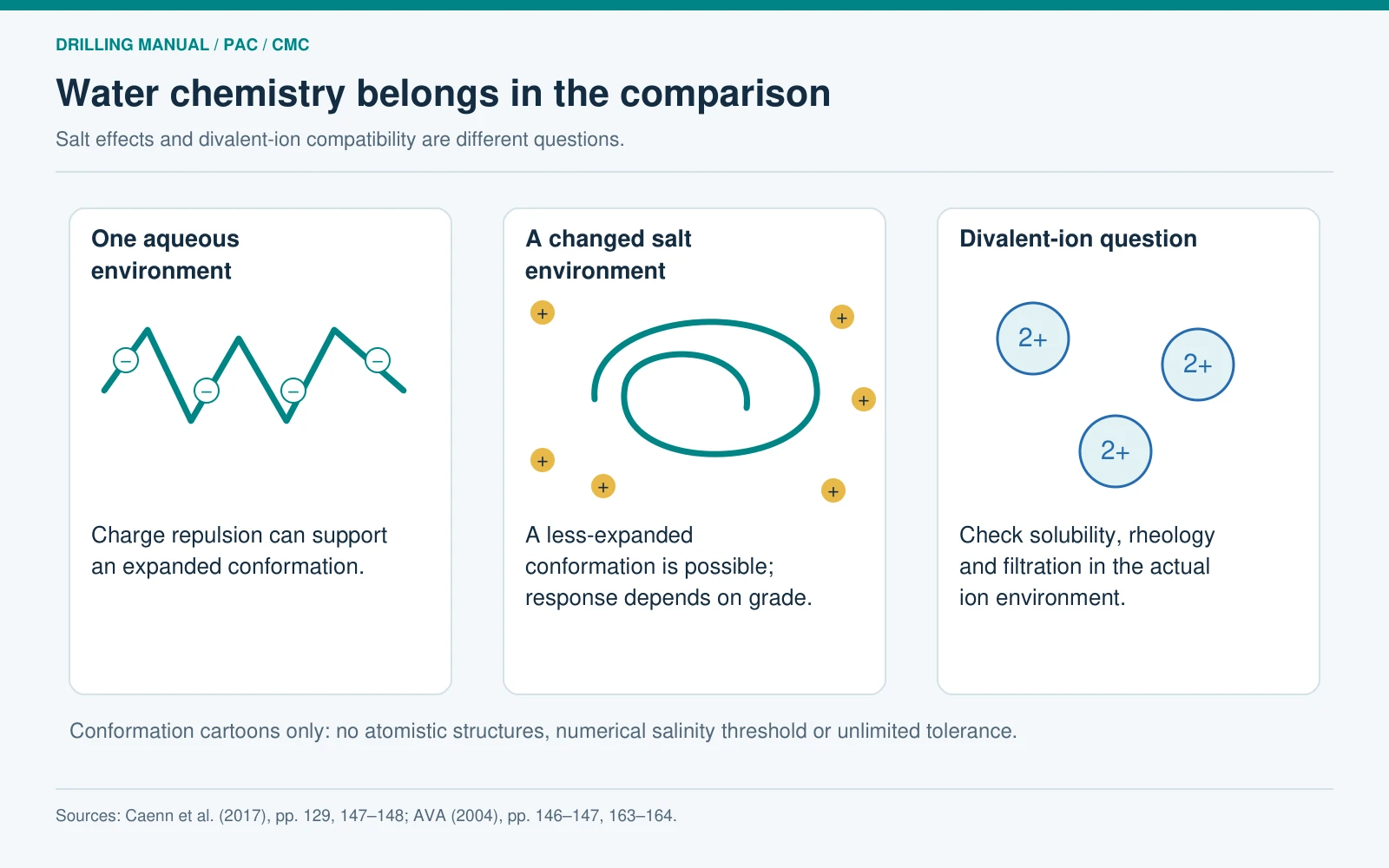
The negative charges on a cellulosic chain influence its shape in water. Dissolved salts can reduce the repulsion between charged parts of the polymer, allowing a different conformation and reducing its viscosity contribution. The chemical substitution and molecular size therefore matter alongside the salt environment. PAC grades are generally described as having better brine tolerance than conventional CMC, but that tendency is not an unlimited compatibility guarantee. [1, pp. 129, 147–148]
Hardness deserves its own line in the comparison. Divalent ions can interact with polymers differently from a simple increase in monovalent salt concentration. The manuals describe loss of solubility and precipitation risks for cellulosics in adverse ion conditions. A product that performs acceptably in one sodium-chloride solution has not thereby been qualified for every calcium-bearing fluid. [2, pp. 146–147, 163–164]
The practical record should identify the actual base water or brine and the expected contaminants. “Salt tolerant” without that context is an incomplete statement. When cement exposure is relevant, connect the polymer comparison with the separate cement-contamination discussion; the response of the complete fluid matters more than an additive label.
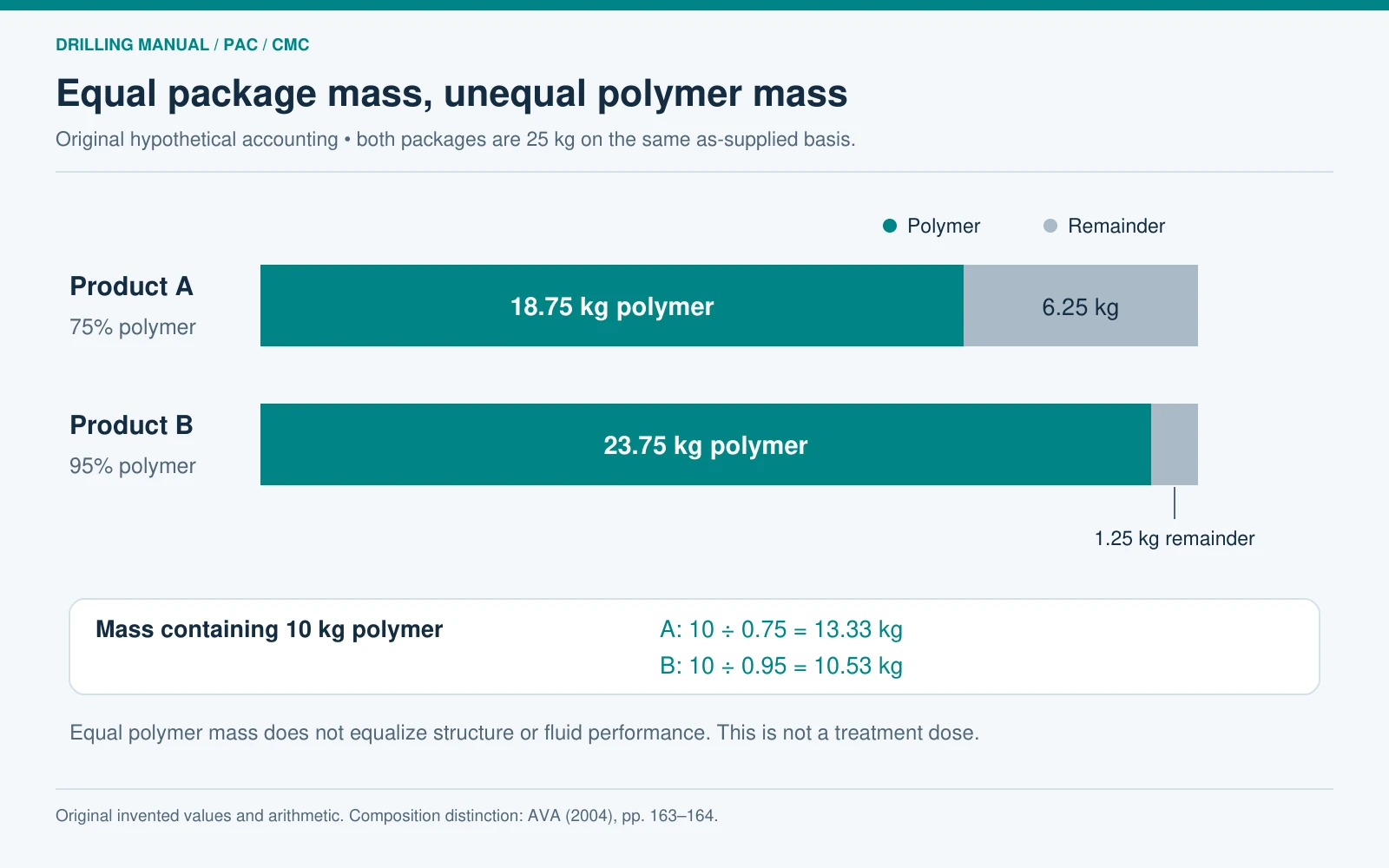
An original comparison: equal sack mass is not equal polymer mass
Consider two invented products, A and B, supplied in 25 kg packages. Assume their polymer mass fractions, on the same as-supplied basis, are 0.75 and 0.95. These numbers are illustrative assumptions, not specifications for CMC, PAC or a named product. The example isolates composition accounting because commercial cellulosics can differ in purity. [2, p. 163]
| Hypothetical quantity | Product A | Product B |
|---|---|---|
| Package mass | 25 kg | 25 kg |
| Assumed polymer mass fraction | 0.75 | 0.95 |
| Polymer in one package | 18.75 kg | 23.75 kg |
| Product mass containing 10 kg of polymer | 13.33 kg | 10.53 kg |
The arithmetic is polymer mass = supplied mass × polymer fraction. The reverse calculation divides the required polymer mass by that fraction. Thus equal package masses differ by 5 kg of polymer in this example. An equal-polymer comparison removes one difference; it does not equalize molecular size, substitution, hydration or fluid performance.
No mud volume or treatment concentration has been specified, so this is not a dosage recommendation. A real PAC vs CMC comparison must also reconcile dry-basis versus as-supplied data and the meaning of the supplier’s assay. “Active content” should not be used as shorthand for guaranteed performance per kilogram.


State what the PAC vs CMC comparison holds constant
There are several legitimate ways to compare candidates, but they answer different questions. The accounting example above is deliberately narrow. A performance comparison also has to describe the starting fluid, because polymer interactions with the aqueous phase, particles and other additives influence the result. A product-only solution and an actual solids-bearing mud are different test matrices. [2, pp. 146–154]
| Comparison basis | Question it answers | Remaining limitation |
|---|---|---|
| Equal supplied mass | What does the same gross product mass contribute? | Polymer content may differ. |
| Equal polymer mass | What changes after composition accounting is normalized? | Polymer structure and interaction with the mud may differ. |
| Matched required performance | Which candidate meets the specified filtration and rheology objectives? | The evidence applies to the tested fluid and conditions. |
A comparison becomes confusing when it changes basis halfway through: for example, discussing equal sack counts while quoting a test conducted at equal polymer content. Neither basis is inherently the answer to every procurement question. State the basis first and keep the measured outcomes alongside it.
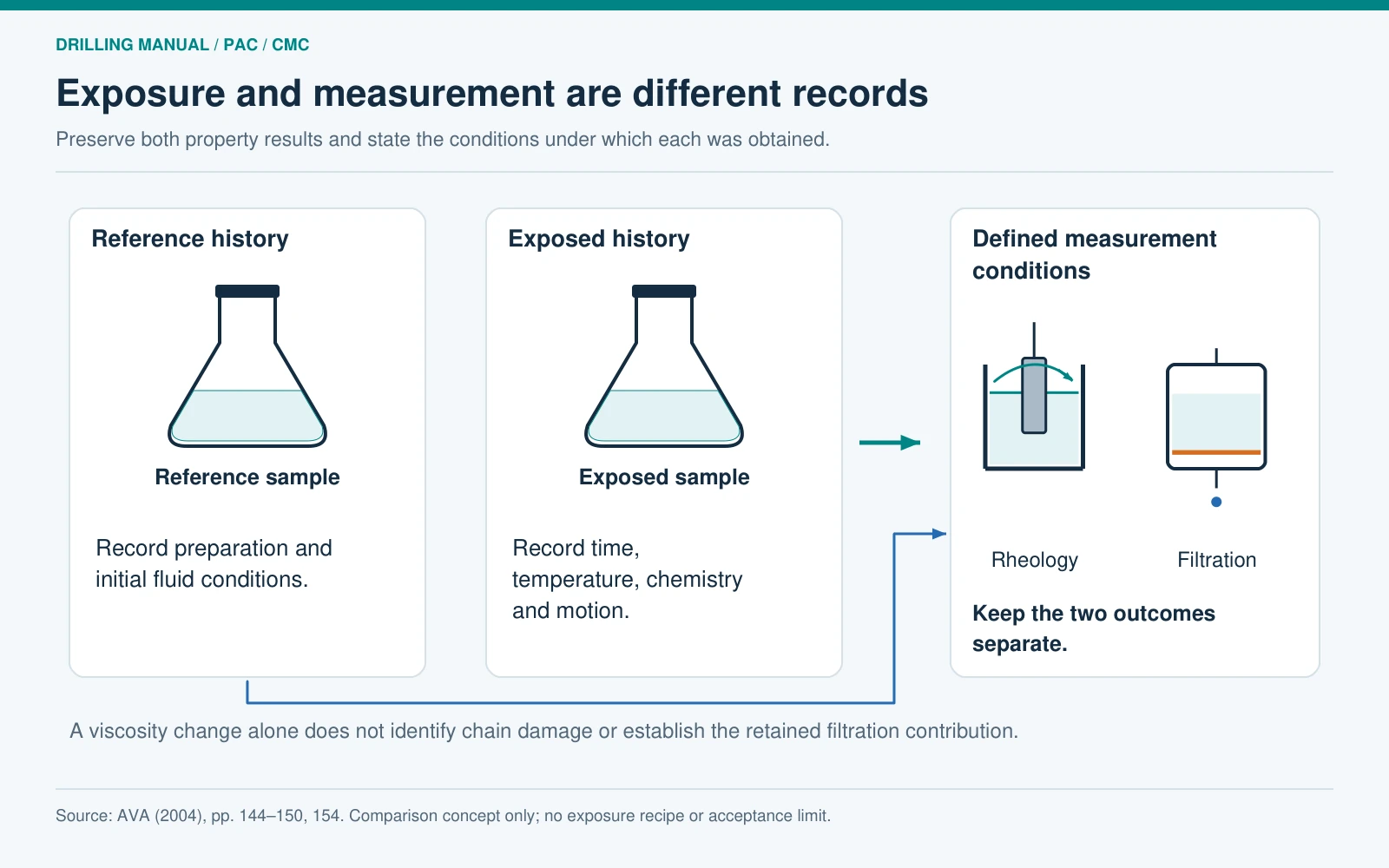
Also retain the untreated or reference-fluid results used to interpret the change. A final filtrate value alone does not show how much improvement the candidate supplied, and a final viscosity value alone does not show whether the starting fluid was already outside its objective. These are comparison-design questions, not instructions for adding polymer to a circulating system.
Evaluate rheology and filtration after the relevant exposure
Temperature is only part of polymer exposure. Time, chemical environment, oxygen and whether the fluid is static or moving can influence the outcome. AVA explicitly distinguishes chemical degradation from other changes in polymer effectiveness and cautions against assigning stability solely from the polymer family name. [2, pp. 144–150]
A fresh sample result therefore cannot stand in for all later conditions. Likewise, comparing a hot measurement with a cooler one can mix a measurement-temperature effect with an exposure-history effect. A meaningful comparison states the preparation and exposure histories, then reports each measured property at its defined conditions. It need not assume that every viscosity loss is irreversible chain damage. [2, pp. 144–150]
Filtration and rheology should remain separate acceptance questions after exposure. The manual notes that CMC can lose viscosifying effectiveness before losing its filtration-control contribution. Rejecting or accepting a candidate from viscosity alone could therefore answer the wrong question. The drilling-fluid rheometer guide explains the measurement equipment; the PAC vs CMC evaluation must retain the filtration evidence as well. [2, p. 154]
What weak performance does—and does not—tell you
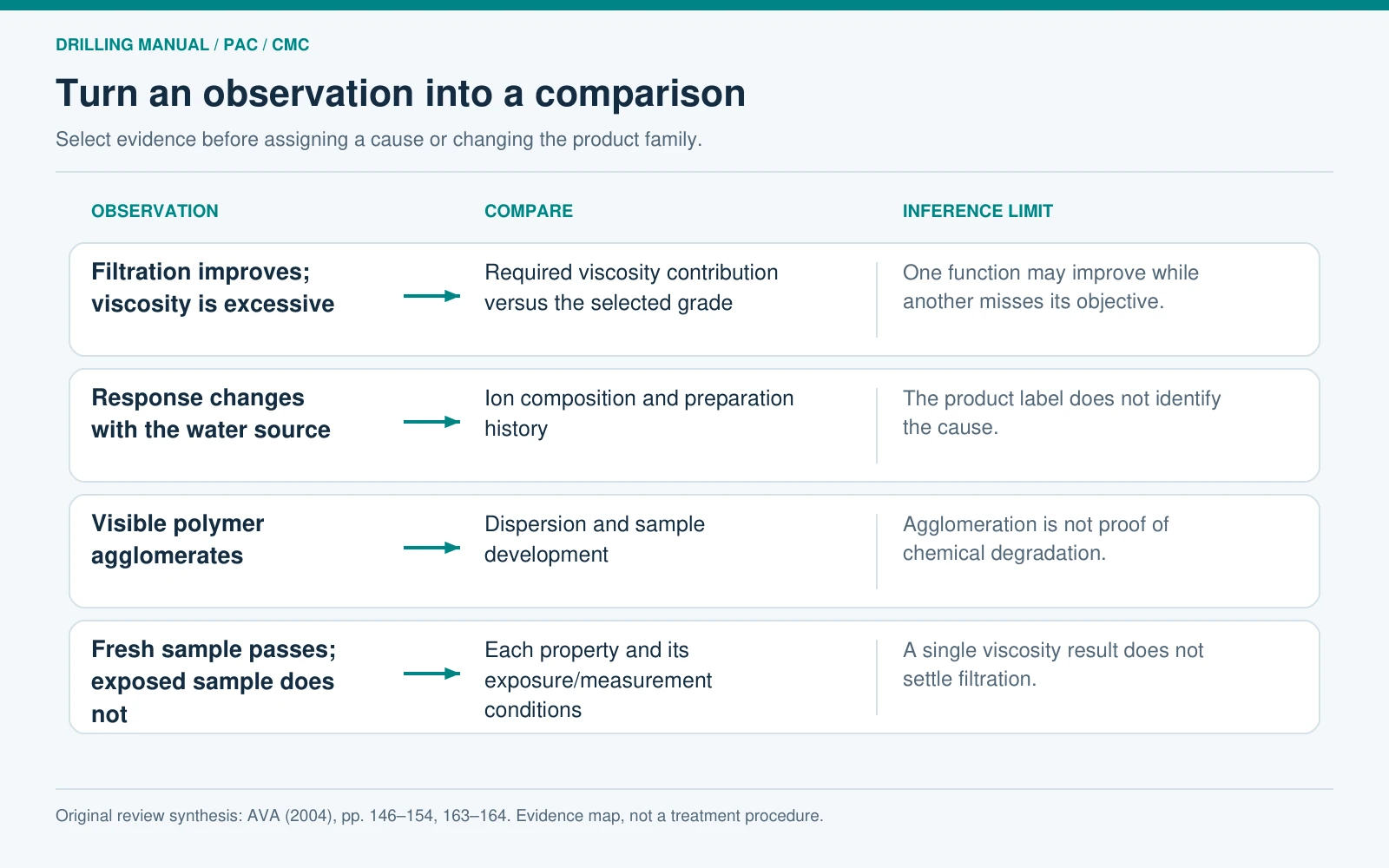
A weak response is evidence to investigate, not proof that the polymer family is unsuitable. Powder must disperse before the polymer develops its intended solution behavior. Poor dispersion can leave agglomerates with a wetted outside and a relatively dry interior. Water chemistry, other additives and exposure history provide further possible explanations. [2, pp. 146–151]
| Observation | Useful distinction |
|---|---|
| Filtration improves but viscosity becomes excessive | The filtration function may work while the chosen grade or formulation misses the rheology objective. |
| Viscosity changes after a water-source change | Compare ion composition and preparation conditions before attributing the change to product quality. |
| Visible polymer agglomerates remain | Incomplete dispersion is different from demonstrated chemical degradation. |
| A fresh fluid passes but an exposed sample does not | Identify which property changed and under which exposure and measurement conditions. |
These distinctions help define the next PAC vs CMC comparison without prescribing a field addition sequence. In particular, replacing CMC with PAC does not remove the need to establish what caused the original response.
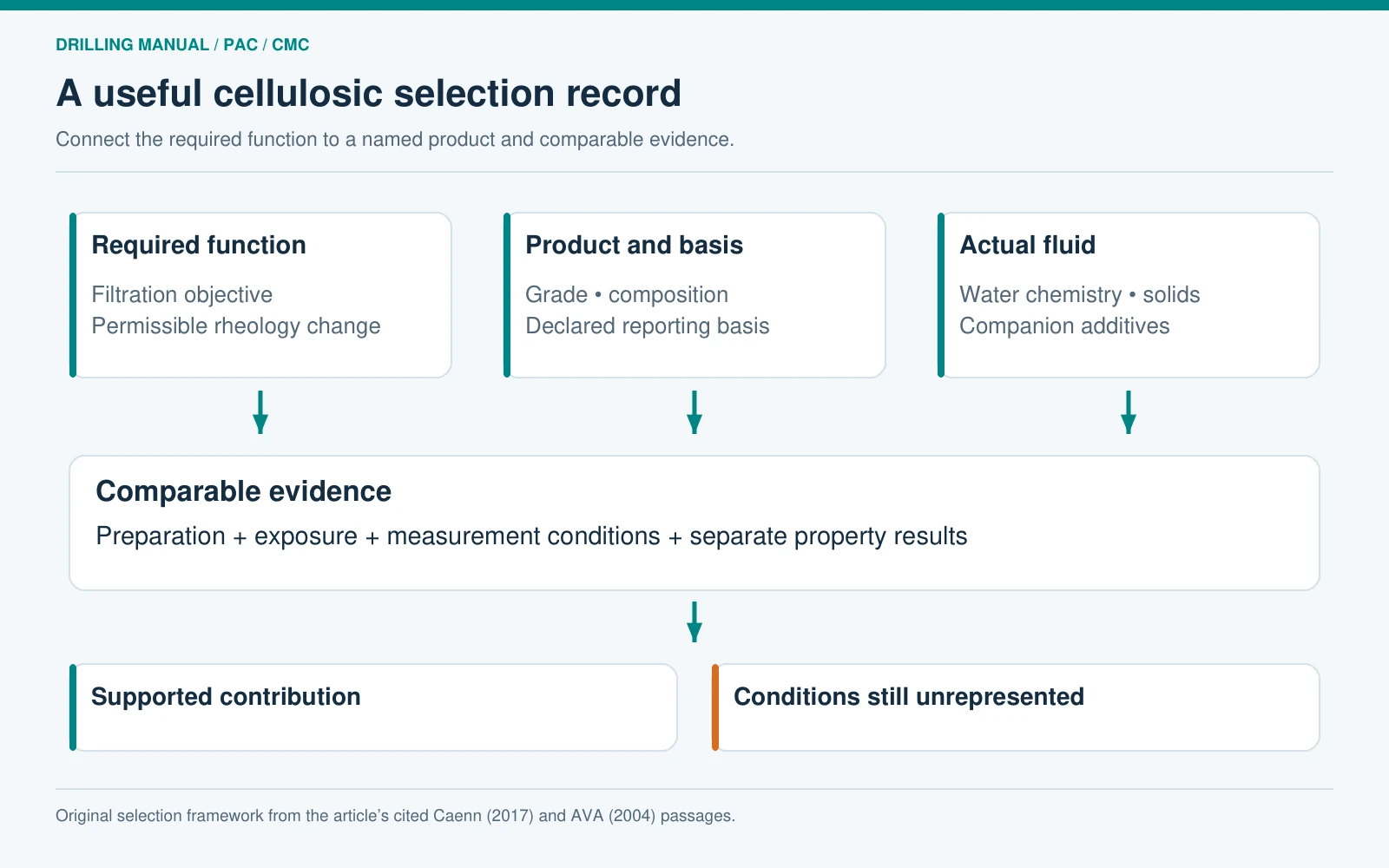
A practical PAC vs CMC selection record
A useful selection record joins the required function to the actual product and fluid. It should be short enough to compare candidates directly, but specific enough that a later reader can reproduce the basis of the decision. The following questions apply the manuals’ descriptions of grade and environmental effects. [1, pp. 128–129, 147–148] [2, pp. 144–154, 163–164]
- Objective: identify the filtration deficiency and the permissible rheology change.
- Product: record the grade, viscosity designation, declared composition and reporting basis.
- Fluid: identify water chemistry, relevant solids and the accompanying additive package.
- Comparison: preserve preparation, exposure and measurement conditions, including the dose basis used for the comparison.
- Decision: state which results support the choice and which operating conditions remain unrepresented.
This makes a PAC vs CMC decision more useful than a general ranking of the two names. The selected grade must supply the needed filtration performance in the intended fluid while leaving its other functions suitable.


Frequently asked questions
Is PAC chemically unrelated to CMC?
No. Both are modified cellulosic polymers. PAC is described as more highly substituted, but the label does not fully define molecular size, purity or actual fluid behavior. Those details belong in the product comparison. [1, pp. 128–129, 147–148]
Does low-viscosity PAC have no effect on viscosity?
Low viscosity describes the grade’s intended contribution relative to more viscosifying grades. It does not mean that every formulation will show exactly zero change. Confirm rheology and filtration together in the intended fluid. [2, pp. 143, 163–164]
Is PAC always better than CMC in a drilling fluid?
No single ranking answers every duty. Better tolerance of a particular brine can matter, but so can the required viscosity contribution and demonstrated filtration response. The right comparison is between specified grades under relevant conditions. [1, pp. 147–148]
Can a viscosity reading replace a filtration result?
No. Polymer effects on liquid viscosity, particle interactions and cake packing are related but distinct. A grade can retain useful filtration performance even when its viscosity contribution changes. [2, pp. 152–154]
Can equal sack counts be used to compare two products?
Only as a gross-mass comparison. Different polymer contents mean different polymer masses, and equal polymer masses still do not establish functional equivalence. Keep the composition and performance bases explicit. [2, pp. 163–164]
Is there one temperature limit for every PAC or CMC grade?
No universal value is justified by the family name alone. Exposure time, chemistry, manufacturing differences and the property being evaluated affect the conclusion. Use relevant, condition-defined evidence for the actual grade and formulation. [2, pp. 144–150]
References
- Caenn, R.; Darley, H. C. H.; and Gray, G. R. Composition and Properties of Drilling and Completion Fluids. Seventh edition. Gulf Professional Publishing / Elsevier, 2017. ISBN 978-0-12-804751-4. Printed pages: 128–129, 147–148. PDF pages in the edition consulted: 132–133, 151–152.
- AVA Drilling Fluids & Services. Drilling Fluids Manual. AVA S.p.A., Version 1, November 2004. Chapter 5, Polymers. Printed pages: 132, 143–154, 163–164. PDF pages in the edition consulted: 134, 145–156, 165–166.