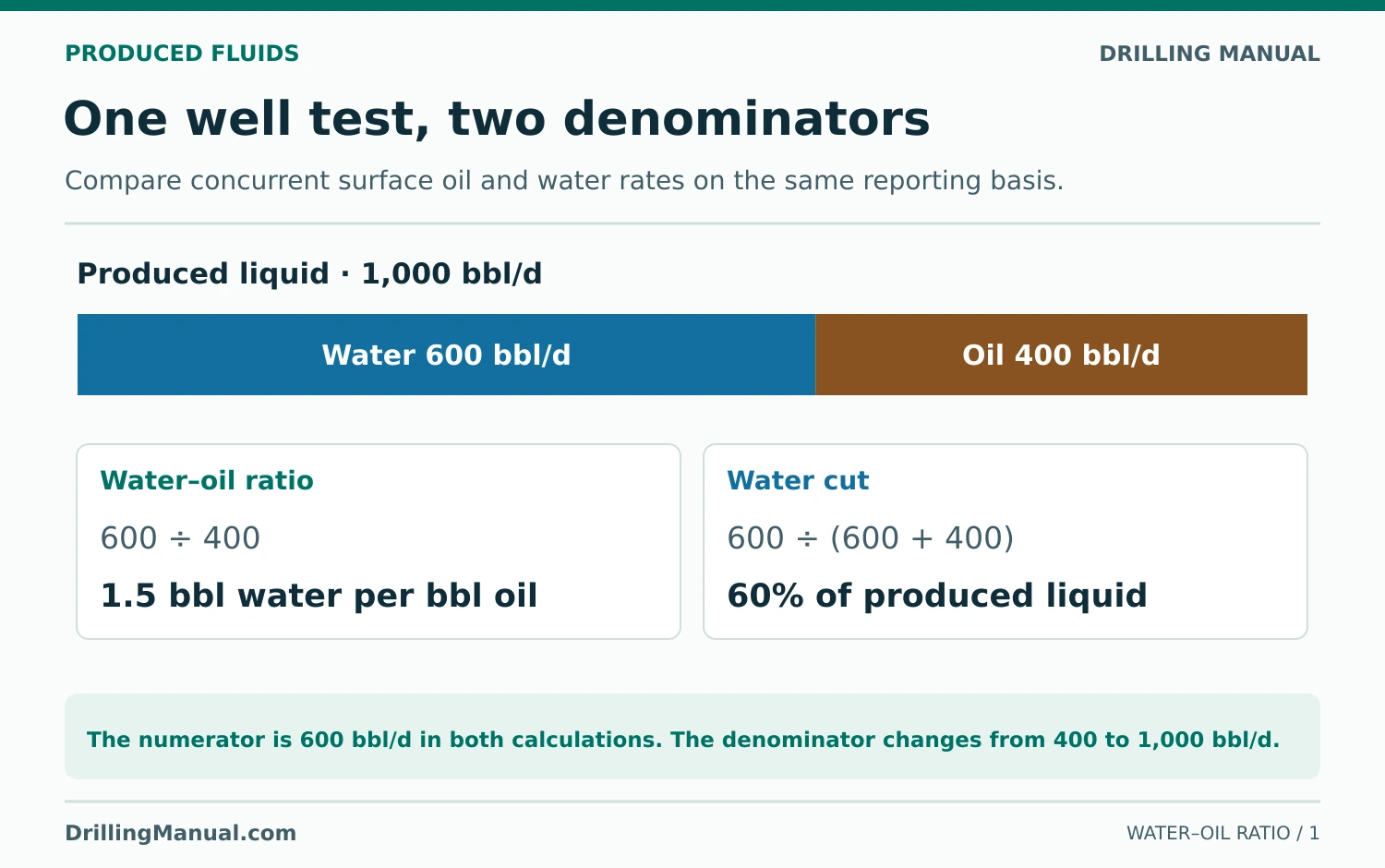
The water–oil ratio (WOR) is the volume of water a well produces per unit volume of produced oil. Divide the water rate by the oil rate over the same interval and on a consistent surface-volume basis, typically barrels of produced water per stock-tank barrel of net oil. A well making 600 bbl of water and 400 bbl of oil per day has a WOR of 1.5 bbl/bbl and a water cut of 60%. On a mud report, an oil/water ratio of 80/20 instead means the recovered liquid is 80% oil and 20% water.
Open the water–oil ratio and drilling-mud OWR calculator.
Which ratio is on the report?
On older field sheets a column headed “water/oil” can contain percent water in total liquid. Check the equation or reconstruct one row from measured volumes before joining two datasets. A production engineer reading “1.5” wants to know how many barrels of water accompany a barrel of oil. A mud engineer reading “80/20” wants to know how the liquid in an invert-emulsion mud divides between oil and water. Write the stream, phase order and basis beside either result. The convention matters most when a daily drilling report and a well-test report reach the same desk.
| Measure | Calculation | What to write on the report |
|---|---|---|
| Production WOR | Water ÷ oil | 1.5 bbl water/bbl oil |
| Production water cut | 100 × water ÷ (water + oil) | 60% of produced oil-plus-water volume |
| Drilling-mud OWR | Normalize retort oil and water to 100 parts recovered liquid, oil first | 80/20 oil/water by liquid volume |
Convert water–oil ratio to water cut, or work backward
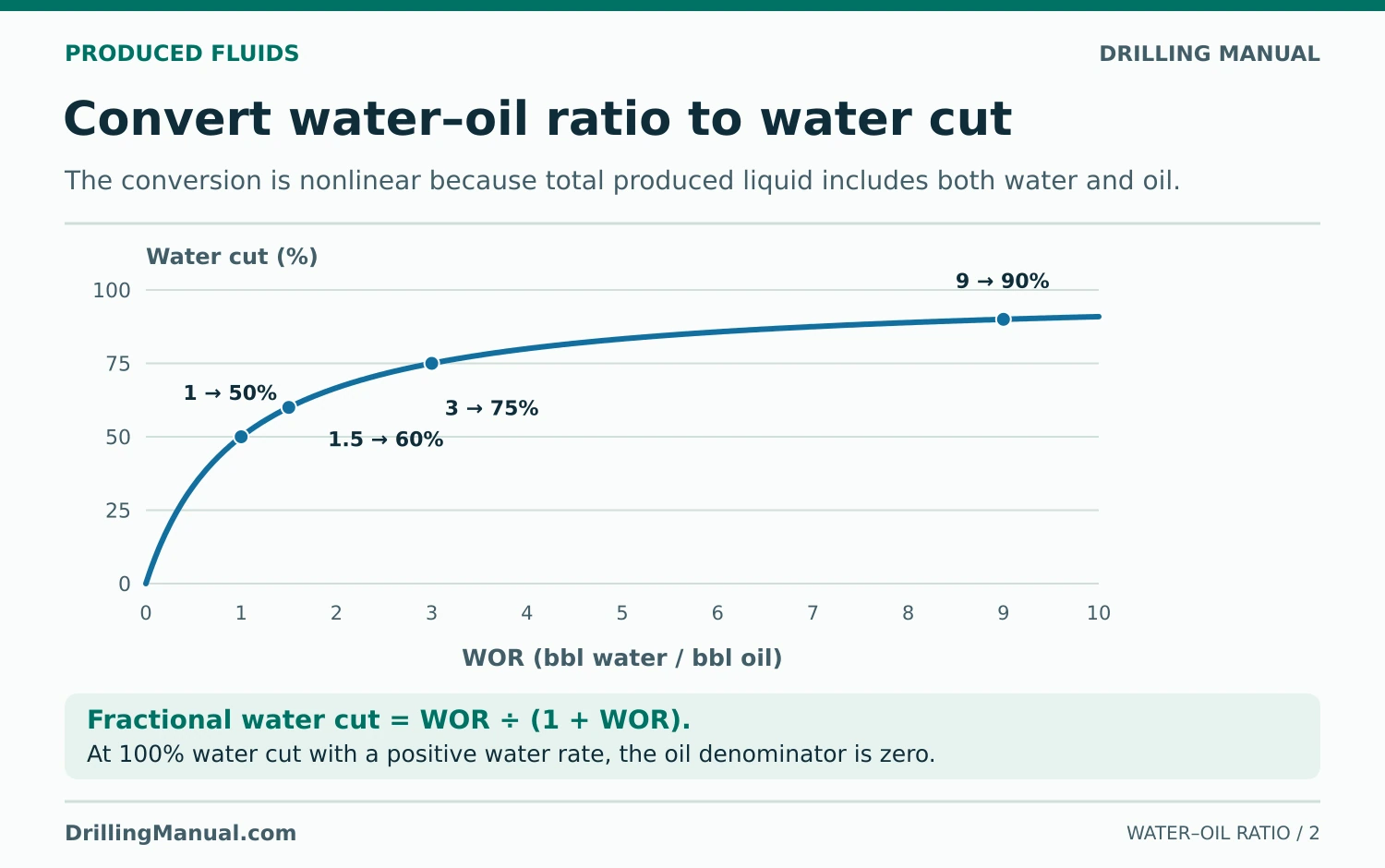
Let W and O be the produced water and oil volumes. They can also be simultaneous rates in the same units. Produced gas stays out of both calculations. With water cut expressed as a percentage, the conversions are:
Water cut (%) = 100 × WOR / (1 + WOR)
WOR = water cut (%) / [100 − water cut (%)]
A WOR of 1 means equal volumes of oil and water, or 50% water cut. At 80% water cut, WOR is 80/20 = 4 bbl/bbl. At 95%, it is 95/5 = 19 bbl/bbl. This nonlinearity matters at high water cut. A change from 95% to 96% looks like one percentage point on a report, but it changes the calculated water per barrel of oil from 19 to 24.

Work a well test from the measured volumes
Suppose a six-hour stabilized test collects 150 bbl of water and 100 bbl of net oil. WOR is 150/100 = 1.5. Water cut is 150/250 = 0.60, or 60%. Multiplying each volume by four gives the equivalent test rates of 600 bbl water/day and 400 bbl oil/day. That extrapolation preserves the ratio. It does not establish how many barrels the well actually produced in the other 18 hours.
If the report instead gives 1,000 bbl/day of total liquid and WOR of 1.5, calculate oil first: 1,000/(1 + 1.5) = 400 bbl/day. Water is the remaining 600 bbl/day. Before using either result for water-handling capacity, confirm whether the total describes that individual well, a commingled flowline or a facility. A field-wide ratio cannot allocate water to one completion.
Why a rising WOR can point to the wrong problem
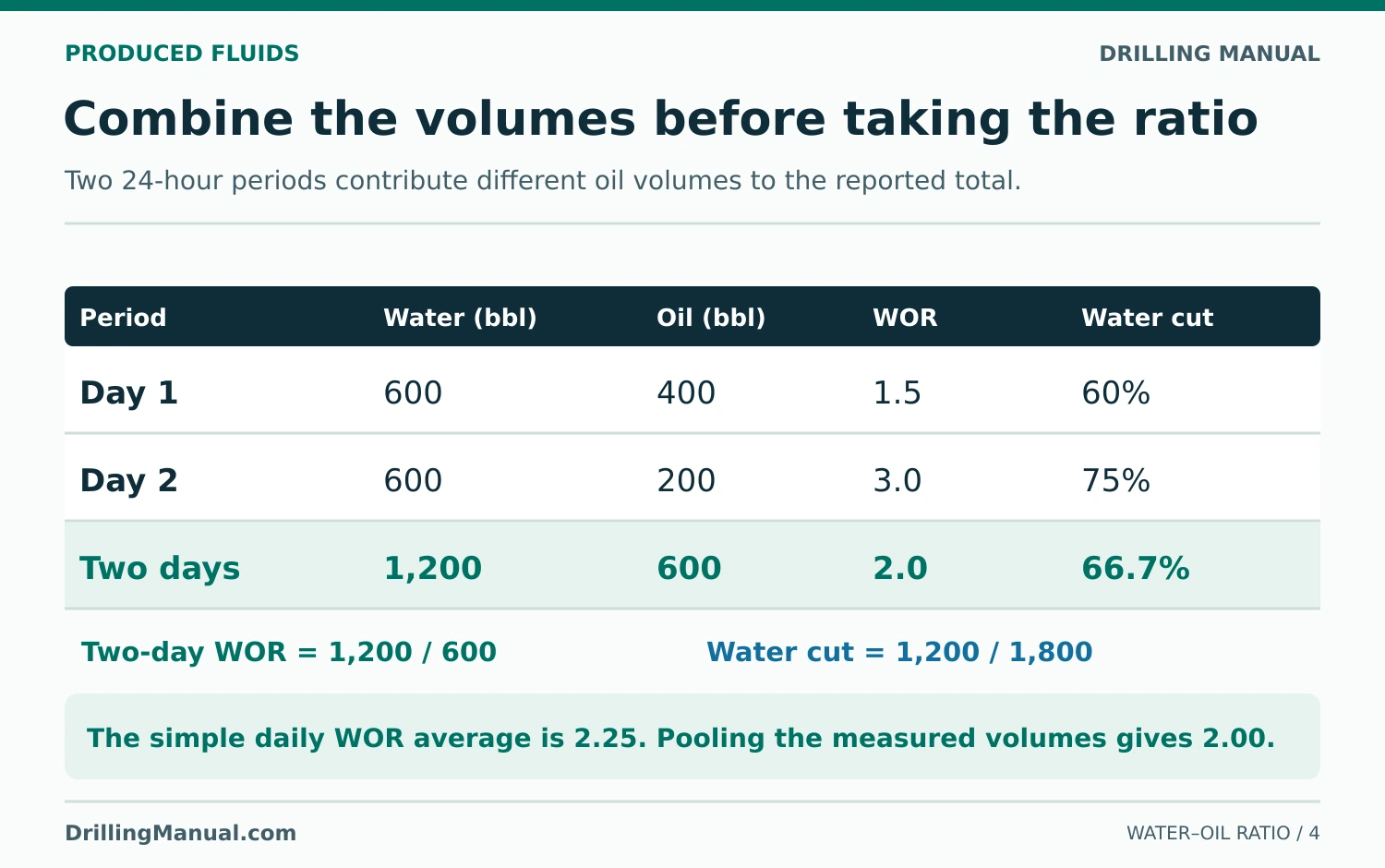
Compare two full days. On day one, water is 600 bbl and oil is 400 bbl. On day two, water is still 600 bbl but oil has fallen to 200 bbl. WOR doubles from 1.5 to 3.0, and water cut rises from 60% to 75%. The water-handling plant sees the same daily water volume. The production change occurred entirely on the oil side.
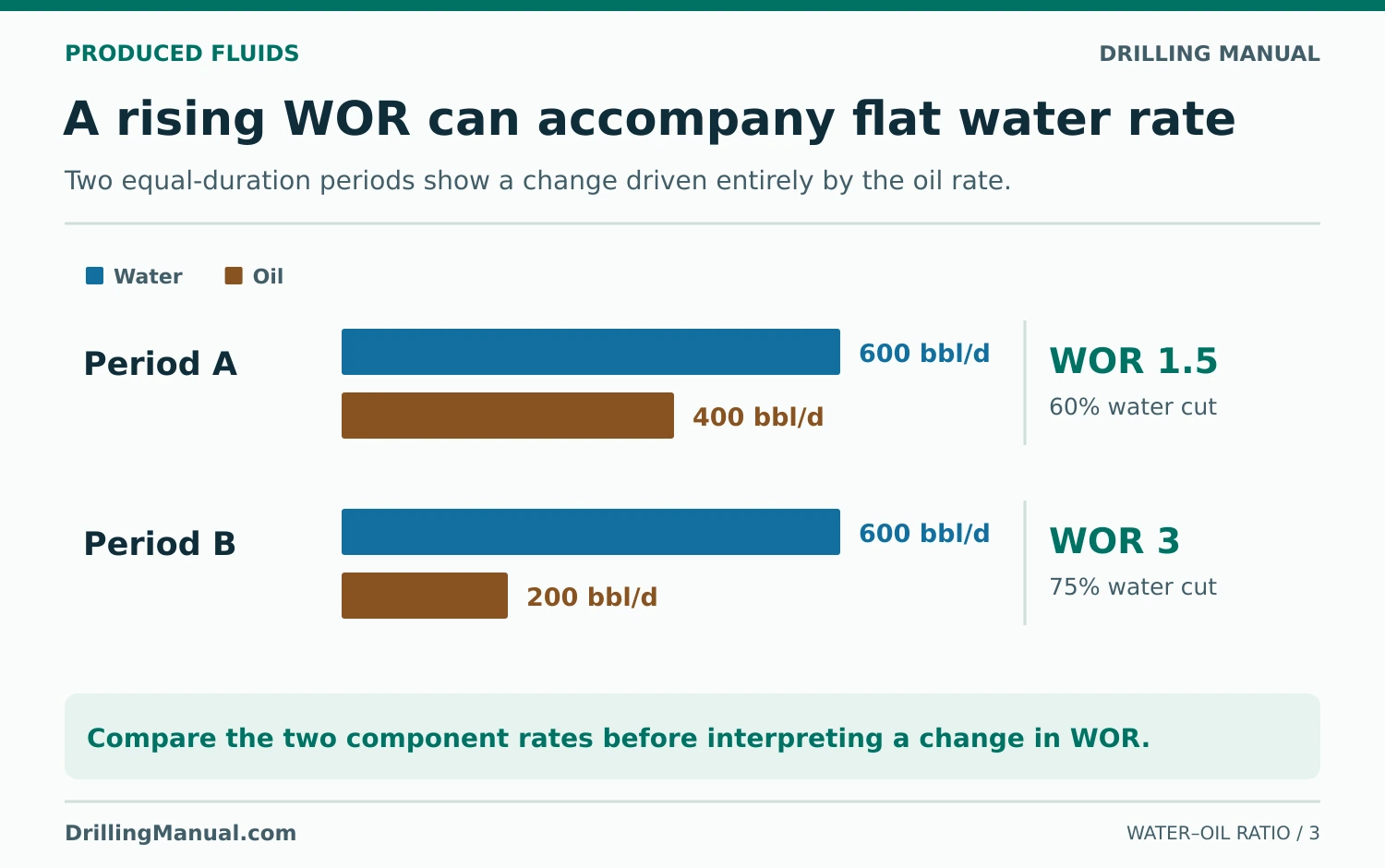
For the combined period, divide total water by total oil: 1,200/600 = 2.0 bbl/bbl. The arithmetic average of the two daily ratios, 2.25, is wrong for these volumes. Combined water cut is 1,200/1,800 = 66.7%. For unequal test durations, convert each rate to volume over its own interval before adding. For a fleet of wells, keep the reporting conditions and time window consistent before pooling their volumes.
A rising WOR warrants a look at the two underlying rates, test duration, allocation changes and recent well activity. During cleanup after a workover, recovered completion brine can add to the measured water. A sustained rise later in the well’s life can have several causes. The ratio alone cannot identify an entry depth, distinguish coning from a leak or select a shutoff treatment. Use the site’s guide to diagnosing water entry for that next diagnostic question.
Calculate the oil/water ratio of drilling mud from a retort
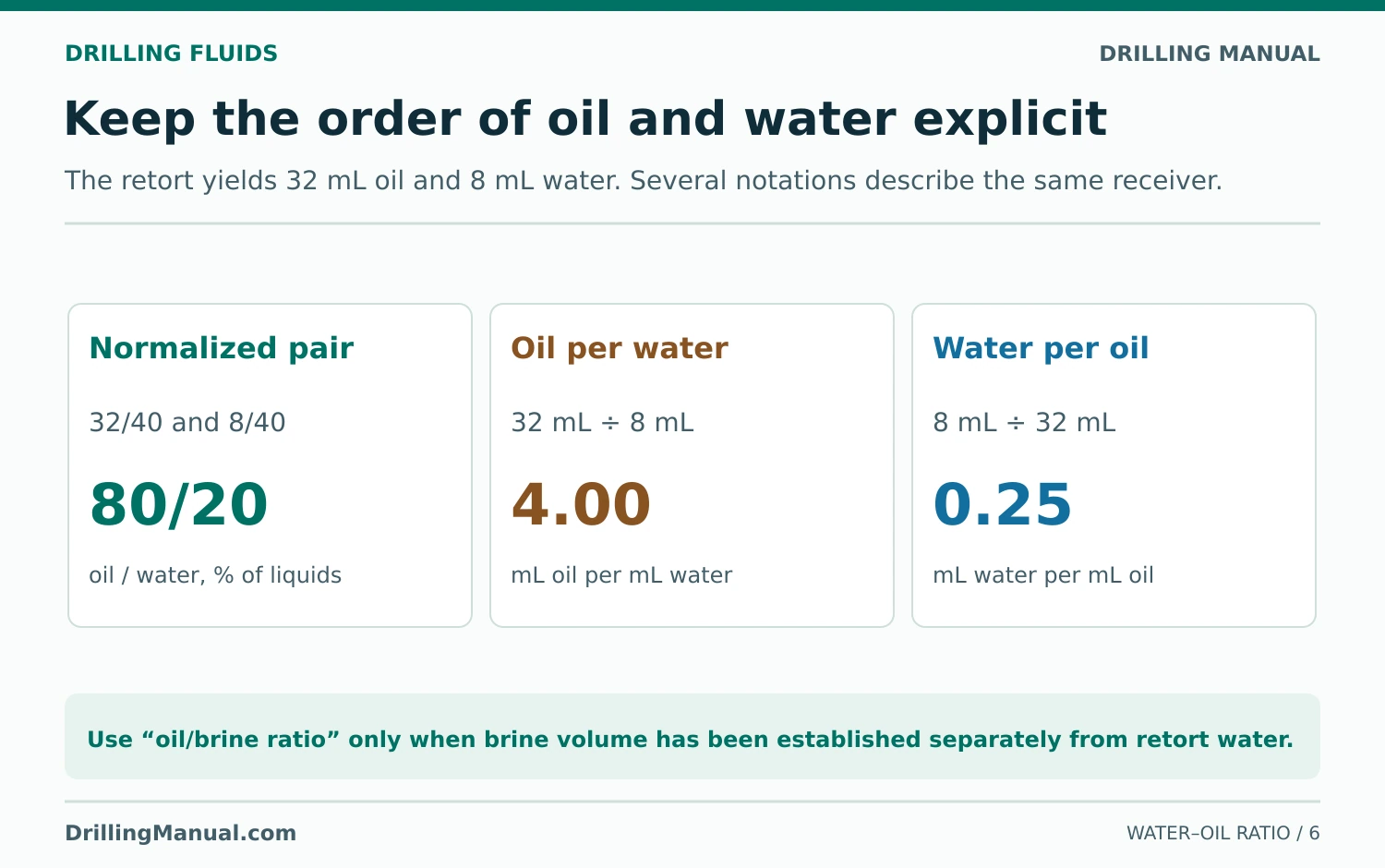
For a mud report, divide each recovered liquid volume by the sum of recovered oil and water. Suppose a 50 mL retort sample gives 32 mL oil and 8 mL water. Oil is 32/40 = 80% of the recovered liquids. Water is 8/40 = 20%. Record the mud OWR as 80/20. If someone asks for the water-to-oil quotient in this same sample, it is 8/32 = 0.25. Neither number describes produced water from the well.
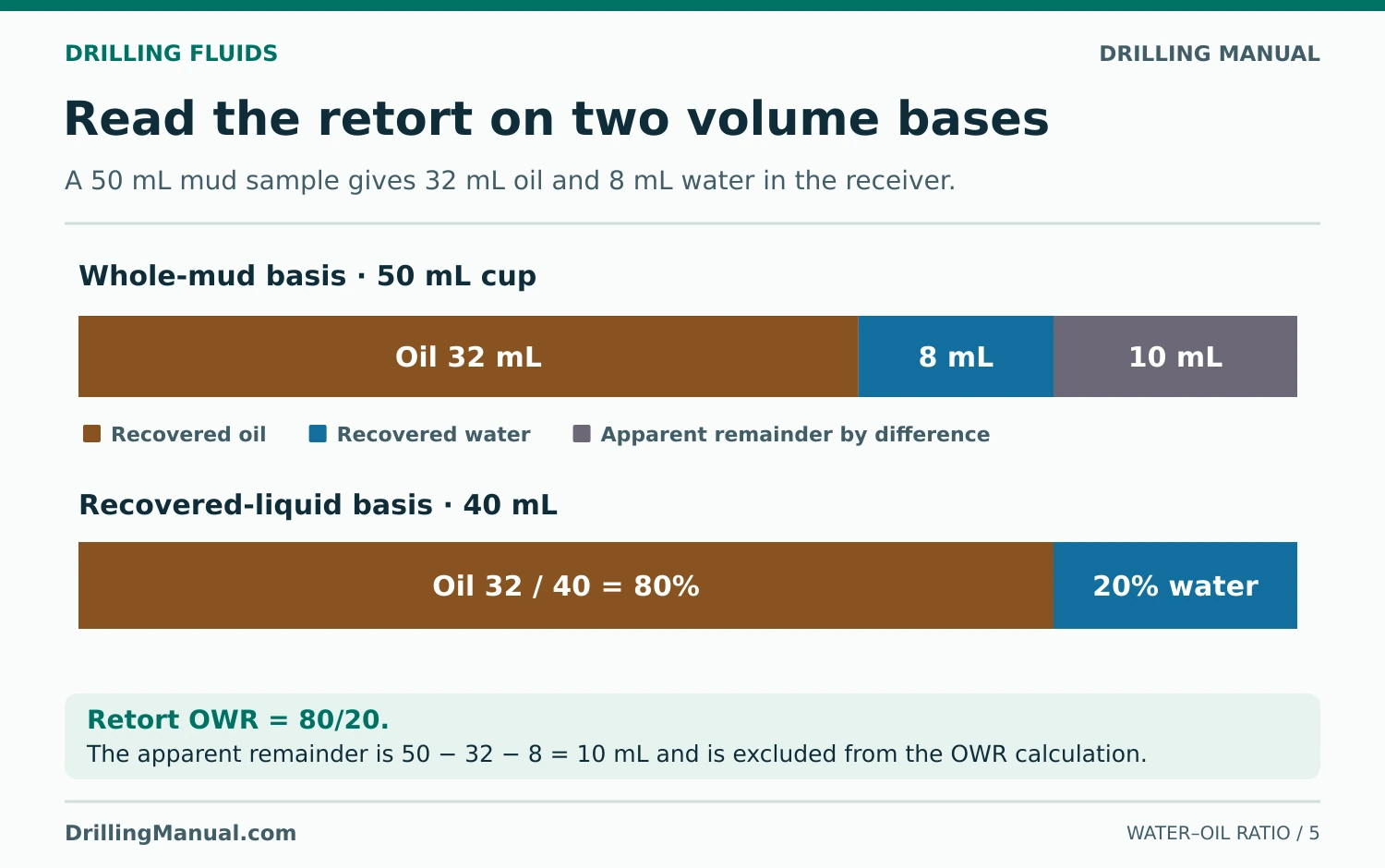
On a whole-mud basis the same sample has 64 vol% recovered oil and 16 vol% recovered water. The 10 mL remainder, or 20% of the cup, is apparent material by difference. Dissolved salt remains behind during distillation, and recovery errors also enter the difference. Use the prescribed salinity correction if the program calls for an oil/brine ratio or true undissolved solids. The site’s drilling-fluid retort guide explains the test and its reporting sequence.
How much base oil would change an 80/20 mud to 85/15?
Start from the liquid inventory. In this idealized example, 200 bbl of whole mud is 80% retort liquid by volume. The liquid inventory is 160 bbl, comprising 128 bbl oil and 32 bbl water on the stated basis. To reach 85/15 by adding only base oil, the 32 bbl water must become 15% of the new liquid volume. New liquid volume = 32/0.15 = 213.33 bbl. Required base oil = 213.33 − 160 = 53.33 bbl.
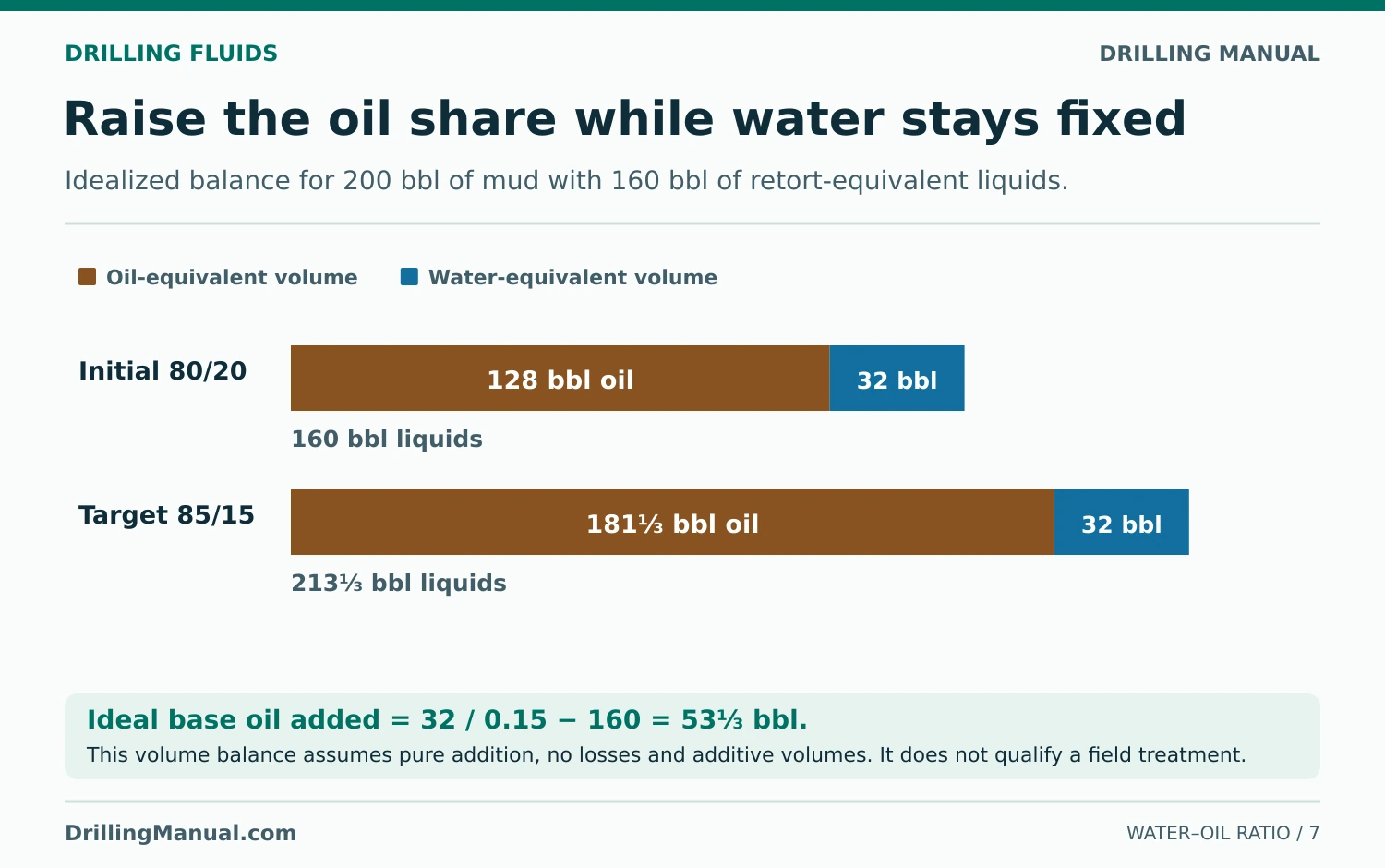
The cross-check is (128 + 53.33)/(160 + 53.33) = 85% oil. Using the entire 200 bbl as the starting liquid volume overstates the requirement. The example assumes additive volumes, no transfer or loss and an unchanged water inventory. A field addition also changes whole-mud density and concentrations. Confirm the program’s oil/water or oil/brine basis, tank capacity and pilot-test response before using a treatment quantity.
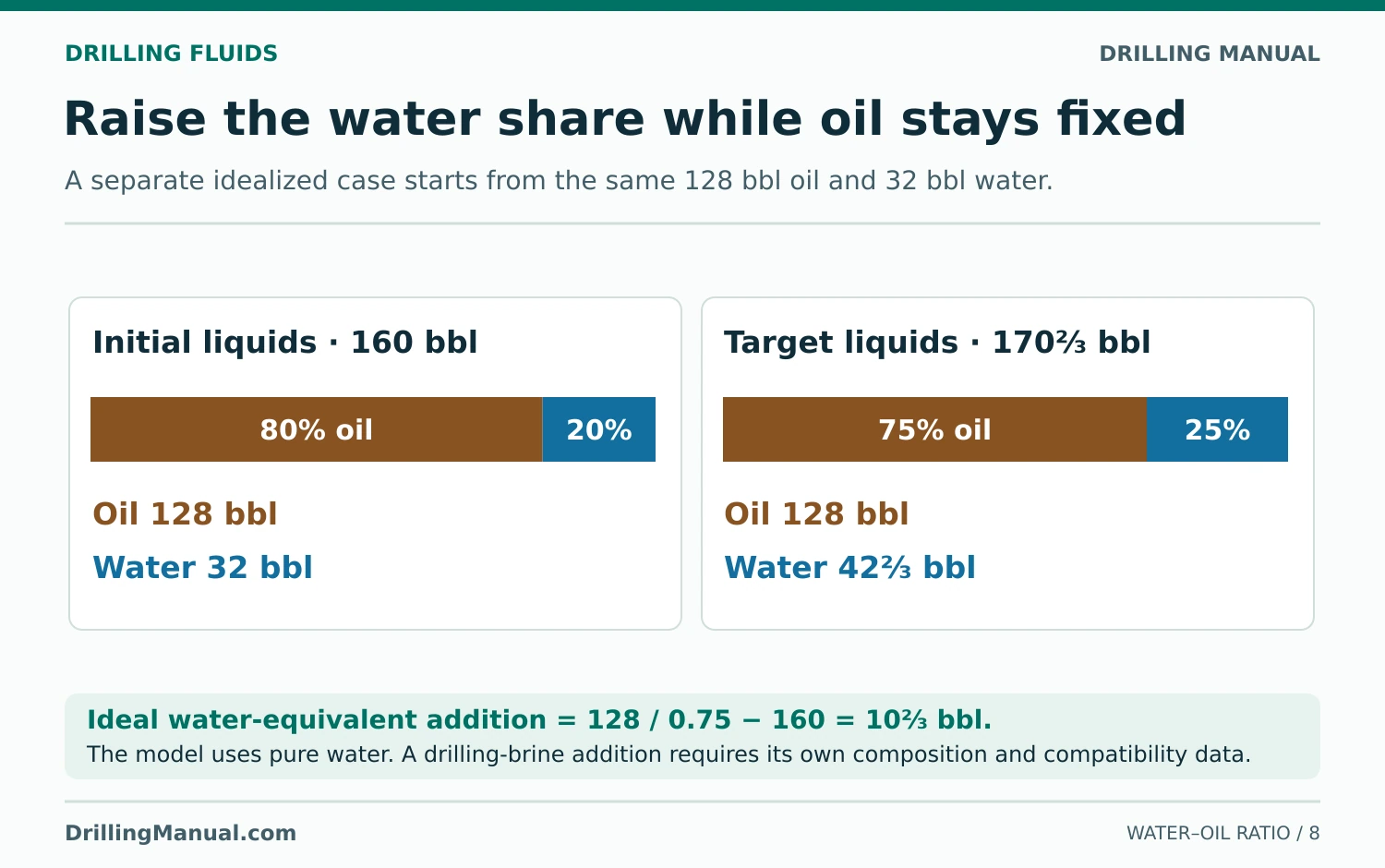
To reuse the calculation, let L be the initial liquid volume and f the target oil fraction as a decimal. For an oil-only addition with water volume W unchanged, base oil to add = W/(1 − f) − L. For a pure-water-equivalent addition with oil volume O unchanged, water to add = O/f − L. In the same 200 bbl starting mud, an alternative target of 75/25 gives 128/0.75 − 160 = 10.67 bbl water equivalent. Each calculation starts from the original mud. A negative addition means the selected phase cannot move the existing mix toward that target.
Frequently asked questions
Can the water–oil ratio exceed 100?
Yes. A well producing 120 bbl water per barrel of oil has WOR 120 bbl/bbl and water cut about 99.17%. WOR has no fixed upper bound when the oil volume remains positive.
What do I report if the well makes no oil?
For positive measured water and zero measured oil, water cut is 100% and a finite WOR is undefined. If both volumes are zero, neither ratio is defined. If oil is below a meter’s detection limit, report that limit instead of entering an exact zero.
Is BS&W the same as water cut?
A basic sediment and water result includes sediment and applies to the sampled stream. A water-cut calculation requires the produced-water and oil volumes for the defined measurement boundary. Check what separated water and what solids the sample includes before using a BS&W reading in a production calculation.
See the oil/water phase-order check and the idealized water-addition example
Technical references
Eni/Agip. Completion Design Manual. STAP-P-1-M-7100, Rev. 0, 28 June 1999. Printed p. 16 and pp. 83–84 = PDF p. 16 and pp. 83–84.
Eni/Agip. Well Test Procedures Manual. STAP-P-1-M-7130, Rev. 0, 28 June 1999. Printed pp. 81–82 = PDF pp. 81–82, §14.3.
Mary Hardy and Thomas Lockhart. “Water Control,” ch. 17 in Petroleum Well Construction, edited by M. J. Economides, L. T. Watters and S. Dunn-Norman. Wiley. Printed pp. 828–829, 831–837, 851 = PDF pp. 828–829, 831–837, 851 in the uploaded edition.
Baker Hughes INTEQ. Drilling Engineering Workbook: A Distributed Learning Course. Rev. B, December 1995 (80270H). Printed pp. 1-14–1-15 = PDF pp. 32–33.