A biocide for drilling mud helps preserve susceptible fluid ingredients by controlling biological activity. Its value is tied to a particular mud, an identified deterioration risk and evidence that the treatment preserves the required fluid performance. A viscosity decrease alone does not establish a microbial cause, and adding preservative does not rebuild polymer chains that have already broken. [1, pp. 148–149]
This article focuses on polymer-containing water-based drilling fluids, including stored fluid. It explains what needs protection, how to distinguish competing causes of deterioration and how to organize a useful qualification record. The broader polymer drilling-mud system guide covers the functions these polymers perform. Here, the question is how to retain those functions without assuming that every mud problem needs a biocide.
What does a biocide for drilling mud protect?
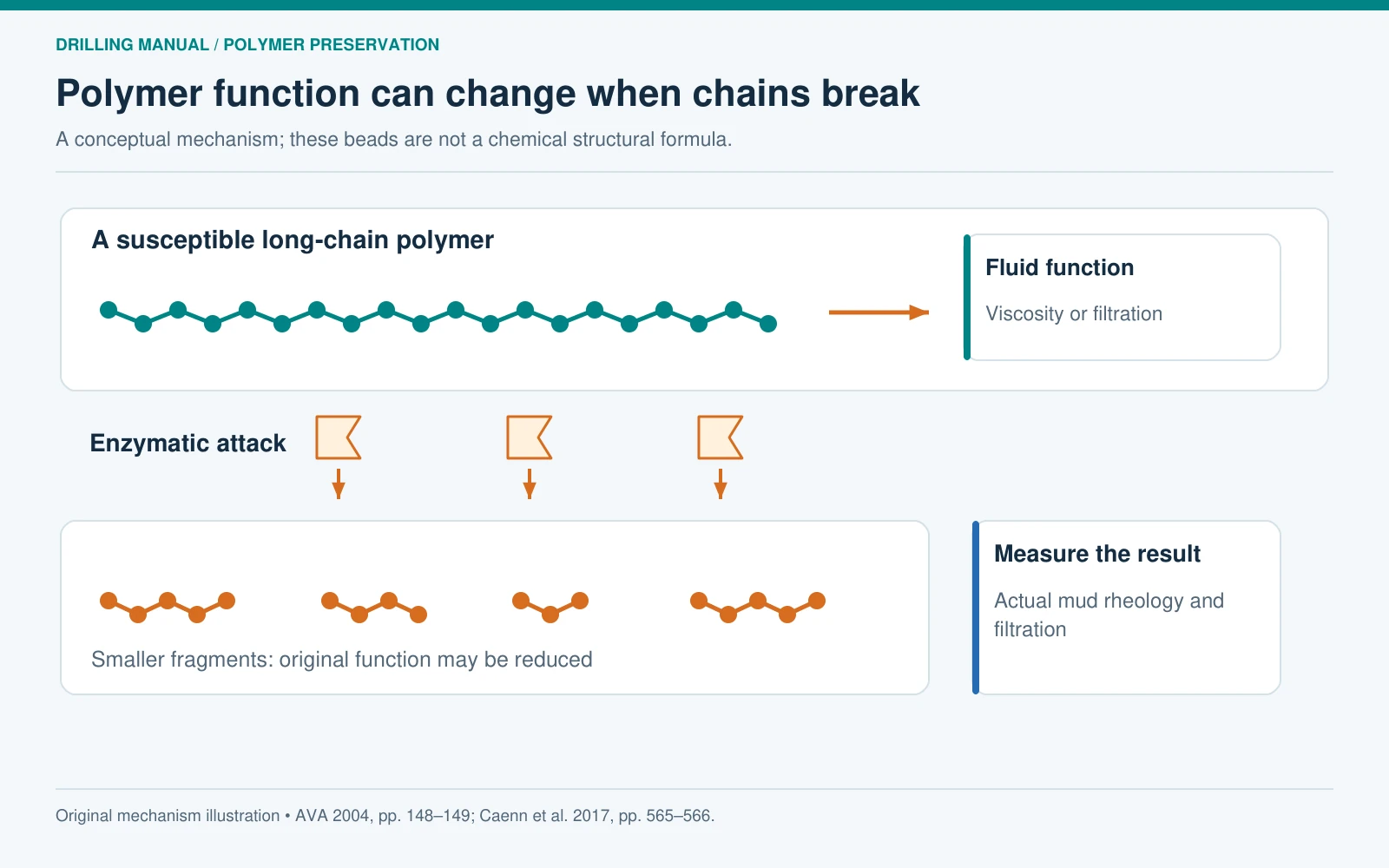
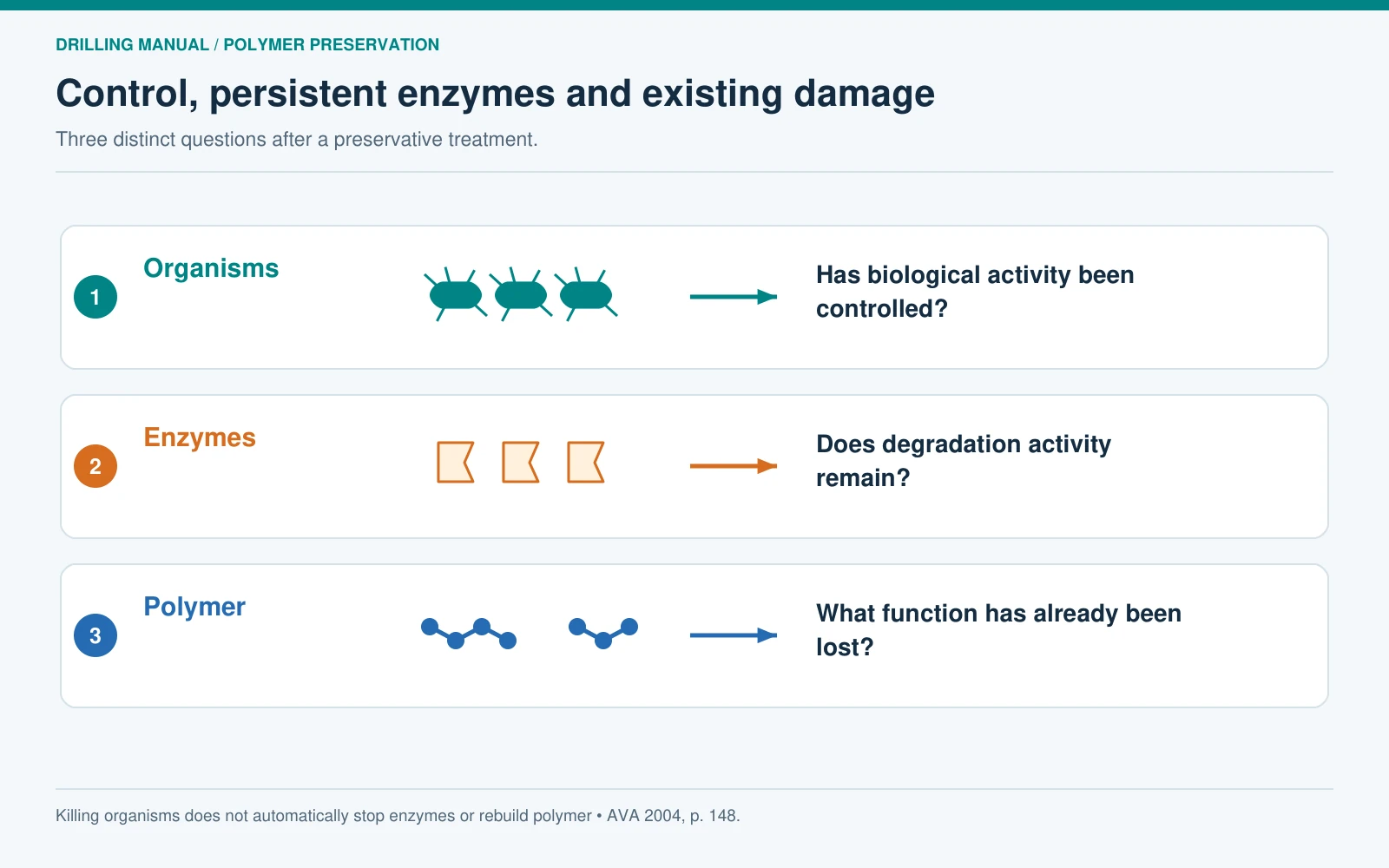
Many natural polymers used in water-based fluids contain carbohydrate structures that microorganisms can use as a nutrient source. Enzymes can break long chains into smaller fragments. The resulting changes may compromise viscosity or filtration control, depending on the polymer’s original job and the rest of the formulation. Starch, guar and xanthan are examples discussed in the manuals; their susceptibility is not identical. [1, pp. 148–149, 162, 166] [2, pp. 131, 565–566]
Define the preservation objective in functional terms: retain the suspension and flow behavior of a viscosifying polymer, preserve filtration control, or maintain a stored fluid for its intended later service. “Biocide added” is an activity record. “Required properties retained over the assessed exposure” is a performance statement that needs measurements.
The term also does not imply that every polymer grade requires the same protection. Chemical modification and product formulation can change resistance. Identify the actual additive, including any preservative already supplied with it, before evaluating an additional treatment.

Which fluids deserve closer preservation assessment?
Start with the ingredients and service history. AVA describes starch as vulnerable to microbial degradation and also explains that modified starches and cellulose derivatives can have different resistance. Baker Hughes identifies storage-related deterioration as a concern for guar fluids and describes fermentation problems in starch-containing salt systems. These examples support fluid-specific assessment; they do not define a universal storage deadline. [1, pp. 148–149, 162, 166] [3, pp. 3-32, 3-35]
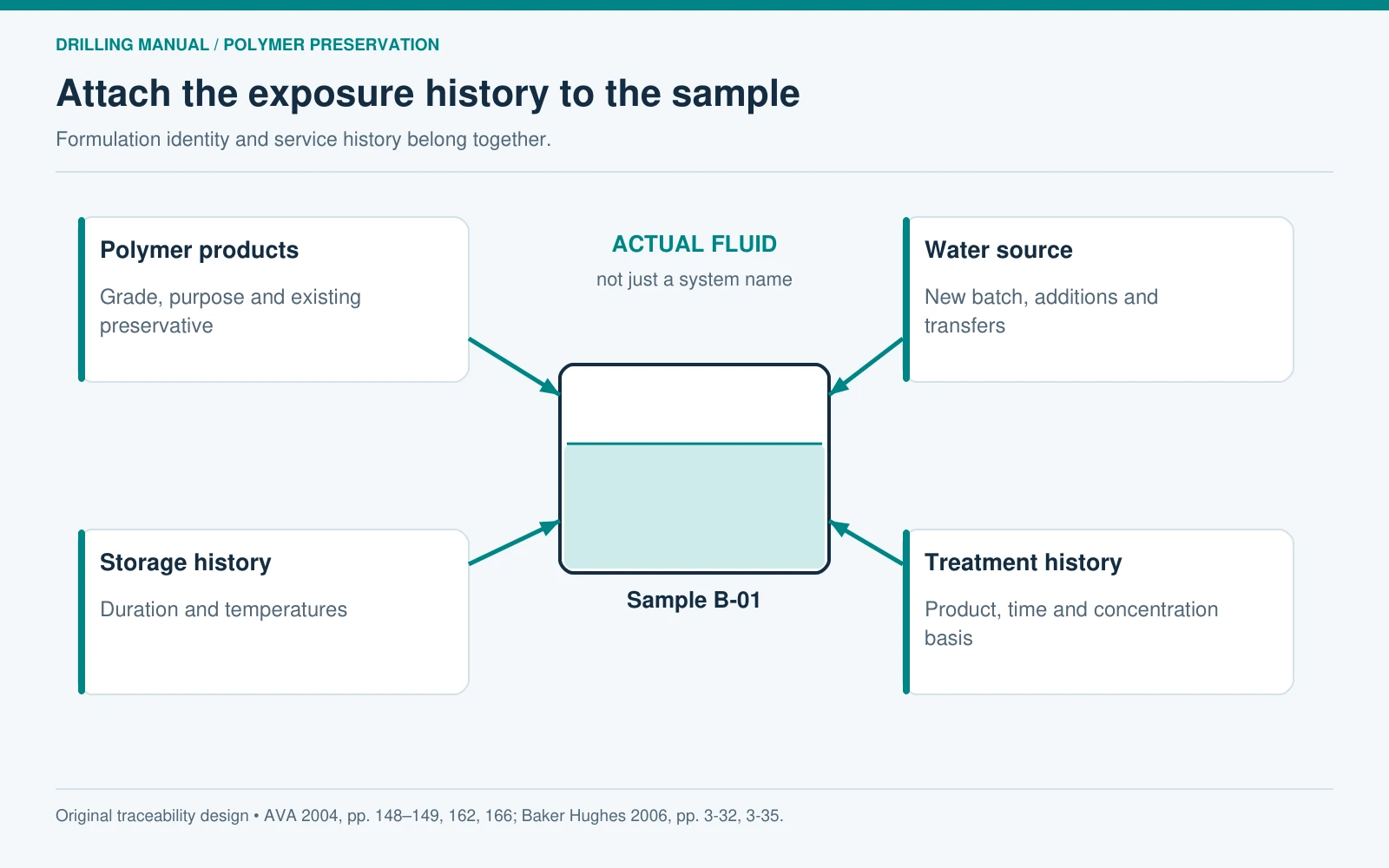
Document the mix-water source, polymer products, fluid age, storage temperatures and additions since the previous check. A new batch mixed with a different water source is not automatically equivalent to a retained sample of yesterday’s mud. Likewise, a circulating system and a reserve tank can have different exposure histories even when their nominal formulations match.
High salinity is not proof of preservation. Baker Hughes reports that saturated salt systems can still experience fermentation. Treat salinity and pH as characteristics of the test environment, rather than substitutes for microbial and fluid-performance evidence. The water-based fluid systems guide helps identify the formulation being assessed.
Distinguish biological damage from heat, shear and dilution
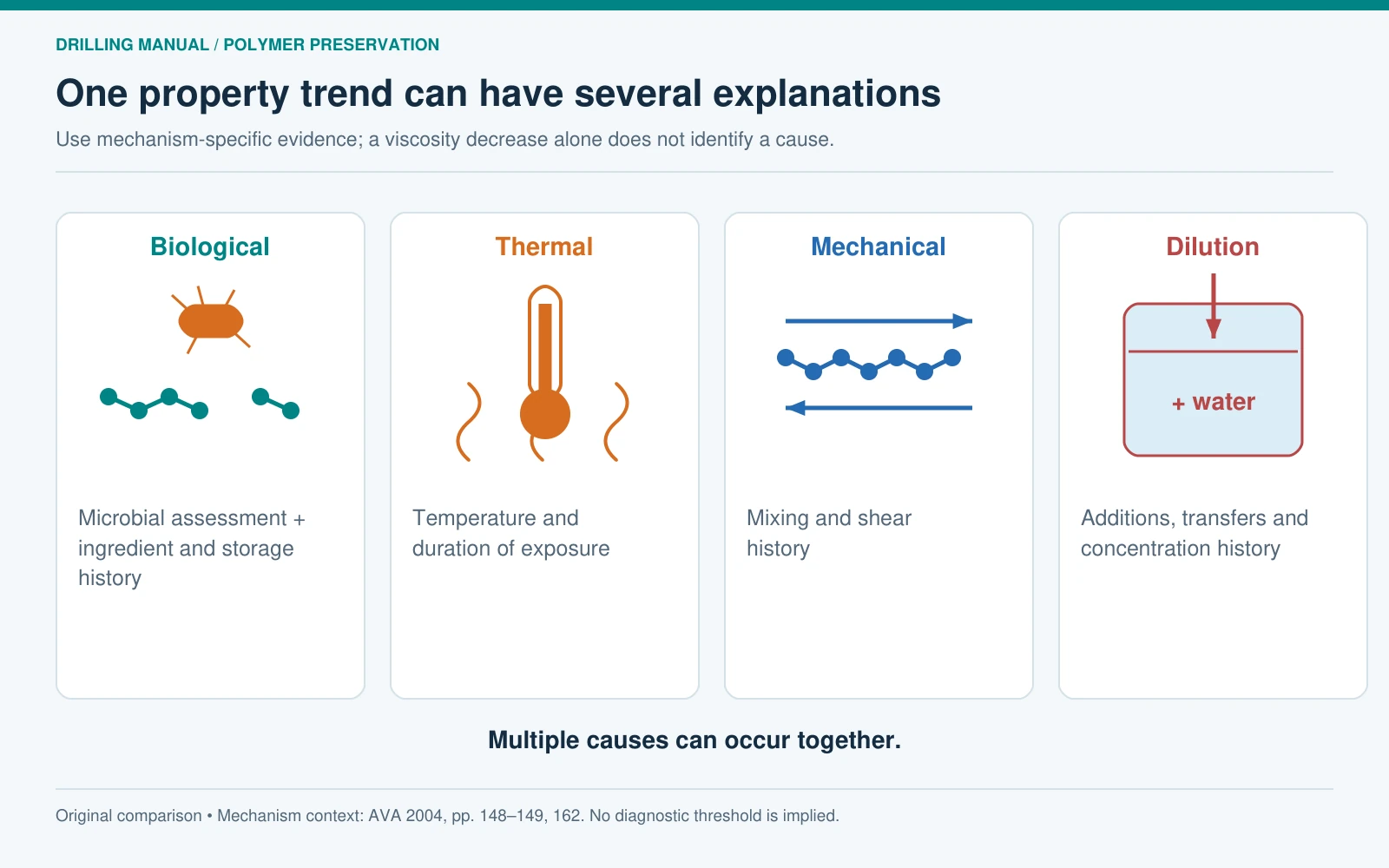
Several mechanisms can produce similar changes in a polymer fluid. AVA discusses thermal and mechanical effects alongside biological degradation. A sound investigation compares the property trend with what happened to the fluid, then seeks evidence for the suspected mechanism. Do not infer a cause solely from a low viscosity reading, color change or odor. [1, pp. 148–149, 162]
| Possible explanation | History or evidence to examine |
|---|---|
| Biological degradation | Susceptible ingredients, storage history and suitable microbial assessment |
| Thermal deterioration | Actual temperature exposure, duration and comparison with appropriately aged samples |
| Mechanical deterioration | Mixing and shear history, including differences between laboratory and field handling |
| Dilution or formulation change | Water additions, transfers, product concentrations and inventory records |
| Chemical incompatibility | Changes in water chemistry or additive package and matched compatibility tests |
These are investigative categories, not a diagnostic lookup table. More than one may apply. For example, dilution can reduce measured viscosity while also changing the concentration of a previously added preservative. Where water chemistry has changed, the drilling-fluid hardness test is useful related reading; hardness itself is not a microbial test.
Why microbial control does not restore damaged polymer
Preservation and repair are different objectives. AVA explains that enzymes released by microorganisms can remain active after the organisms are killed. A successful reduction in viable organisms therefore does not, by itself, demonstrate that polymer degradation has stopped. Nor does it reverse chain breakage that has already occurred. [1, p. 148]
This distinction matters when interpreting a late treatment. If microbial evidence improves but filtration control continues to deteriorate, the result should not be reported simply as “biocide failed” or “mud cured.” The microbial response, remaining enzyme activity where assessed, and fluid-property response are separate observations.
Baker Hughes also notes difficulty dealing with established fermentation in starch systems. The practical implication is to assess preservation before deterioration becomes extensive, while retaining a separate fluid-restoration decision if damage is already present. That restoration decision requires testing the actual mud; increasing a preservative concentration is not evidence that lost polymer function has returned. [3, p. 3-35]
Build evidence around an identified fluid sample
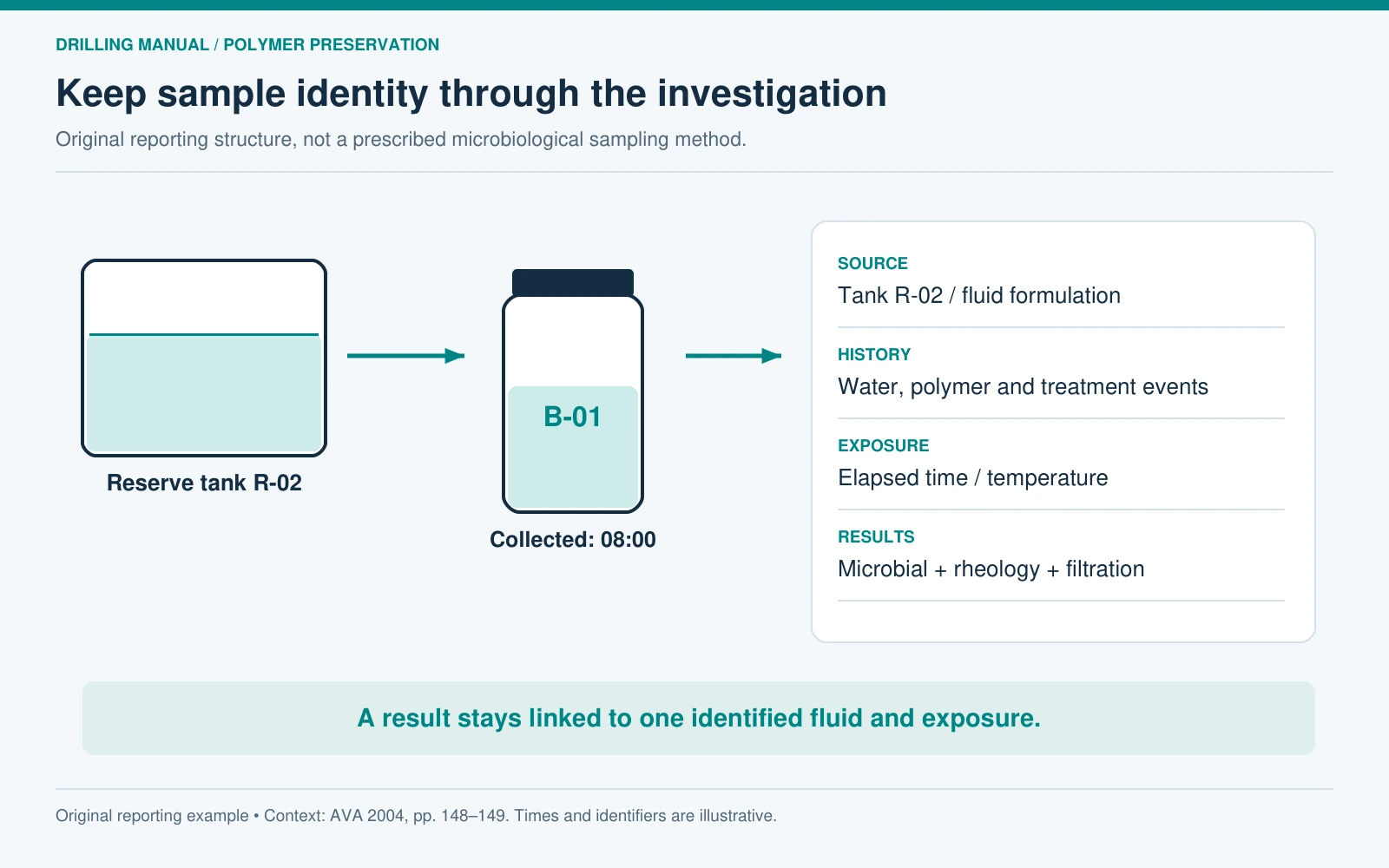
A useful investigation starts with sample identity. Record the tank or circulation point, collection time, fluid formulation, previous treatments and the conditions between collection and analysis. Ask the laboratory to state the microbial method used, what its result represents and the relevant sampling or handling requirements. The reporting framework here is an original synthesis, not a new standardized microbiological procedure.
Pair the biological information with the properties the polymer is meant to support. Record test temperature and method for rheology, and the filtration conditions used. A change in measurement conditions can obscure whether the fluid itself changed. The existing water-based mud testing guide provides the related physical and chemical test context.
Record unusual appearances as observations, without allowing them to stand in for analysis. A smell is not a safe identification method or proof of a particular organism. Equally, an apparently normal sample does not demonstrate that it will retain performance through a different storage period. The question is whether the evidence represents the actual fluid and intended exposure.

Choose a biocide for drilling mud through compatibility
A biocide for drilling mud must be suitable for the complete formulation. Caenn, Darley and Gray specifically identify mud compatibility and corrosion behavior as constraints on biocide selection. AVA likewise connects preservative selection with the fluid-loss system and environmental acceptability. Historical examples in these books are not a current product recommendation or a universal dose schedule. [2, p. 454] [1, p. 190]
Obtain the current product identity, active-component basis and intended application from the responsible supplier. Establish which water chemistry, pH, temperature and other additives were included in the supporting evaluation. A result in clean water does not automatically represent a solids-bearing polymer mud.
The qualification record should state the proposed concentration basis, exposure time and order of preparation used in the assessment. It should also identify the fluid-property criteria against which compatibility will be judged. A detectable residual, if measured by an appropriate product-specific method, is evidence about remaining chemical. It is not a stand-alone demonstration of microbial control or retained drilling performance.
Compare treated and untreated samples under matched conditions
A matched comparison makes interpretation clearer. Split an identified fluid into comparable portions, document the untreated reference and the proposed treatment, and keep the stated holding and measurement conditions consistent. The exact experimental design and microbiological methods belong to the qualified laboratory and the selected product. This framework identifies the information needed to understand its result.
Collect initial and later fluid-property data alongside the microbial assessment. Include the actual temperature and elapsed time rather than reporting only “before” and “after.” If multiple candidate products are compared, changes in active basis or handling should remain visible.
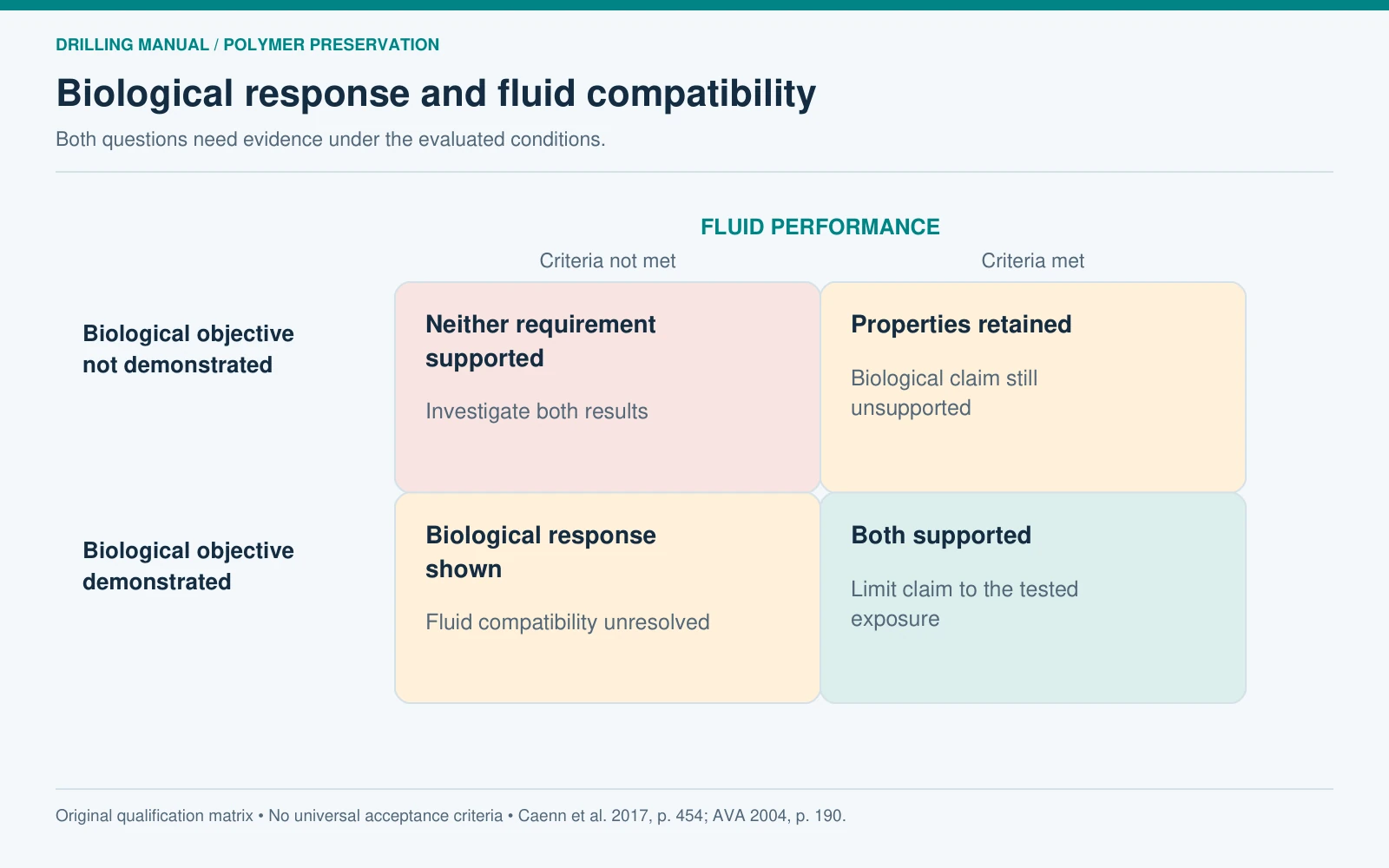
The outcome has two linked requirements: evidence appropriate to the biological objective and acceptable fluid performance. A treatment may suppress biological activity while changing rheology or filtration undesirably. Alternatively, a sample may retain viscosity for the short test period without establishing long-term preservation. Neither observation should be expanded beyond the conditions and duration actually assessed. The manuals’ discussion of polymer degradation and compatibility provides the basis for keeping these questions separate. [1, pp. 148–149] [2, p. 454]
Illustrative example: property retention is only part of the result
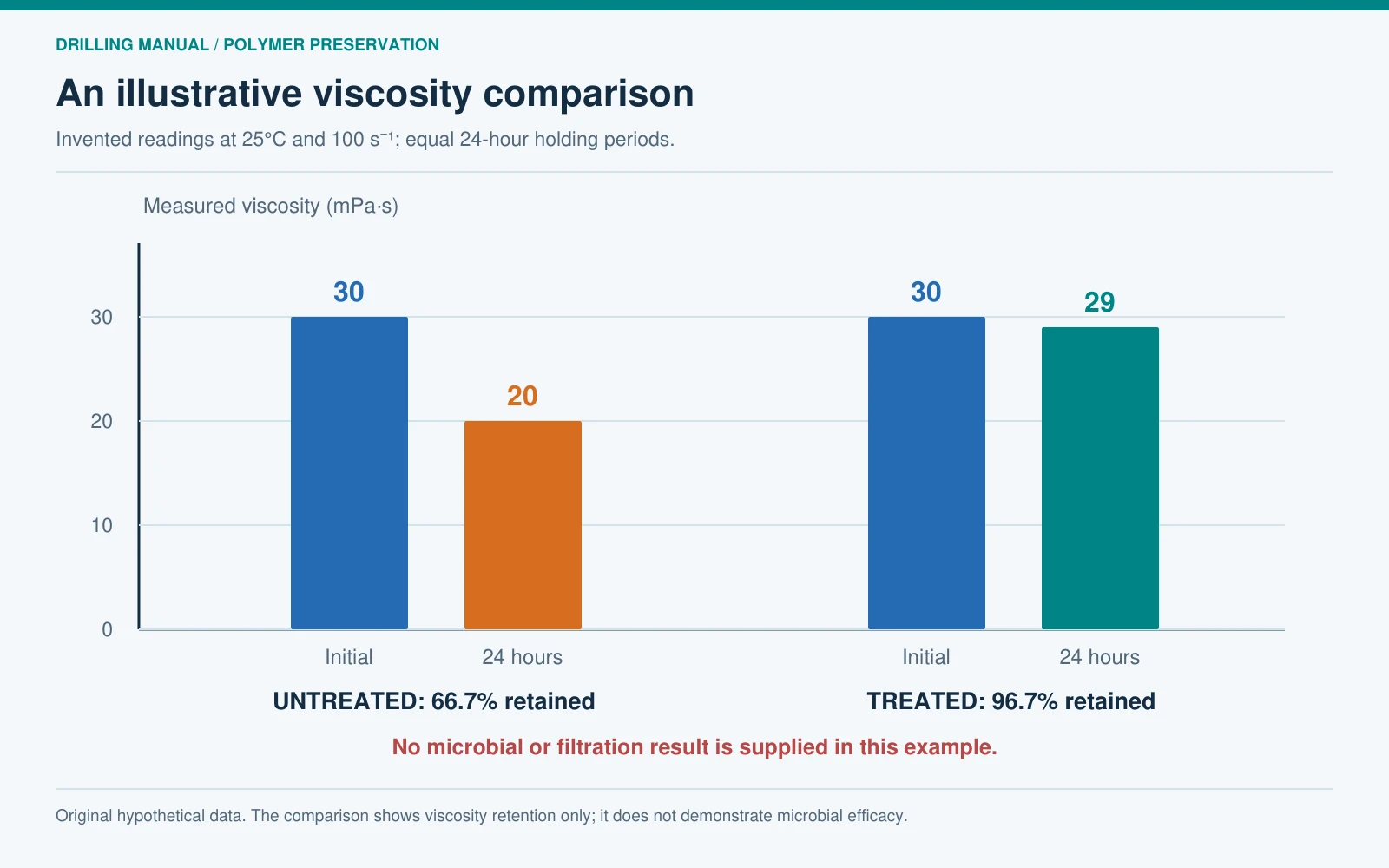
Consider an invented laboratory comparison of one polymer fluid. Two matched portions start at a measured viscosity of 30 mPa·s at 25°C and a shear rate of 100 s−1. After the same 24-hour holding period, the untreated portion measures 20 mPa·s and the treated portion measures 29 mPa·s under the same measurement conditions. These are illustrative values, not field data or acceptance limits.
Relative to their own initial readings, the untreated portion retains 20 ÷ 30 × 100 = 66.7%, while the treated portion retains 29 ÷ 30 × 100 = 96.7%. The numerical conclusion is limited: the treated portion retained more of this measured viscosity over this exposure.
The comparison does not establish a biological mechanism because no microbial results have been supplied. It also does not establish filtration performance, longer-term preservation or suitability for a different fluid. Add those results before making the corresponding claims. If the two portions had different temperatures, dilution or mixing histories, the comparison would be less informative even though the arithmetic remained correct.
Keep preservation evidence connected to field history
Once a treatment has been selected, preserve the link between its qualification and the fluid actually in service. Record make-up water changes, transfers, fresh polymer additions, treatment events and periods in storage. The mud circulating system helps identify the active and reserve volumes whose histories need to be distinguished.
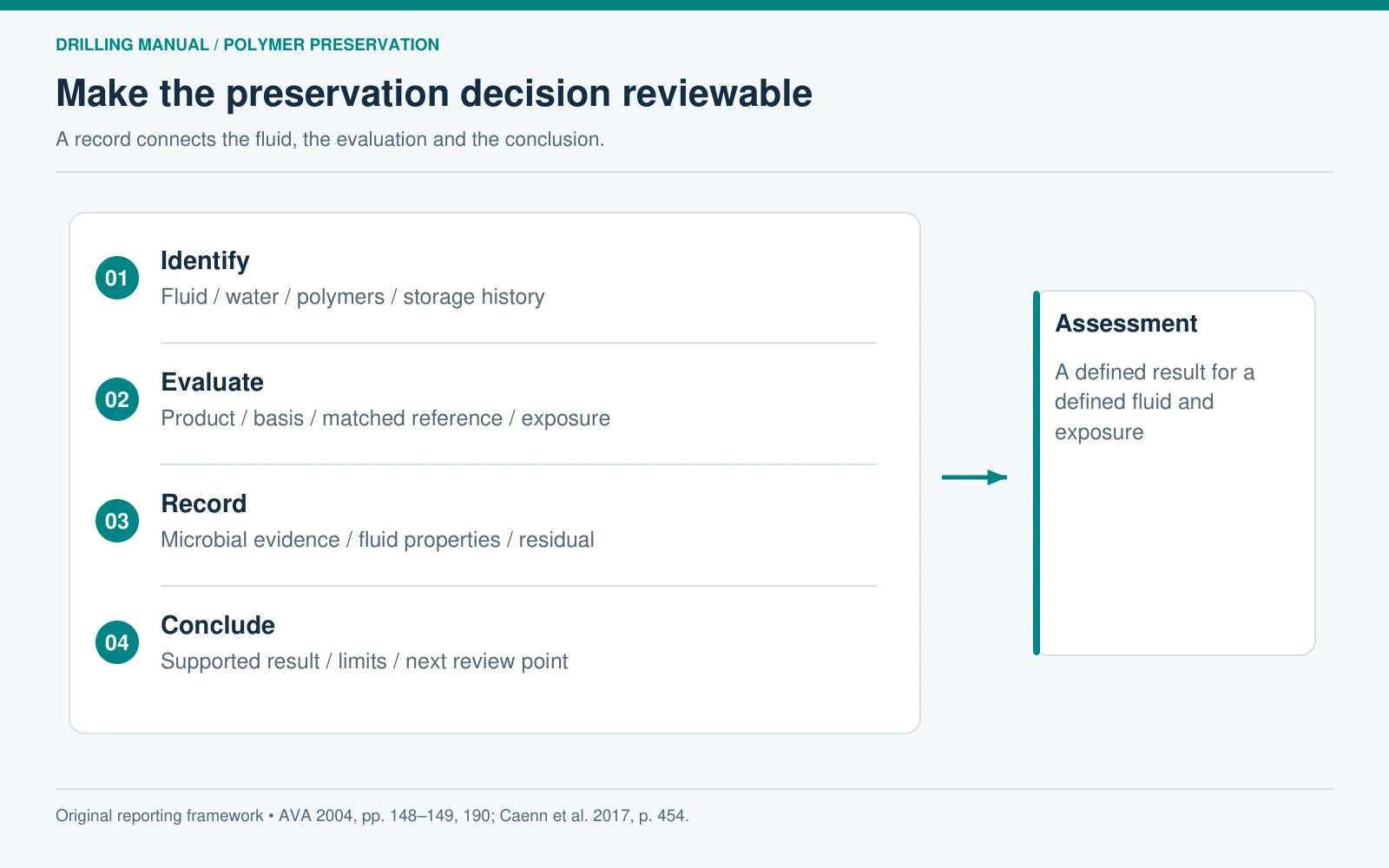
A useful record separates product addition from subsequent verification. It includes the sample identity, elapsed exposure, relevant microbial result, fluid-property results and any residual measurement with its method. It then states the supported conclusion and the next review point. A new water source, substantial dilution or altered storage duty may require reassessment because the earlier evidence represented different conditions.
Keep uncertainty explicit. “Performance retained during the evaluated period” is defensible when supported by measurements. “The mud is permanently protected” is not established by a single sample. This traceable approach makes the preservation decision reviewable without turning a historic book recipe into a general operating instruction.


Frequently asked questions
Does every water-based mud need a biocide?
No universal requirement follows from the cited manuals. Susceptibility depends on the polymer products, formulation and service history. Some grades have greater resistance or include preservation measures. Identify the ingredients and intended exposure, then assess the need for additional protection. The fact that a fluid contains a polymer is not enough to select a treatment. [1, pp. 148–149, 162]
Can a biocide restore viscosity after bacterial degradation?
It cannot be assumed to rebuild degraded polymer chains. Microbial control and restoration of fluid properties are separate objectives, and enzymes may remain active after organisms are killed. Check the actual rheology and filtration response before deciding whether further fluid conditioning or replacement of degraded ingredients is needed. [1, p. 148]
Does high salinity prevent fermentation?
Not reliably as a general rule. Baker Hughes describes fermentation in starch-containing salt systems and notes that high salinity alone is not a sufficient deterrent. Salinity remains an important test condition, but it does not replace preservation evidence for the particular formulation. [3, p. 3-35]
Is falling viscosity proof of microbial damage?
No. Thermal history, shear, dilution and formulation changes can also affect polymer-fluid behavior. Match the property trend with operational records and suitable microbial assessment. A single viscosity reading cannot identify which mechanism caused the change. [1, pp. 148–149, 162]
How should a biocide for drilling mud be compared?
Include sample identity, product and concentration basis, untreated reference, exposure time and temperature, microbial method and results, and the relevant rheology and filtration data. State any residual method separately. This is an original reporting framework; the qualified laboratory defines the applicable methods and assessment criteria.
Can one treatment dose be used for all drilling fluids?
The sources do not support that conclusion. Formulation compatibility, product chemistry and intended exposure all matter. Use current product-specific information and a qualified evaluation of the actual mud. A historical concentration in a manual should not be carried into a different formulation as a universal operating dose. [2, p. 454] [1, p. 190]
References
- AVA. Drilling Fluids Manual, Version 1, November 2004. Polymer chemistry and fluid-system chapters. Printed pages: 148–149, 162, 166, 190. PDF pages in the edition consulted: 150–151, 164, 168, 192.
- Caenn, R., Darley, H.C.H. and Gray, G.R. Composition and Properties of Drilling and Completion Fluids, 7th edition. Gulf Professional Publishing/Elsevier, 2017. ISBN 978-0-12-804751-4. Printed pages: 131, 454, 565–566. PDF pages in the edition consulted: 135, 456, 566–567.
- Baker Hughes Drilling Fluids. Drilling Fluids Reference Manual, Revision 2006. Water-based fluid systems. Printed pages: 3-32, 3-35. PDF pages in the edition consulted: 113, 116.