To calculate centrifuge barite recovery, divide the mass rate of barite in the selected product stream by the mass rate of barite in the feed. To find how much barite the rig actually retains, follow that product to its final destination. A centrifuge can concentrate barite in the solids-rich discharge while the piping sends that discharge to waste.
Draw the actual streams first
Label the feed, solids-rich discharge and liquid-rich centrate. Record which stream returns to the active system, which goes to a second stage and which leaves the system. Write those destinations for the operating mode used during sampling. A generic flowsheet on the wall may show a different valve lineup. Treat any side stream, dilution or recirculation across the measurement boundary explicitly.
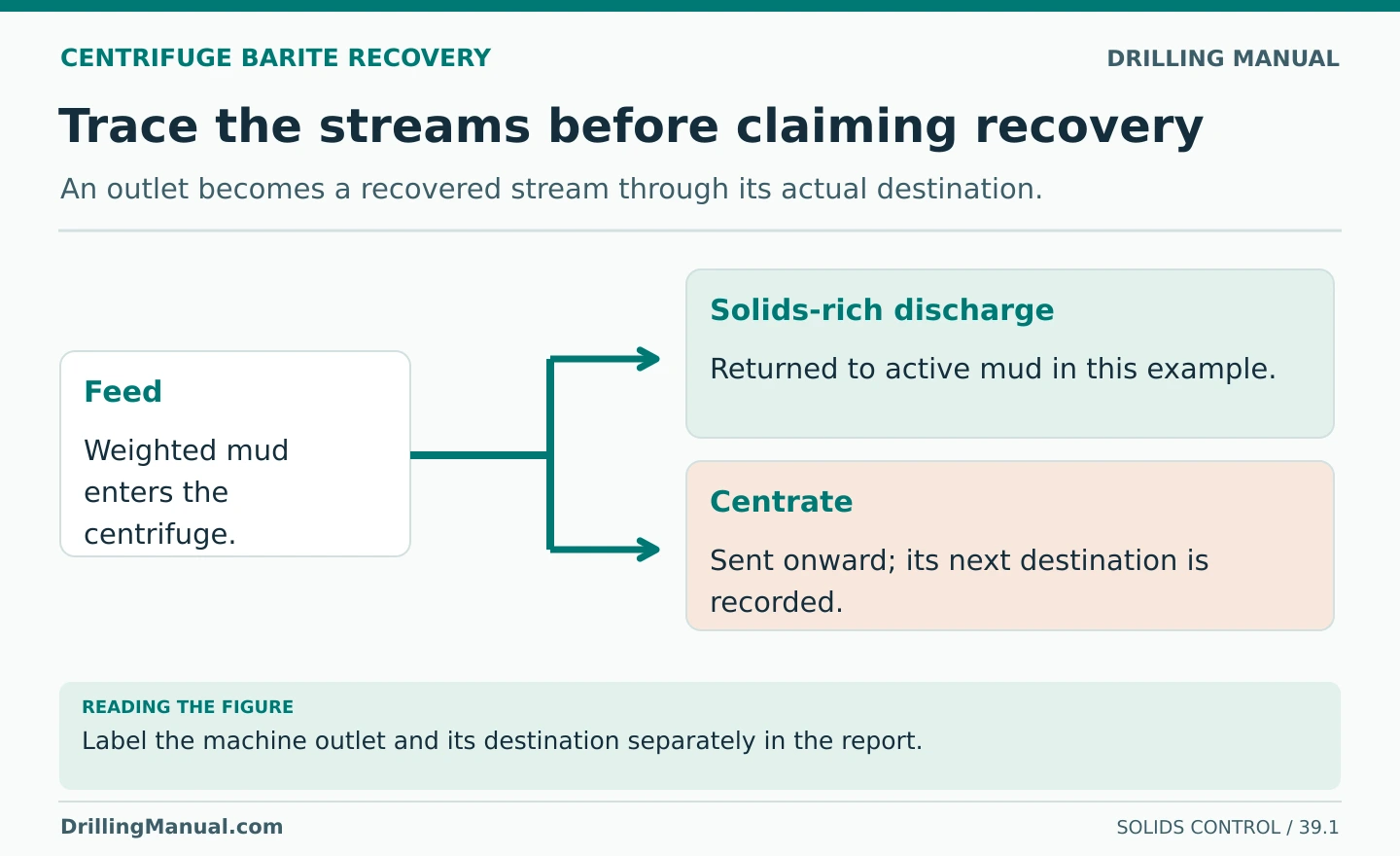
Centrifugal separation responds to settling behaviour. Particle size, particle density, fluid properties and operating conditions all matter. The solids-rich stream can contain drilled solids as well as barite. The centrate can carry fine barite. Neither outlet can be treated as a single pure component on the strength of its name or appearance.


Calculate recovery and grade separately
Assume the following hypothetical dry-solids mass rates are known from representative sampling. The two solids components close exactly in this teaching example. The liquid in each stream has been excluded from the table.
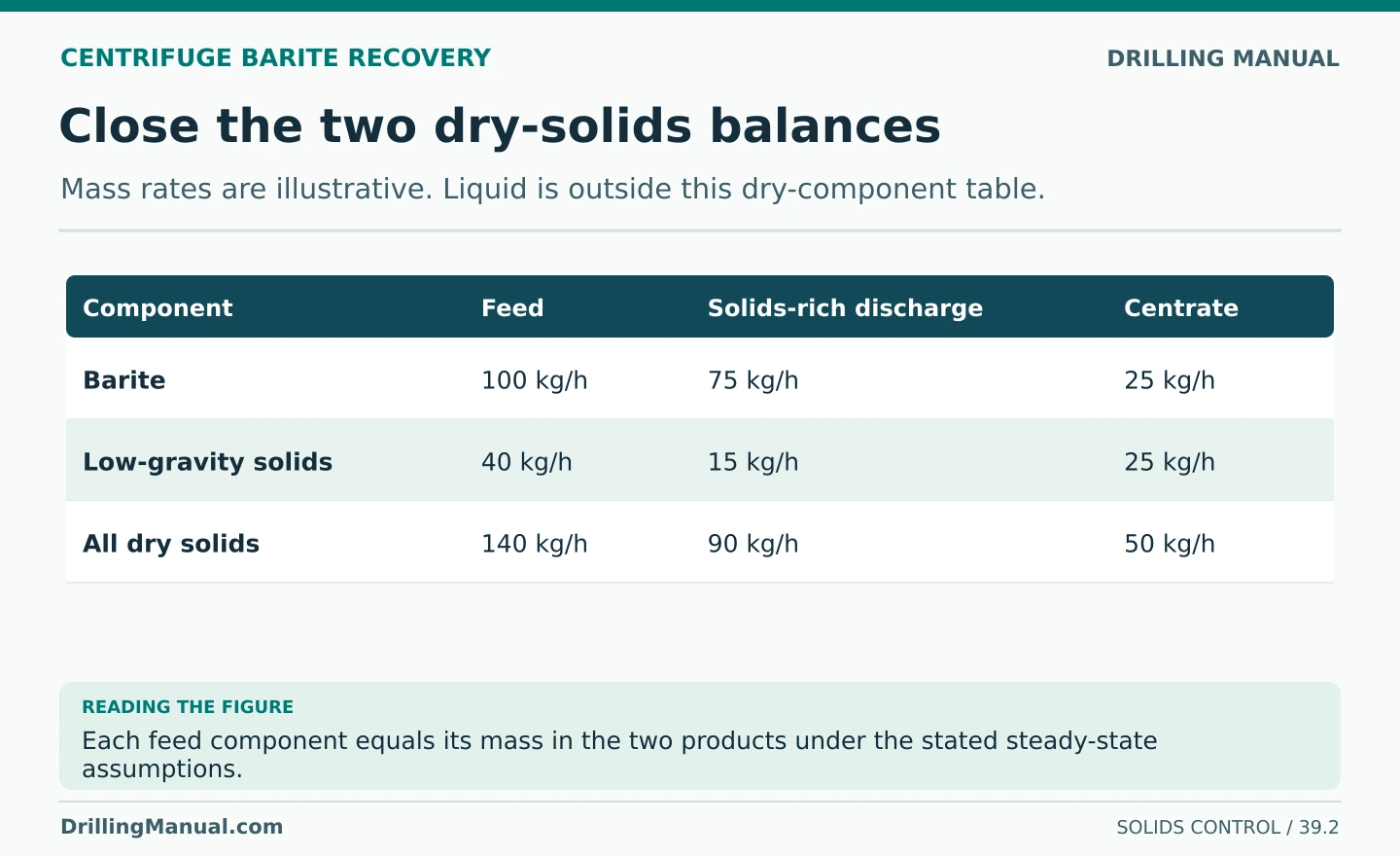
| Dry component | Feed | Solids-rich discharge | Centrate |
|---|---|---|---|
| Barite | 100 kg/h | 75 kg/h | 25 kg/h |
| Low-gravity solids | 40 kg/h | 15 kg/h | 25 kg/h |
| Total dry solids | 140 kg/h | 90 kg/h | 50 kg/h |
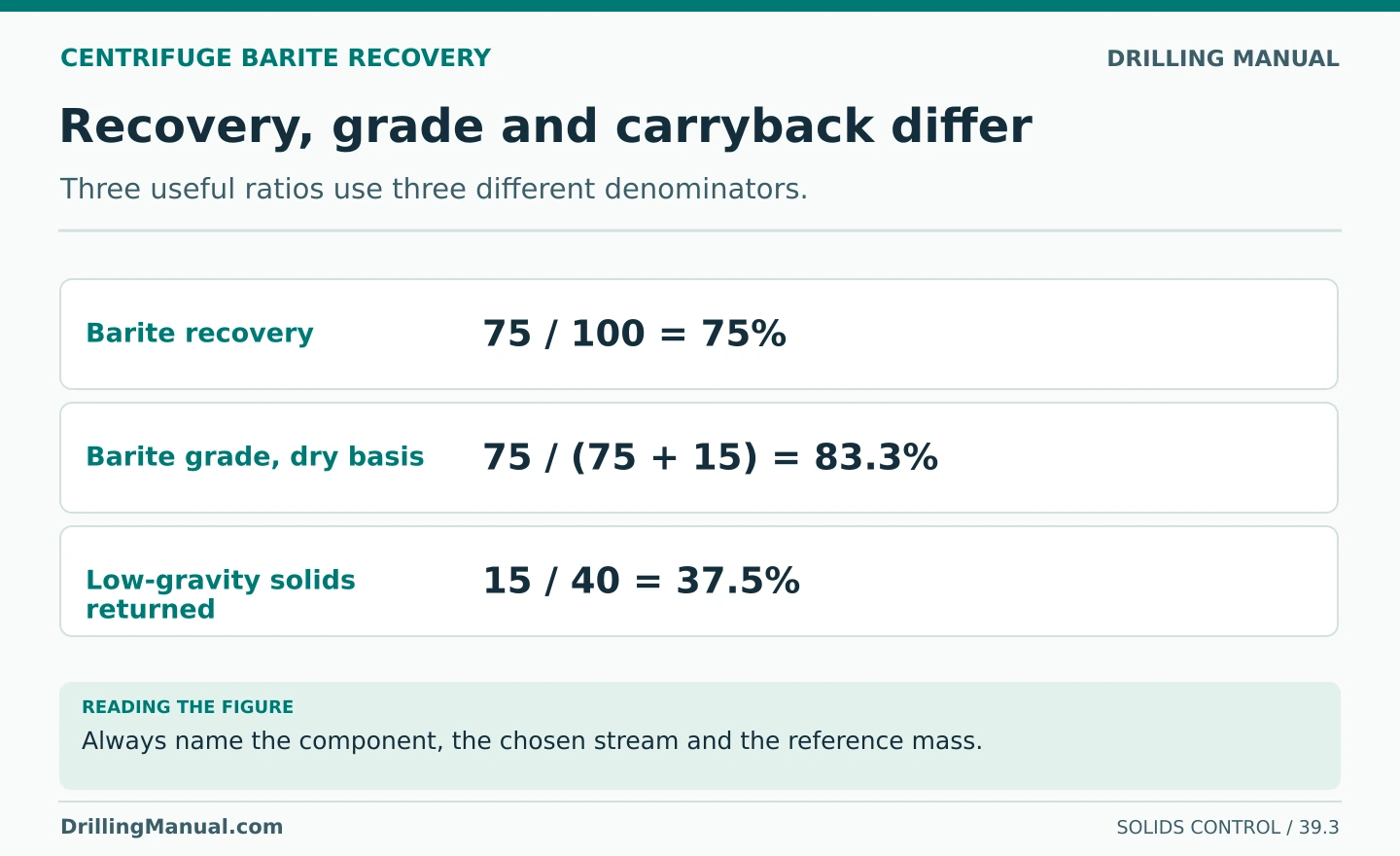
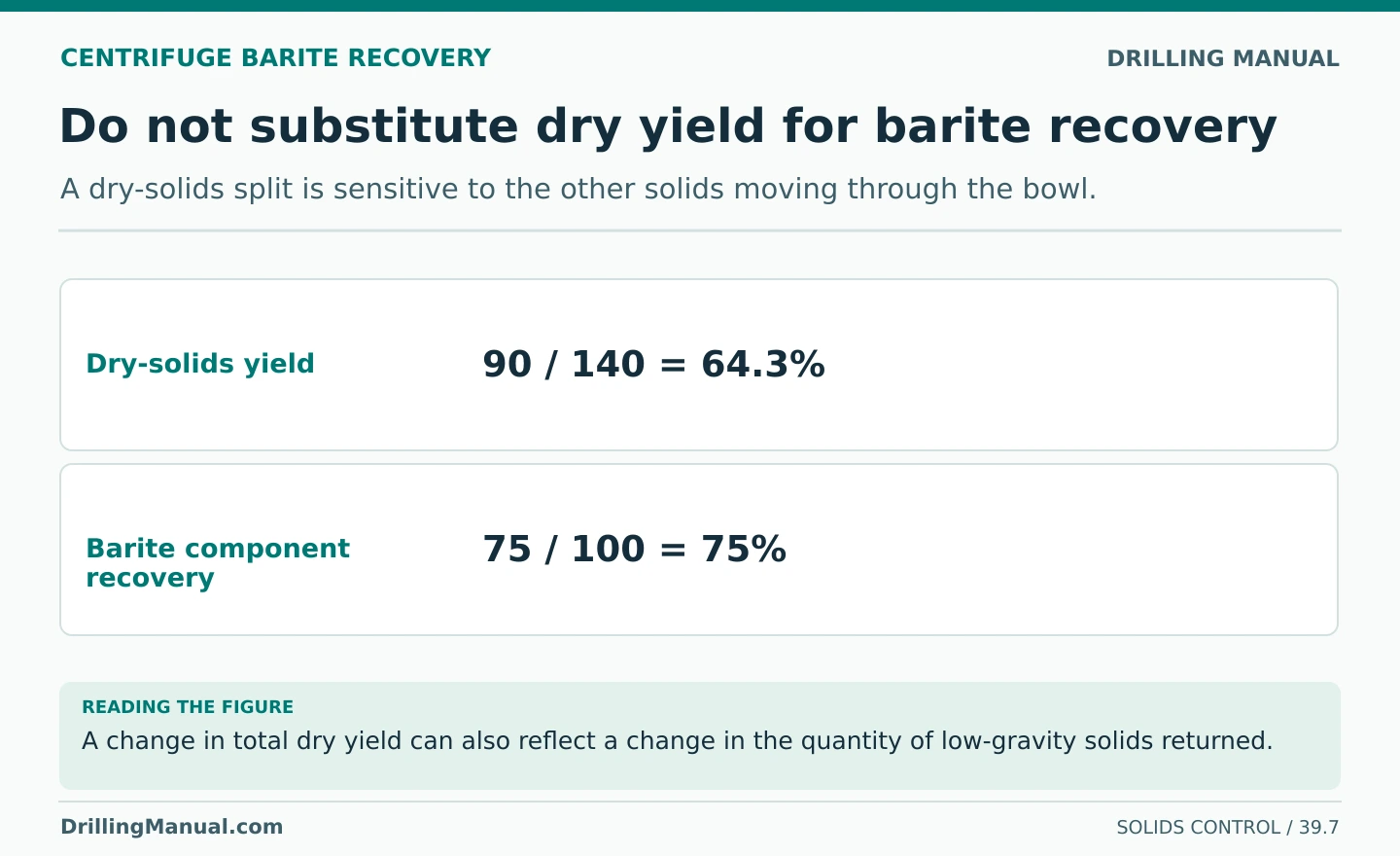
The solids-rich discharge receives 75/100 = 75% of the incoming barite. Its barite grade is 75/90 = 83.3% of dry-solids mass. It also receives 15/40 = 37.5% of the incoming low-gravity solids. Quoting 83.3% as barite recovery confuses the composition of one product with the split of the incoming barite.

Follow the selected product home
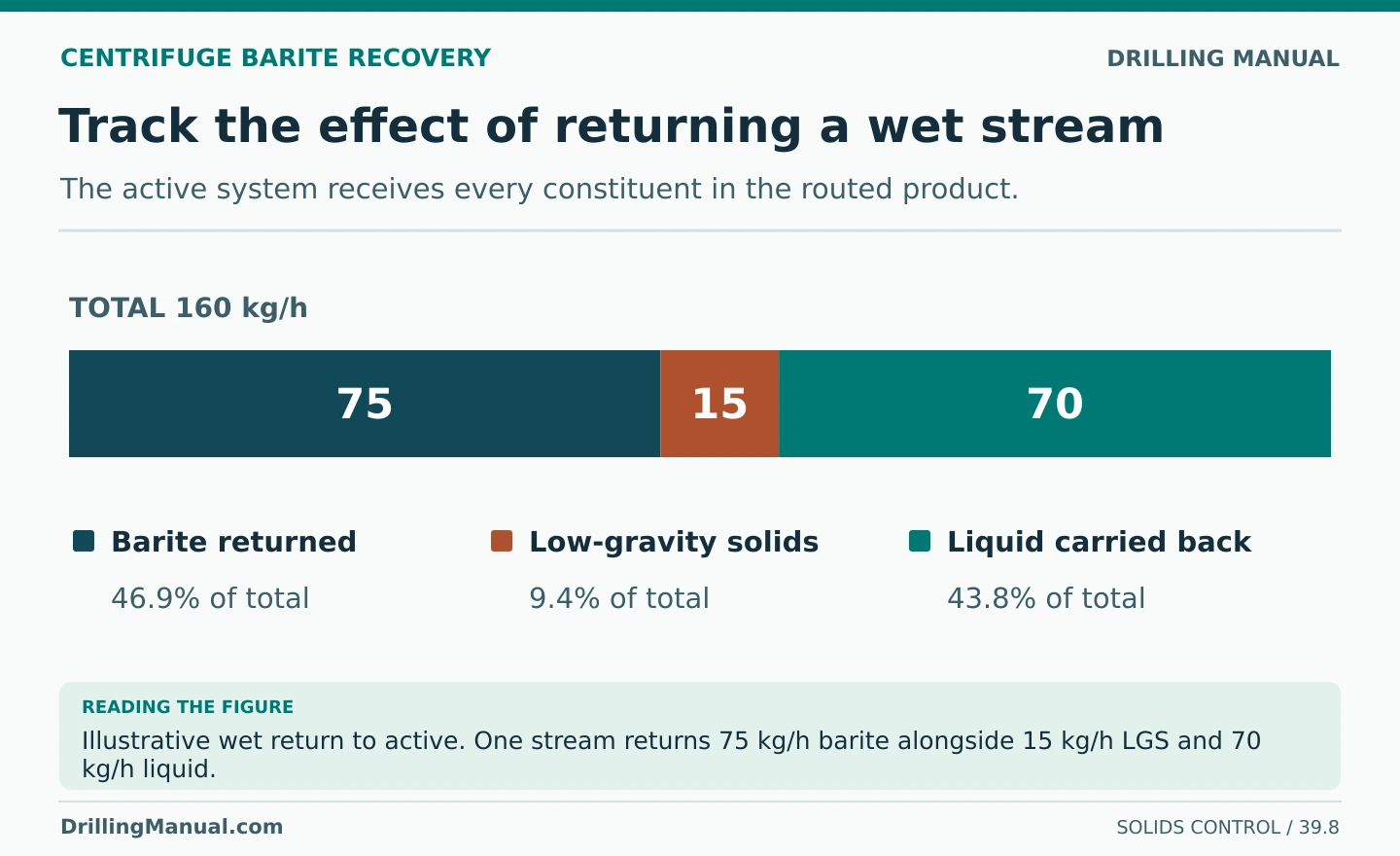
If the rig returns all of the solids-rich discharge and discards all centrate, it returns 75 kg/h of barite and 15 kg/h of low-gravity solids in this example. If only the centrate returns, it returns 25 kg/h of each. In a two-stage system, sample the final return and final waste streams as well. Counting an intermediate transfer into the second machine as recovered material exaggerates what came back to the tanks.
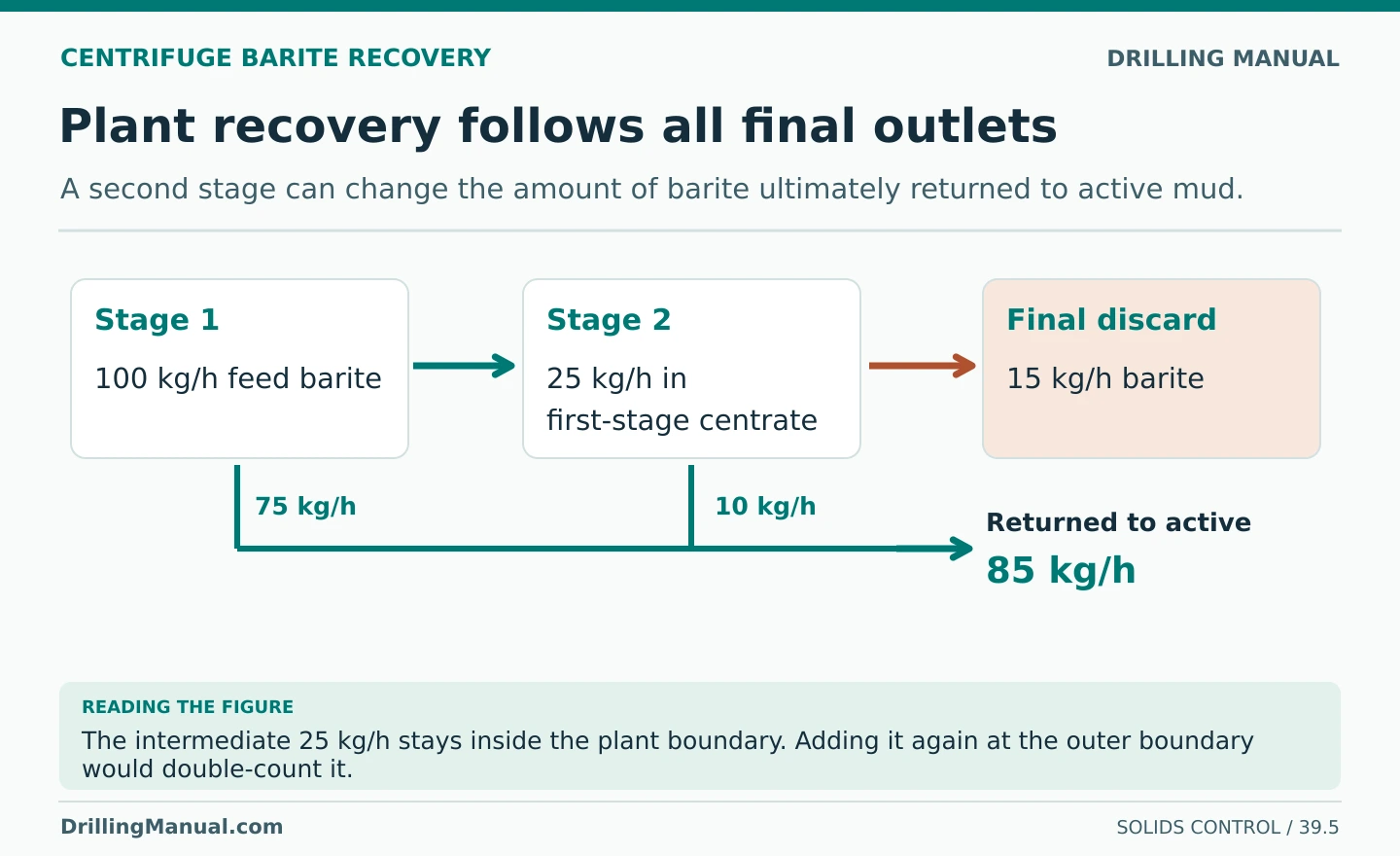
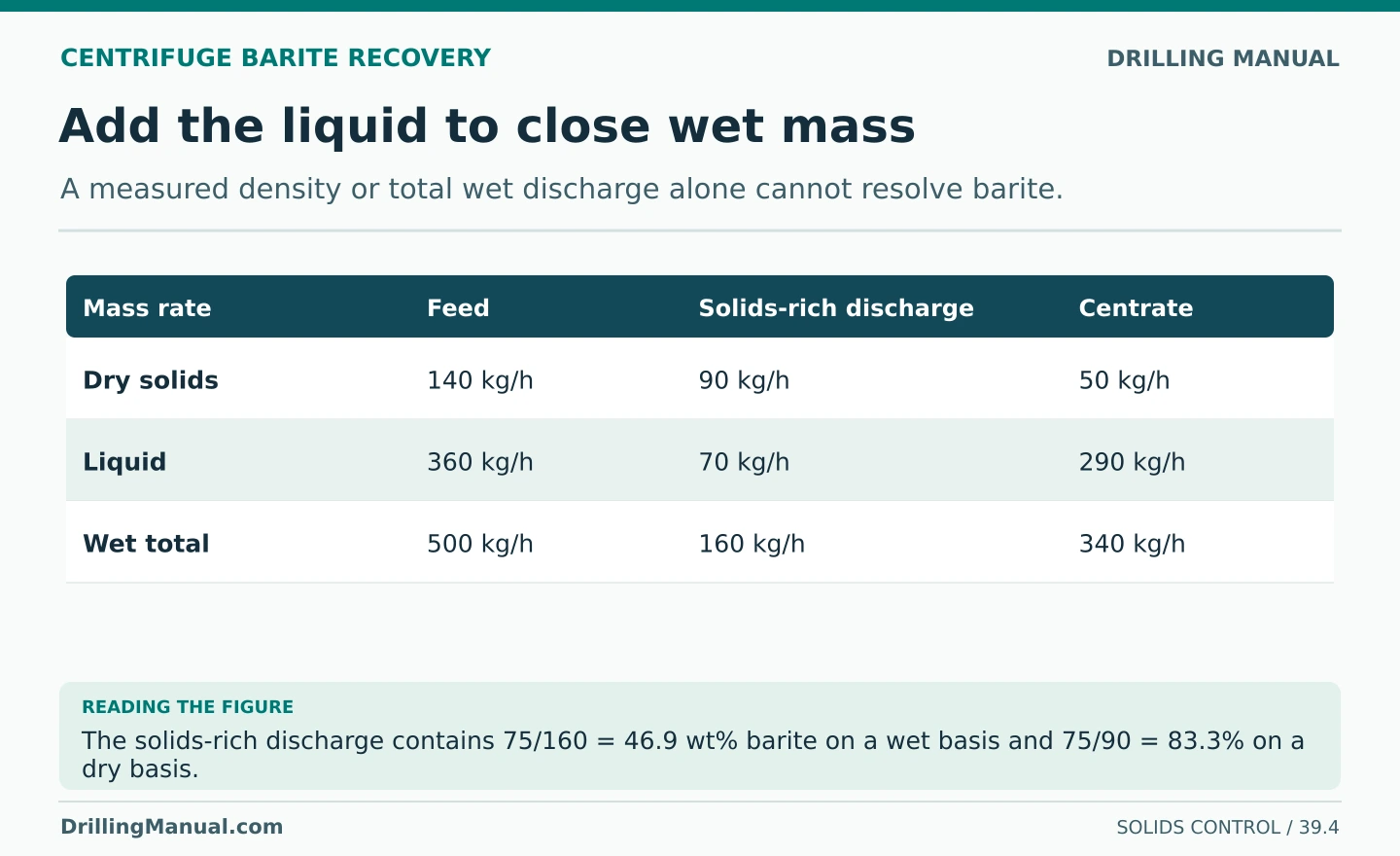
Keep the liquid balance separate. Returning a useful solids fraction and losing an expensive liquid phase can occur in the same operating mode. A solids-only calculation cannot settle a whole-mud cost question. It needs fluid volumes, liquid composition where relevant, dilution rates and a genuine replacement or handling cost for the streams being compared.
Check the measurements before comparing settings
Mud weight alone cannot identify the proportions of barite and drilled solids when liquid content also changes. Match stream flow with solids concentration and a validated component estimate. Verify that all concentrations are on compatible mass or volume bases before multiplying. State the assumed densities when converting a volume estimate into component mass.
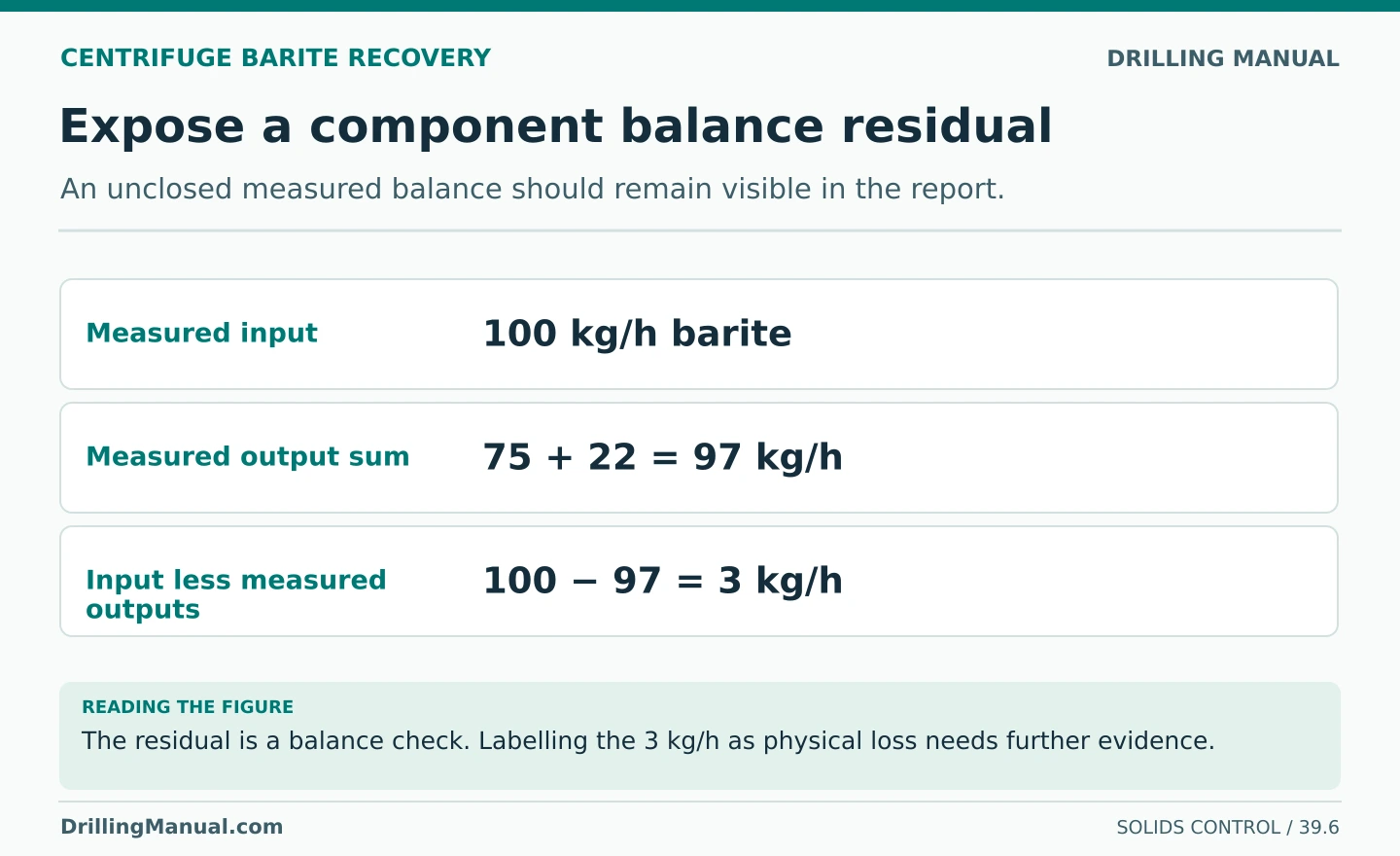

For each component, calculate feed minus the sum of measured outlet rates. Retain that residual in the report. A purported gain of two percentage points deserves little weight when repeats or closure errors are larger. One useful field comparison lists barite returned, low-gravity solids discarded and liquid lost per operating hour beside the feed condition. That tells the supervisor what improvement was purchased with the setting change.
See the wet balance and two-stage recovery examples
Field or laboratory record
Download the editable centrifuge component ledger (TXT).
Frequently asked questions
Does a heavy discharge prove high recovery?
It shows that the sampled product is dense. Recovery needs the barite rate in the discharge and the incoming barite rate over the same period.
Can I use a dry sample to calculate what is in the active mud?
The dry sample gives a solids composition for one stream. You also need its rate, destination and the other material movements into or out of the active system.
Which measure is best for evaluating a second centrifuge?
Measure the incremental change across the system boundary, including final barite return, drilled-solids removal and liquid disposal. Intermediate recirculation can otherwise count the same material twice.
Further reading and technical references
Use Oilfield Centrifuge Mechanisms & Types for the machine and its separation stages. For properties of the weighting material in the balance, see Barite in Drilling Mud Properties & Formula.
ASME Shale Shaker Committee. Drilling Fluids Processing Handbook. Gulf Professional Publishing, 2005. Printed pp. 314–315, 318–319, 590 (PDF pp. 341–342, 345–346, 617). Printed pp. 328–332 (PDF pp. 355–359), ch. 14.