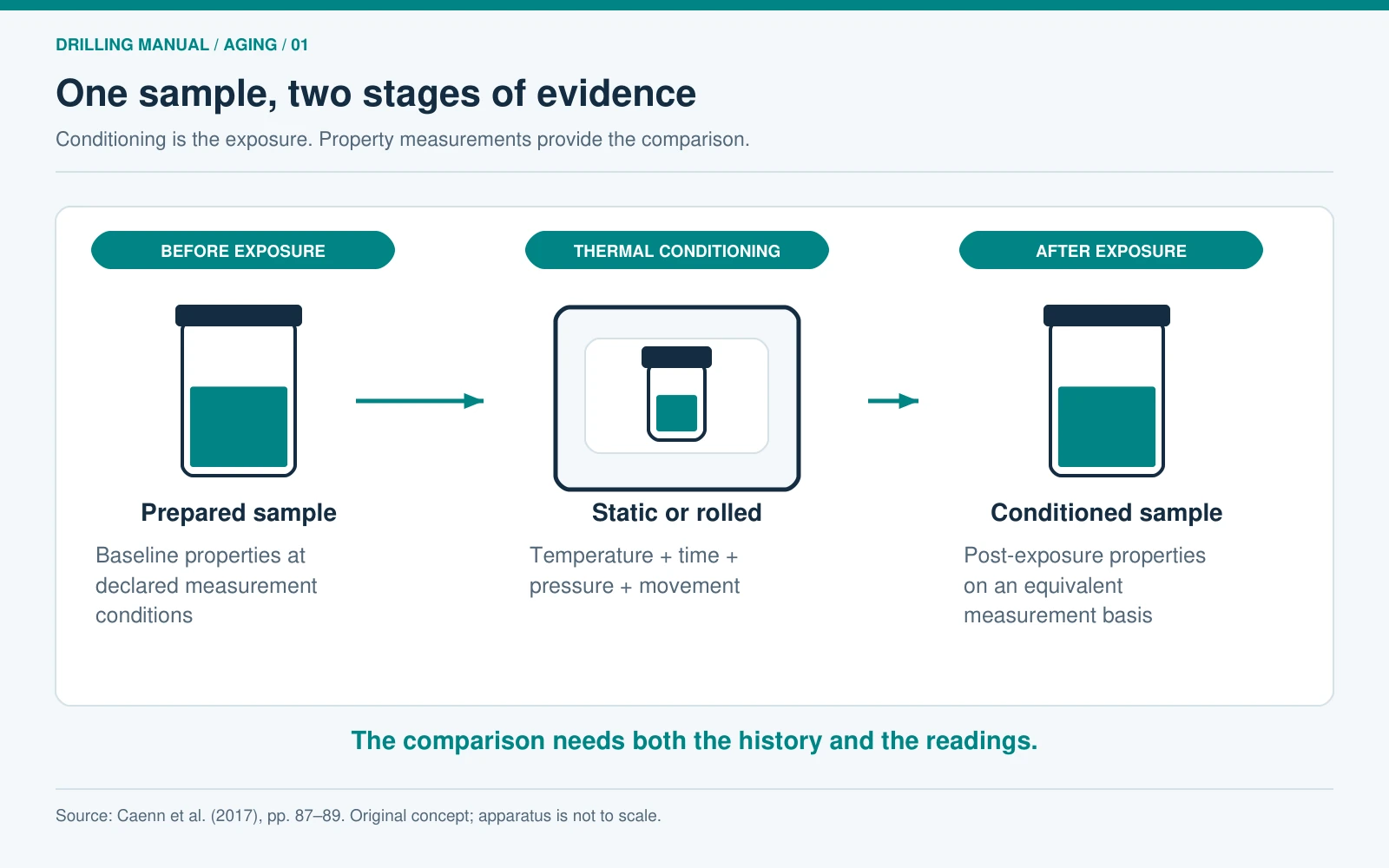
A drilling fluid aging test exposes a prepared mud sample to a defined period of conditioning, often at elevated temperature, and examines how its properties change. The useful result is a comparison: the fluid before exposure, the fluid after exposure, and the conditions under which both were measured. A temperature written beside an oven setting does not establish the temperature at which the final viscosity was measured.
Caenn and colleagues describe elevated-temperature aging because constituents of water-based fluids can deteriorate during circulation and during hotter static periods. They distinguish rolled cells from cells left undisturbed and identify different evidence needed from each. [1, pp. 87–89] This guide develops that distinction into a practical way to read laboratory reports. For the wider property vocabulary, see the drilling-mud properties guide.
What a drilling fluid aging test actually evaluates
Aging is the conditioning stage. Rheology, filtration and other selected measurements are the observations used to judge the conditioned sample. Saying that a mud “passed hot rolling” is incomplete unless the report identifies the measured endpoints and the acceptance criteria for that particular application. The oven itself does not produce a single universal thermal-stability score.
The sample also has a history before entering the cell. Mixing, hydration, contamination and previous exposure may affect its starting condition. Caenn emphasizes controlled evaluation and possible interactions among components, including the effects of agitation, temperature and contaminants. [1, p. 87] A fresh laboratory formulation and a field sample therefore answer different questions even when their nominal product concentrations match.
Fluid aging examines the condition of the mud. A shale-recovery experiment adds a defined shale challenge and measures retained or lost solids. Both may use a roller oven, but sharing equipment does not make their endpoints interchangeable. Record the sample and the question before comparing any numbers.
Static aging and hot rolling preserve different evidence
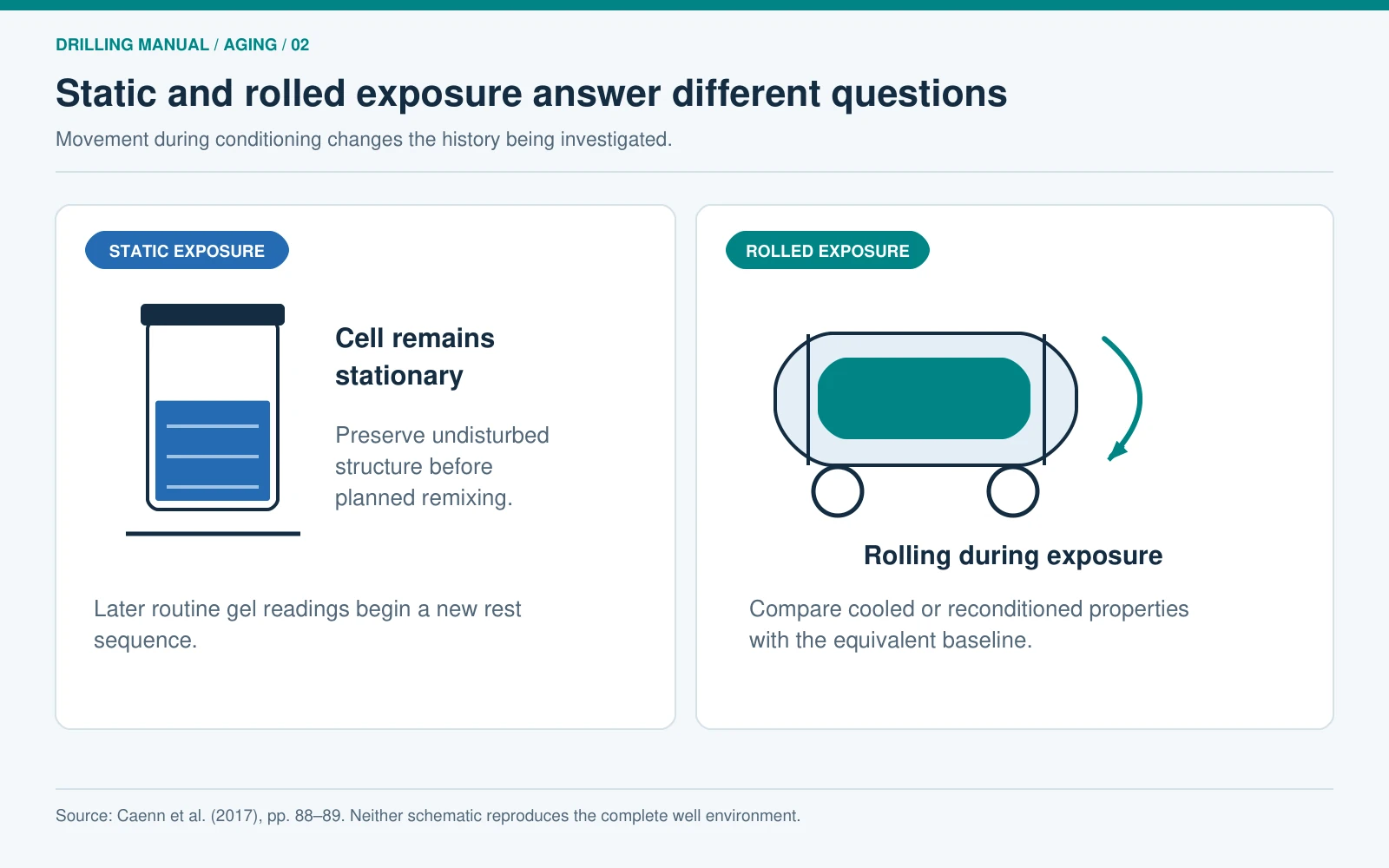
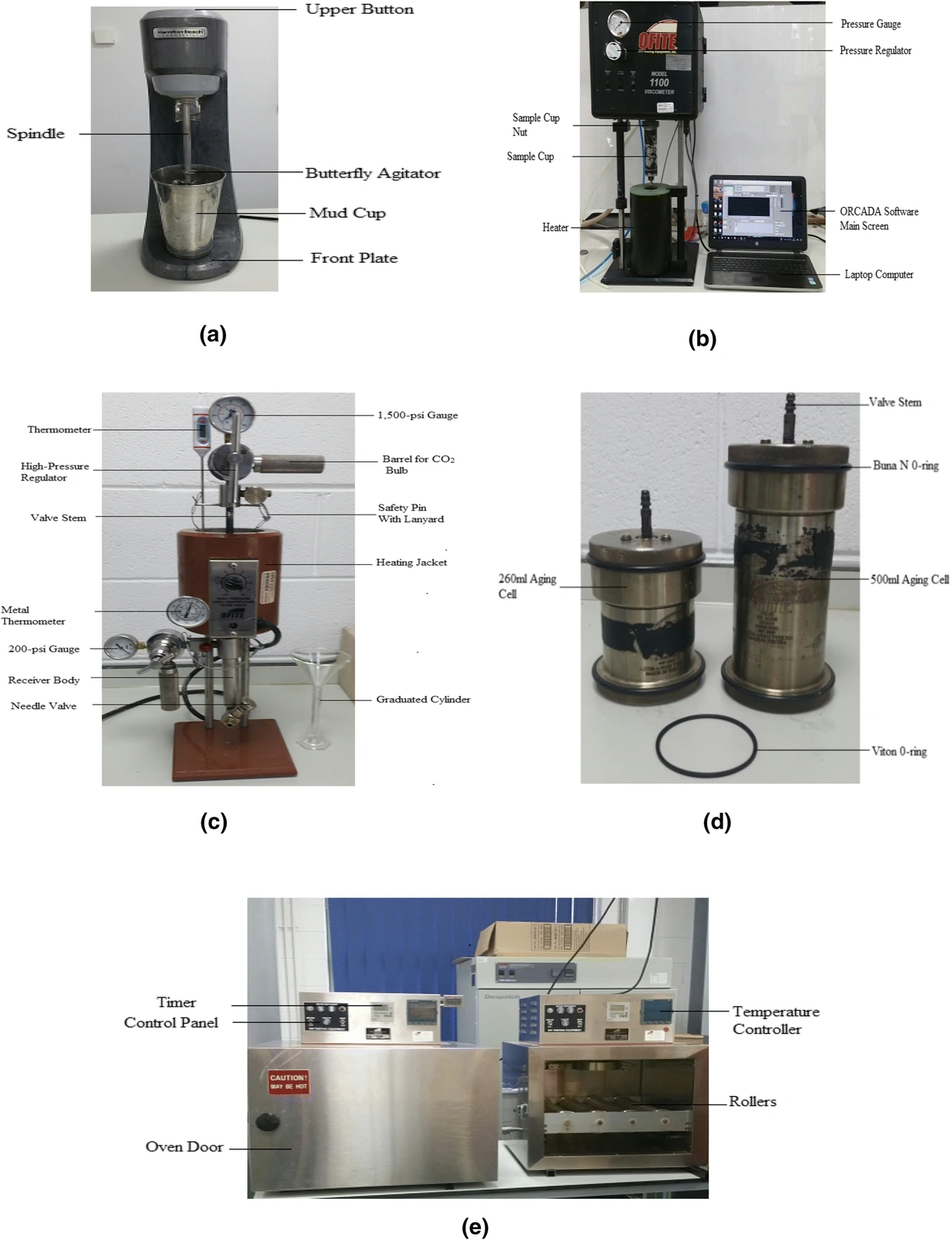
In hot rolling, the cell moves on rollers while the fluid experiences the selected temperature history. In static aging, the cell remains stationary for the selected exposure. Caenn uses rolling to represent aspects of circulating exposure and static aging to investigate an undisturbed mud left in a hot interval. These are laboratory representations, not complete reproductions of the well. [1, pp. 88–89]
| Conditioning route | Principal question | Evidence to preserve |
|---|---|---|
| Rolled exposure | How do selected fluid properties change after heat and rolling? | Baseline and post-exposure properties, with equivalent measurement conditions. |
| Static exposure | What develops while the fluid remains undisturbed? | Undisturbed condition before remixing, followed by any separately defined reconditioned measurements. |
| Direct measurement at high temperature and pressure | How does the fluid behave while those conditions are applied? | The actual measurement temperature, pressure and shear history. |
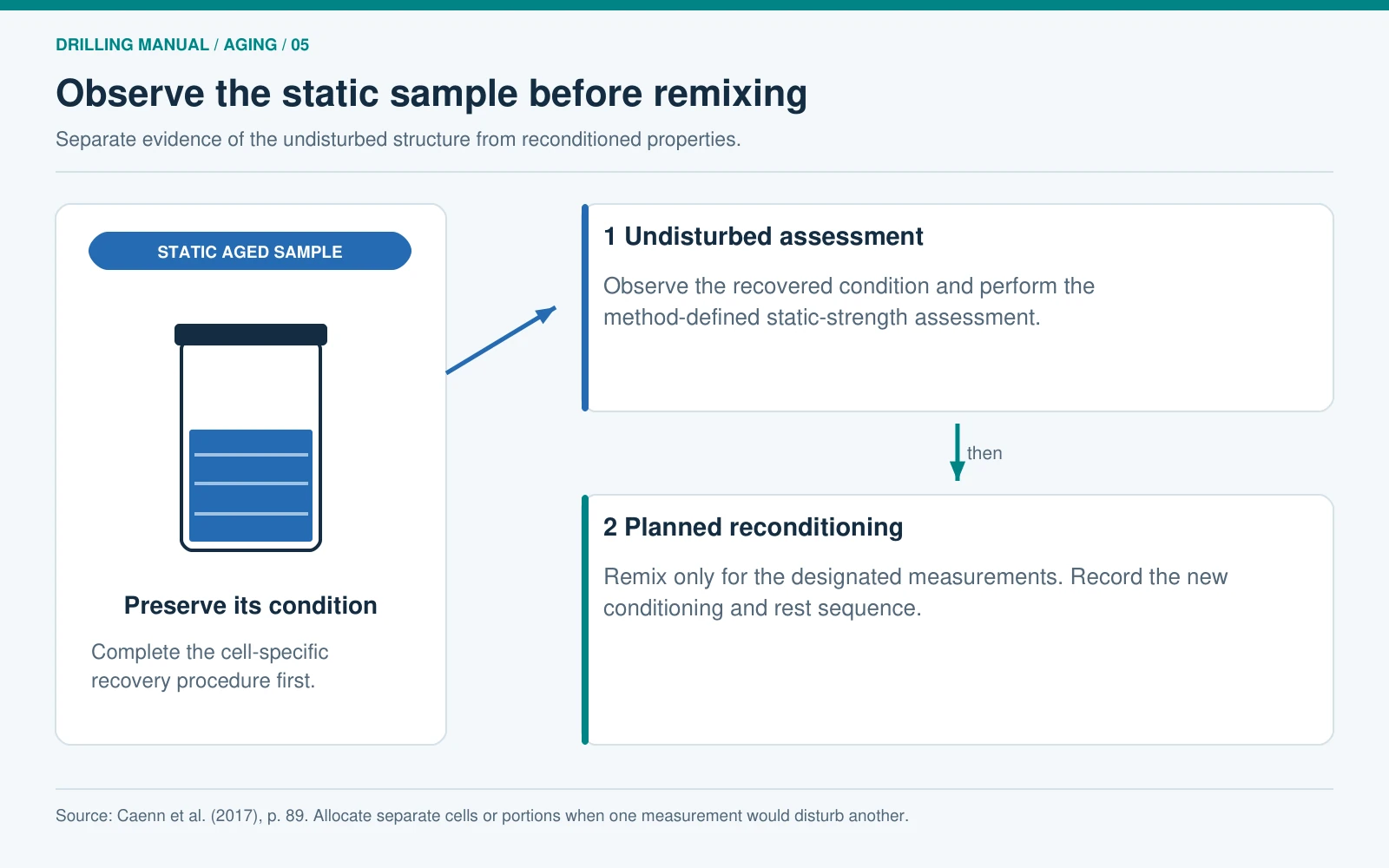
For a static sample, remixing can remove the very structure the test was intended to examine. Caenn describes cooling a statically aged cell and measuring its undisturbed strength with a shearometer before disturbance. [1, p. 89] A routine gel reading taken after remixing describes a newly established rest period; it cannot be relabelled as the original undisturbed aged gel. The gel-strength guide provides related background.
Choose the exposure history before choosing a duration
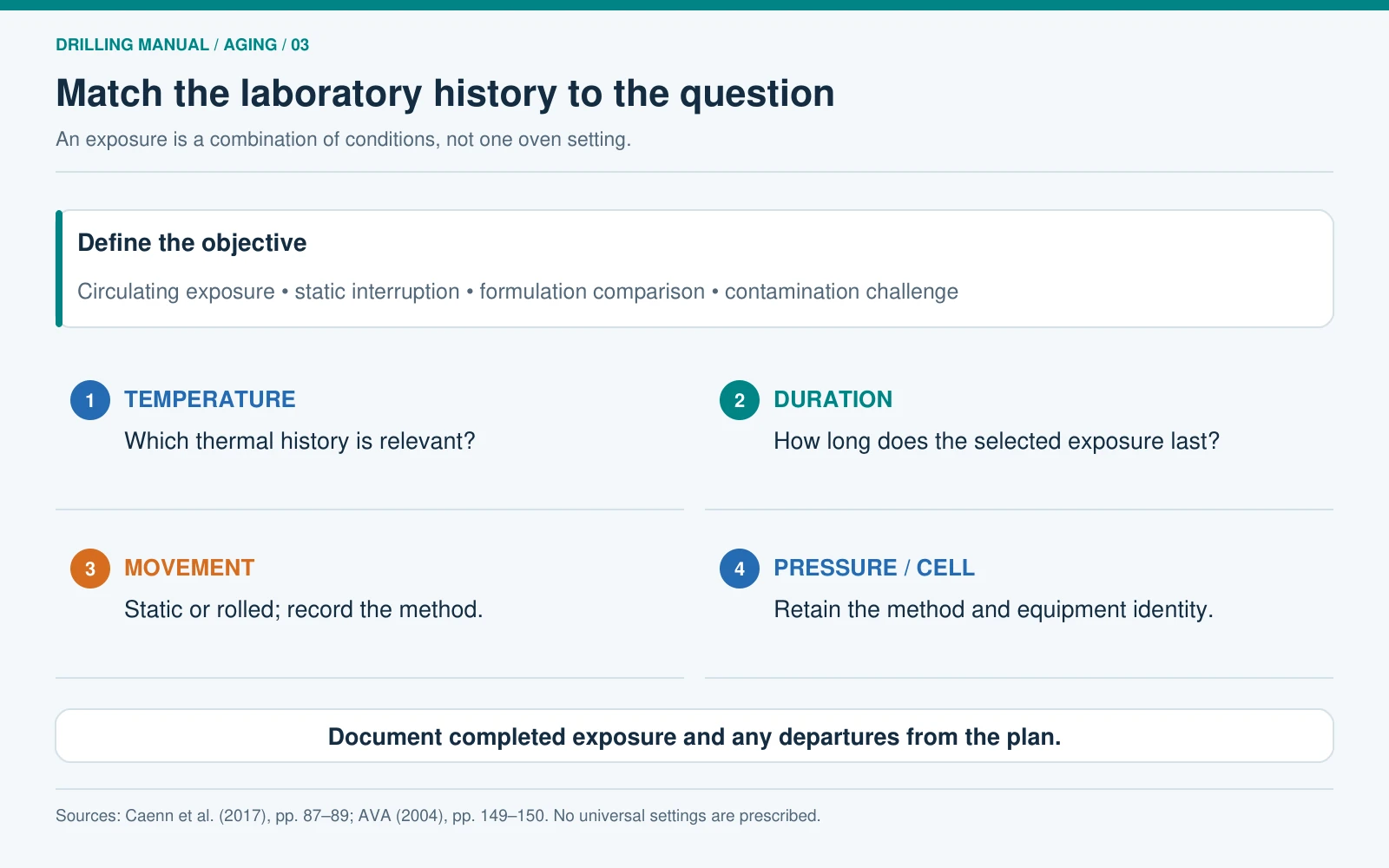
A defensible drilling fluid aging test starts with the intended scenario: circulating exposure, a static interruption, a formulation comparison or a contamination challenge. Temperature and duration belong to that scenario. A hotter test is not automatically a more faithful test, and a longer test does not necessarily reproduce more footage drilled.
Caenn describes a historical rolling approach using at least 16 hours near the average circulating temperature. That is a described method, not proof that every fluid, well or investigation requires the same schedule. Static exposure is described at the temperature of interest for the required interval. [1, pp. 88–89] Report the selected method and why its conditions answer the question.
AVA cautions that metal laboratory cells can equilibrate quickly. Holding a sample continuously at bottomhole temperature may give it more sustained high-temperature exposure than circulating fluid experiences. The manual also identifies laboratory oxygen, cell materials and pressure as potential influences on polymer behavior. [2, pp. 149–150] These are reasons to describe the experiment carefully, rather than adjust the interpretation after seeing an unexpected result.
Cell pressure, fluid compatibility, fill volume and equipment limits belong in the approved laboratory method. An illustrative temperature or duration in this article is not an operating specification for a pressure vessel.
Separate aging temperature from measurement temperature
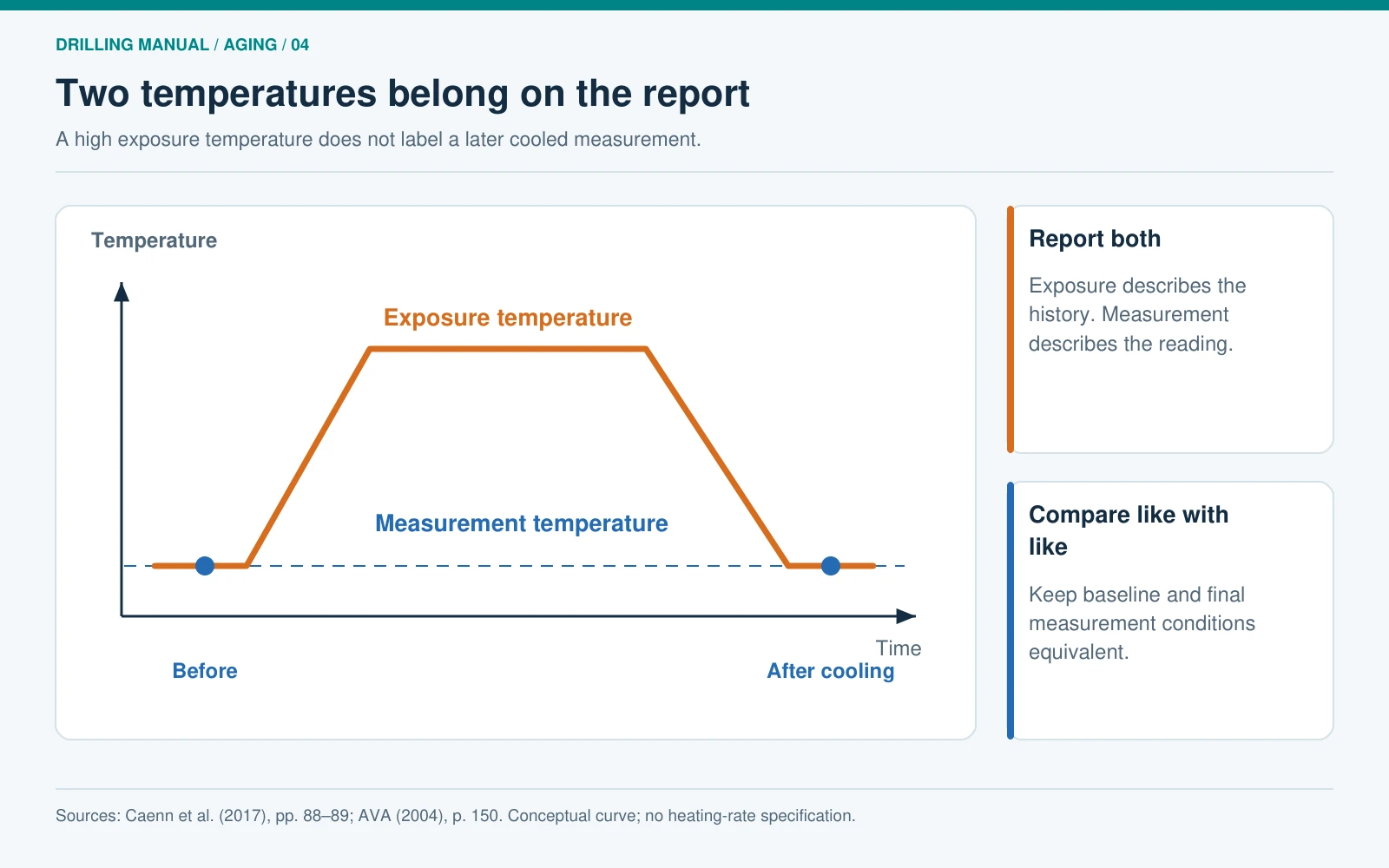
The exposure temperature tells the reader what thermal history the fluid received. The measurement temperature tells the reader the conditions of a particular property reading. A drilling fluid aging test can expose a sample at high temperature and then measure it after cooling. Those results describe the cooled, aged material.
Caenn explicitly describes cooling rolled samples before comparing rheology and filtration with their pre-aging values. AVA separately warns that measurements made under laboratory conditions may differ from properties at actual downhole temperature and pressure. [1, pp. 88–89] [2, p. 150]
For a fair comparison, write both temperatures and make the pre- and post-aging measurement procedures equivalent. If a baseline is measured at 25°C and the final reading at 60°C, the numerical difference combines thermal conditioning with a changed measurement condition. It cannot be assigned entirely to aging. Likewise, a cooled reading is not a direct viscosity measurement at the exposure temperature. Where downhole rheology is the question, obtain measurements under the relevant pressure and temperature separately.
Build a baseline that can be compared
Identify the fluid, sample date, preparation history and any deliberate treatment. Split comparable portions from the same starting material when assessing alternative aging routes. Keep an unaged baseline and, where treatment effects are being investigated, a reference fluid handled by the same method. This comparison design follows the controlled-evaluation principle in Caenn. [1, p. 87]
Select endpoints before exposure. Rheology and filtration are central to the described aging evaluation, but the question may also require observations of separation, settled material or a static gel. Do not choose only the property that improved. Caenn notes that long-term aging of nonaqueous fluids may be needed where weight-material settling is a concern. [1, pp. 87–89]
For each numerical property, retain the method, units, measurement temperature and conditioning sequence. For filtration, that includes the test medium and test conditions specified by the chosen procedure. For rheology, retain individual readings as well as derived summaries. The water-based mud testing index links to the separate routine measurement guides. Aging should add a traceable history to those measurements.
Preserve the order of observations after exposure
The observation order is part of the drilling fluid aging test. First complete the equipment-specific cooling and pressure-release procedure. Then examine and document the recovered sample in the order required by the test objective. A photograph and a written description can preserve features that subsequent mixing removes.
- Record the exposure actually completed, including any interruption or departure from the intended conditions.
- For a static investigation, preserve the undisturbed sample for the designated assessment before remixing it.
- Document visible layers, settled material and the consistency of the sample without silently combining unlike regions.
- Apply the specified reconditioning procedure to the portion intended for routine post-aging measurements.
- Measure at the declared conditions and compare with the equivalent baseline.
This reporting sequence distinguishes the undisturbed measurement described by Caenn from the reconditioned rheology and filtration comparison. [1, pp. 88–89] If the sample was already stirred, record that limitation instead of inventing an undisturbed result. Where both questions matter, allocate separate portions or cells in advance so that one assessment does not consume the evidence needed by another.
Worked example: one property can conceal another
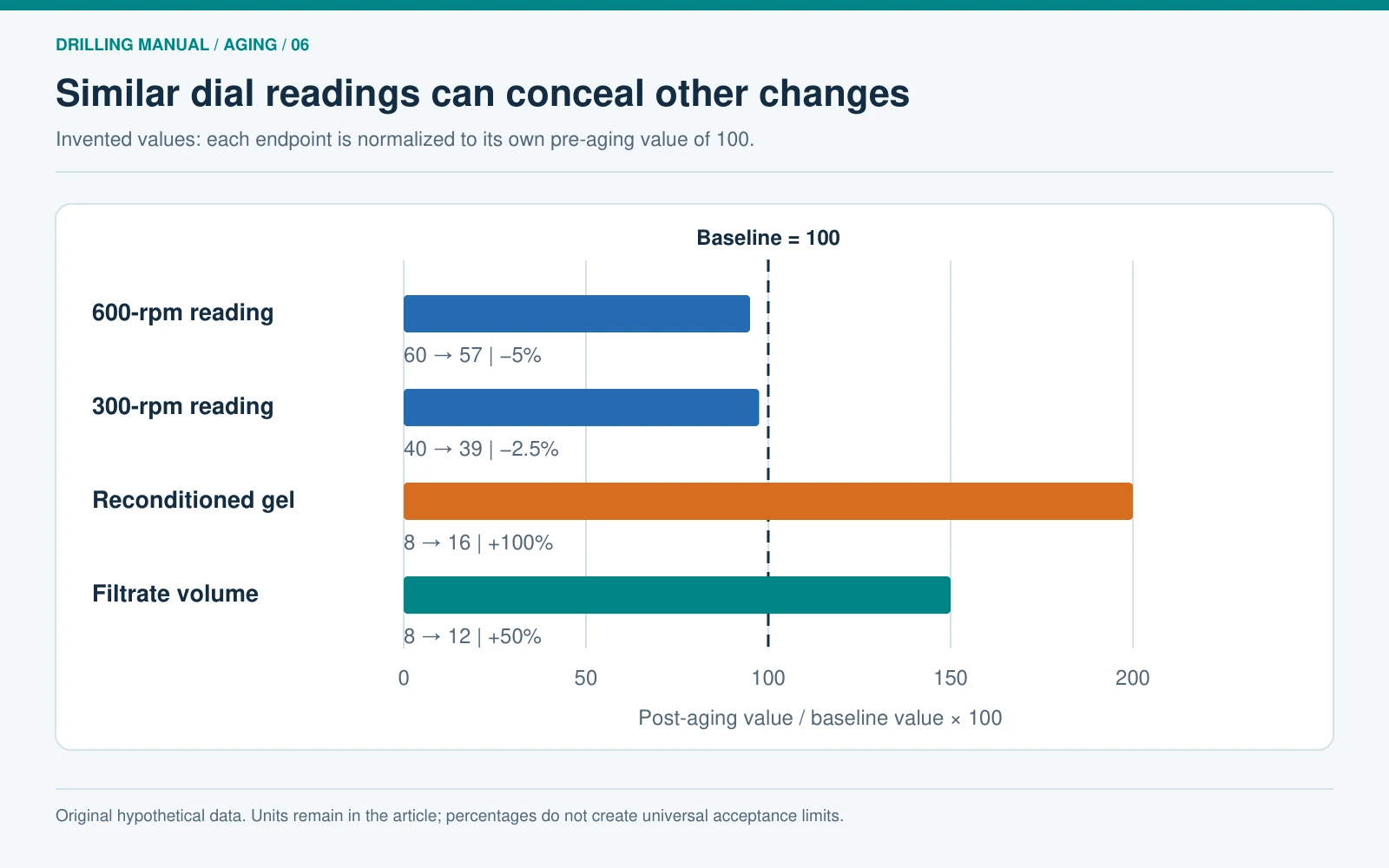
Consider an invented drilling fluid aging test used only to illustrate interpretation. A laboratory compares a baseline with the same formulation after a hypothetical 16-hour rolled exposure at 120°C. Rheology and the specified filtration measurement are both made at 25°C, using the same methods before and after exposure. These settings are example labels, not a recommended procedure.
| Endpoint | Before aging | After aging | Arithmetic change |
|---|---|---|---|
| 600-rpm dial reading | 60 divisions | 57 divisions | −5% |
| 300-rpm dial reading | 40 divisions | 39 divisions | −2.5% |
| 10-minute gel after specified reconditioning | 8 lbf/100 ft² | 16 lbf/100 ft² | +100% |
| Filtrate under the same specified method | 8 mL | 12 mL | +50% |
The percentage calculation is 100 × (after − before) / before. For filtrate, 100 × (12 − 8) / 8 = 50%. The high-speed dial readings changed modestly, while the reported gel doubled and filtrate increased. A statement that “viscosity was almost unchanged” would leave two relevant results unexplained.
The comparison does not identify which chemical component changed, establish an acceptance limit or predict a pump-start pressure. The gel is explicitly a post-reconditioning 10-minute result, not an undisturbed 16-hour gel. Repeatability and the application-specific requirements still determine whether the observed differences are actionable. The example applies Caenn’s requirement to compare multiple properties after aging. [1, pp. 88–89]
Interpret the pattern before proposing a treatment
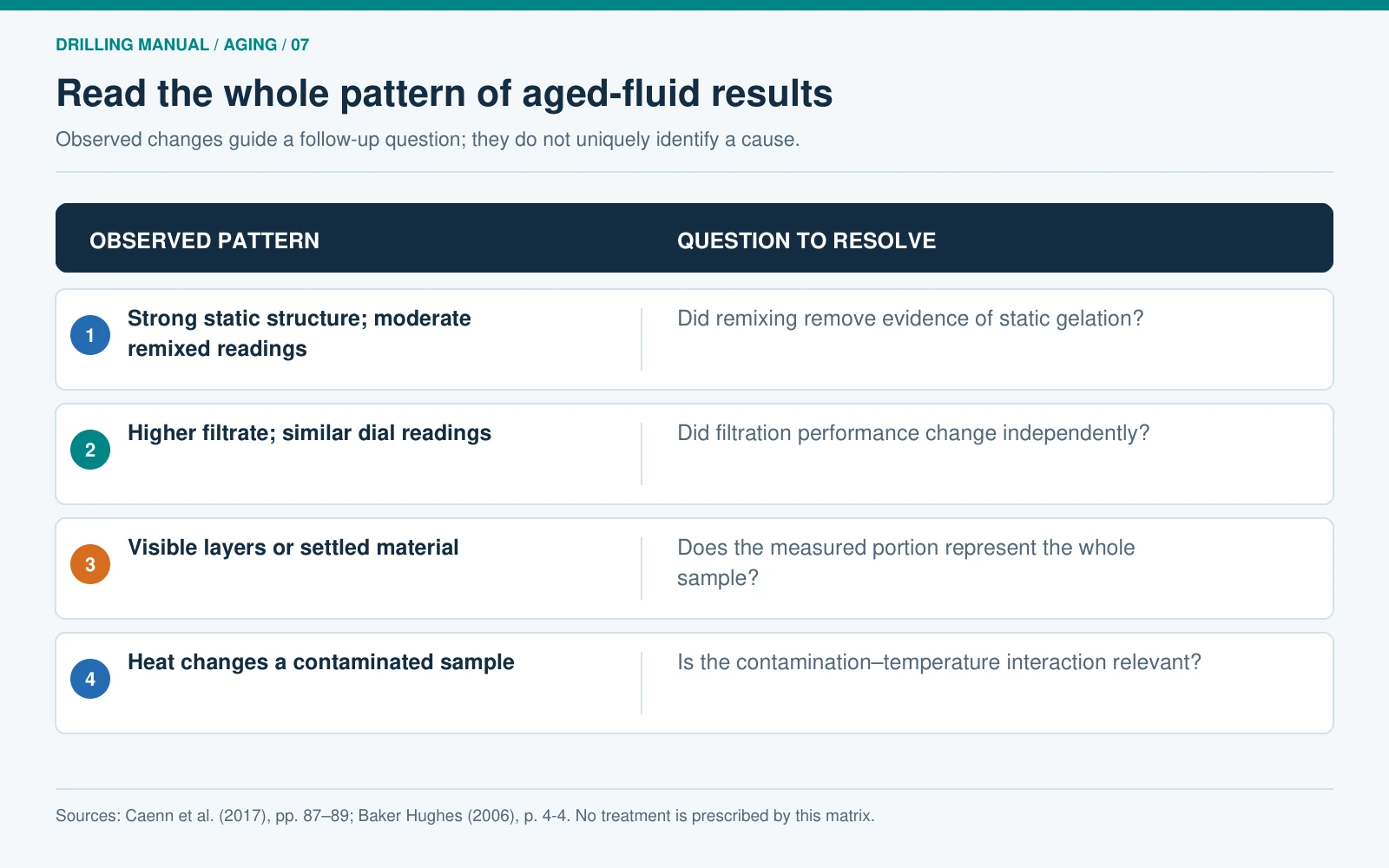
A drilling fluid aging test is most useful when several observations tell a consistent story. Increased gelation deserves different follow-up from loss of suspension or deterioration in filtration control. A large change in one endpoint with little change in another is not contradictory; those measurements describe different aspects of the fluid.
| Observed pattern | Question to resolve |
|---|---|
| Undisturbed structure is strong, but remixed readings are moderate | Did the preparation sequence erase a static-aging concern? |
| Filtrate increases while dial readings remain similar | Has filtration performance changed independently of the chosen rheology summary? |
| Layers or settled material appear | Does the sampled portion represent the full aged fluid? |
| A contaminated sample behaves differently only after heating | Is the contamination–temperature interaction relevant to the intended exposure? |
The Baker Hughes manual discusses high-temperature solidification in its cement-contamination chapter and recommends thermal laboratory evaluation to support wellsite testing. It identifies hot rolling and static aging as useful in pilot assessment. [3, p. 4-4] The separate cement-contamination article covers that operational topic. Here the important point is to compare the actual contaminated and treated candidates under the same aging history, rather than select a treatment from an ambient result alone.
Report the result with its limits
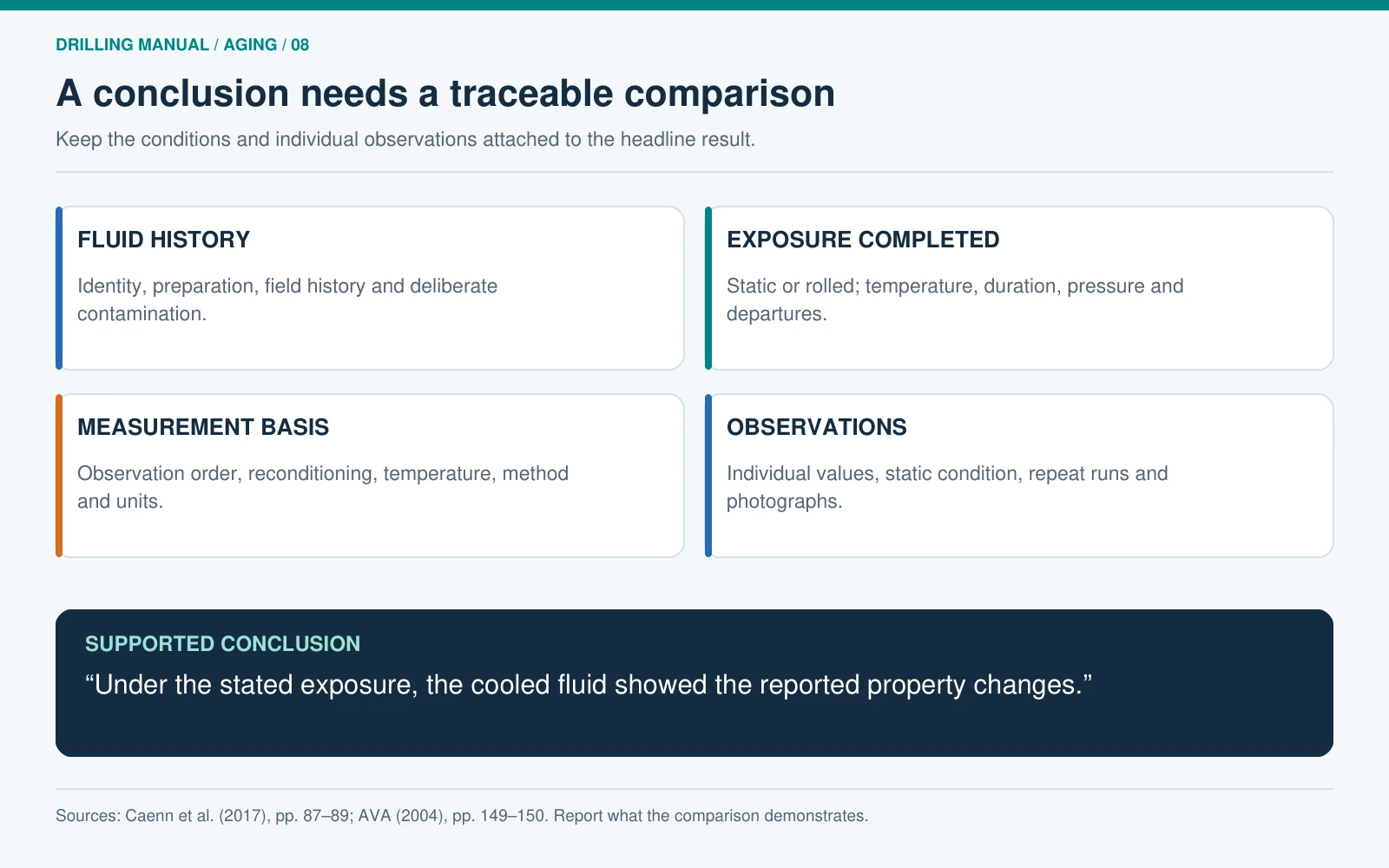
A useful drilling fluid aging test report allows another reader to reconstruct the comparison. Include fluid identity, preparation and contamination history, conditioning mode, exposure temperature and duration, cell and pressure information, observation order, reconditioning method, measurement conditions, individual results and repeat runs. Explain any difference between intended and completed exposure.
Write a conclusion that matches the evidence. For the invented example, a defensible conclusion is: “After the stated rolled exposure, the cooled sample retained similar high-speed readings but showed higher reconditioned gel and filtrate values.” It would be premature to describe the mud as stable at every downhole condition or to identify irreversible polymer damage from those values alone.
AVA’s discussion of oxygen, pressure and laboratory heat history explains why field extrapolation needs judgment. [2, pp. 149–150] When comparing water-based fluid systems, use the same relevant evaluation basis and retain the actual observations. A useful qualification decision joins the aging evidence to the intended circulation, static exposure and required fluid functions.
Frequently asked questions about fluid aging
Is hot rolling the same as static aging?
No. Rolling introduces movement during exposure; static aging leaves the sample undisturbed. The distinction matters particularly when the question concerns a structure formed during a static interval. Caenn describes separate routes and an undisturbed-strength measurement for the static sample. [1, pp. 88–89] A rolled result cannot automatically replace that evidence, even if temperature and duration are identical.
Must every drilling fluid aging test last 16 hours?
No single duration answers every investigation. Caenn describes a rolling method with at least 16 hours, while static testing uses the required duration at the temperature of interest. [1, pp. 88–89] State the method being followed and relate the schedule to the intended exposure. Do not describe an arbitrary shorter or longer test as equivalent merely because the oven temperature matches.
Does a cooled viscosity reading describe viscosity downhole?
It describes the fluid at the temperature, pressure and conditioning state of that measurement. Thermal aging may have altered the material, but cooling changes the measurement conditions. AVA explicitly distinguishes ordinary laboratory readings from properties at realistic downhole pressure and temperature. [2, p. 150] Direct measurements at relevant conditions are needed when the decision depends on the fluid’s behavior while hot.
Can a normal result after remixing rule out static gelation?
No. Remixing changes the sample’s structure. A subsequent routine gel test begins a new conditioning and rest sequence. Caenn’s static-aging discussion preserves the undisturbed sample for the relevant strength assessment. [1, p. 89] If that observation was missed, the report should say so. The reconditioned reading remains useful, but it answers a different question.
Why can two laboratories obtain different aging results?
First compare sample history, exposure, pressure, cell materials, oxygen exposure and measurement procedures. AVA identifies several of these differences as influences on laboratory polymer evaluation. [2, pp. 149–150] Before assigning the disagreement to product quality, check that both laboratories tested comparable materials and reported the same endpoint. Raw readings and complete method records make that review possible.
What is the main limit of a drilling fluid aging test?
It evaluates a defined sample after a defined history. It does not independently reproduce every downhole temperature cycle, shear condition, contamination event or solids distribution. Its strength is a controlled comparison tied to a clear question. Caenn and AVA both emphasize the conditions and limitations of laboratory evaluation. [1, pp. 87–89] [2, pp. 149–150]
References
- Caenn, R.; Darley, H. C. H.; and Gray, G. R. Composition and Properties of Drilling and Completion Fluids. Seventh edition. Gulf Professional Publishing / Elsevier, 2017. ISBN 978-0-12-804751-4. Printed pages: 87–89. PDF pages in the edition consulted: 92–94.
- AVA Drilling Fluids & Services. Drilling Fluids Manual. Version 1, November 2004. Printed pages: 149–150. PDF pages in the edition consulted: 151–152.
- Baker Hughes Drilling Fluids. Reference Manual. Revised 2006. Printed pages: 4-4. PDF pages in the edition consulted: 193.