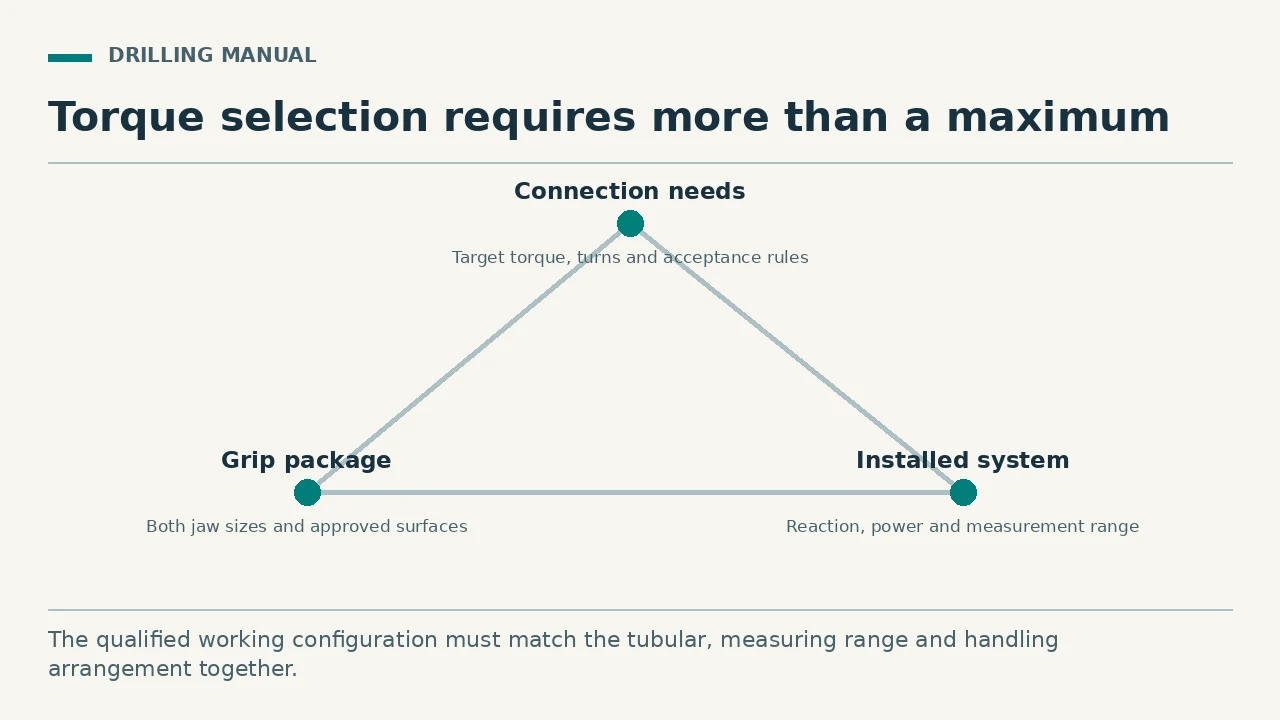
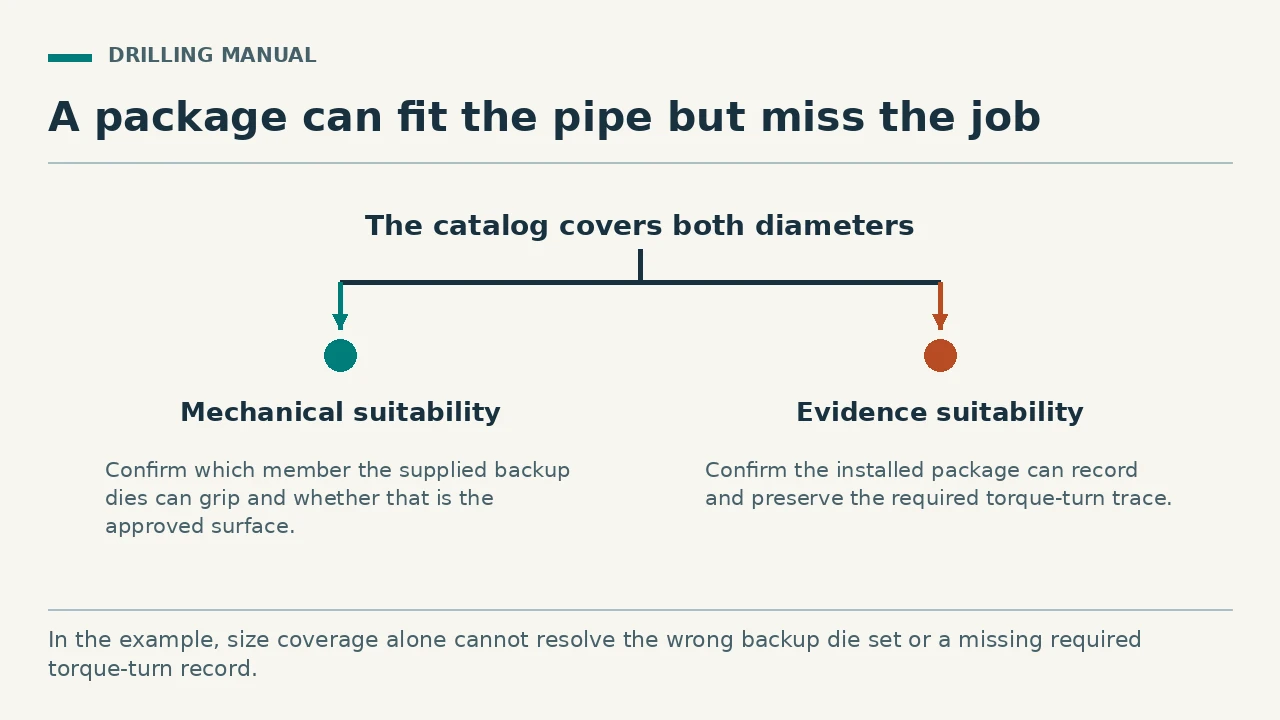
A power tong grips and turns a tubular to make or break a threaded connection. The rental description might say “casing tong” or “tubing tong,” but that label alone does not establish compatibility. A defensible selection ties together the actual gripping diameters, surface finish, torque window, speed, backup arrangement and connection-record requirement. The backup and measurement package can eliminate a tong that otherwise looks large enough.
Start with the connection instead of the power unit
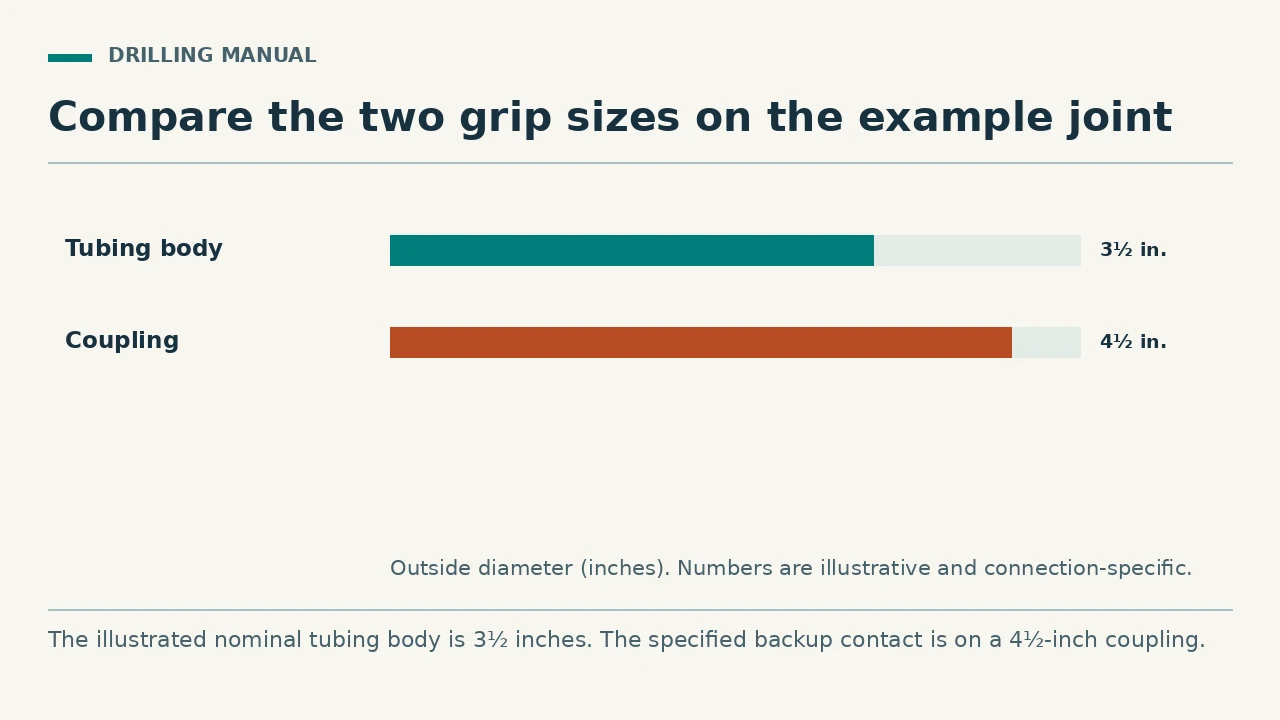
For drillpipe, the grip commonly acts on a tool joint with appreciable wall thickness and a designated gripping surface. Tubing and casing may present a different OD and wall thickness at the coupling and pipe body. On premium or corrosion-resistant tubulars, the connection supplier may restrict die marks and allowable gripping arrangements. Record the exact product, wall, material and approved grip zones. One nominal size can appear with more than one coupling OD and different handling requirements.
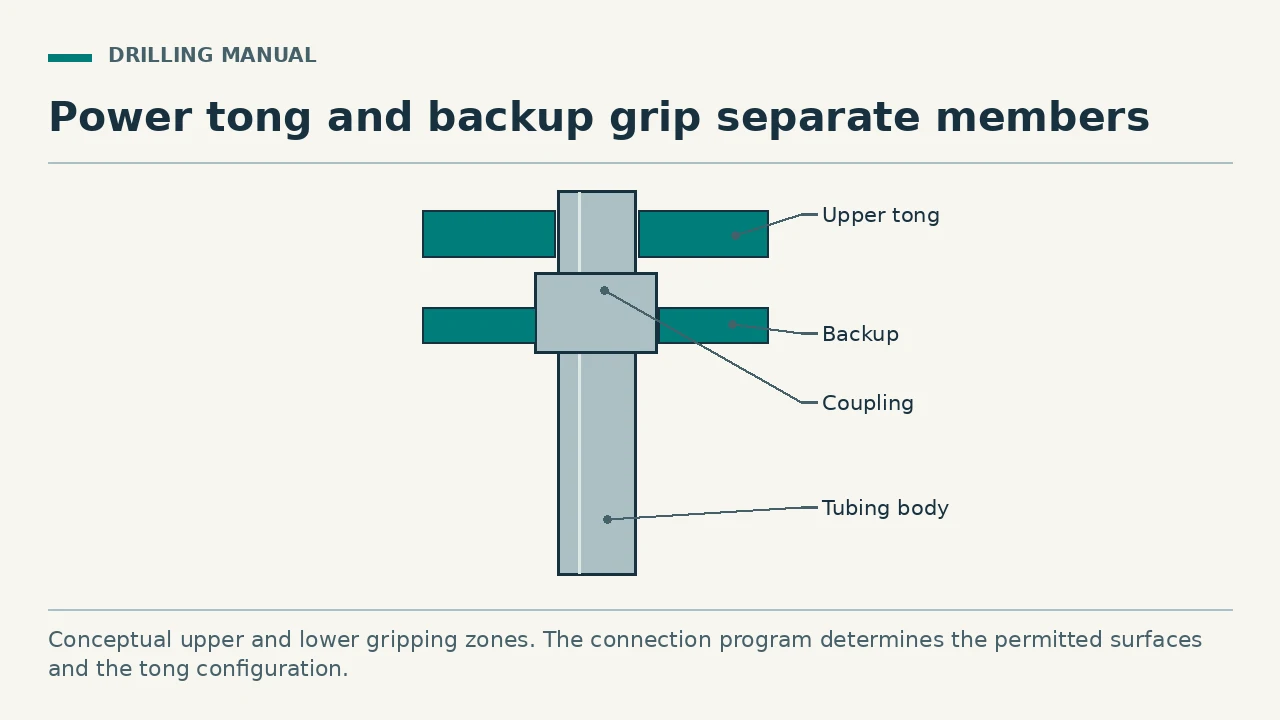
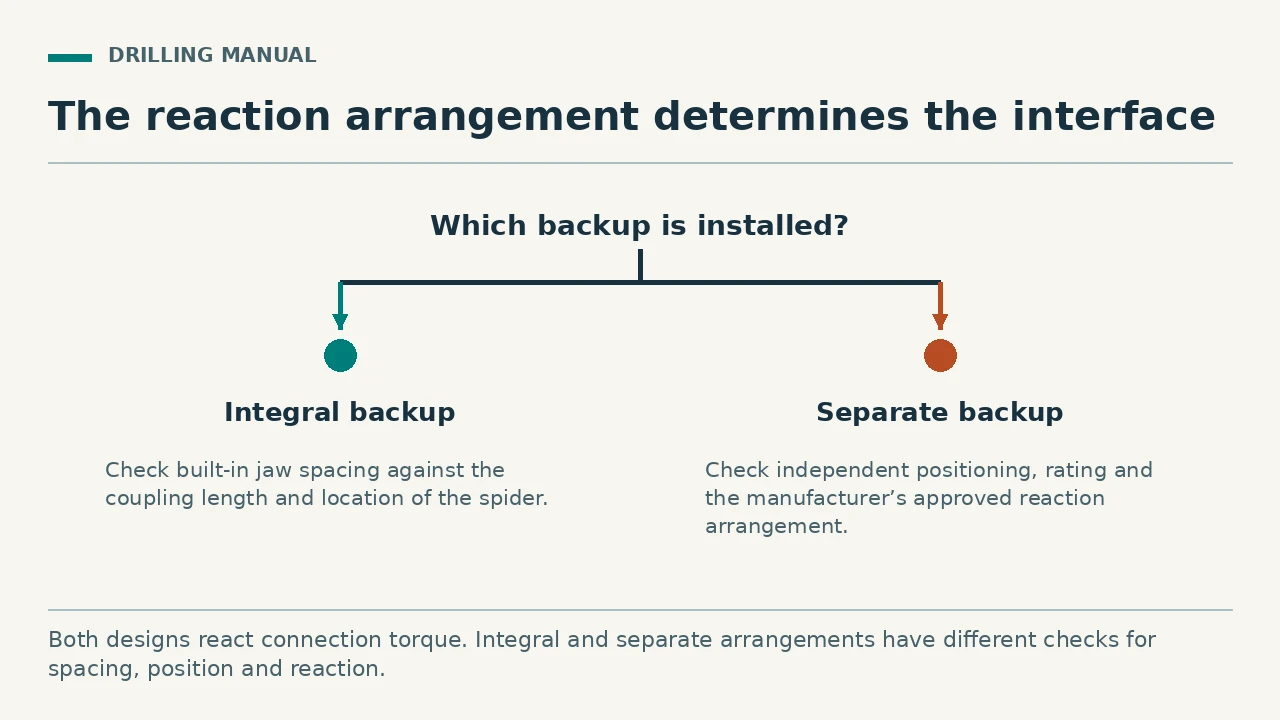
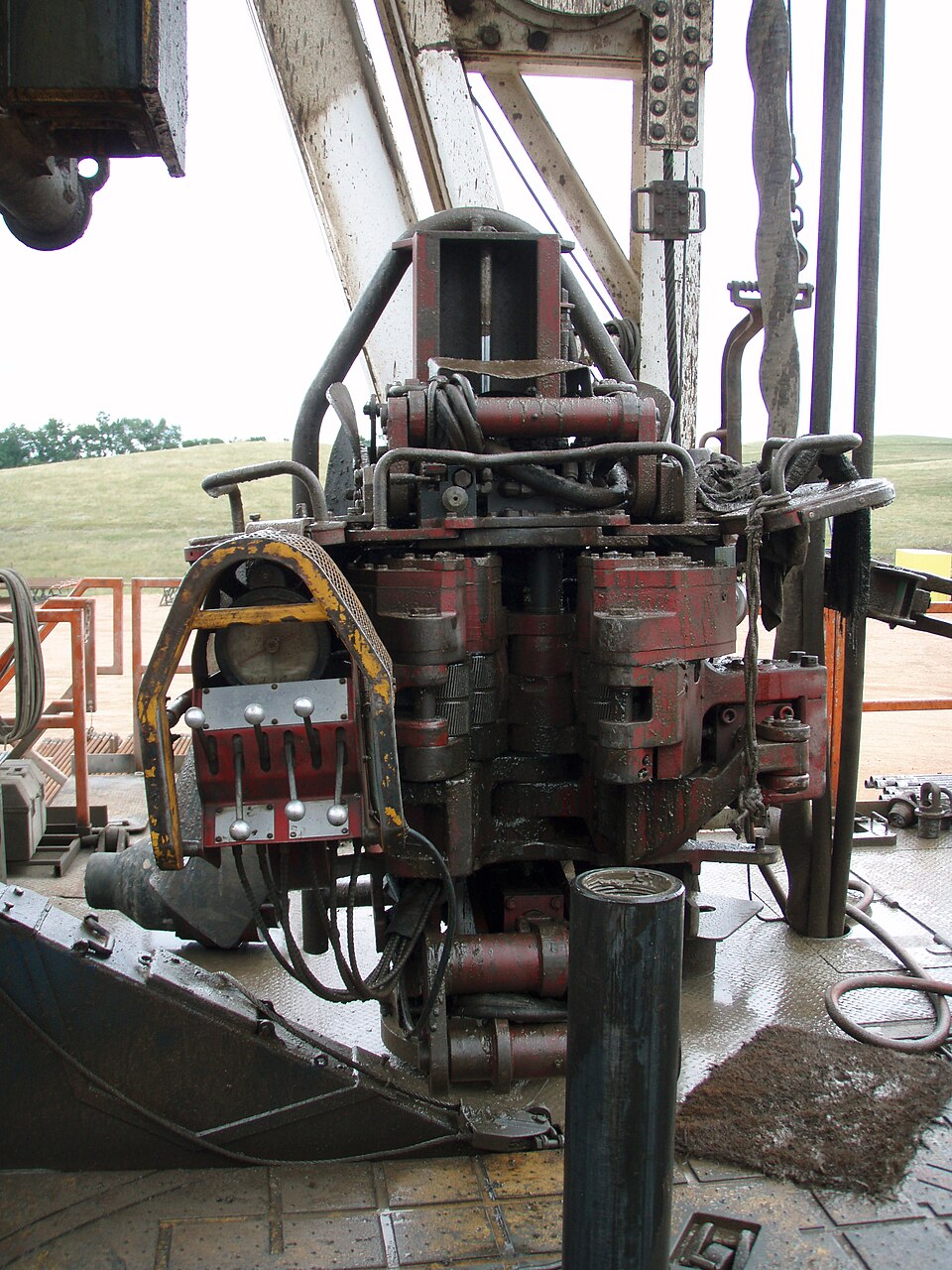
The tong applies rotation. Its backup reacts the torque on the opposite member. Depending on the package, a separate backup is suspended and positioned independently, or an integral backup forms part of the assembly. Either arrangement must fit the actual space below the connection. Include nearby upsets, protectors, clamps, control-line equipment and the distance to the spider or slips in the review.
Compare the available configurations
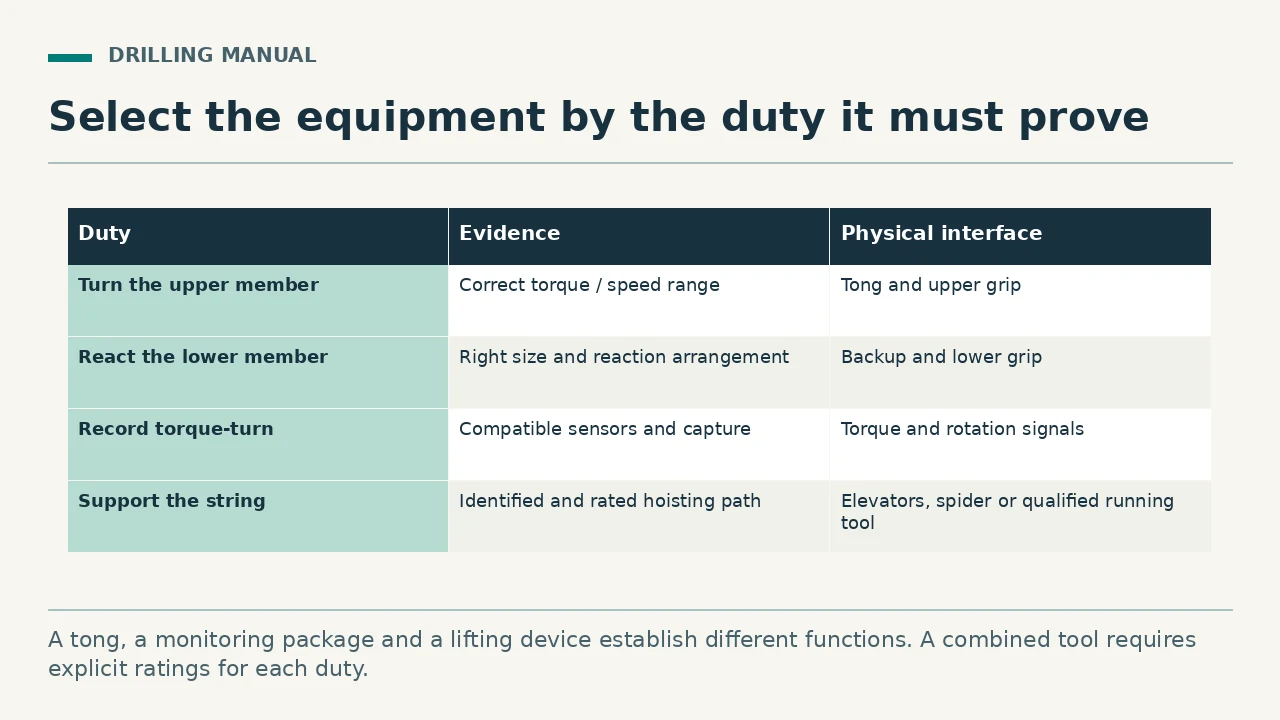
An open-throat tong can approach the tubular from the side when its door and opening align. Other designs and specialist casing-running equipment engage the tubular differently. A top-drive casing-running tool may combine rotation, lifting and circulation through a different load path. A tong model that grips and turns pipe is not automatically a hoisting tool. Define how the string stays supported during the entire stage.
Hydraulic supply compatibility includes both pressure and flow at the duty required. Torque and speed capabilities depend on model and gear. A high maximum torque says little about the ability to control a relatively low required torque with adequate resolution. Ask for the operating range, indicated torque range and usable speeds for the actual gear and jaw set. Check that the suspension can follow the axial movement as the pin advances. Review permissible jaw force separately from turning torque. The IADC manual treats resistance to crushing as a separate selection limit. A tong can deliver the required torque and still damage the pipe if the selected dies need more clamping force than that tubular allows.
The casing connection guide distinguishes thread families. A premium connection data sheet illustrates why the connection-specific makeup requirements travel with the tong request.
Example of a seemingly correct tong that still fails selection
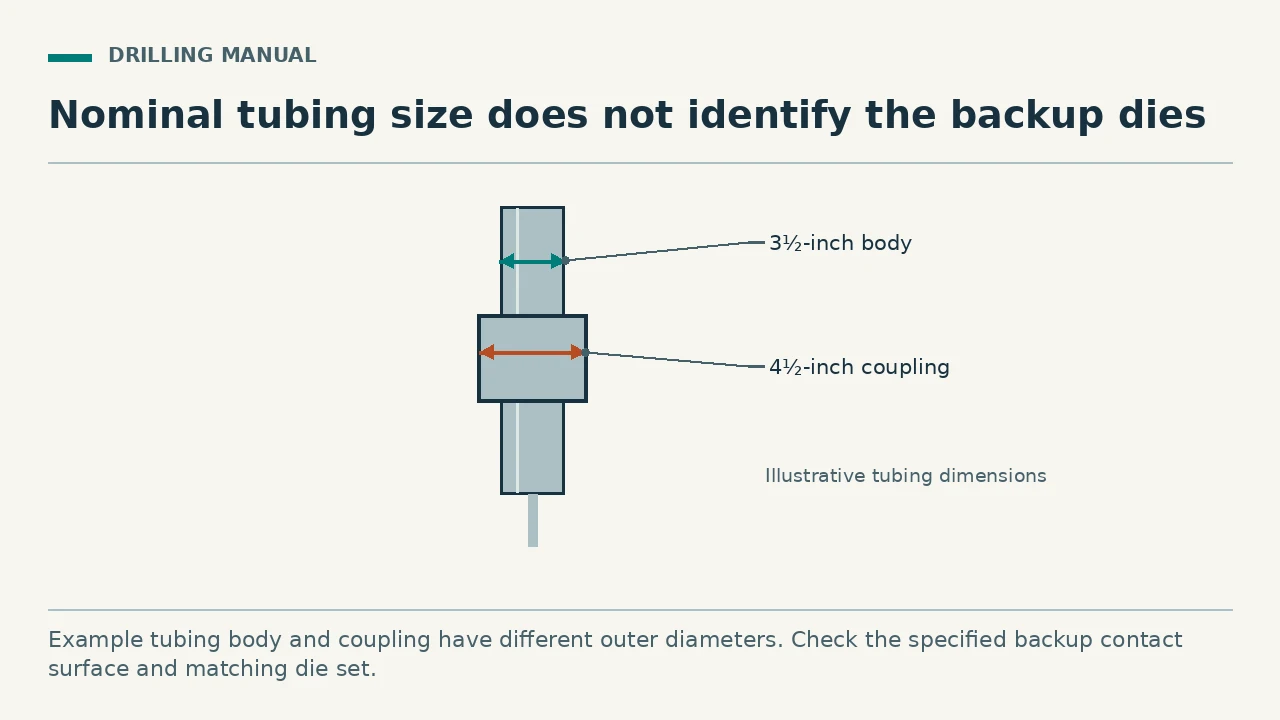
Consider a hypothetical tubing run with a 3½-inch body, a 4½-inch coupling and a requirement for a saved torque-turn graph. Rental package A lists an OD range covering both sizes and adequate maximum torque. Its supplied backup dies fit the pipe body, but the running program calls for backup on the coupling. The quote also lists a peak torque indicator without a turn sensor. Two separate acceptance requirements remain unmet even though the tong horsepower and maximum torque seem ample.
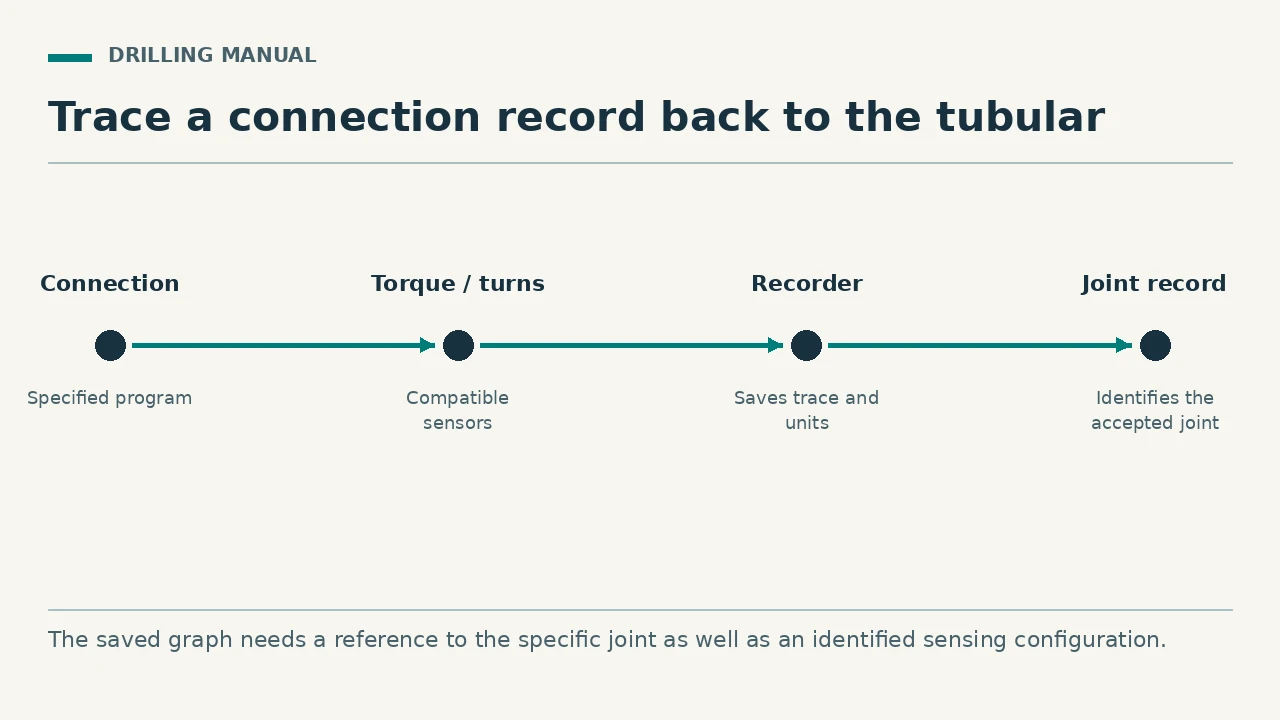
Package B includes the specified backup jaw set and a torque-turn package. That makes it a candidate. Verify that the assembly can grip the approved section and accept the vertical movement during make-up, that the sensor ranges and calibration cover the job, and that connection identity follows the downloaded graph. A curve without the joint identification will be difficult to use when tracing a disputed connection.

Power tong components and their functions
| Component | Function in the connection |
|---|---|
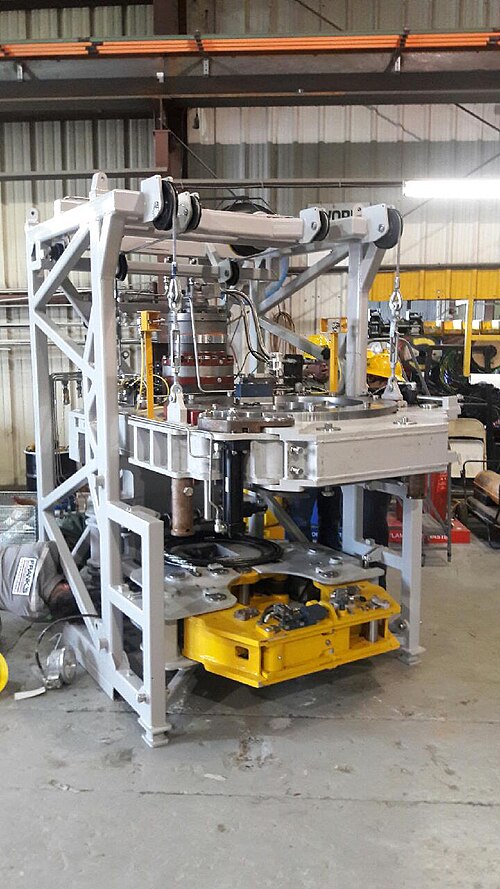
| Hydraulic motor, gearbox and ring gear | The motor supplies rotation. The selected gear sets the torque and speed range. The ring gear drives the upper jaws around the pipe. |
| Cage plates, brake bands, jaws and dies | The cage plates carry the jaws. Brake-band drag lets the jaws cam inward so the dies grip the designated surface and transmit torque. |
| Backup and its dies | Grip the other member of the connection and react the applied torque. Check the OD at this grip separately from the upper grip. |
| Door, latch and rotation interlock | The door admits pipe through the throat. The latch secures the door. The interlock inhibits rotation when the door is open. |
| Suspension and compensation | Support the tong assembly and allow vertical movement as the connection advances. The slips or other designated equipment carry the tubular string. |
| Load cell, indicator and optional turn encoder | The cell senses reaction load, the matched indicator displays torque, and the encoder supplies rotation data for a torque-turn record. |
Operating limits, working hours and preventive maintenance
For the McCoy 80-1040-21, the sliding-head tong jaws cover 4.5–10 in. At 2,500 psi the manual estimates 6,000 ft·lbf in high gear and 40,000 ft·lbf in low gear. A connection needing 8,000 ft·lbf would exceed that high-gear figure even though it falls within the tong’s overall rating. The tubular supplier’s approved make-up window and grip restrictions still govern the joint.
McCoy bases its maintenance schedule on 10 operating hours per day at normal temperature. This figure describes the use assumed when setting inspection intervals. It does not establish a ten-hour shutdown point or a total service life. Log actual tong hours and high-load service so the maintenance supervisor can adjust the schedule for the duty.
| Service trigger on this model | Preventive maintenance |
|---|---|
| Start of each shift and before storage | Lubricate the points listed in §5.5, including cam followers, idler gears and jaw slots. Before each job, verify the door interlock by the prescribed functional test. |
| Before each use and at least daily during steady operation | Inspect jaw rollers, dies, brake linings, lifting points and hoses. Verify jaw engagement during the functional test. |
| Monthly in normal service | Inspect all jaws used since the last monthly check, examine structural welds and fasteners, and check full engagement of the door latch. |
| Gear damage or metal chips found during inspection | Withdraw the tong for overhaul before another connection. For hands-on maintenance, isolate hydraulic power and relieve stored pressure by the manufacturer’s procedure. |
The component drawings, gear ratings and inspection checklists are in McCoy technical manual TM12028, §§2.1–2.2, 4.0.2, 5.2, 5.5 and 5.8–5.9.
Ask what the tender price includes
Get a component list for the tong, backup, jaws, dies, power source, compensation, suspension and monitoring equipment. Request the manufacturer ratings in the relevant modes. Note who supplies the torque program, who verifies setup and who accepts the connection record. A missing die set is easier to correct at the yard than after the first casing joint has reached the floor.
Specify what the torque-turn recorder must capture
Two joints can reach the same final torque while their torque-turn traces differ before the peak. For the Tenaris TPN connection, guide GDL49054/1 (June 2025, p. 8) places the expected shoulder point between reference torque and minimum make-up torque. A shoulder above that minimum can still qualify if it remains clearly visible, final torque falls within the specified band, and the graph meets the profile criteria in GDL23353. The TPN guide excludes the delta-turn criterion used for other connections. Copying a graph template from another connection can wrongly reject or accept a joint.
Put the exact connection designation and running-guide revision on the tong request. Confirm the measured rotation belongs to the rotating member relative to the backup, the torque and turn channels share a time reference, and the saved trace can resolve the required feature. Specify how ambiguous shoulder detection or visible jaw slip is recorded and routed for disposition.
Field comparison
| Configuration | Typical distinction | Controlling selection question |
|---|---|---|
| Drillpipe torque wrench or tong | Grips designated tool-joint surfaces | Are both jaw contacts clear of tapers and hardband? |
| Tubing or casing power tong | Different upper and backup grip diameters may apply | Which member does the supplier permit each jaw to grip? |
| Integral backup | Matched upper and lower assembly | Does the spacing suit coupling length and floor clearance? |
| Separate backup | Independent positioning and reaction system | Is the reaction arrangement rated, compatible and demonstrable? |
| Instrumented package | Torque, turns and speed may be recorded | Can the system supply the specified trace against the correct joint ID? |

What to record in the field
| Check or record | Job-specific entry |
|---|---|
| List upper and lower grip diameters, surfaces and restrictions separately. | |
| Enter target and allowed torque range from the connection running program. | |
| Verify jaws, dies, compensation, power and monitoring as a complete package. | |
| Record the remaining physical clearance and who signs the connection record. |
Additional technical figures (5)
Questions from the field
Can a casing tong be used on tubing?
Only when its complete configuration suits the tubing, grip surfaces, force limits and required control range. Nominal OD overlap alone is insufficient.
Do all power tongs record turns?
No. A package may provide a torque indication only. Turn measurement requires compatible sensing and recording equipment.
Is the highest-capacity tong the best choice?
Select for the relevant operating window, tubular protection and measurement resolution. Excess torque capacity does not demonstrate fine control at the job requirement.

Technical references
IADC Drilling Manual (2015), Casing and Tubing. Full manual PDF pages 114–115, figure CT-13 and power tong selection.
Eni Corporate University, Drilling Rigs. Pages 309–311, manual, combined and power tongs.
McCoy Global, Torque Turn System for Power Tongs. Monitored variables and connection record capabilities.