VAM TOP is a premium threaded-and-coupled connection used in casing and tubing strings. Its design combines load-bearing threads, a metal-to-metal seal, and a torque shoulder. The name identifies a connection family; the correct dimensions, performance ratings, and make-up requirements depend on the exact product supplied. See the manufacturer’s VAM TOP overview.
Looking for a VAM TOP data sheet or torque table? Start at VAM Services and choose Connection Data Sheets. Have the connection designation, outside diameter, nominal weight, steel grade, and coating condition available. This guide explains what to check in those documents and how to distinguish standard VAM TOP from HT, HC, and FE variants.
VAM TOP casing and tubing: identify the actual connection
Vallourec’s product overview lists a family range from 2â…œ to 16 inches. That range describes the catalog, not availability or qualification of every combination of size, weight, grade, and option. Record the complete designation from the supplied documentation before selecting technical data. For the purpose of each string in the well, see our guide to casing types.
For a useful identification record, put these fields on one line: connection and suffix → OD → nominal weight or wall thickness → grade/material → coupling option → surface treatment. Keep the traceability reference beside them. A note saying only “7-inch VAM†leaves too much unresolved to select operating values.
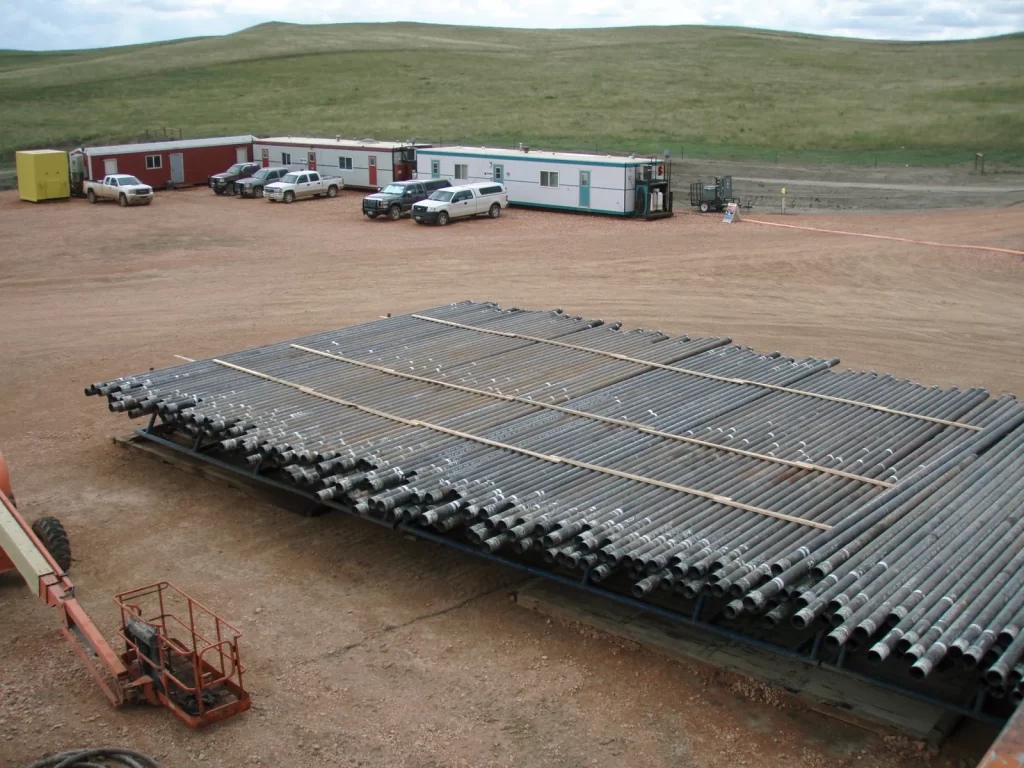

The distinction between casing and tubing also matters when reading qualification claims. VAM USA’s published overview identifies ISO 13679 CAL-IV qualification for its tubing range through 4½-inch OD, while describing different testing and a minimum 60% pipe-body-yield compression rating for standard casing from 5 inches upward. A family headline such as “up to 100%†must therefore be checked against the specific connection data sheet and applicable qualification evidence.
How the threads, seal, and shoulder work
A helpful way to read a premium connection drawing is to separate its mechanical engagement from its sealing surfaces. Rabia’s Well Engineering & Construction, section 6.2, explains metal-to-metal sealing in premium connections and the supporting role of the shoulder. Its illustrated NEW VAM example is background theory, not a VAM TOP inspection drawing.
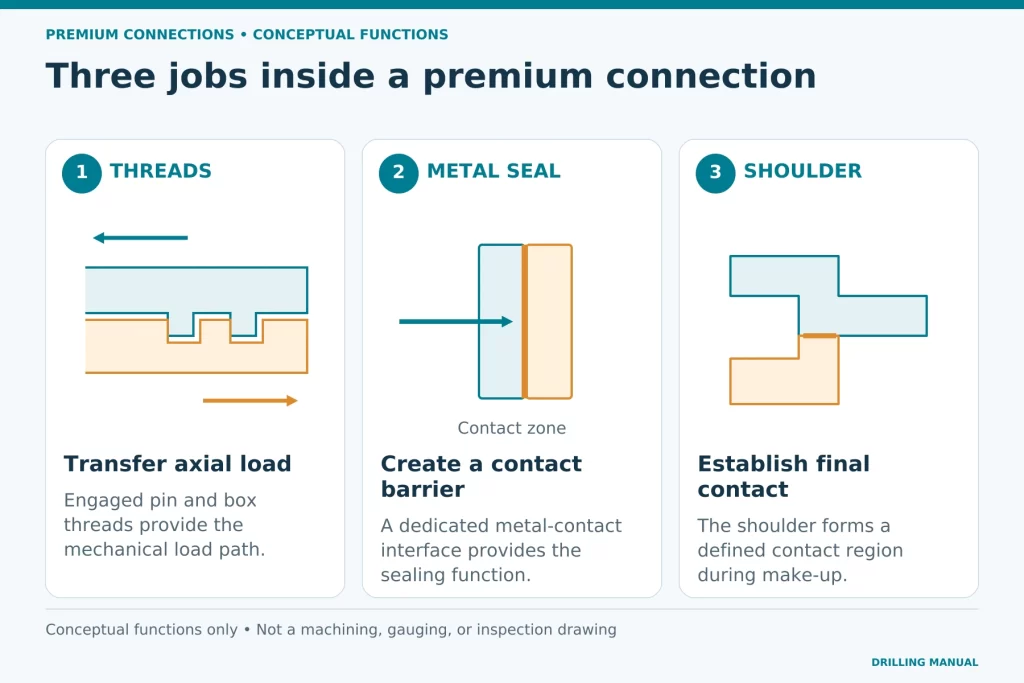
Metal-to-metal seal
The sealing interface is a controlled area of metal contact. Its geometry and condition matter independently of the visible thread condition. A clean-looking thread is therefore not enough to judge the seal. Use the product’s inspection criteria for the actual surfaces and configuration.
Reverse-angle torque shoulder
The shoulder provides a defined contact region at the end of make-up and supports the connection’s mechanical and sealing behavior. Nippon Steel’s VAM TOP HT description identifies the reverse-angle shoulder and the enlarged shoulder used in that high-torque variant. This helps explain why a variant name matters when selecting the running document.
Thread profile
The engaged threads transfer load between the pin and box. Their appearance does not establish interchangeability with another premium connection or with API buttress casing threads. Use the full connection designation; a similar thread shape is insufficient identification.
Coupling
“Threaded and coupled†means the joint uses a separate coupling with internally threaded ends. Coupling dimensions belong in the clearance check, alongside the pipe dimensions. Where a special-clearance or other coupling option is supplied, retain that option in the identification record rather than shortening everything to “VAM TOP.â€
Internal profile and drift
Keep the required through-bore and drift information visible in the job documentation. A drift check uses a specified mandrel to check bore passage; nominal internal diameter alone does not document that check. The VAM Book, December 2023 edition, section 5.4, describes the distinction. When a crossover or mixed connection is involved, ask for the relevant internal dimensions for that assembled combination instead of assuming continuity from the adjacent pipe.
Standard VAM TOP, HT, HC, and FE: what changes?
The suffix points to a design emphasis. It is a starting point for selecting documentation, not a complete performance specification.
| Designation | Manufacturer’s stated emphasis | What to verify for your application |
|---|---|---|
| VAM TOP | Premium casing and tubing connection family | Exact configuration, rated envelope, and applicable qualification |
| VAM TOP HT | Higher torque capability, including applications involving rotation | Approved torque information and the specific running application |
| VAM TOP HC | Greater compression capability | Required compression and combined-load performance |
| VAM TOP FE | Fatigue-enhanced connection for riser applications | Applicable fatigue assessment and riser configuration |
Sources: Vallourec HT/HC overview and VAM TOP FE overview. For HC design details, see Nippon Steel’s HC page.
Do not approve mixed weights, grades, or variants from the family name alone. The VAM Book, December 2023 edition, section 6, explains that matching OD, or even matching OD and weight, does not establish interchangeability. It directs readers to the Mix Torque Calculator. Check the proposed pairing and its resulting performance and make-up requirements through that official route.
How to find and read the correct VAM TOP data sheet
Use the official VAM Services portal for connection data, the VAM Book, and related technical tools. Begin with the product identity, then record the document reference and revision used for the job. Save the matching running instructions with the data sheet so that dimensional information and assembly requirements stay together.
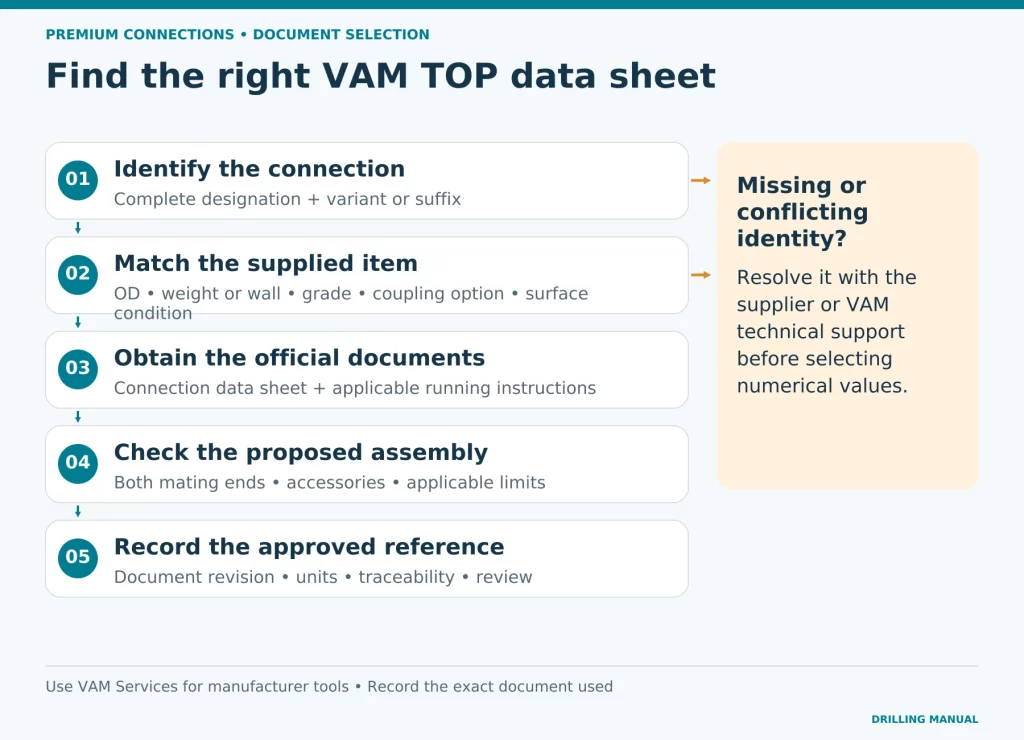
Use this review worksheet when checking a sheet. These are questions to resolve, not replacement acceptance criteria.
One easily confused field is make-up loss: the length taken up when mating ends engage. It affects the effective assembled length and is not the coupling’s overall length. Section 5.5 of the linked VAM Book explains how it enters the tally. Keep the manufacturer’s dimensional definitions with the calculation.
| Document field | Question to resolve |
|---|---|
| Designation and variant | Does the name, including every relevant suffix, match the supplied item? |
| OD, nominal weight, wall, grade | Have I selected the intended combination and unit system? |
| Coupling dimensions and bore information | Does this document cover the clearance and passage requirements being checked? |
| Make-up loss and length fields | Which stated dimension belongs in the tally calculation, and what is its definition? |
| Connection ratings | What load case, assumptions, and restrictions accompany each rating? |
| Running requirements | Which torque, compound or coating, and acceptance instructions apply? |
| Document reference | Can another person retrieve the same revision and verify the selection? |
Using a data sheet in an Excel register
An Excel register is useful for tracking verified documents. Include the equipment identity, document title, revision, source link, units, and reviewer beside any transcribed value. Keep the source document attached or linked. A spreadsheet stripped of its source and configuration becomes difficult to audit, even when the arithmetic is correct.
For example, if two sheets share an OD but show different weights or surface conditions, treat them as separate records until the appropriate technical authority resolves their applicability. Do not average the values or choose the row that looks closest. This document-control approach is also useful when reviewing casing specifications.
VAM TOP make-up torque: select the table, then assess the joint
There is no single torque value for the VAM TOP family. Manufacturer tables organize values by configuration; for example, the Nippon Steel-hosted VAM TOP HC table distinguishes size, nominal weight, wall thickness, and strength group. That published file is useful for understanding the table structure. Obtain the applicable current data for the supplied connection before using numerical values.
Final torque is only one part of make-up acceptance. The manufacturer’s VAM TOP running poster also addresses shoulder torque, turn-related criteria, and trace shape. Evaluate those against the applicable running instructions. A final value inside a permitted range does not, by itself, resolve an abnormal trace.
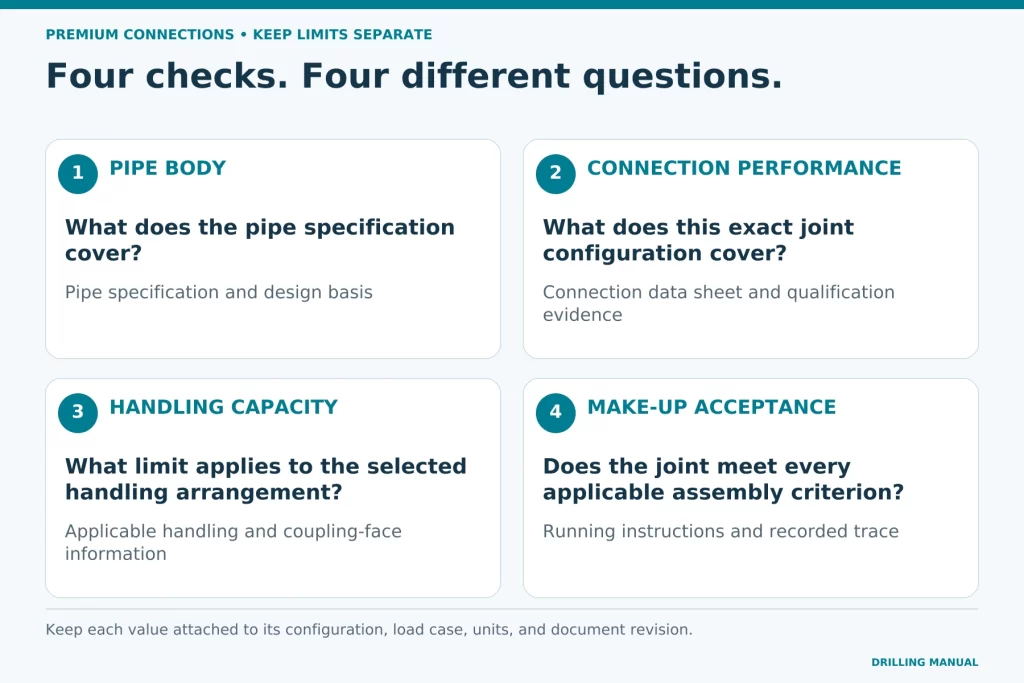
What belongs beside a torque value in Excel?
Record its units, exact connection configuration, source revision, surface condition, applicable compound information, and the accompanying acceptance-document reference. Label minimum, target or optimum, and maximum fields exactly as the source defines them. Avoid creating a workbook that presents an isolated “VAM TOP torque†cell without its selection conditions.
Keep handling checks separate as well. The official running poster specifically distinguishes coupling-face load capacity for side-door elevators from connection capacity. Check the relevant handling information for the selected equipment; do not carry a connection-strength number into a different calculation merely because both are expressed as force.
Thread compound, CLEANWELL, and preparation
CLEANWELL is a factory-applied coating system offered for specified products. VAM USA states that specific running rules and torque tables apply. Identify whether the actual connection is conventionally doped or supplied with a particular CLEANWELL system before selecting its instructions.
For a conventionally doped connection, confirm the approved compound, specified quantity, application locations, and any applicable friction-factor instruction in the manufacturer’s documents. A fixed pin/box percentage copied from a general article is inadequate. The same applies to borrowing a compound quantity from a different size or coating condition. Our thread-compound guide provides background terminology.

For the pre-job discussion, bring the selected documents, pipe identification, coating or compound details, inspection requirements, and acceptance criteria into the same review. Connect that review to the wider casing-running procedure or liner-running plan. When a marking, document, or proposed mating component disagrees, resolve the discrepancy with the supplier or VAM technical support before adopting a value.
Technical background: H. Rabia, Well Engineering & Construction, “Casing Properties,†section 6.2, printed pages 142–144. Manufacturer resources linked above were checked in November 2026. This independent guide explains document selection and connection concepts; the applicable manufacturer documentation and approved job instructions govern the actual assembly.