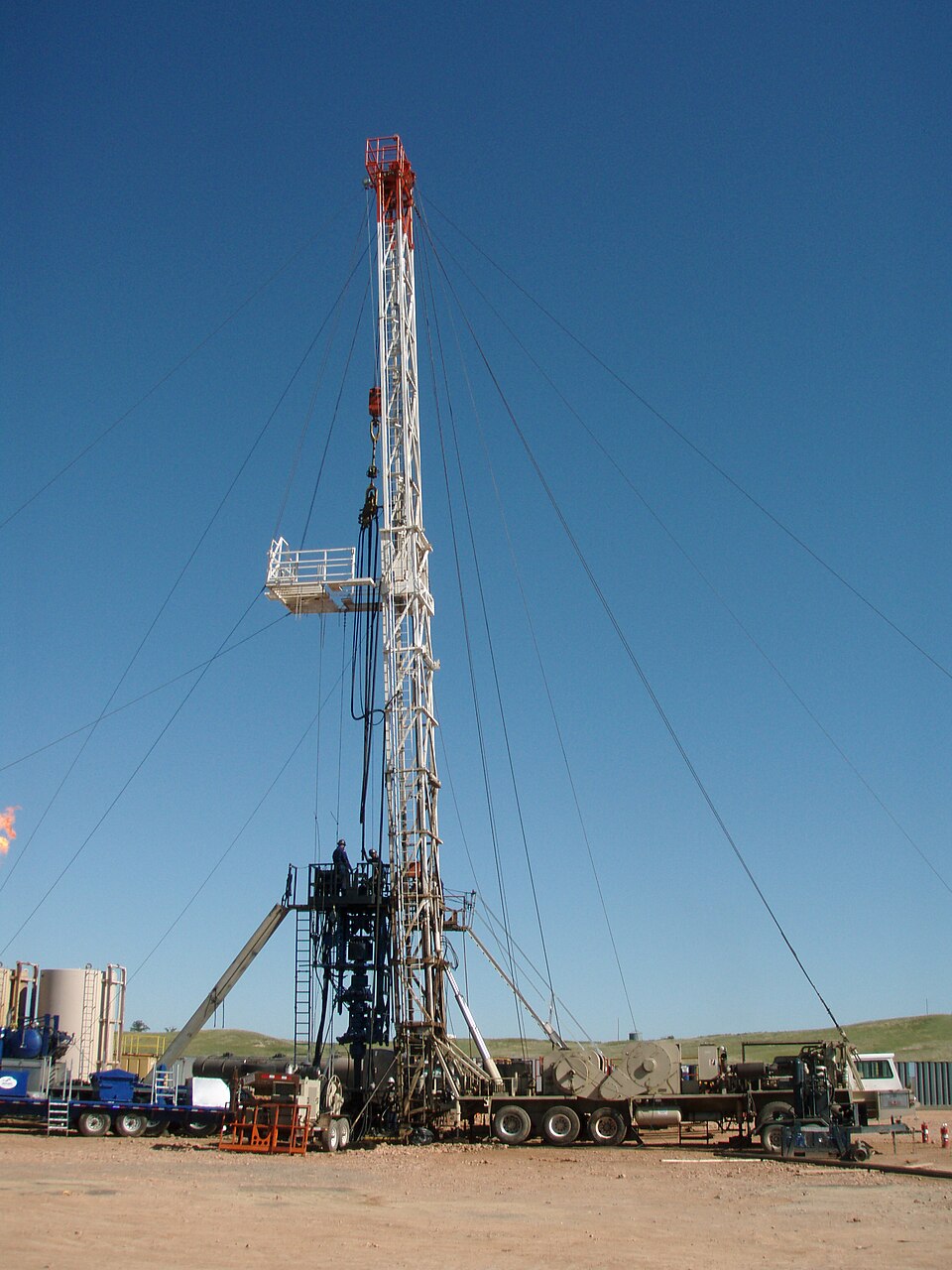
A workover tubing tally records which tubulars and accessories actually went into or came out of the well, their sequence and their measured contributions to string length. Joint count alone cannot locate a packer, nipple or failed connection. The tally becomes a depth record only after it identifies the string reference, the surface datum and the point on each tool whose depth is being reported.
Establish the length convention before numbering the joints
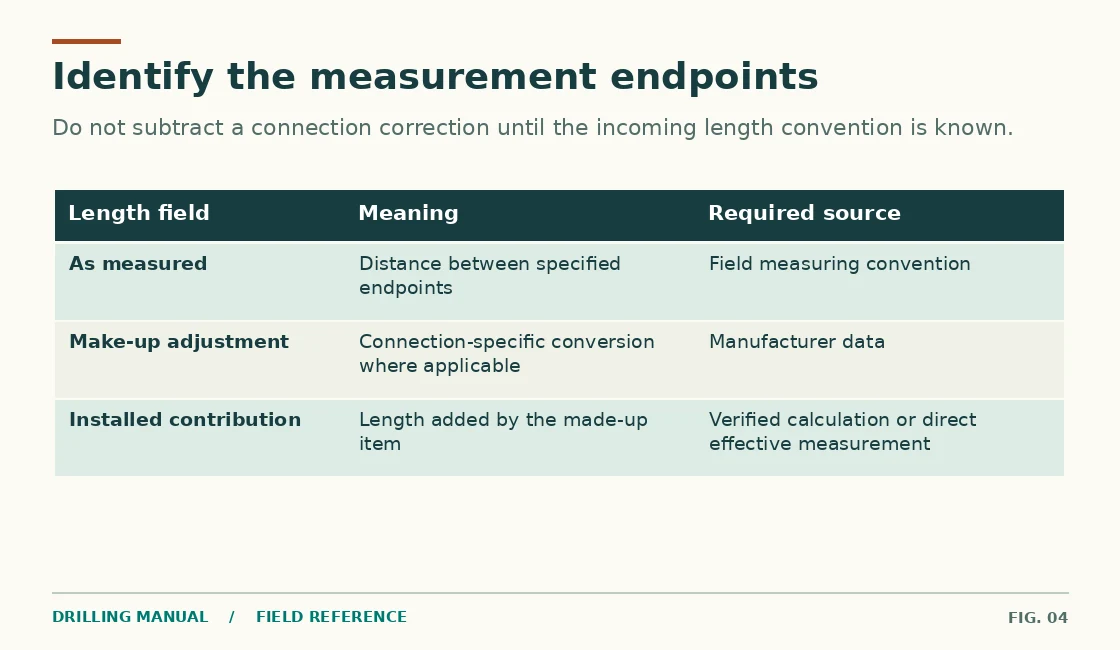
Identify the connection type and the exact measurement endpoints. Some records give an overall tally length requiring a connection-specific make-up allowance. Others already give effective installed length. Use the applicable connection drawing or manufacturer instructions to decide which convention applies. Deducting make-up loss twice introduces a systematic error on every affected joint.
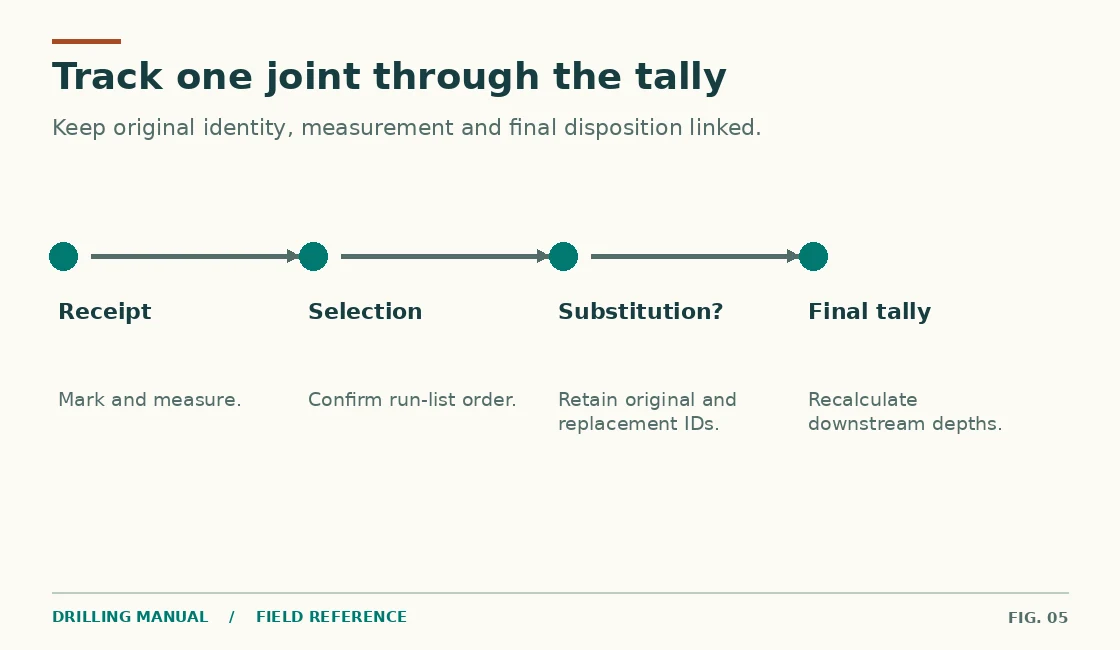
Set the units and recording precision. Keep joint number, serial or traceability reference where applicable, measured length, any adjustment, effective installed length and cumulative length in separate columns. Number tubing, pups and accessories and reconcile stock on the rack with the running sequence. Quarantined joints, substitutions and items laid back remain in the inventory, each with an explicit disposition.
Two independent measurements can expose a tape misread before it enters the cumulative tally. For example, 31.20 ft and 31.24 ft differ by 0.04 ft. Eni’s Completion Procedures Manual, §8.1, item 7 (p. 68), calls for a recheck when the pair differs by more than 0.01 ft. Under that manual the discrepancy calls for a new measurement at the agreed endpoints. Averaging the pair would hide the discrepancy. Use the tolerance in the governing job procedure.
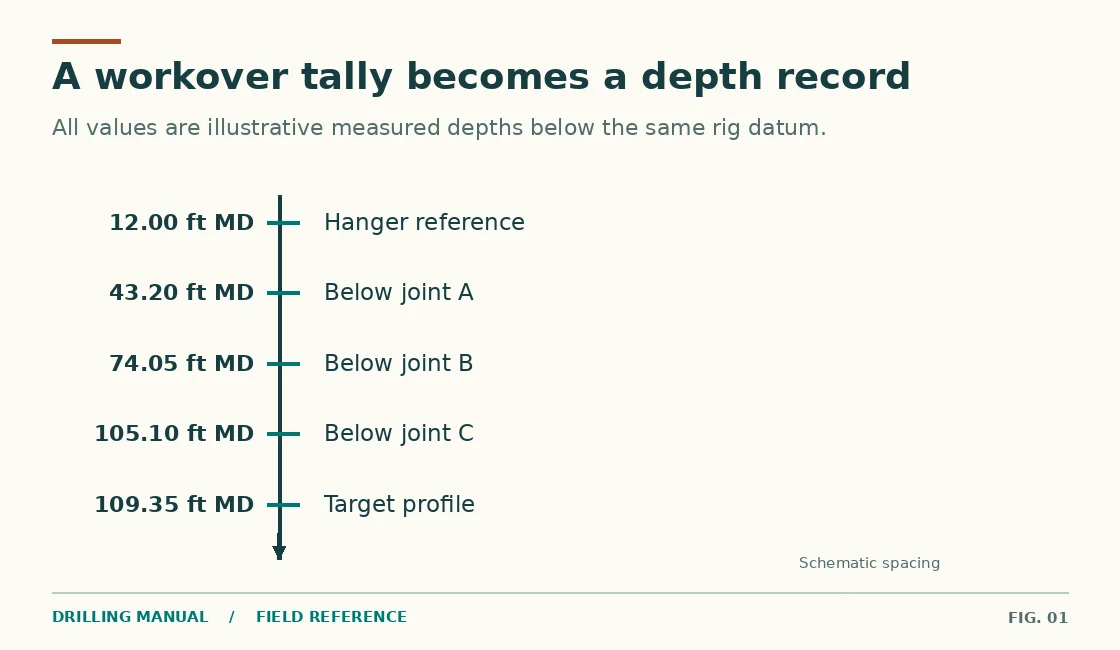
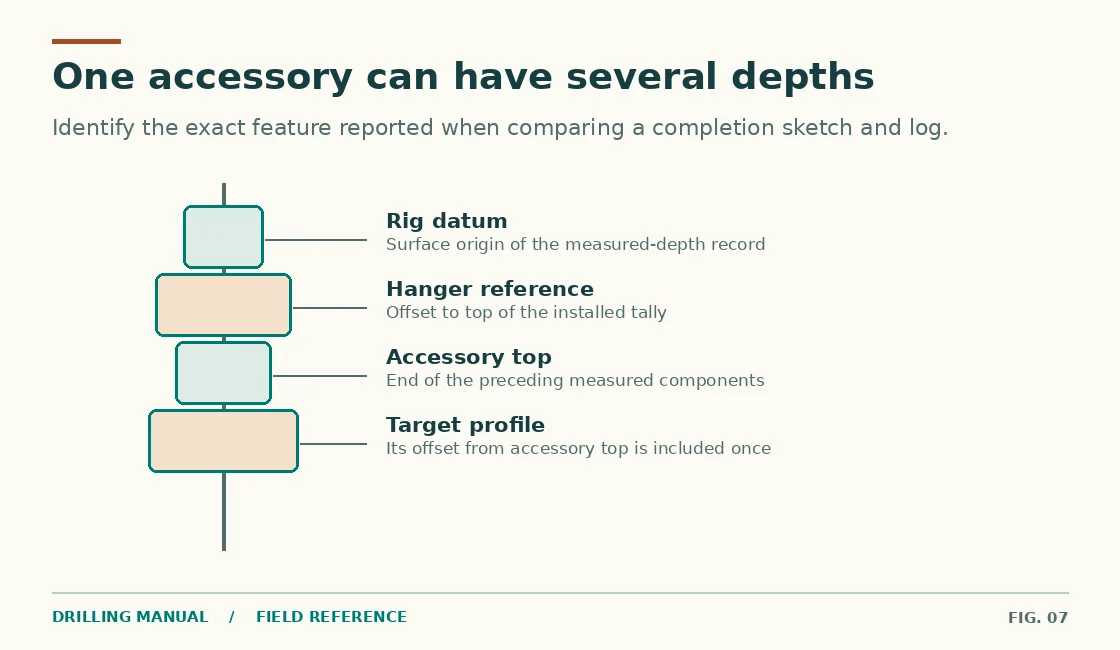
Calculate a tool depth from the hanger reference
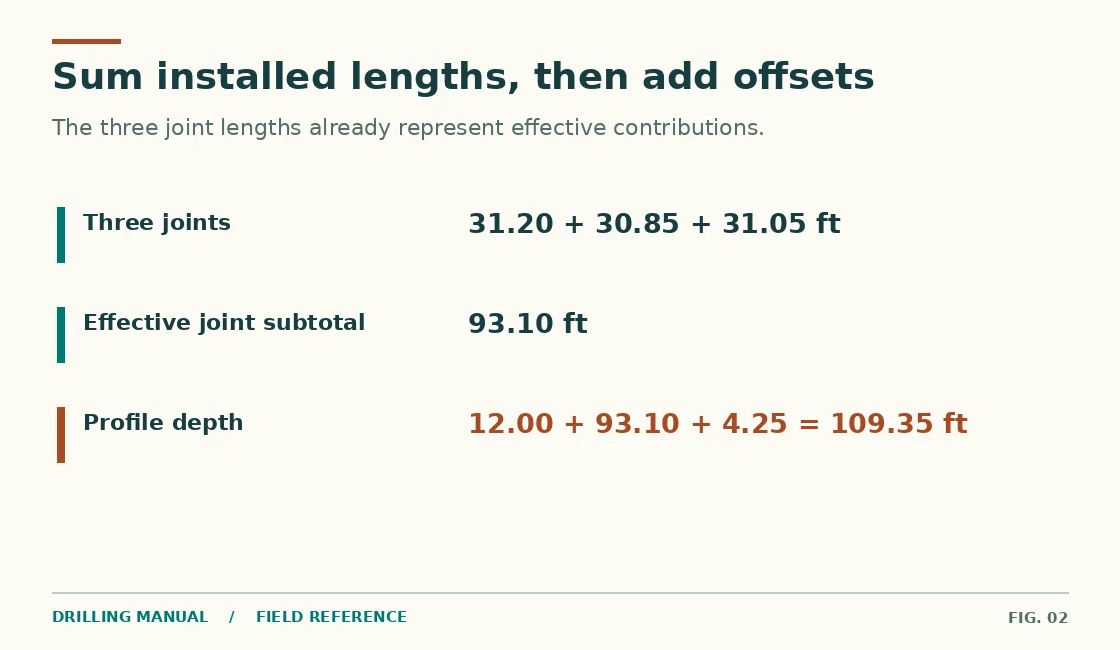
Assume the named hanger reference is 12.00 ft below the rig depth datum. Increasing measured depth is downward. From that hanger reference to the top of a target accessory, the effective installed lengths in a simplified portion of string are 31.20, 30.85 and 31.05 ft. Their sum is 93.10 ft. If the target profile lies 4.25 ft below the top of the accessory, its calculated depth is 12.00 + 93.10 + 4.25 = 109.35 ft MD below the rig datum.
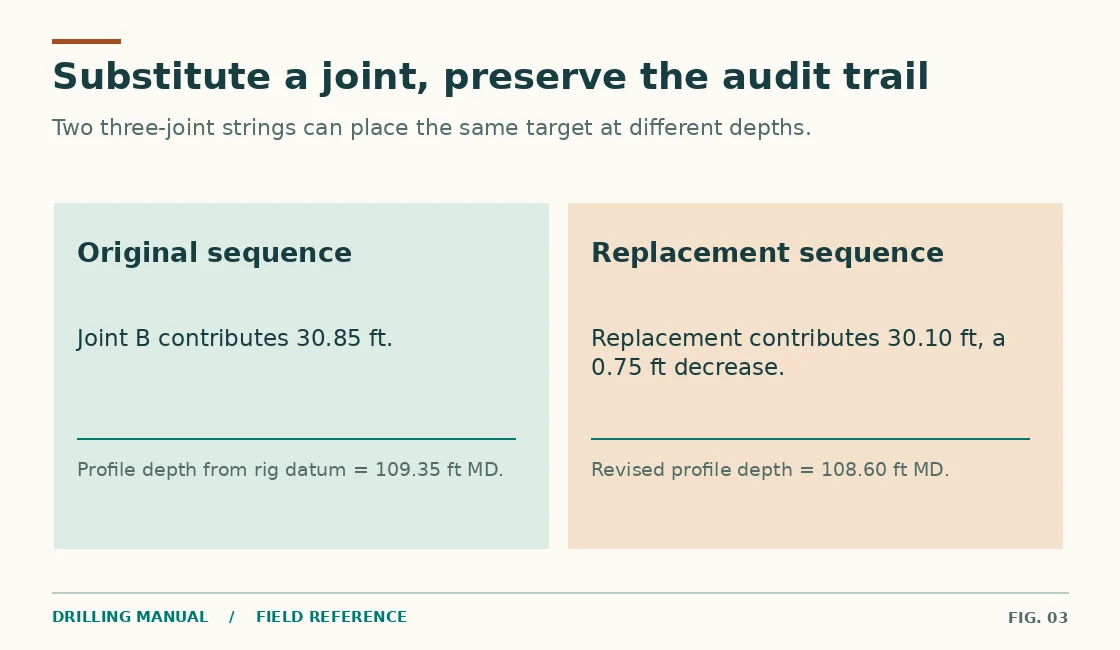
Now replace the 30.85 ft joint with one whose effective length is 30.10 ft. That substitution reduces the calculated depth of the profile and every downstream point by 0.75 ft. The updated profile depth is 108.60 ft MD, while the number of joints is unchanged. Mark the original item as laid back and the replacement as run rather than editing the former measurement out of the record.
The casing tally worksheet illustrates how component lengths accumulate. Compare the workover datum with wireline depth correlation before concluding that two depths disagree.
Keep pipe tally, landed depth and correlated depth distinct
An unloaded surface tally is a geometrical description of the assembly. In the well, axial load, temperature and pressure can change string length. Landing and packer conditions determine the final configuration. If corrected depths are needed, use the appropriate string model and record the well state and model inputs separately from the original measured lengths.
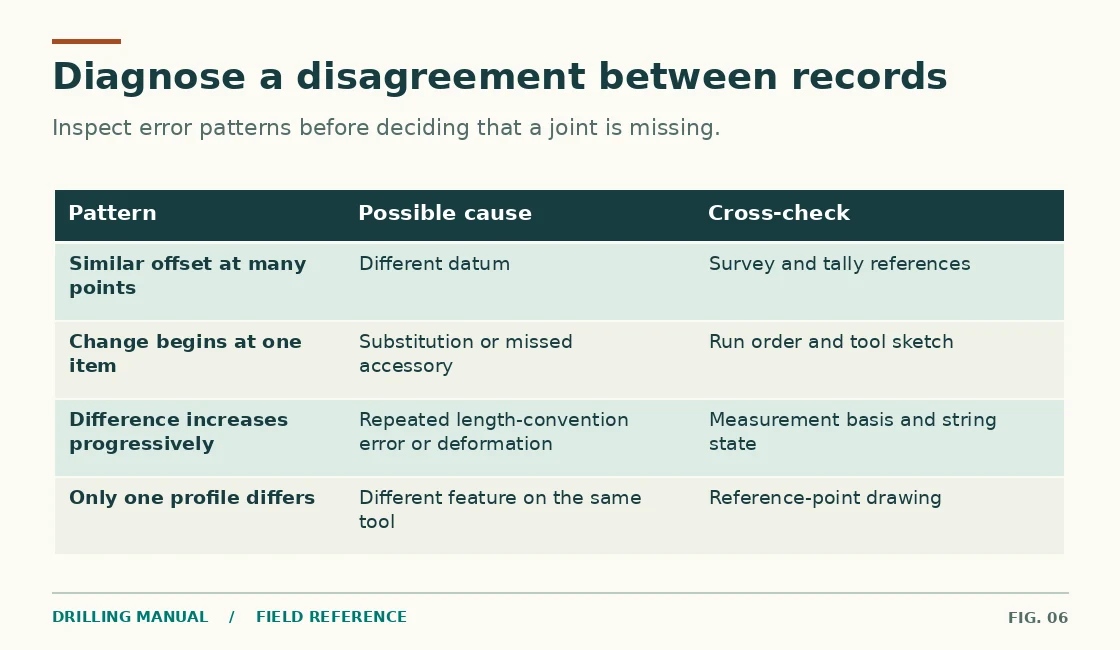
A wireline or log depth can offer an independent check if tied to a defined reference and recognizable feature. Reconcile its datum, tool offset, measured-depth basis and relevant corrections before comparing. If one source reports packer top and another the internal locating profile, a consistent difference may be genuine geometry. Several depths disagreeing by roughly the same amount suggest checking the common datum first.

Reconcile the run list at the handover
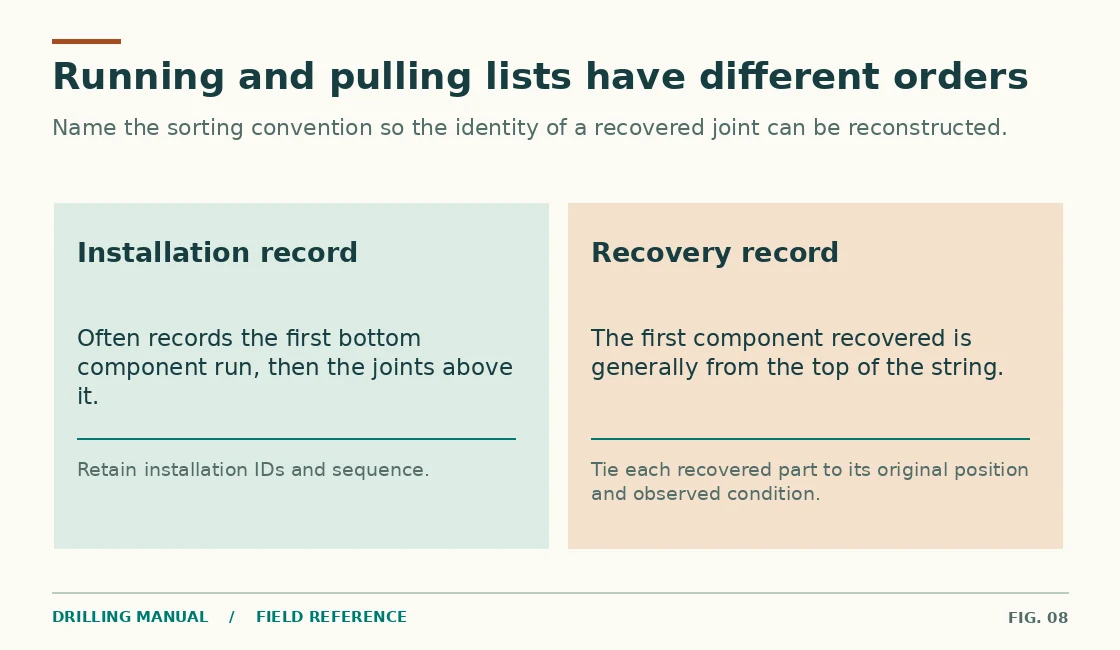
At each ownership handover compare the running tally with physical pipe and the last confirmed assembly version. Verify that a blank entry is investigated rather than interpreted as zero. Check whether pup joints, crossovers, seal assemblies and hanger offsets appear exactly once. On a pull, identify the order convention: the first item out is generally at the top, which can reverse the order used on an installation list.
For a failed tubing string, associate observations with the recovered item number and its calculated in-well interval. Record which part of a joint failed, whether it was recovered in full, and any uncertainty due to missing pipe or changed string condition. This turns a report of “tubing parted at depth” into an auditable location for the next fishing or integrity review.
Calculate how a small per-joint tally bias accumulates
Suppose 120 installed joints are each entered 0.03 ft longer than their effective made-up length because the same makeup allowance was omitted. The calculated profile ends up 120 × 0.03 = 3.60 ft too deep. The error has one sign on every joint. Treating it as random tape scatter would understate its effect.
Identify the measurement endpoints and the supplier’s definition of running length on the source file. If the quoted value already includes makeup loss, deducting that loss again creates the opposite bias. Track subs and accessories separately, reconcile only the connections actually made up, and retain the original and corrected depth records. Elastic or thermal movement of a landed string is a different correction from tally bookkeeping.
Set up a tubing tally in a spreadsheet
Use one row per component in installation order, one length unit and a signed datum offset. In this layout column B is measured component length, C is the positive makeup deduction, D is effective installed length, and E is cumulative depth below the selected rig datum. Row 2 holds the starting reference. In the original 12.00-ft datum example, enter 12.00 in E2. For the first joint in row 3, enter =B3-C3 in D3 and =E2+D3 in E3, then copy both formulas down.
If the supplied length is already an effective running length, enter it in B and zero in C. Use the same datum for accessories. Record the component ID and orientation, preserve the original as-run order, and reconcile the computed final depth to an independent reference. A convenient spreadsheet cannot detect the same mistaken deduction copied into every row.
| Spreadsheet row | Component | B: length (ft) | C: deduction (ft) | D: effective (ft) | E: cumulative (ft) |
|---|---|---|---|---|---|
| 2 | Starting reference | — | — | — | 12.00 |
| 3 | Joint A, length already effective | 31.20 | 0.00 | 31.20 | 43.20 |
| 4 | Joint B, length already effective | 30.85 | 0.00 | 30.85 | 74.05 |
Field comparison
| Item in the example | Effective length or offset | Cumulative depth below rig datum |
|---|---|---|
| Hanger reference | 12.00 ft datum offset | 12.00 ft MD |
| Joint A | 31.20 ft | 43.20 ft MD |
| Joint B, original run list | 30.85 ft | 74.05 ft MD |
| Joint C | 31.05 ft | 105.10 ft MD |
| Profile below accessory top | 4.25 ft | 109.35 ft MD |
| Profile after substitution | 0.75 ft shorter than original | 108.60 ft MD |

What to record in the field
| Check or record | Job-specific entry |
|---|---|
| Datum, hanger reference, sign convention and units | |
| Joint ID, connection, endpoints, measured and effective length | |
| Accessory description, two reference points and installed offset | |
| Racked, run, laid-back and rejected totals plus the reconciled revision |
Additional technical figures (5)
Questions from the field
Can average joint length be used for final depth?
A nominal average gives a planning estimate. Installed depth requires the actual run sequence, lengths and reference offsets.
How should a substituted joint be recorded?
Retain both identities, mark which item was left out and recompute every downstream point using the difference in effective length.
Why might the completion log disagree with the tally?
Check datums, component working points, string condition, stretch and correlation corrections before attributing the difference to a missing joint.

Technical references
ENI, Completion Procedures Manual, STAP-P-1-M-7120. pp. 66–68, completion string running procedure and tubing identification.
ONGC, Workover Operations (Onshore). PDF p. 67, item 78, individual tubular lengths and tool dimensions.
HSC, Recommended Running and Handling for Special Alloy Tubulars. Running and handling, connection-specific measurement and make-up loss.