Xanthan gum in drilling fluids is used chiefly to shape rheology: it can provide substantial viscosity at low shear rates while its effective viscosity falls as shear rate increases. That behavior supports solids suspension and can help cuttings transport. Selecting it still requires evidence from the complete fluid, because one viscosity reading cannot describe every shear condition, static suspension or filtration performance. [1, pp. 142–143] [2, pp. 167–169]
The decision is more specific than choosing something that “thickens mud.” It concerns the viscosity profile needed for the duty, how the product develops that profile, and whether the profile survives the expected environment. The polymer drilling-fluid overview places xanthan among other system components; this guide examines its particular contribution.
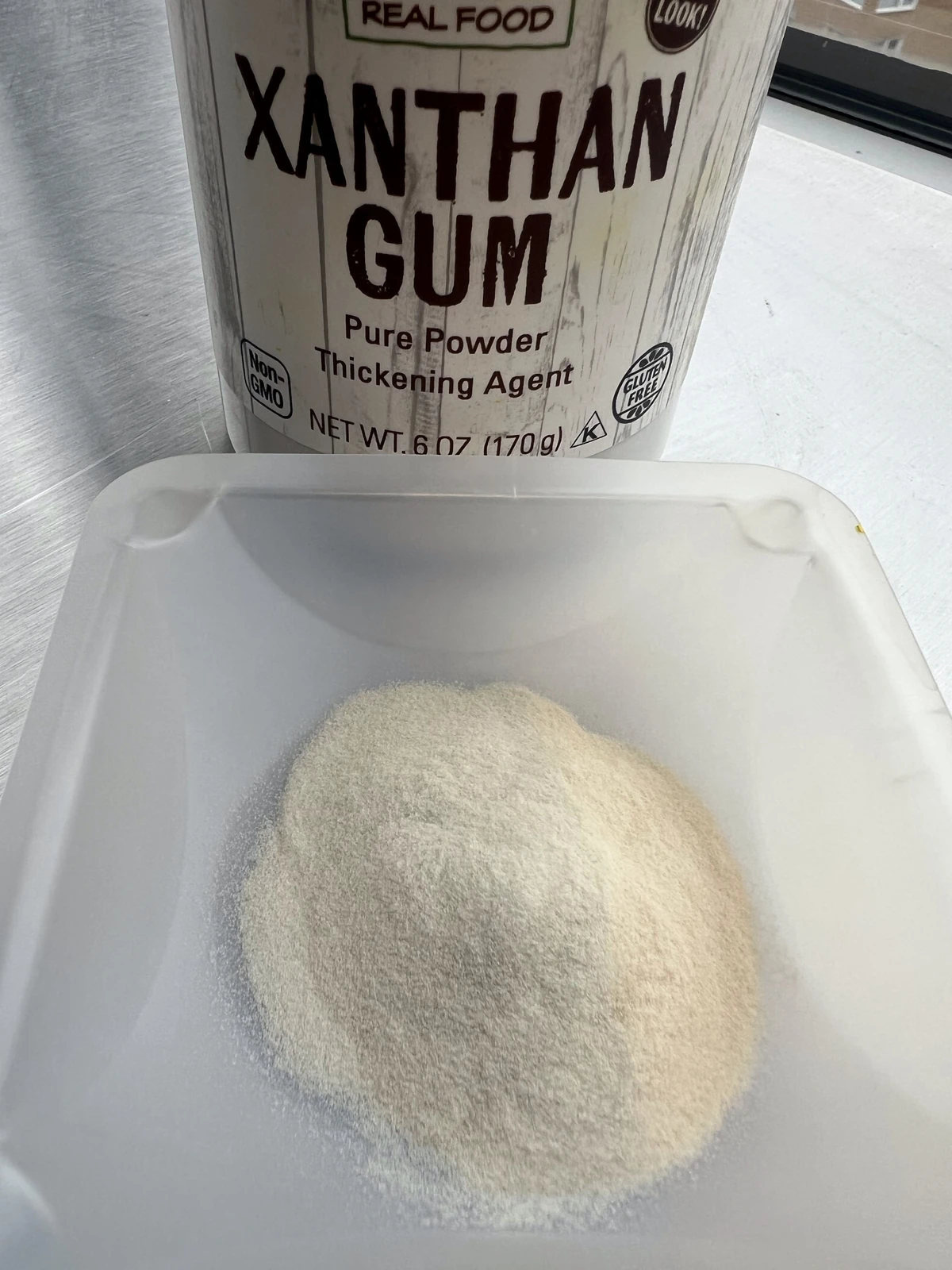

The role of xanthan gum in drilling fluids
Xanthan is a water-soluble biopolymer made by fermentation. It is often identified as XC polymer in drilling-fluid discussions. Its branched structure and associations in solution produce a strongly non-Newtonian response. In practical terms, viscosity depends on the rate of deformation, so the fluid cannot be described by a single viscosity number without stating the conditions. [1, pp. 142–143] [2, pp. 167–169]
Low-shear-rate viscosity is relevant to the resistance encountered by particles moving slowly relative to the surrounding fluid. That makes it useful in evaluating suspension. During circulation, the complete viscosity profile also contributes to cuttings transport and pressure losses. The book treats transport, suspension and filtration as related but distinct functions of the drilling fluid. [1, pp. 3, 142–143]
Xanthan can also contribute to filtration control through the fluid’s viscosity and other interactions. Calling it primarily a rheology modifier therefore does not mean that it has no filtration effect. It means that filtration performance still needs its own assessment and may require a dedicated companion component. [2, pp. 153–154, 167–169]
How xanthan gum responds to shear rate
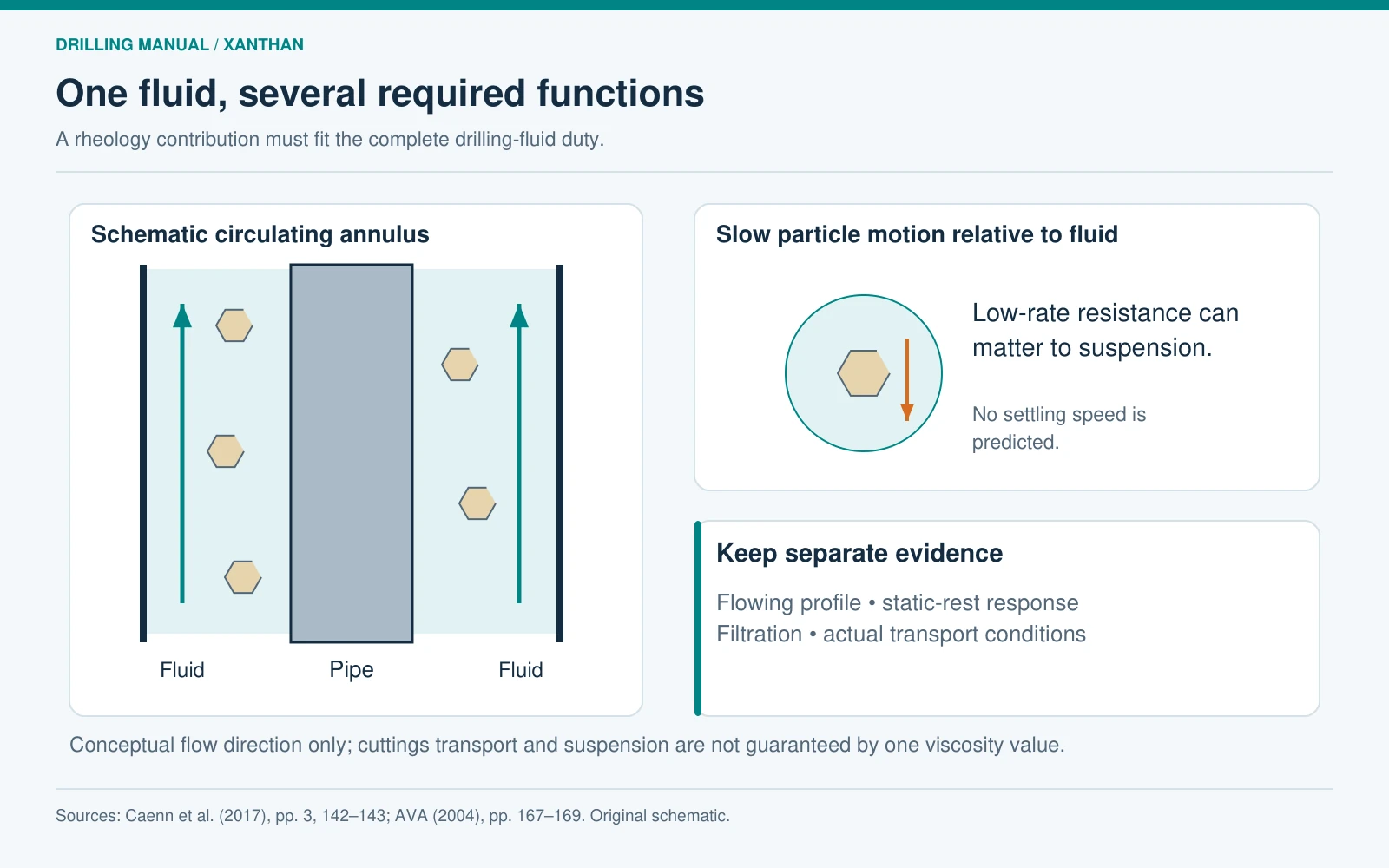
At lower shear rates, associations among xanthan molecules contribute to an interacting network. As shear rate increases, the structure becomes more oriented and its associated groups can separate or rearrange, producing less resistance per unit shear rate. This shear-thinning response helps explain the use of xanthan gum in drilling fluids. A conceptual network sketch explains the relationship without claiming to depict a molecular structure. [1, pp. 142–143] [2, pp. 168–169]
Shear thinning should not automatically be called polymer destruction. Changes in alignment or association differ from chemical degradation, which involves a change in the polymer itself, such as chain cleavage. Conversely, a measured loss of viscosity after exposure cannot be assumed to be harmless alignment. The sample history and relevant comparisons are needed to distinguish possibilities. [2, pp. 144–150, 168–169]
Shear rate also differs from circulation rate. The local deformation rate depends on flow and geometry; a pump-rate value is not a rheometer shear-rate setting. A measured fluid profile must be applied to the relevant flow situation rather than assigning one “low” or “high” condition to the entire well. [1, pp. 152–155]
An original example: the same high-rate point can hide a difference
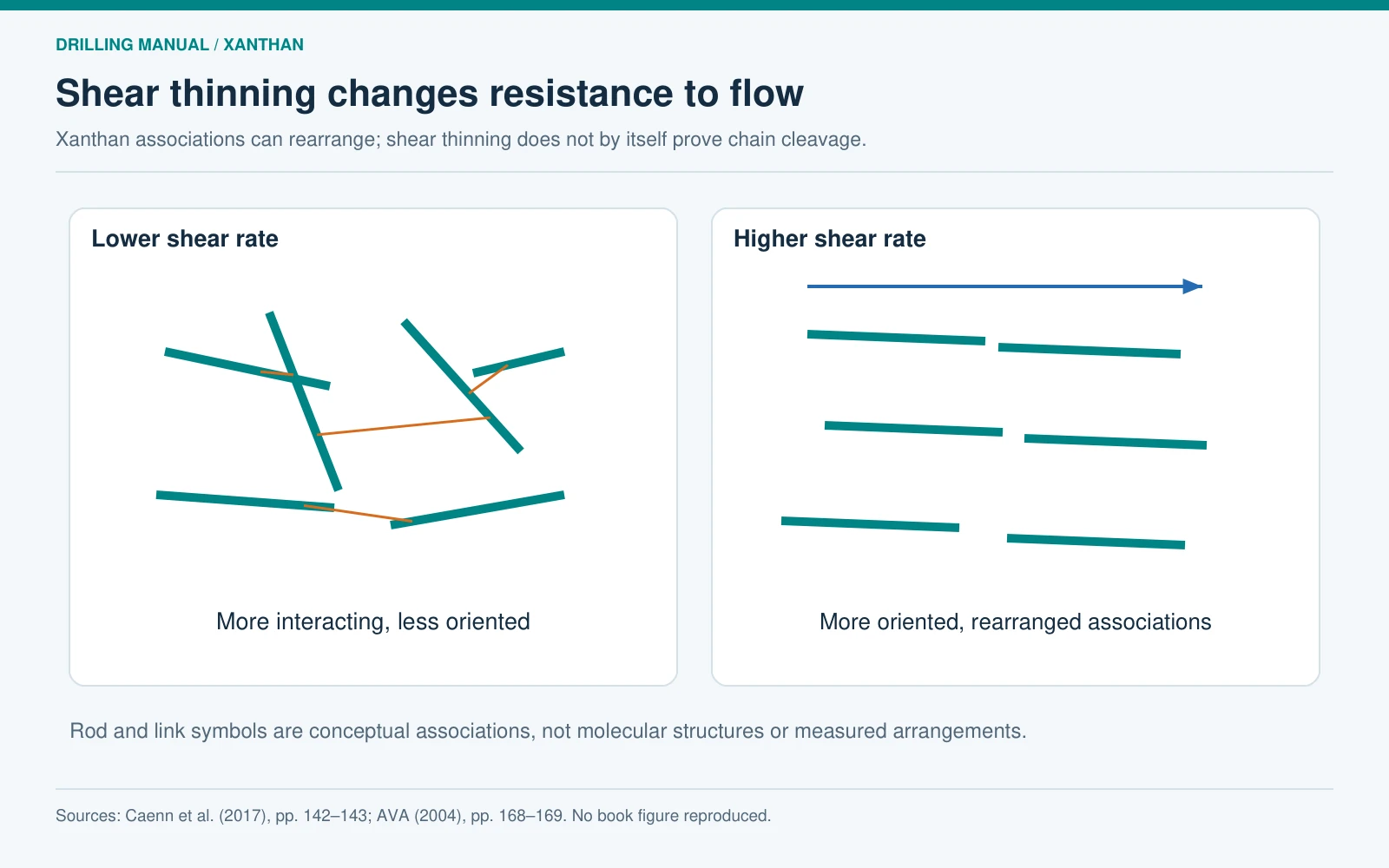
Suppose two hypothetical whole fluids are measured at the same temperature and with the same preparation history. The invented values below describe Fluid A and Fluid B. They are not product data, a recommended specification or a prediction of what adding xanthan will do.
| Shear rate | Fluid A viscosity | Fluid B viscosity |
|---|---|---|
| 1 s−1 | 120 mPa·s | 300 mPa·s |
| 10 s−1 | 60 mPa·s | 95 mPa·s |
| 100 s−1 | 30 mPa·s | 30 mPa·s |
At the highest shear rate shown, the fluids match. At 1 s−1, Fluid B’s viscosity is 300 ÷ 120 = 2.5 times Fluid A’s. Both profiles are shear thinning over the displayed range. The example applies the book’s shear-dependent-viscosity concept to original numbers; it does not fit a constitutive model or extrapolate to other rates. [1, pp. 175–176]
The interpretation is limited but useful: the shared 100 s−1 result would hide a lower-rate difference. It would not tell us which fluid has the preferred static gels, smaller filtrate volume, better temperature retention or acceptable hydraulics in a particular well. Nor do these three points establish a cuttings settling velocity.
Use the rheometer measurement guide for the instrument context. For product selection, retain the profile and its conditions instead of reducing the evidence to one convenient reading.
Low-shear viscosity and gel strength answer different questions
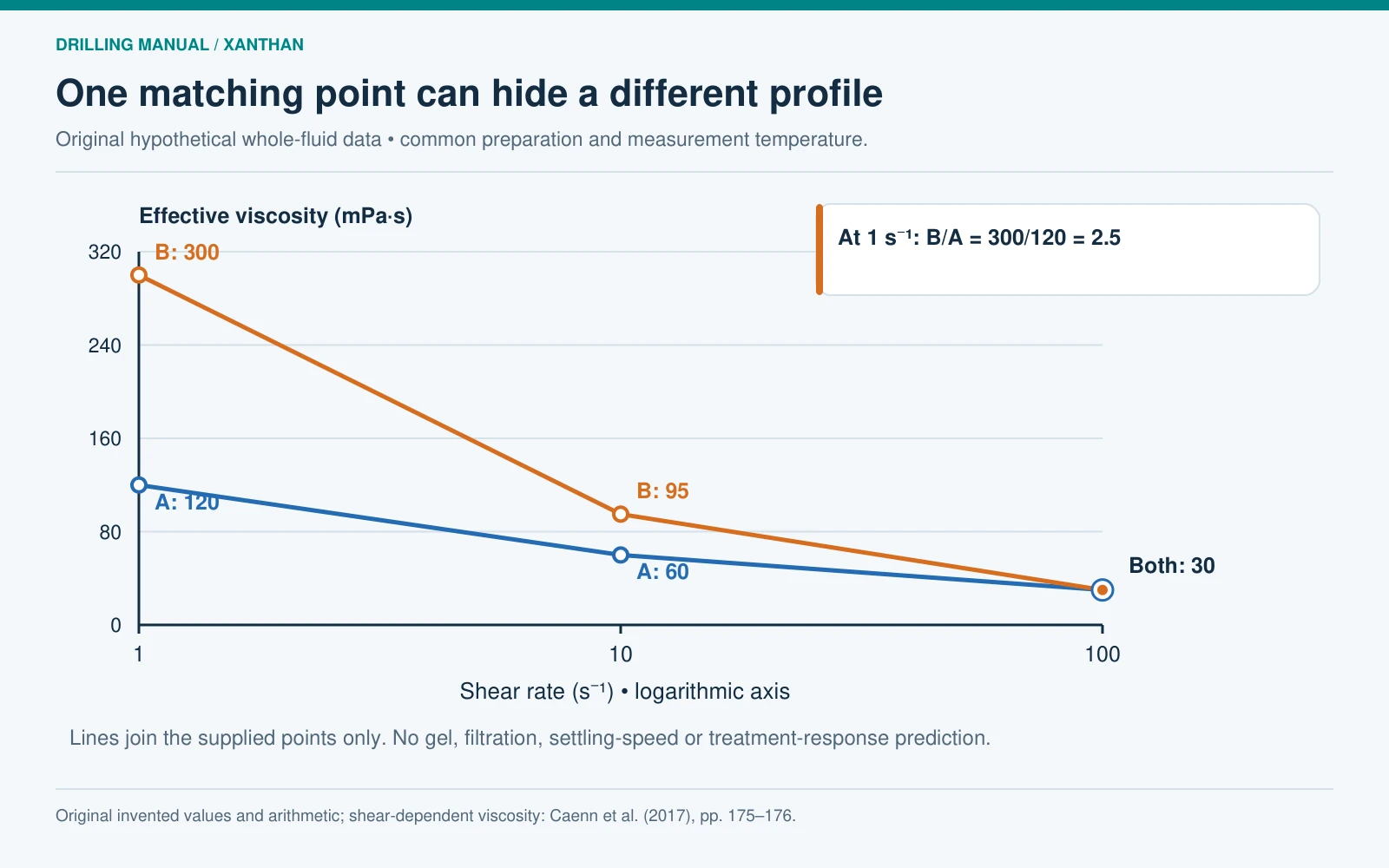
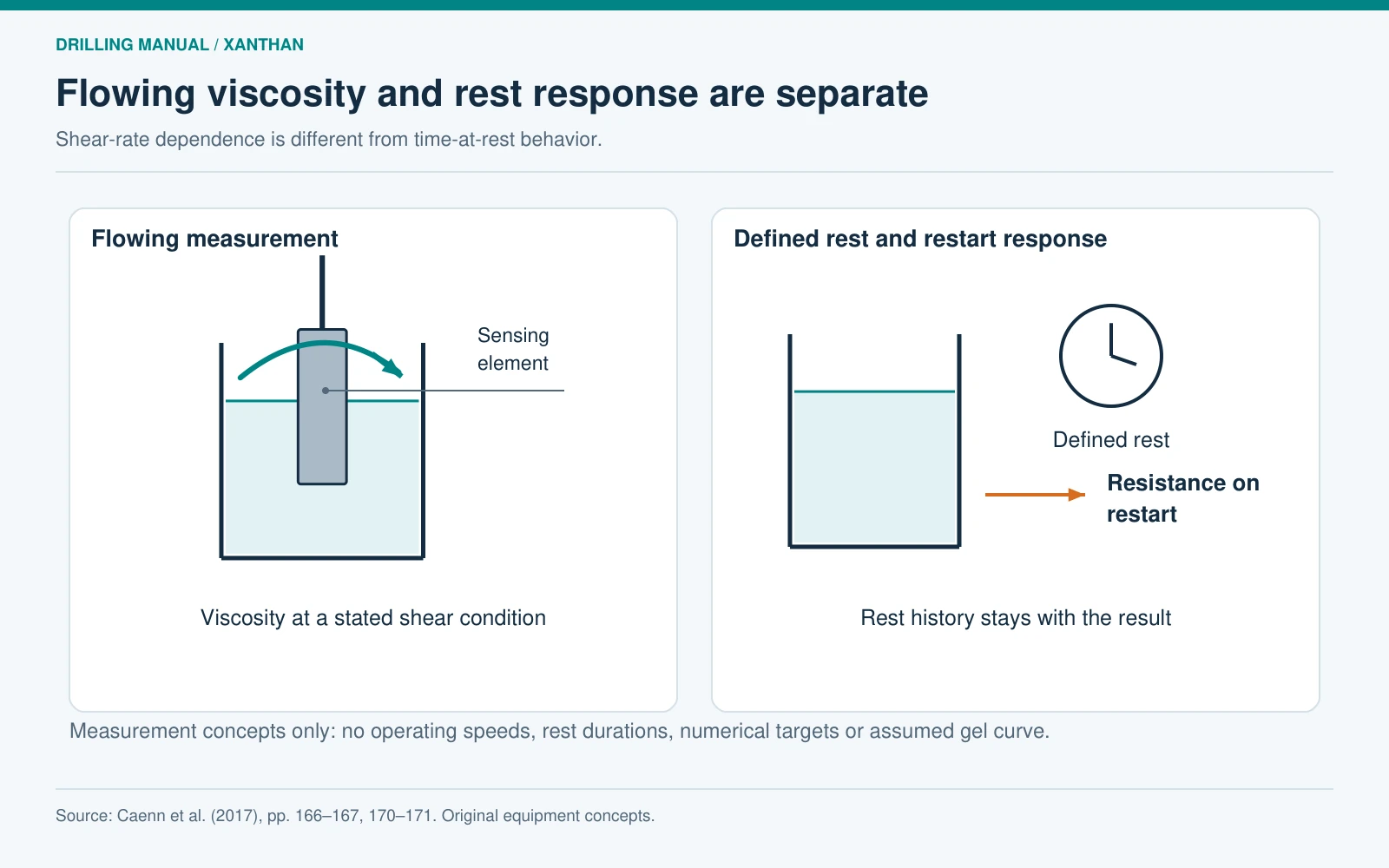
A viscosity measured while the fluid is shearing describes a flowing condition. Gel strength describes resistance associated with a specified period of rest and subsequent disturbance under a defined measurement method. The two properties are connected through fluid structure, but they are not interchangeable. Shear thinning describes dependence on shear rate; thixotropic behavior additionally involves time and shear history. [1, pp. 166–167, 170–171]
This distinction matters when assessing xanthan gum in drilling fluids. A useful low-rate flowing response does not itself prove that solids will remain acceptably suspended throughout a static period. Equally, a high gel result does not establish an ideal flowing profile. Rest time, measurement history and the complete formulation belong with the result. [1, pp. 3, 166–167, 170–171]
The gel-strength guide covers that separate measurement. In a xanthan comparison, record the flowing profile and the static-response evidence as distinct entries rather than treating either as a substitute for the other.


Xanthan hydration: dispersion before comparison
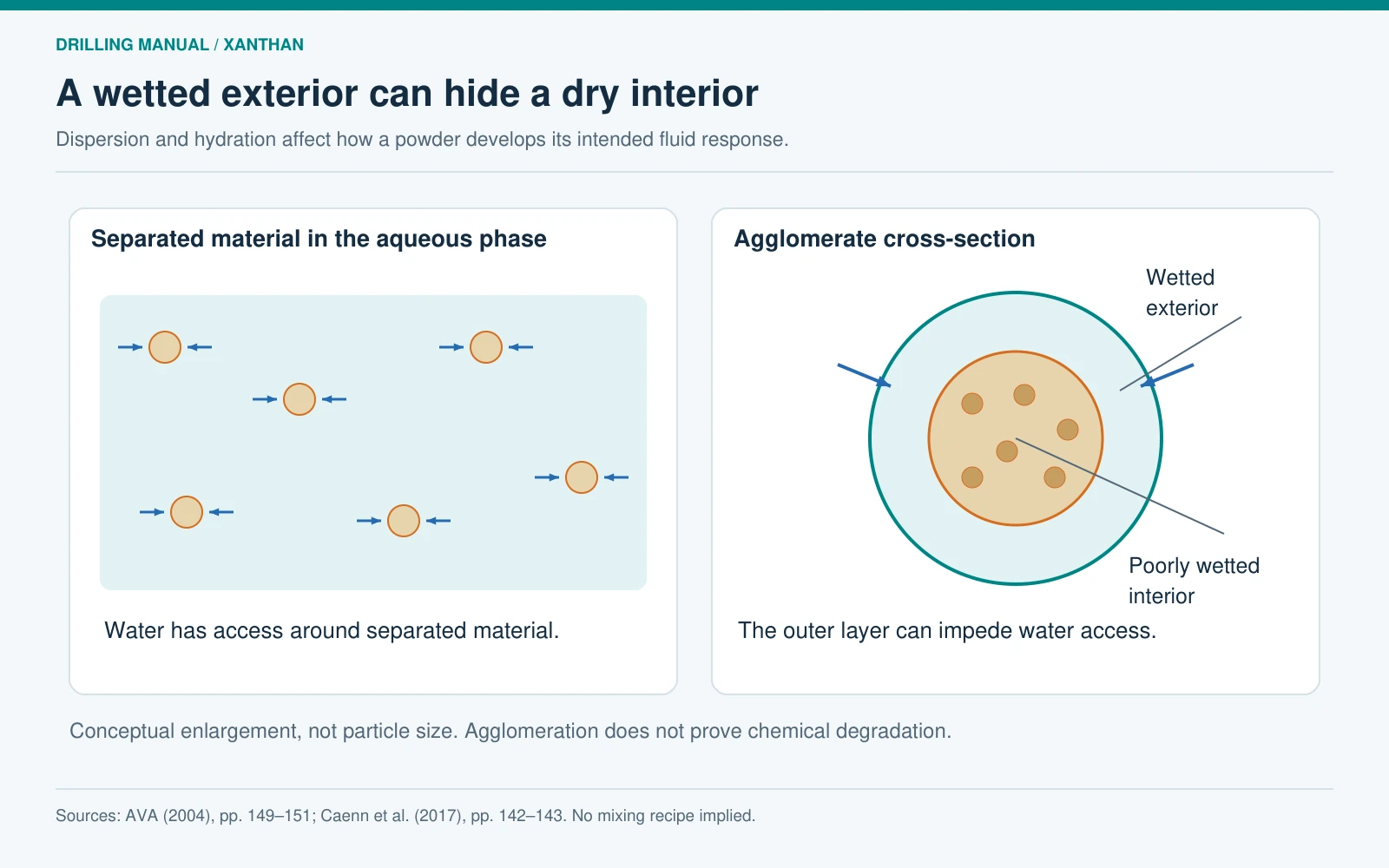
Powder added to an aqueous fluid must disperse so that water can interact with it and develop the intended solution behavior. If the powder agglomerates, a wetted outside can surround a poorly wetted interior. These “fish-eyes” make an apparent mixing result difficult to interpret: product is present, but it has not necessarily developed the behavior expected from well-dispersed material. [2, pp. 149–151]
The observation is different from confirmed chemical degradation. It is also different from demonstrating that the polymer is unsuitable for the water chemistry. The Caenn text notes that very high salt concentrations can interfere with complete xanthan hydration, so the preparation medium belongs in the record even when a hydrated xanthan formulation is described as salt tolerant. [1, pp. 142–143]
Comparing xanthan gum in drilling fluids requires the product form, starting water or mud, preparation history and evidence that the samples are comparable. This article does not prescribe an addition rate, mixing sequence or corrective treatment. Those details depend on the product and fluid program; the point is to avoid interpreting incomplete development as a finished rheology result.
Xanthan compatibility: salinity, hardness and pH
Xanthan’s comparatively rigid associated structure can make its solution behavior less sensitive to simple salt changes than some other anionic polymers. That does not mean that every xanthan product will hydrate or perform identically in every brine. The salt level, ion types and formulation must remain visible in the comparison. [1, pp. 142–143] [2, pp. 167–169]
The manuals specifically identify adverse interactions involving divalent ions under high-pH conditions. A calcium-rich, alkaline environment therefore asks a different question from a sodium-chloride solution. If cement contamination is credible, use the separate cement-contamination guide for that fluid problem; the word “xanthan” alone does not establish compatibility. [2, pp. 146–147, 169]
Interactions with companion polymers also matter. A blend can produce behavior different from that inferred by adding the separate product descriptions together. Evaluate xanthan in the intended additive package, and distinguish a promising blend result from a general statement that every combination is compatible. [2, pp. 150–154, 168]
Separate exposure history from measurement temperature
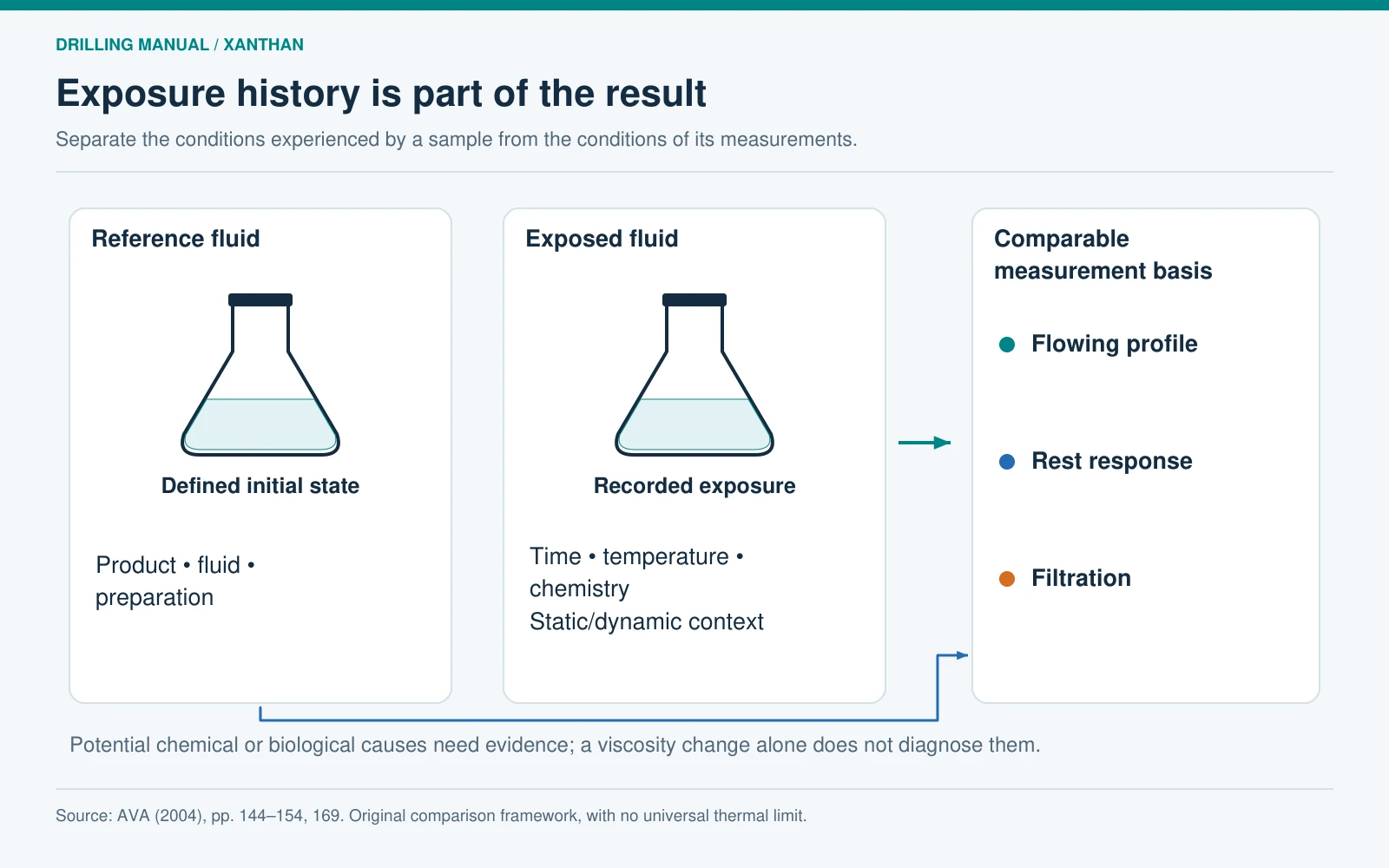
A sample’s temperature during measurement is not its entire thermal history. Exposure duration, chemical environment, oxygen and static or dynamic conditions can influence the retained performance. AVA distinguishes degradation from other changes in effectiveness and explains why polymer family names alone are an unreliable basis for thermal classification. [2, pp. 144–150]
The supplied references give different broad temperature statements for xanthan. Turning one of those into a universal service limit would hide the formulation and exposure assumptions. Thermal evaluation of xanthan gum in drilling fluids should report what happened to the actual fluid under defined conditions, including the temperature at which the subsequent properties were measured.
Biological or enzymatic degradation is another potential loss mechanism for xanthan. Its relevance depends on the fluid and exposure context; a viscosity change alone does not diagnose it. The manuals’ discussion supports considering that possibility, not issuing a generic preservation recipe or assuming that every stored fluid has the same problem. [2, pp. 148–150, 169]
Connect xanthan performance to the whole fluid
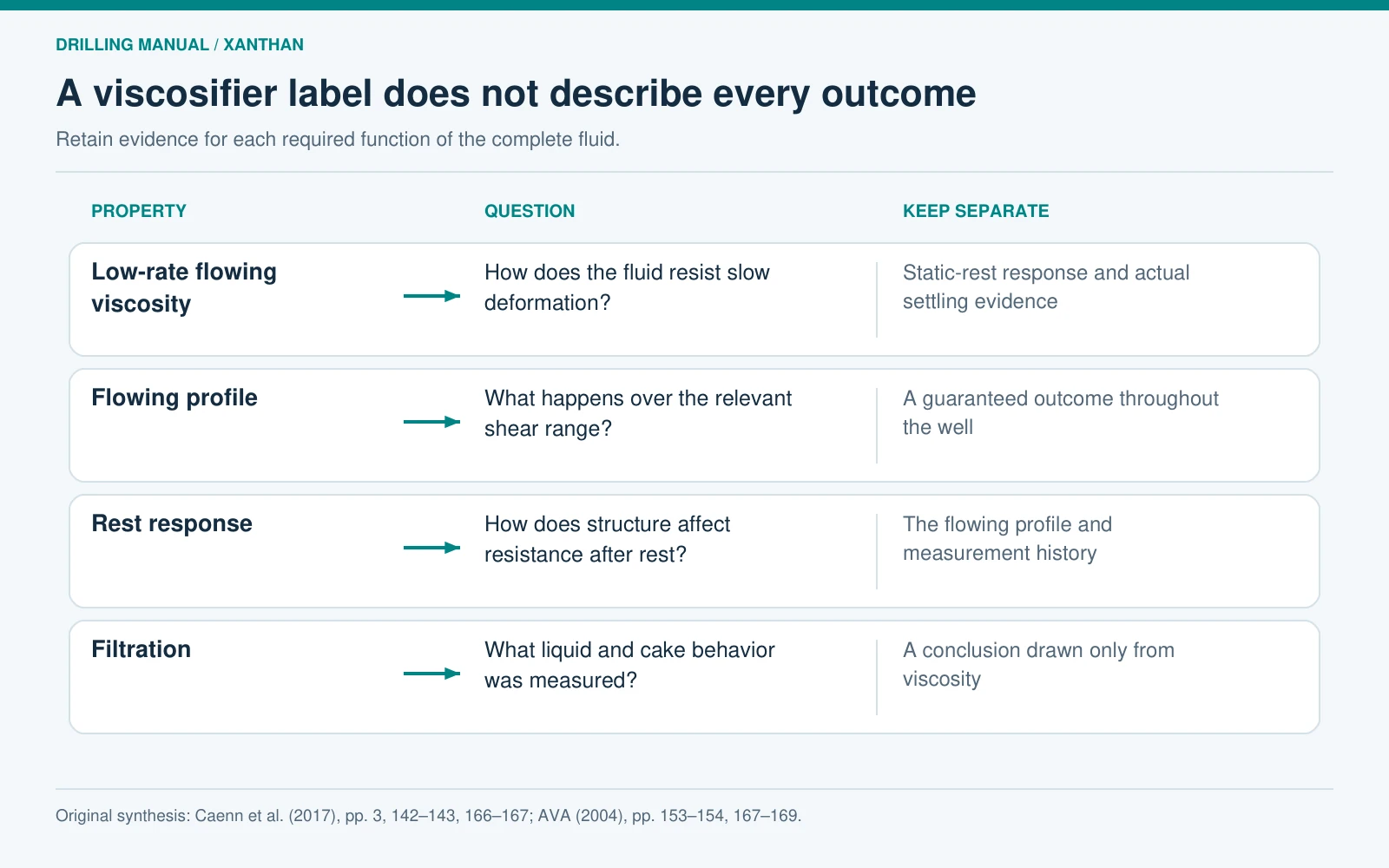
Rheology is one part of a circulation system that must transport cuttings, suspend solids, control filtration and meet other well requirements. Greater viscosity in a useful shear-rate range can support one function while changing another. The decision should therefore preserve the required fluid profile rather than pursue the largest possible viscosity number. [1, p. 3]
| Question | Relevant evidence | What remains separate |
|---|---|---|
| How does the fluid resist slow deformation? | Low-shear-rate viscosity with stated conditions | Static-rest response and actual particle settling |
| What happens over the flowing range? | The measured profile and a suitable hydraulic assessment | A guarantee of cuttings removal throughout the well |
| Does the fluid control filtration? | Filtrate and cake evidence under the relevant test conditions | The viscosity profile alone |
| Does the formulation tolerate the environment? | Comparable preparation, contamination and exposure evidence | A universal rating derived from the polymer name |
Xanthan and cellulosic filtration reducers consequently address overlapping but different formulation needs. Xanthan gum in drilling fluids can be used alongside a cellulosic filtration reducer. The water-based systems guide provides formulation context, while the filtration-test guide covers that separate measurement. Neither function should be inferred solely from a product’s role as a viscosifier. [2, pp. 153–154, 167–169]
Evaluating xanthan gum in drilling fluids
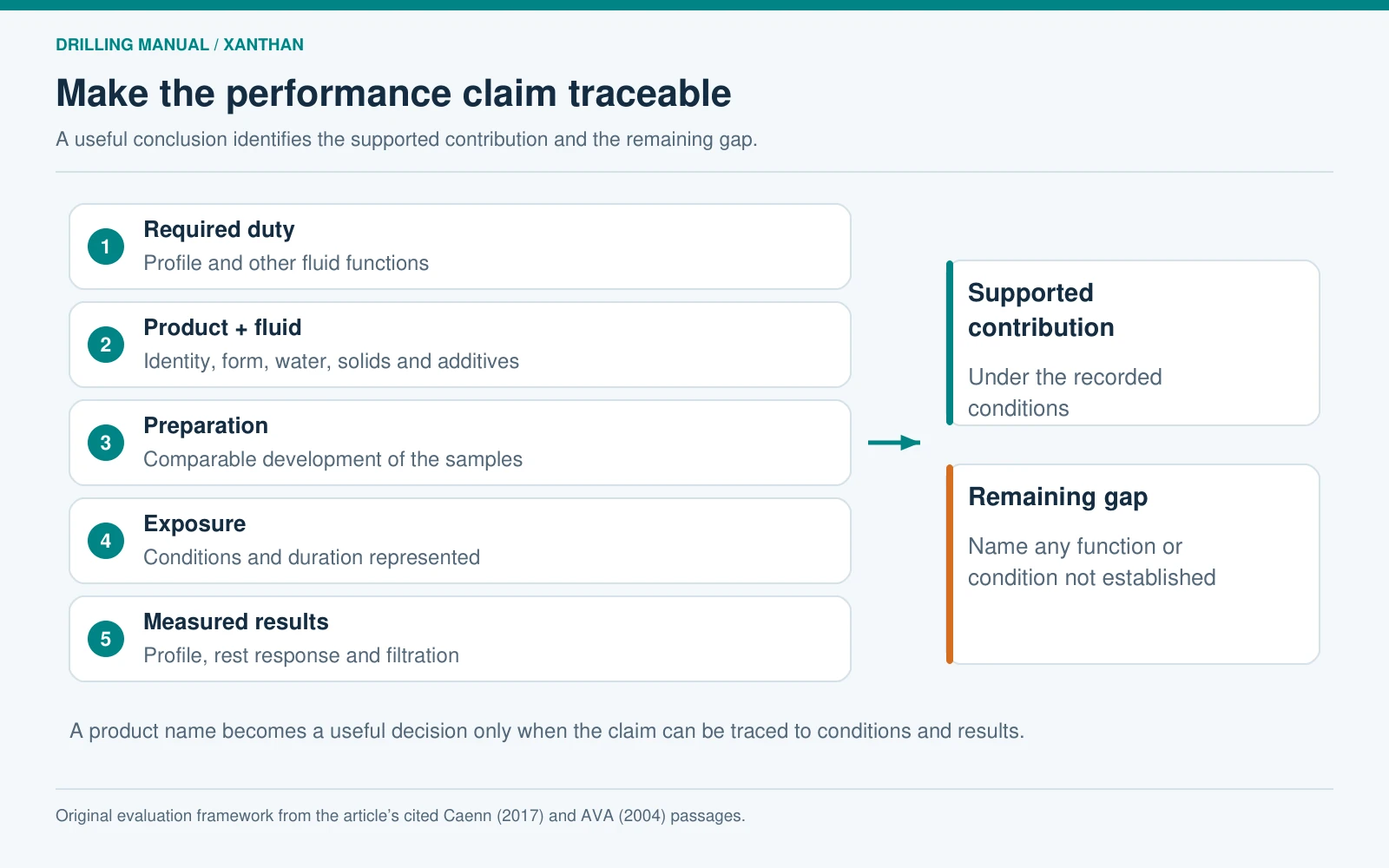
Keep the product, fluid and duty together in the evaluation. Record the required profile; the product identity and form; the starting water, solids and companion additives; and the preparation and exposure history. Then retain the measured rheology, rest-response and filtration evidence with their conditions. These fields apply the source principles to a practical comparison. [1, pp. 142–143, 166–167] [2, pp. 144–154, 167–169]
A performance claim for xanthan gum in drilling fluids should state both the supported benefit and its boundary. For example, a candidate may preserve the required low-rate response after the tested exposure, while its filtration result remains unacceptable. Another may match a higher-rate reading but fail to provide the required lower-rate behavior. Naming the specific gap makes the next decision clearer than calling either product simply “strong” or “weak.”
The aim is a suitable complete fluid. Xanthan earns its place when its measured contribution fits that fluid’s requirements under the conditions the evidence actually represents.


Frequently asked questions
What is the main role of xanthan gum in drilling fluids?
Its principal role is rheology modification, particularly a strong low-shear response combined with shear thinning. That can support suspension and transport, but those outcomes must be evaluated in the whole fluid and well context. [1, pp. 142–143]
Does a high viscosity reading prove good suspension?
No single reading proves it. The shear rate, rest history and complete fluid matter. A flowing viscosity result is also different from a static gel measurement or direct evidence of particle settling. [1, pp. 3, 166–167]
Is xanthan a fluid-loss additive?
It can contribute to filtration behavior, but rheology modification is its principal application here. Measure filtration separately and evaluate whether the formulation needs another component to meet that requirement. [2, pp. 153–154, 167–169]
Does salt tolerance mean hydration is unaffected by salinity?
No. Behavior after hydration and the ability to develop that behavior during preparation are different questions. The Caenn text identifies incomplete hydration in very high salt concentrations as a possible limitation. [1, pp. 142–143]
Does shear thinning mean the xanthan chains are breaking?
Not necessarily. Alignment and changes in association can explain shear thinning without establishing chemical degradation. A persistent performance change after exposure needs evidence beyond the observation that viscosity changed. [2, pp. 144–150, 168–169]
Is there a universal xanthan dosage or temperature limit?
No universal value follows from the name alone. Product form, fluid chemistry, companion additives, exposure and required performance affect the assessment. Use a defined formulation evaluation rather than treating a general material description as a field setting. [2, pp. 144–154, 167–169]
References
- Caenn, R.; Darley, H. C. H.; and Gray, G. R. Composition and Properties of Drilling and Completion Fluids. Seventh edition. Gulf Professional Publishing / Elsevier, 2017. ISBN 978-0-12-804751-4. Printed pages: 3, 142–143, 152–155, 166–167, 170–171, 175–176. PDF pages in the edition consulted: 9, 146–147, 156–159, 170–171, 174–175, 179–180.
- AVA Drilling Fluids & Services. Drilling Fluids Manual. AVA S.p.A., Version 1, November 2004. Chapter 5, Polymers. Printed pages: 144–154, 167–169. PDF pages in the edition consulted: 146–156, 169–171.