What drilling fluid lubricants can change
Drilling fluid lubricants are additives selected to reduce friction at relevant contacts between the drillstring, casing, formation or filter cake. A useful selection must answer three questions: which contact needs improvement, whether the additive works in the actual fluid, and whether that improvement survives the conditions represented by the evaluation. The lowest laboratory number is only one part of that decision.
Baker Hughes distinguishes the lubricity contribution of a fluid from the many mechanical and wellbore causes of torque and drag. The manual also warns that a coefficient measured between laboratory surfaces cannot be transferred directly to a particular borehole. Caenn, Darley and Gray explain why the contact matters: pipe against casing, rock and filter cake presents different interfaces. [1, pp. 11-18–11-20] [3, pp. 368–372]
That makes selection a comparison of evidence, rather than a product-name exercise. A lubricant may improve a controlled friction measurement while leaving a cuttings bed, an undergauge interval or an unfavorable well path unresolved. This article develops a practical comparison record; it does not prescribe a treatment concentration or a field torque limit. Use the separate torque and drag guide for the broader mechanical calculation context.
Start with the contact, not the product family
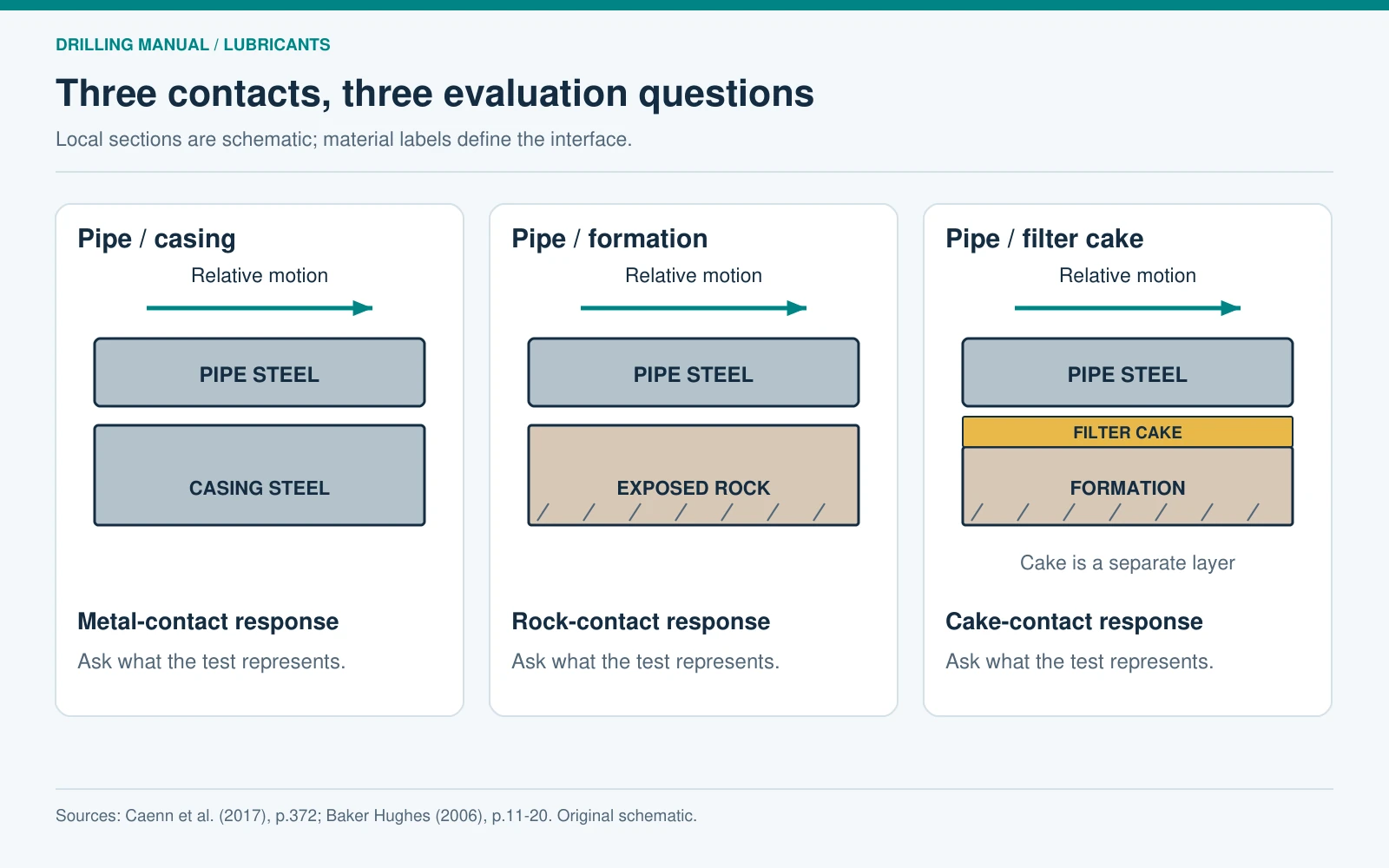
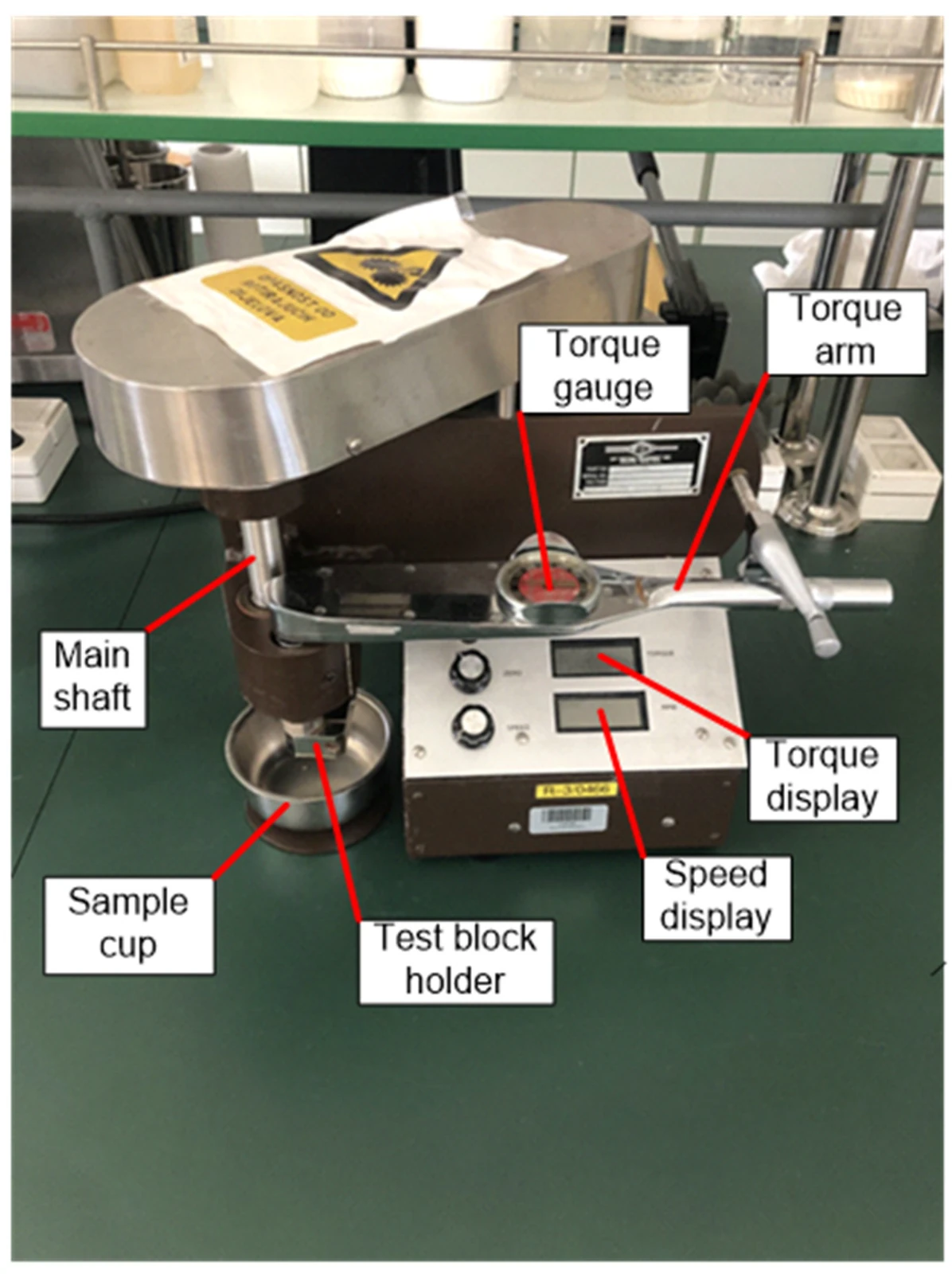
The phrase “good lubricity” is incomplete without the two surfaces and the loading conditions. A metal contact in a tester can reveal how a fluid affects that particular interface. A pipe contacting a deposited cake adds the cake’s composition and response to sliding. Neither is automatically a substitute for contact with exposed formation. [3, pp. 369–372]
| Contact of interest | Useful question | Limit of the conclusion |
|---|---|---|
| Pipe against casing | Does the candidate improve the relevant metal-contact response? | Lower friction does not by itself demonstrate lower wear. |
| Pipe against formation | Does the evaluation represent the exposed material and fluid? | A steel-only comparison does not reproduce every rock contact. |
| Pipe against filter cake | How does the treated cake behave when contacted and sheared? | Cake thickness or visual smoothness alone does not establish lubricity. |
Baker’s discussion of filter cake emphasizes its ability to shear or allow movement at the contact, alongside thickness and composition. This is why a thin-looking cake should not become the sole acceptance evidence for drilling fluid lubricants. The question is how the relevant surface behaves, not whether the sample looks polished. [1, pp. 11-20–11-21]
Film lubrication, extreme-pressure action and wear
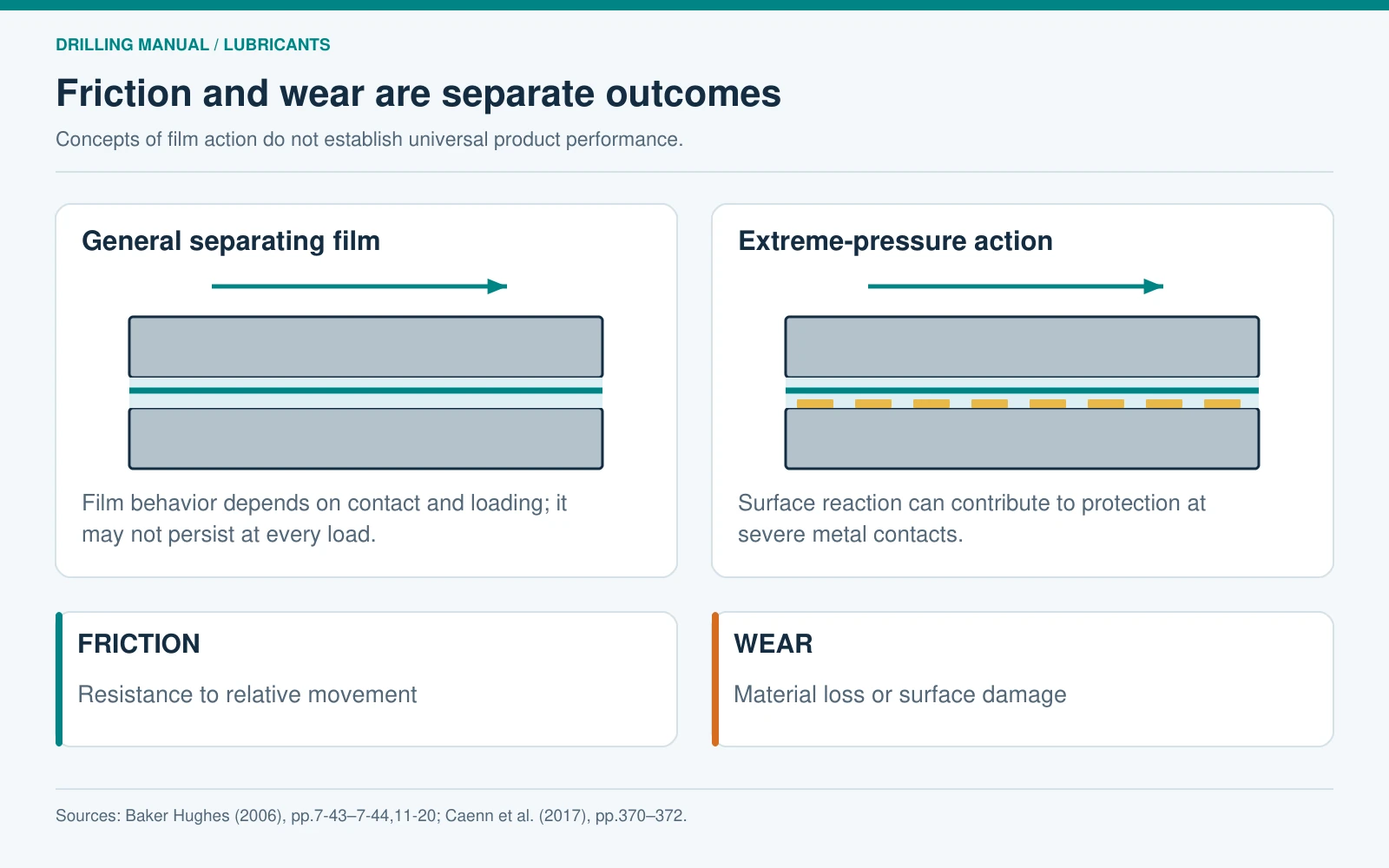
Baker groups drilling lubricants broadly into modified-film materials and antiwear or extreme-pressure materials. General films can separate contacting surfaces, but their behavior changes with loading; a film that gives easy sliding under one condition may not remain effective at a more severe contact. The manual describes certain extreme-pressure additives as developing protective action through reactions at metal surfaces under frictional heating. These are functional distinctions, not a universal ranking of commercial products. [1, pp. 7-43–7-44, 11-20]
Keep friction and wear as separate outcomes. Friction concerns resistance to movement. Wear concerns loss or damage of contacting material. Evidence that a candidate lowers the first does not automatically quantify the second. The cited books discuss differences between small-scale tests and larger casing-wear evaluations; a test result must remain attached to the response actually measured. [1, p. 11-20] [3, pp. 370–372]
For a selection report, state whether the objective is a friction comparison, an extreme-pressure response, a wear assessment or cake-contact behavior. Calling all four “lubricity” hides the evidence gap. There is no single load or concentration in this guide that separates acceptable and unacceptable performance.
Compare drilling fluid lubricants under matched conditions
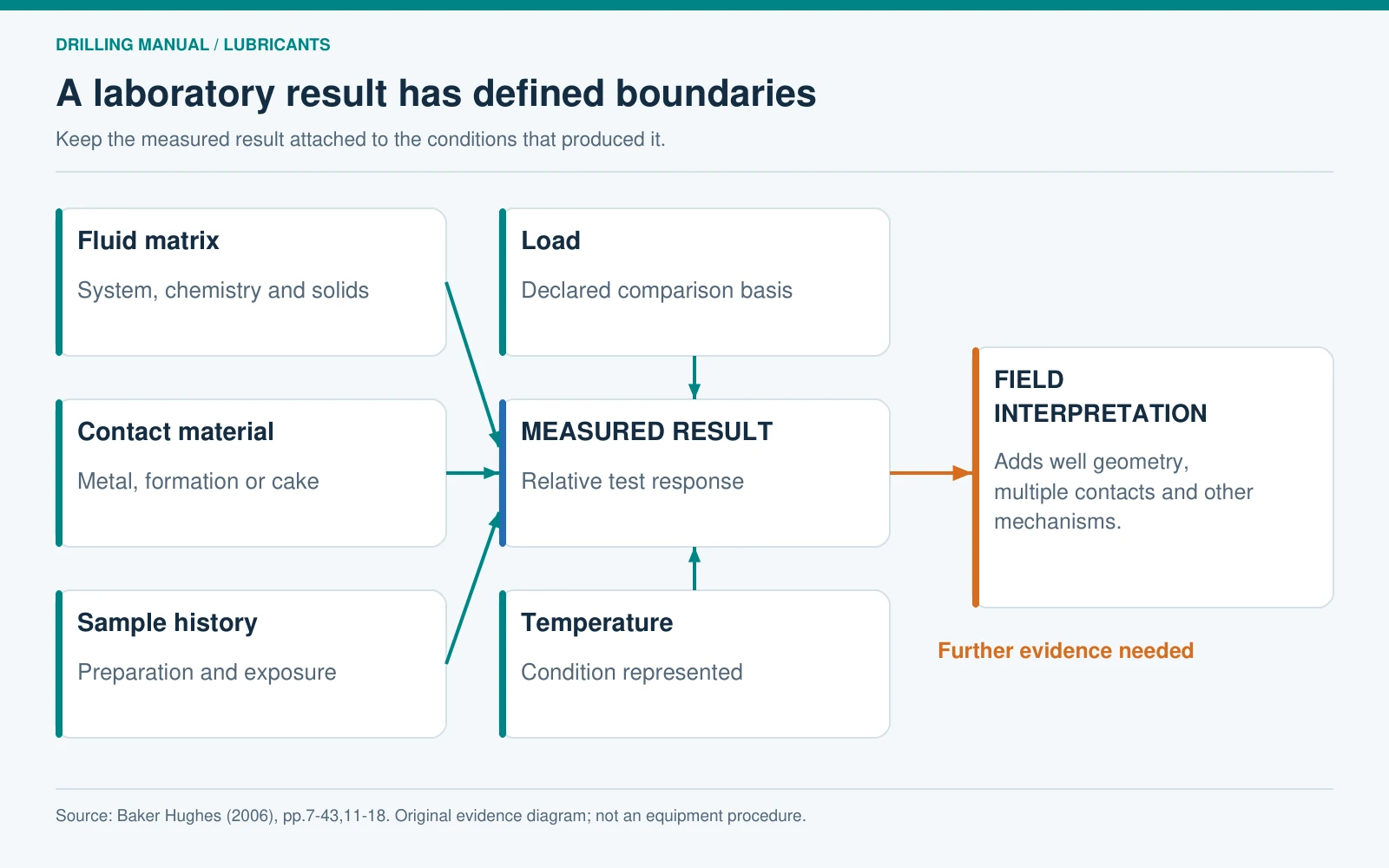
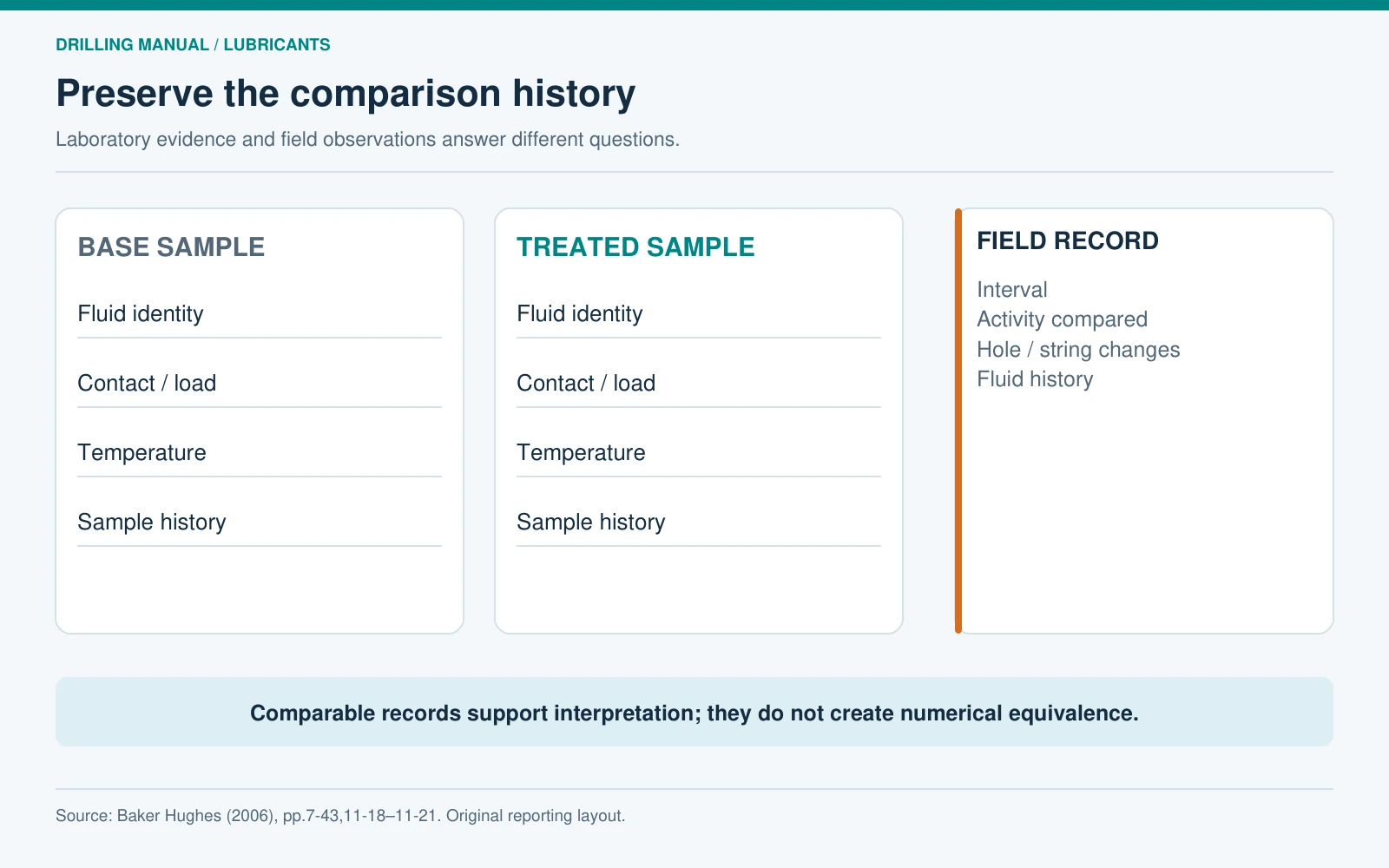
A meaningful comparison starts with an identified untreated fluid and declared test conditions. Record the fluid system, sample history, contact materials, loading basis and temperature represented. Compare treated and untreated samples using the same agreed method. Otherwise, the apparent product difference may include a change in the fluid or the test itself. This record structure follows the manuals’ emphasis on relative testing, representative conditions and compatibility; it is not an instrument operating procedure. [1, pp. 7-43, 11-18–11-20]
Use the actual mud matrix when judging drilling fluid lubricants. A result obtained in clean water cannot establish performance in a fluid containing salts, polymers and drilled solids. Caenn and colleagues describe examples in which additives behave differently between water and mud; Baker identifies temperature, the amount and nature of solids, and longer exposure as important limitations of a simple laboratory prediction. [3, pp. 370–372] [1, p. 7-43]
Separate the baseline from the conditions challenged. “Untreated mud at the same temperature” is a comparison; “fresh untreated mud versus an aged treated sample” combines treatment with a history change. The latter may still be useful, but it answers a different question and needs that limitation written beside the result.
A 20% laboratory improvement is not a torque forecast
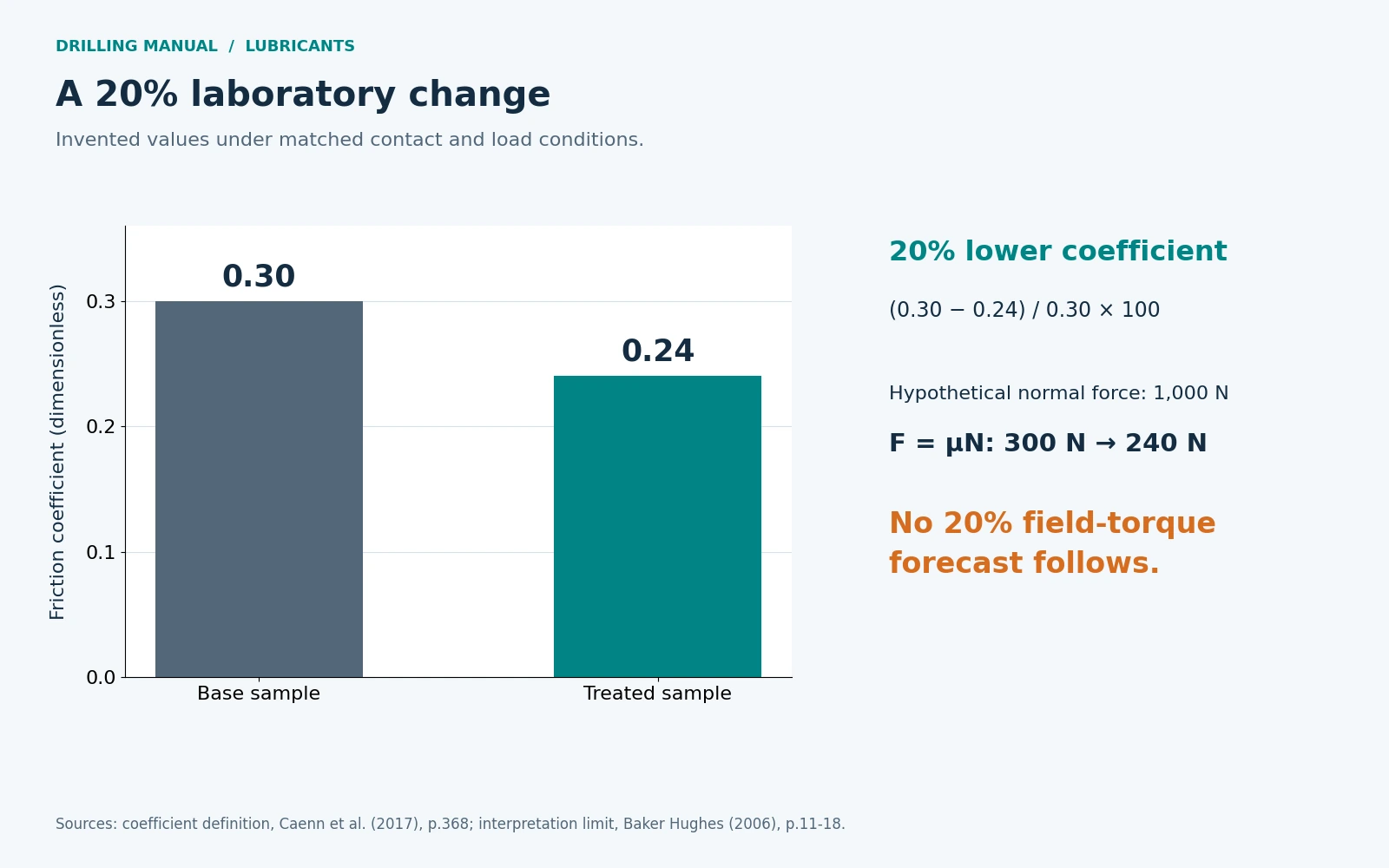
Consider an invented comparison, made only to explain interpretation. The measured friction coefficient falls from 0.30 for a base sample to 0.24 for a treated sample under the same declared contact and load. The relative decrease is (0.30 − 0.24) ÷ 0.30 × 100 = 20%.
| Hypothetical result | Base sample | Treated sample |
|---|---|---|
| Coefficient, dimensionless | 0.30 | 0.24 |
| Illustrative normal force | 1,000 N | 1,000 N |
| Resisting force from F = μN | 300 N | 240 N |
The force calculation uses the definition of friction coefficient given by Caenn and colleagues. The values are not field measurements, an approved test setting or a recommended friction factor. They show a 60 N difference for this hypothetical fixed-load contact. [3, p. 368]
The defensible report is “20% lower measured coefficient in this comparison.” It is not “20% less surface torque in the well.” Field contacts, loading and geometry are distributed along the string, and other torque or drag mechanisms may remain. Baker explicitly limits laboratory coefficients to relative comparisons rather than direct borehole application. [1, p. 11-18]
Compatibility of drilling fluid lubricants with the whole mud
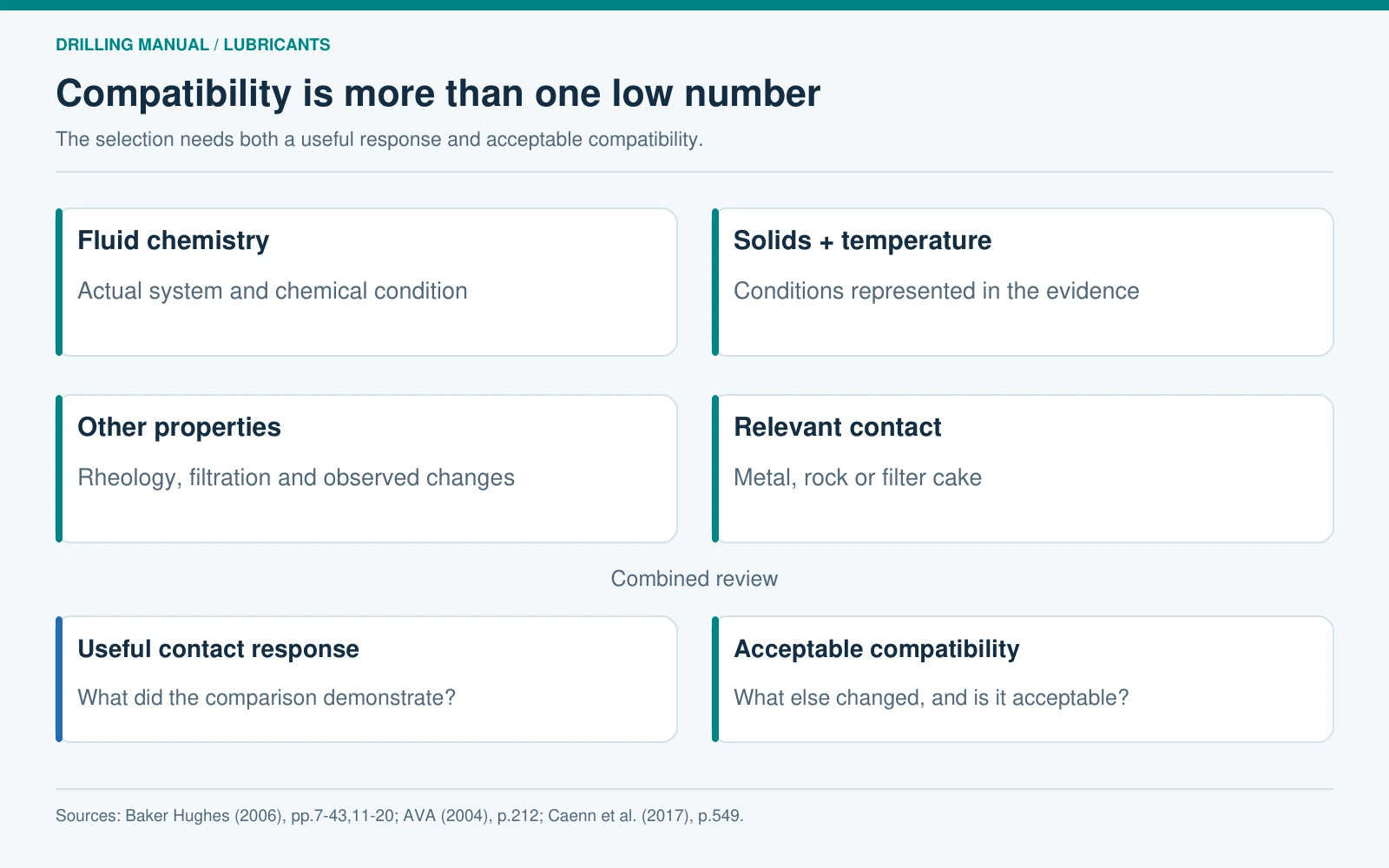
A candidate must preserve the functions that the fluid already performs. Baker warns that some lubricating additives can adversely affect viscosity, filtration control and cost. AVA calls for testing both solid and liquid candidates for selection and compatibility. A favorable friction result therefore belongs beside the other fluid measurements, not on a separate approval sheet that ignores them. [1, p. 11-20] [2, p. 212]
| Review item | Evidence to retain | Unsupported shortcut |
|---|---|---|
| Fluid chemistry | Actual system, water or brine basis and relevant chemical condition | “It worked in another water-based mud.” |
| Solids and temperature | Conditions represented in the comparison | “The fresh cool sample is enough.” |
| Other mud properties | Rheology, filtration and observed changes | “The lowest friction number must win.” |
| Contact objective | Metal, rock or cake evidence as applicable | “Every lubricity test answers the same question.” |
Silicate mud illustrates the problem with broad compatibility labels. Caenn, Darley and Gray note that familiar lubricants for conventional water-based mud do not necessarily provide good lubricity in silicate systems. That is a reason to evaluate the actual formulation, not a reason to reject every silicate fluid or endorse one lubricant family. [3, p. 549]
The existing water-based fluid systems guide provides system context, while the mud properties guide explains the wider property set. This selection review keeps the individual lubricant decision within that larger fluid requirement.
Consider a purely qualitative comparison of two drilling fluid lubricants. Candidate A gives the lower friction reading, but the treated sample also shows a viscosity change that has not been accepted. Candidate B gives a smaller friction improvement and retains the other measured properties within the project’s requirements. The correct report does not declare A superior solely from its friction result. It identifies the unresolved property change, records the useful evidence for B, and explains whether further evaluation is needed. Nor does B automatically qualify for a different mud or contact. This example illustrates the selection logic; it reports no measured product performance. [1, p. 11-20]
Solid drilling fluid lubricants need an equipment check
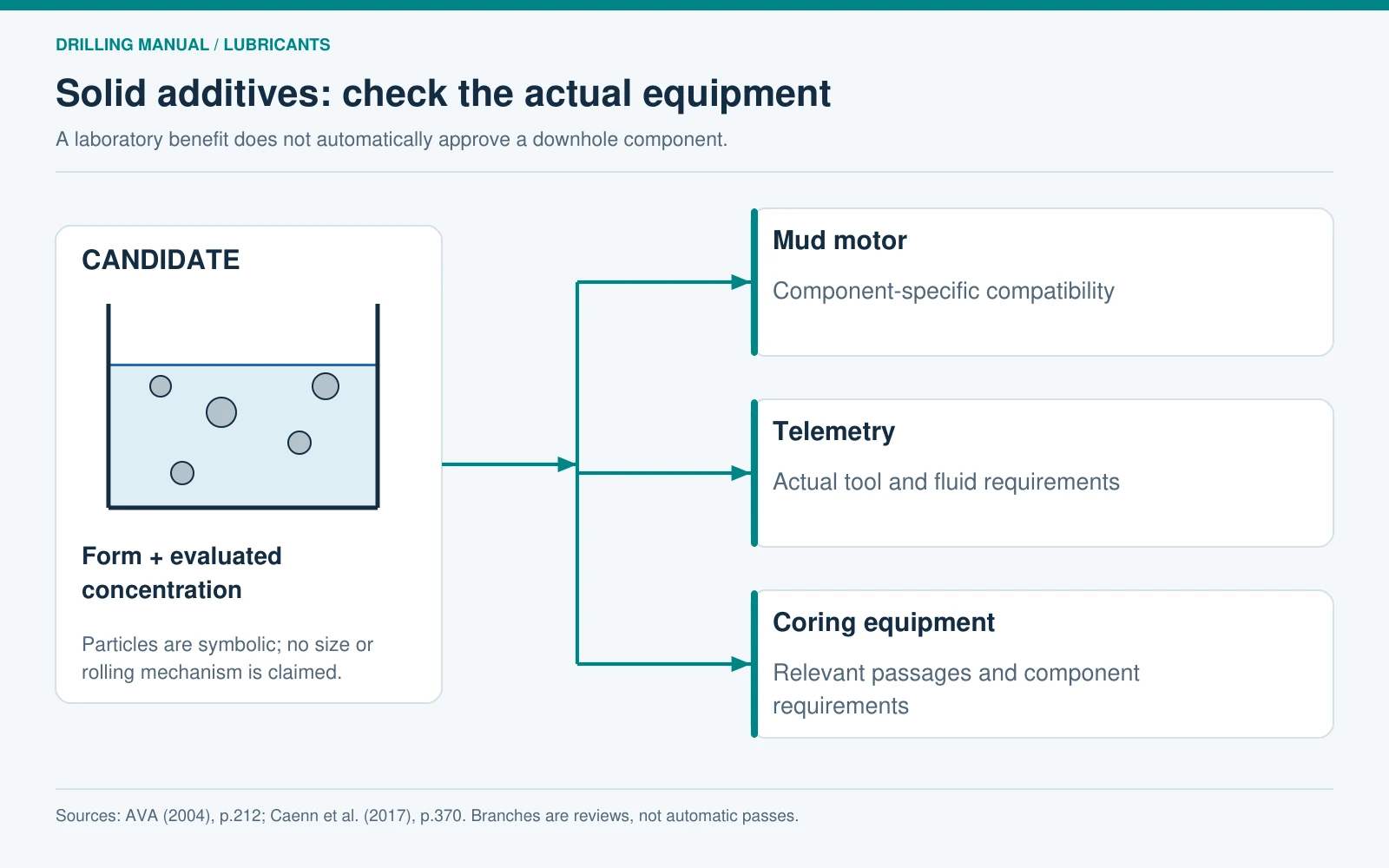
Physical form adds another question. AVA specifically calls for checking solid-phase lubricants against mud motors, telemetry and coring equipment at the proposed concentration. A material that improves a laboratory contact is not automatically suitable for every downhole component through which the fluid passes. [2, p. 212]
Record the candidate’s form and the actual equipment configuration. Ask for the compatibility basis rather than substituting an assumed universal particle-size limit. Nor should a diagram of rounded particles imply that every solid lubricant works as a miniature rolling bearing: the Caenn text discusses uncertainty over the mechanism of glass beads, including their incorporation into filter cake. [3, p. 370]
Liquid candidates still need fluid compatibility evidence. “Liquid” answers a handling-description question; it does not guarantee that rheology, filtration or the relevant contact response will remain acceptable.
Read field behavior without losing the alternative explanations
A rise in torque or drag does not identify a missing lubricant. Baker describes mechanical and hole-geometry contributions, while Caenn includes changing direction, undergauge hole and drillstring dynamics. If those contributions change during a trial, a before-and-after surface reading cannot isolate the additive’s effect by itself. [1, p. 11-18] [3, p. 368]
Preserve the operating context alongside the fluid record: the interval, the activity being compared and any known changes in hole or string conditions. Treat a favorable observation as evidence to assess, rather than proof that every part of the original problem was friction at the treated interface. A lubricant comparison should remain traceable when the next shift reviews it.
Filter-cake friction and differential sticking are related topics, but a lower bench coefficient does not exclude every sticking mechanism. The separate differential sticking guide owns that wider problem. Likewise, solids control remains relevant to the condition of the circulating fluid; adding a lubricant does not erase the solids history. [1, pp. 7-43, 11-20–11-21] [3, p. 372]

A selection record for drilling fluid lubricants
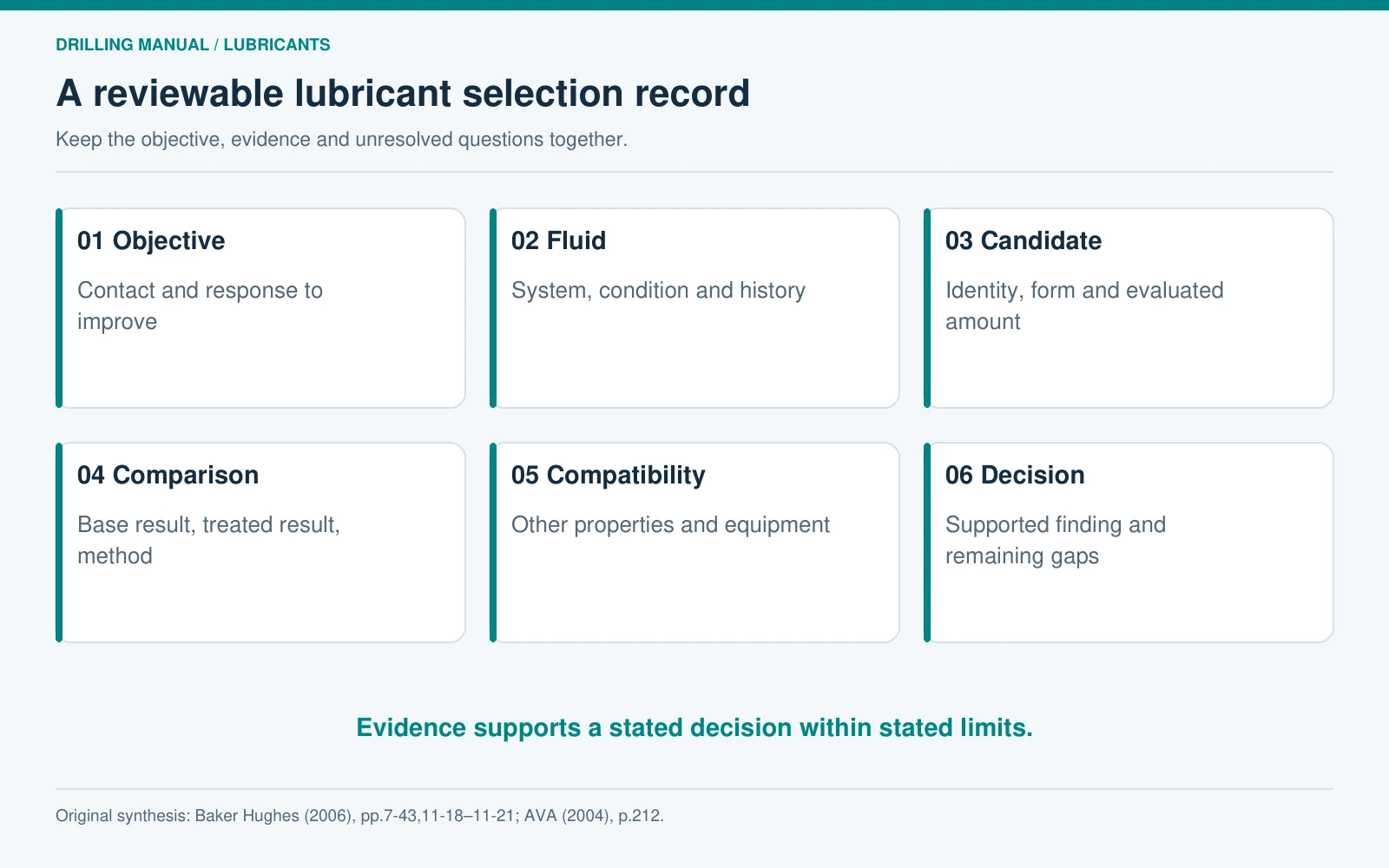
Bring the evidence together in a short record that another engineer can review without reconstructing the comparison. The following fields are an original reporting structure, not a universal qualification standard:
- Objective: identify the contact and the response to improve.
- Fluid identity: record the actual system, sample condition and relevant solids or chemistry information.
- Candidate: identify the product, physical form and evaluated concentration.
- Comparison: retain the untreated result, treated result, method and represented conditions.
- Compatibility: record other mud-property changes and equipment questions.
- Decision: state what the evidence supports, what remains unresolved and who reviews the next evaluation.
Keep this record connected to the daily mud report. Laboratory evidence and field observations then retain their different meanings while referring to the same fluid history. Selection is strongest when a useful contact response and acceptable compatibility are both demonstrated; one should not be silently substituted for the other.
Frequently asked questions
These answers summarize the selection boundaries developed above.
Are all drilling fluid lubricants interchangeable?
No. The relevant fluid chemistry, contact, temperature, solids and equipment differ. A material’s success in one water-based system does not establish performance in another; the silicate example makes this limitation explicit. Compare candidates in the intended system and retain the conditions represented. [1, p. 7-43] [3, p. 549]
Does lower laboratory friction mean lower field torque?
It supports a relative improvement in the measured contact. It does not directly predict the magnitude of surface torque change in a well. Geometry, multiple contacts and mechanical contributions still matter. The 20% example above deliberately stops at the laboratory comparison. [1, p. 11-18]
Is an extreme-pressure test a filter-cake test?
No. Baker notes that an EP test does not reproduce drillpipe contact with filter cake. Cake-contact evidence requires an evaluation that actually represents that interface. Label each result by the response measured rather than treating unlike instruments as interchangeable. [1, p. 7-43]
Can a lubricant correct every cause of drag?
No. Mechanical restrictions, hole geometry and other drilling conditions can contribute to drag. A useful lubricant acts on the contact behavior represented by its selection; it does not establish that the rest of the hole condition is satisfactory. [1, p. 11-18] [3, pp. 368, 372]
Why check viscosity and filtration during selection?
Because the fluid must retain its other required functions. Baker identifies adverse viscosity and filtration effects as possible consequences of lubricant additions. A friction improvement accompanied by an unacceptable property change is an unresolved selection, not an automatic success. [1, p. 11-20]
What extra check applies to solid additives?
AVA highlights compatibility with mud motors, telemetry and coring equipment at the proposed concentration. Obtain evidence for the actual components and candidate. A generic particle sketch or successful beaker comparison cannot supply that equipment-specific confirmation. [2, p. 212]
References
- Baker Hughes Drilling Fluids. Drilling Fluids Reference Manual, revised 2006. Chapters 7 and 11. Printed pages: 7-43–7-45, 11-18–11-21. PDF pages in the edition consulted: 444–446, 565–568.
- AVA S.p.A., A Newpark Company. Drilling Fluids Manual, Version 1, November 2004. Printed pages: 212. PDF pages in the edition consulted: 214.
- Caenn, Ryen; Darley, H.C.H.; and Gray, George R. Composition and Properties of Drilling and Completion Fluids, Seventh Edition. Gulf Professional Publishing/Elsevier, 2017. ISBN 978-0-12-804751-4. Printed pages: 368–372, 549. PDF pages in the edition consulted: 370–374, 550.