What drilling waste management must control
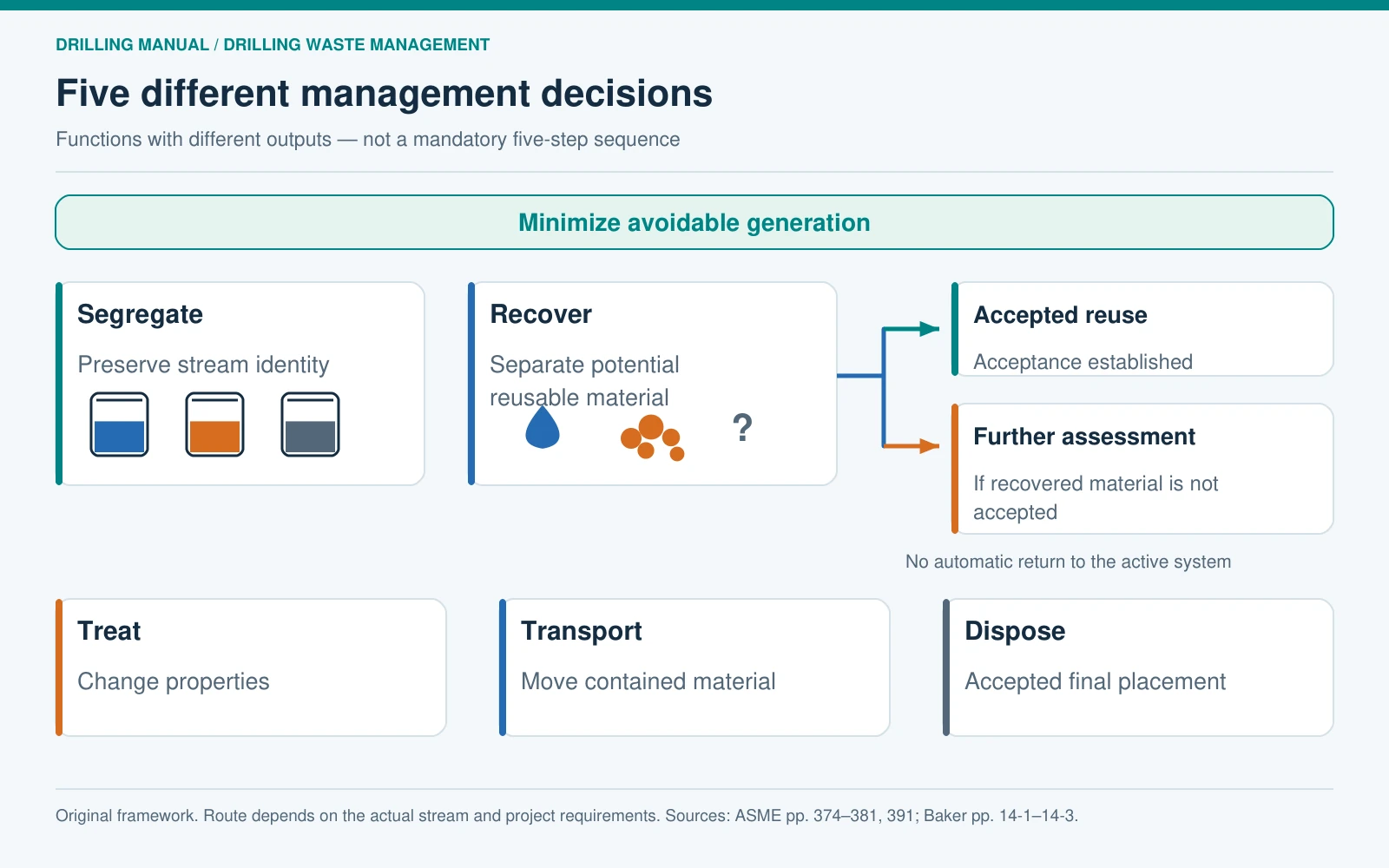
Drilling waste management is the planned handling of the materials that remain after drilling-fluid use and solids separation, from their identification at the rig to an accepted recovery, treatment or disposal destination. It includes wet cuttings, unwanted drilling fluid and other associated liquids. Choosing a treatment machine is only one part of that job. The drilling waste management plan must also explain which streams stay separate, where recovered material can go and how the remaining waste will be accounted for.
The ASME handbook distinguishes treatment from disposal: treatment changes or separates the waste, while disposal addresses its eventual placement. Baker Hughes places these decisions within a wider system of waste reduction, reuse, recovery, logistics and reporting. Together, these books support a practical rule: follow every output, including the material recovered by the process. [1, pp. 367–374, 391] [2, pp. 14-1–14-3]
This guide explains the decisions and evidence needed for that plan. Equipment settings, waste classifications, approved destinations and discharge requirements must come from the applicable project documents. Historical practices in the source books are not presented as current permission to discharge or dispose of waste.
Identify and segregate the drilling waste streams
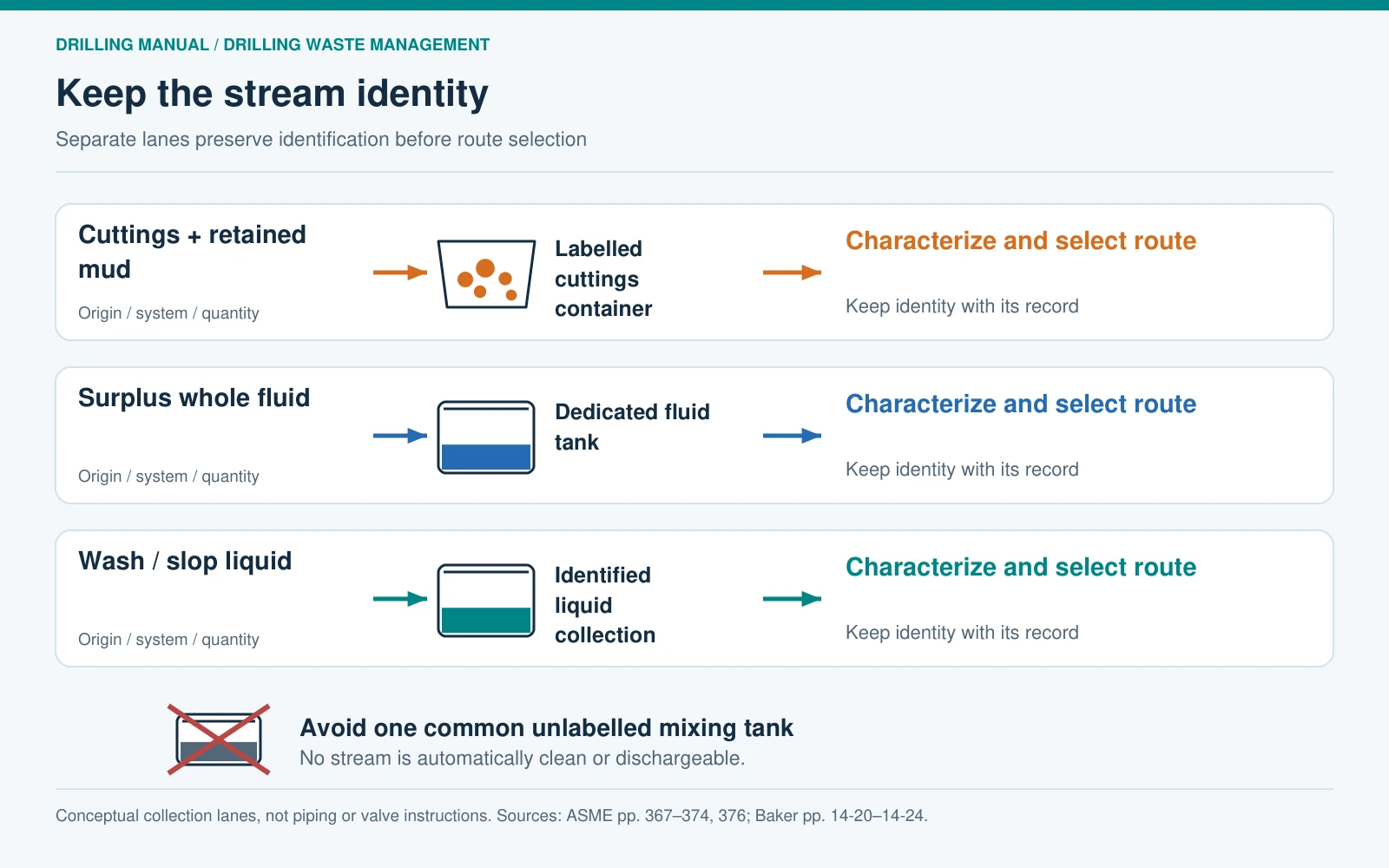
Start drilling waste management planning with the source of each stream. Cuttings leaving a shaker carry associated drilling fluid; they are not the same material as the drilled rock volume calculated from hole geometry. Spent whole mud, tank-cleaning liquid and oily drainage also have different origins and may need different handling. The ASME chapter makes this distinction central to waste quantification. [1, pp. 367–374]
Segregation preserves options. Baker Hughes explains that mixing relatively uncontaminated liquid with oily residues can enlarge the quantity requiring that treatment route. Separation therefore begins with collection and routing, before a later separator is asked to undo the mixture. It does not mean assuming that an apparently clear stream is already acceptable for discharge. [2, pp. 14-20–14-24]
| Stream | Useful identification | Decision to retain |
|---|---|---|
| Cuttings with retained mud | Originating interval, fluid system, wet mass or volume and sampling basis | Recovery opportunity and residual destination |
| Surplus or unwanted whole fluid | System identity, condition, quantity and reason for removal | Recondition, reuse, treat or dispose |
| Wash liquid or slops | Collection area, known contacts, separate oil/water/solids observations | Suitable treatment and acceptance evidence for each output |
| Other drilling-related residues | Material identity and origin, such as cement or spacer returns | Keep the receiving route compatible with that material |
The table is an original identification aid. A stream name is a starting point for characterization, not a complete laboratory description or a waste classification.


Reduce avoidable waste before selecting treatment
Drilling waste management starts upstream of the waste container. Solids-control performance affects both the drilled solids left in the circulating fluid and the liquid carried out with separated solids. An operating choice that produces very wet discharge can lose useful fluid; ineffective solids removal can also increase the need for fluid dilution and subsequent discard. The complete fluid-and-waste balance matters to drilling waste management. [1, pp. 367–372] [2, pp. 14-20–14-21]
Look beyond the active mud system. Tank residues, changes in the product carried by transport tanks, washing and the collection of rainwater can add substantially to the handling task. The books describe planning collection paths and reducing unnecessary additions of water as part of waste minimization. The appropriate arrangement depends on the rig and the receiving process; it should be settled before streams are combined. [1, pp. 375–377] [2, pp. 14-22–14-24]
The separate guides to solids control, mud cleaners and oilfield centrifuges cover the equipment roles. Here, the review question is broader: where does each discharge go, and what additional fluid, solids or cleaning waste does that choice create?
Recovery changes the balance, not the acceptance decision
In drilling waste management, a recovered stream has potential value, but recovery alone does not establish its suitability for another use. The ASME discussion of thermal treatment makes this explicit: recovered oil quality depends on the process, while the remaining solids still require handling. The same accounting discipline is useful whenever a waste stream is separated. [1, pp. 395–397]
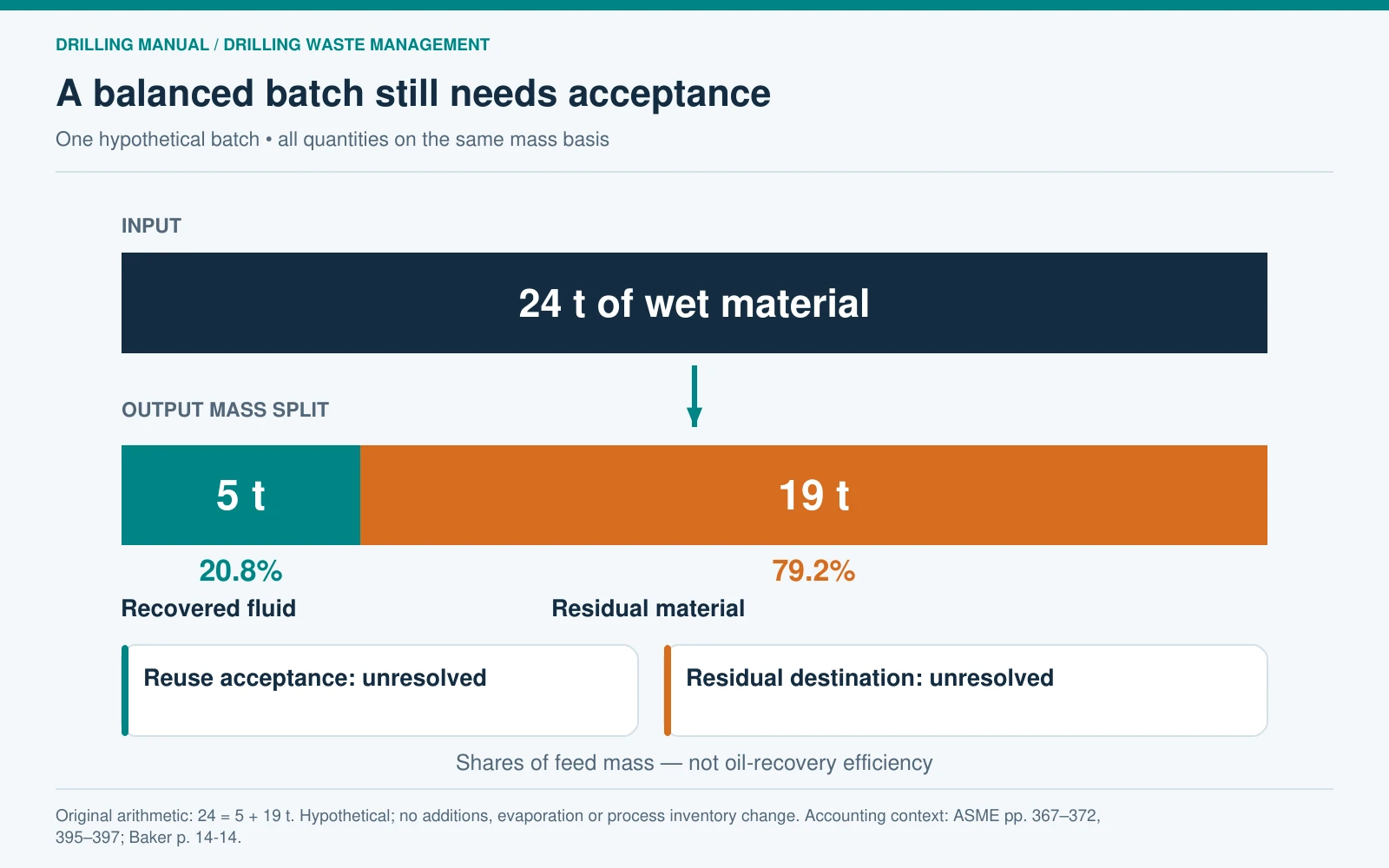
Consider an original, hypothetical mass balance. A separator receives 24 tonnes of wet material and produces 5 tonnes of recovered fluid plus 19 tonnes of residual material. Assume the same batch boundary, no additions, no evaporative loss and no change in stored material inside the process.
| Quantity | Mass | What it establishes |
|---|---|---|
| Incoming wet material | 24 t | Declared batch input |
| Recovered fluid | 5 t | 20.8% of input mass in this output |
| Residual material | 19 t | 79.2% of input mass still to be managed |
| Balance check | 5 + 19 = 24 t | Mass accounted for under the assumptions |
The 20.8% figure is not an oil-recovery efficiency because the oil content of the feed was never specified. It also says nothing about contamination or the suitability of either output. Record the recovered-fluid acceptance decision separately from the mass balance and the residual destination. These invented quantities illustrate bookkeeping, not expected equipment performance.
Define the reporting period as carefully as the unit. The example closes one batch; a continuous process may hold material at the start and end of a shift. Comparing an incoming quantity for one period with outgoing quantities for another can create an apparent discrepancy. Account for that stored material before assigning a cause to the difference. Keep weighed mass, measured volume and estimated volume visibly different in the record.
For recovered fluid, connect the proposed reuse with its relevant drilling-fluid property assessment and the receiving system’s requirements. A recovered quantity that has not been accepted remains a candidate resource. Counting it immediately as useful replacement fluid would overstate the achieved benefit.
Drilling waste management treatment options
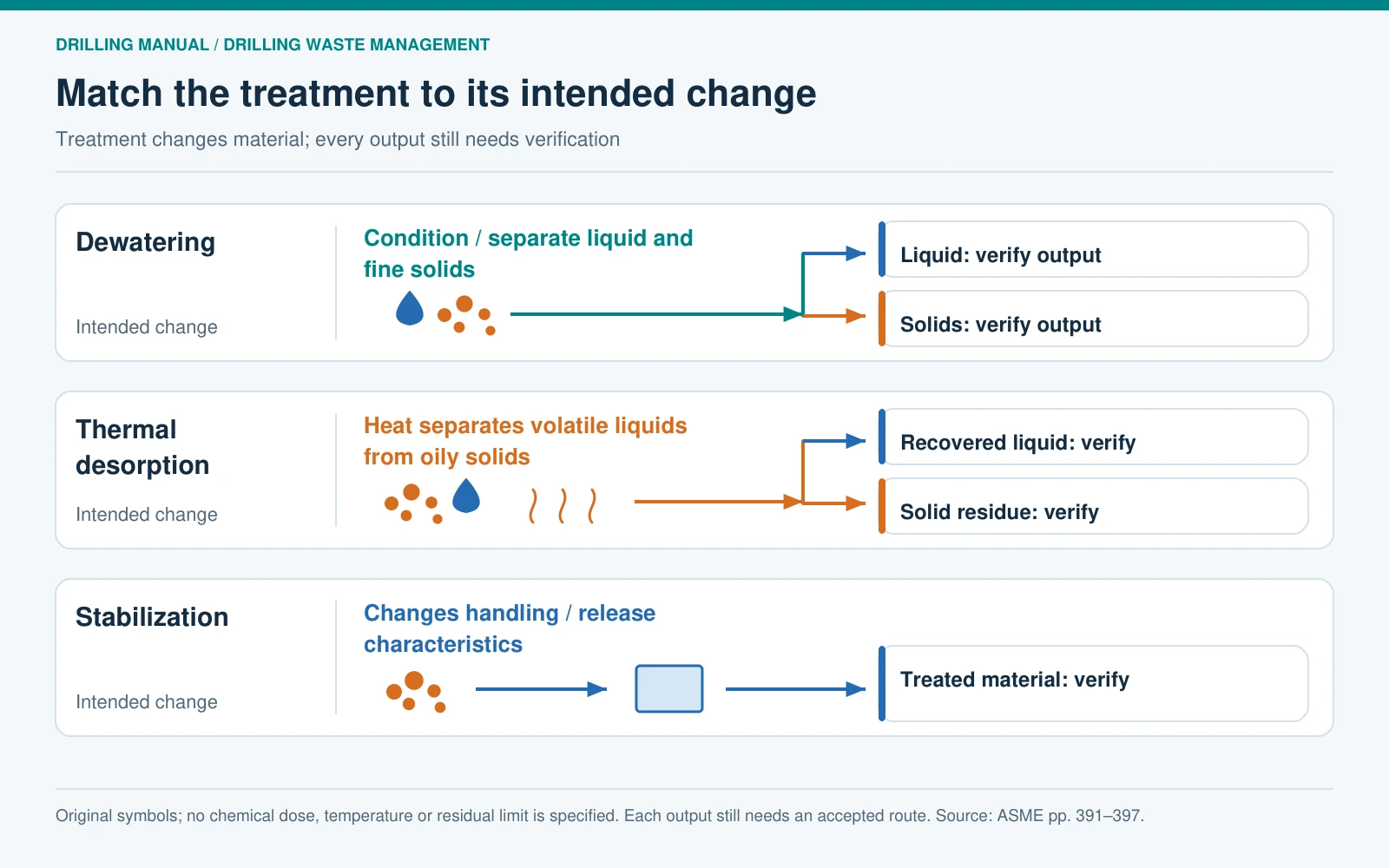
Different drilling waste management treatments solve different problems. The ASME handbook describes dewatering, thermal desorption and solidification or stabilization as distinct approaches. Their selection depends on the material and the required change, followed by assessment of the resulting streams. A process label does not replace that assessment. [1, pp. 391–397]
| Approach | Main purpose in this comparison | Question after treatment |
|---|---|---|
| Dewatering | Separate liquid and fine solids, with chemical conditioning where required | What is the quality and destination of the liquid and separated solids? |
| Thermal desorption | Use heat to separate volatile liquid components from oily solids | Are recovered liquids suitable for their proposed use, and where will solids go? |
| Solidification or stabilization | Change handling properties and, depending on the process, reduce contaminant release | What testing supports the claimed result and the destination of the treated material? |
Removing one constituent does not prove that all concerns have disappeared. In its thermal-desorption discussion, the handbook notes that salts and metals remain relevant in the solid residue. Likewise, clear-looking water after separation is not by itself evidence that the liquid meets the intended reuse or disposal requirements. [1, pp. 392, 395–397]
Keep the feed description with the output results. A result from one waste mixture does not automatically describe a later batch with different fluid, water content or retained solids. Specify which sample and process period the evidence represents, and what aspect of the proposed destination it addresses. Describe the proposed output quality and its verification before comparing treatment quotations. Keep detailed slop-processing, cuttings-dryer and thermal-treatment design in their dedicated subjects. This article supplies the framework for deciding which questions those specialists must answer.

Include transport and the receiving destination
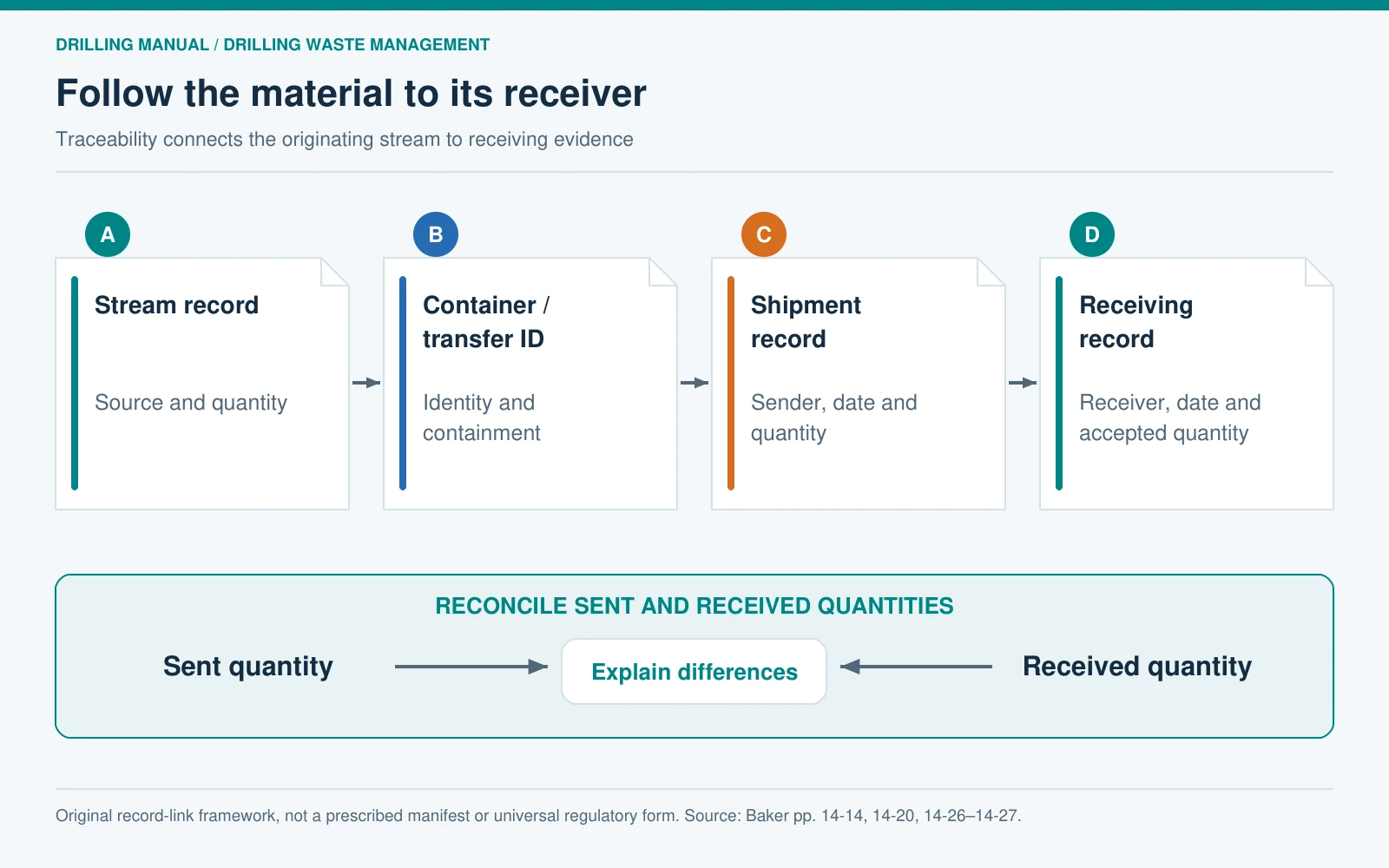
Drilling waste management remains incomplete when material merely leaves the rig. A drilling waste management shipment record should connect the originating stream and measured quantity with the container or transfer batch, transporter, receiving facility and receipt evidence. Baker Hughes describes tracking waste through to disposal or recycling, including reconciliation between quantities sent and received. [2, pp. 14-14, 14-20]
Transport selection also affects the rig arrangement. The manual discusses cuttings boxes, bulk systems, available footprint, loading constraints and turnaround time. A container cycle includes filling, storage, transfer, unloading and its return to availability; the outbound journey is only part of the cycle. Offshore handling may also depend on vessel schedules and weather. [2, pp. 14-26–14-27]
Confirm the receiving route for the actual stream, not simply the presence of a nearby facility. The ASME chapter distinguishes transport to shore, treatment at a facility and final disposal. A site capable of accepting one material may not be the destination for every residue created during the well. [1, pp. 380–381]
For a proposed injection route, retain the need for a specifically engineered receiving formation, access and isolation assessment. It is not an automatic alternative whenever transport becomes difficult. This guide does not supply an injection design or operating program. [1, pp. 378–380]

Track accumulation as well as treatment performance
A process can produce an acceptable sample yet fail to keep pace with incoming waste. Drilling waste management planning therefore needs both quality evidence and the timing of generation, processing and removal. The handbook discusses limited storage and changing waste-generation rates; Baker Hughes connects container requirements with the drilling interval and turnaround time. [1, p. 380] [2, p. 14-26]
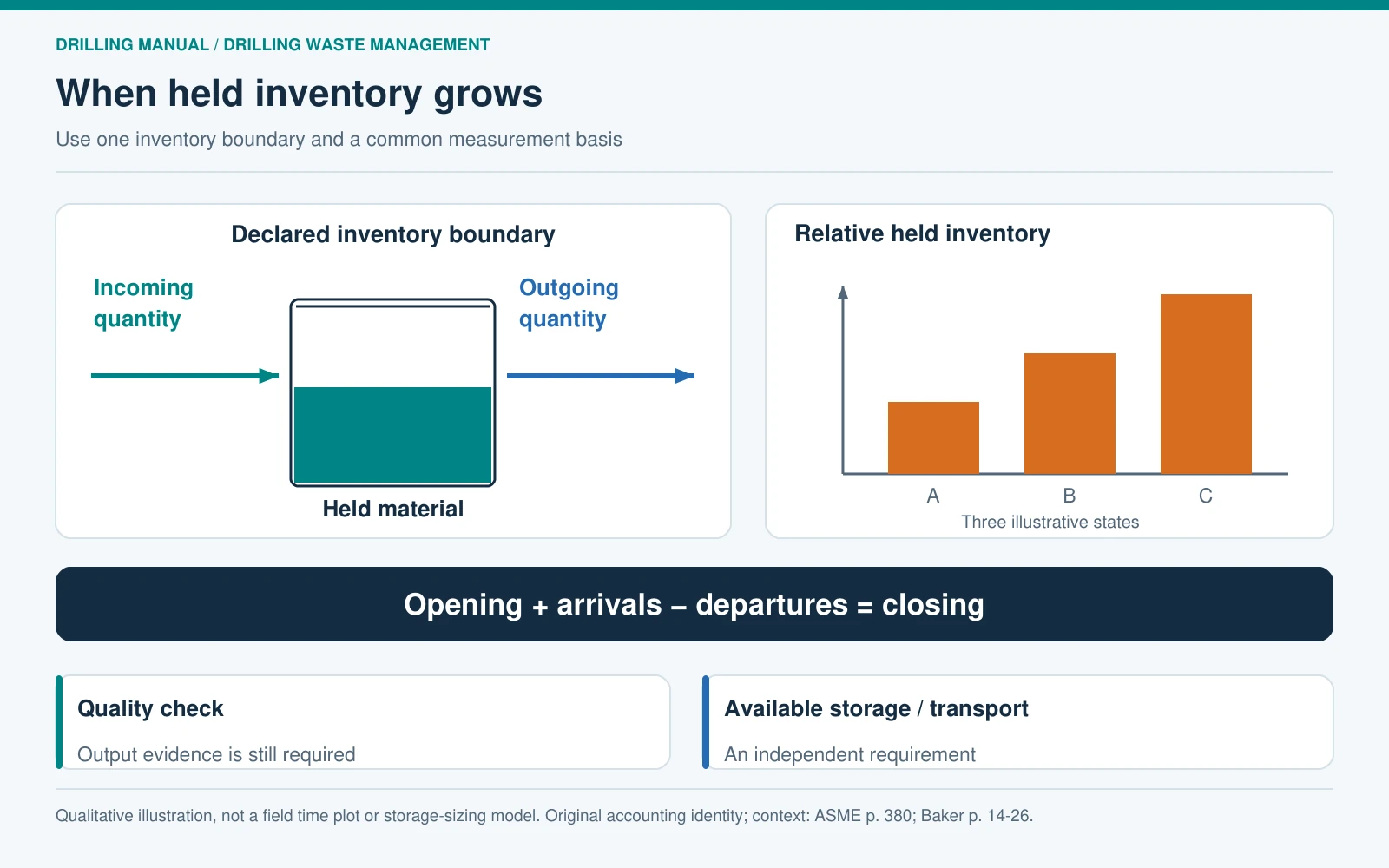
For a stated inventory boundary and a common measurement basis, compare opening quantity plus arrivals against departures and closing quantity. If arrivals exceed departures, the held inventory grows. A larger nameplate processing rate does not resolve interruptions in feeding, output storage or transport. Record the actual constraint rather than treating every accumulation as a treatment-quality problem.
Use separate performance entries for waste generated, recovered material accepted for reuse, residuals awaiting movement, material received at the destination and unexplained differences. Do not substitute the amount processed for the amount finally disposed. Where records use different mass and volume units, retain the conversion basis and avoid adding them directly.
The daily mud report can support fluid-use context, while the waste record follows the resulting streams. Keep their boundaries explicit so the same transfer is not counted twice.
Make the drilling waste management decision reviewable
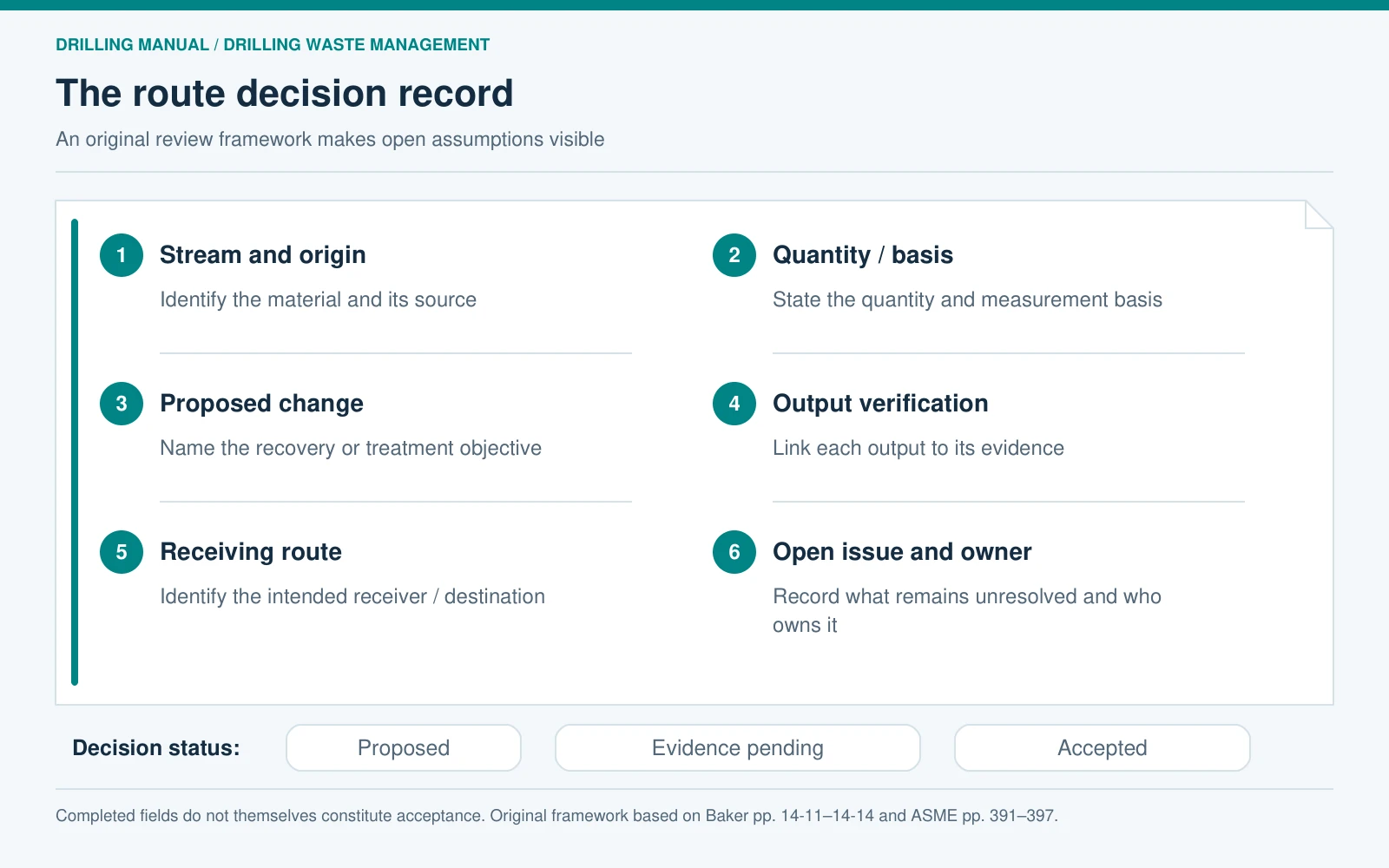
A useful drilling waste management decision record ties the route to the evidence: stream identity, expected quantity and variability, proposed recovery or treatment, required output checks, receiving arrangement and unresolved assumptions. Add a named owner for each open issue. This is an original organizing framework based on the manuals’ emphasis on coordinated planning, measurement and feedback. [2, pp. 14-11–14-14]
Compare total system consequences rather than one treatment price. Include collection, storage, fluid recovered for an accepted use, transport, further processing, residual disposal and delays. A reduction in hauled mass may be useful, but it must be assessed alongside the quality and fate of the outputs.
Close the record with actual receipts and a reconciliation of the declared streams. Explain deviations such as extra wash liquid, changed fluid identity or a different receiving route. That gives the next well a usable planning basis and makes an apparently successful treatment result understandable in the context of the whole operation.
Frequently asked questions
Is water-based drilling waste automatically harmless?
No. Its base-fluid name does not describe every additive, entrained material or receiving-environment concern. The ASME discussion includes salts, retained oil and metals among the characteristics that may matter. Characterize the actual waste and apply the project-specific acceptance requirements. [1, pp. 372–374]
Does solids control complete the waste-management job?
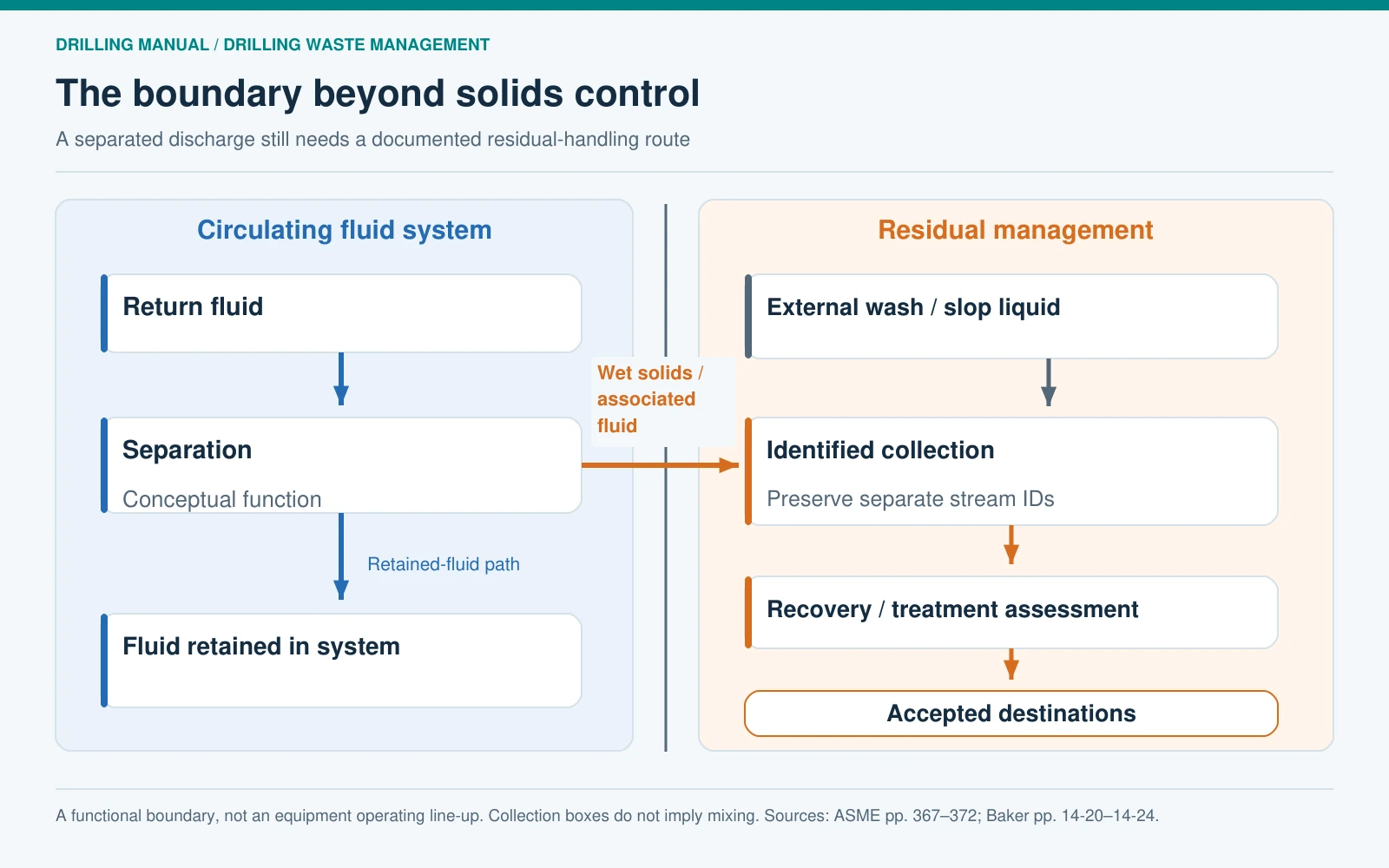
No. Solids control separates material from the circulating fluid, but its discharge remains a stream to collect, characterize and route. Some liquid can be recovered; the residual solids and any rejected liquid still need a documented destination. [1, pp. 367–372, 391]
Can recovered drilling fluid return directly to the system?
Only when its condition and the proposed use have been evaluated and accepted. Recovered quantity and recovered quality are separate entries. The source handbook specifically notes that recovered-oil quality can vary with the treatment process. [1, pp. 395–397]
Does clear separated water prove it can be discharged?
No. Appearance does not establish the acceptance criteria for reuse or disposal. The handbook notes that separated water may require further treatment. The applicable authorization and evidence must be identified for the actual receiving route. [1, p. 392]
Is thermal desorption a disposal method?
It is a treatment step. It separates volatile liquid components from oily material, producing outputs that still require an accepted use or destination. Treating the solids does not erase the need to account for recovered liquid and residual contaminants. [1, pp. 395–397]
What should the final waste report demonstrate?
It should connect the identified incoming streams to recovered products, residuals, shipments and receiving evidence, with consistent quantities and explained differences. A processing total alone does not show where the material ultimately went. [2, pp. 14-14, 14-20]
References
- Piper, William; Harvey, Tim; and Mehta, Hemu. “Waste Management,” Chapter 16 in ASME, Drilling Fluids Processing Handbook. Gulf Professional Publishing/Elsevier, 2005. ISBN 0-7506-7775-9. Printed pages: 367–381 and 391–397. PDF pages in the edition consulted: 394–408 and 418–424.
- Baker Hughes Drilling Fluids. Drilling Fluids Reference Manual, revised 2006. Chapter 14, “Fluids Environmental Services.” Printed pages: 14-1–14-4, 14-11–14-14, 14-20–14-28. PDF pages in the edition consulted: 657–660, 667–670, 676–684.