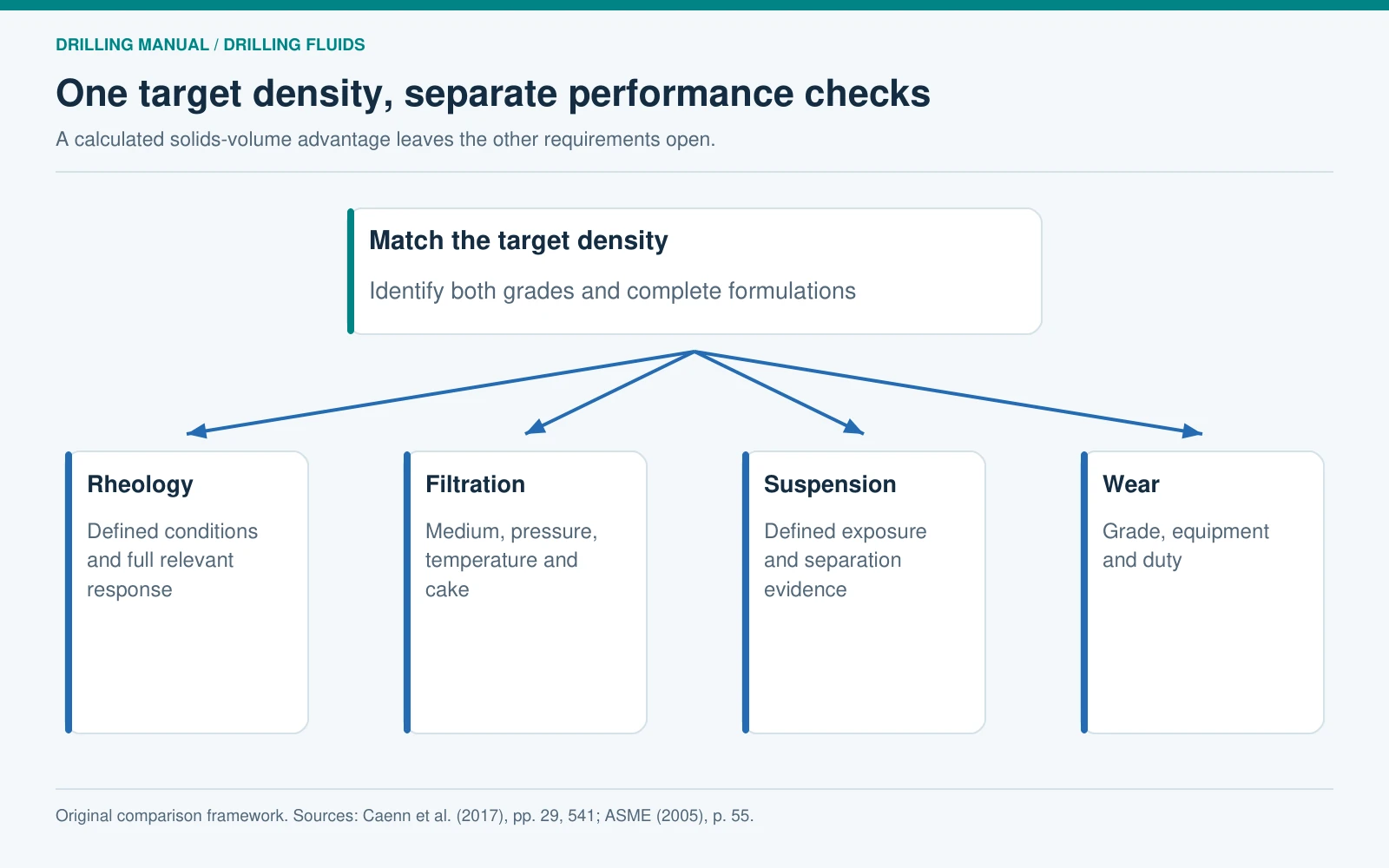
Hematite vs barite in drilling mud is a tradeoff between weighting-material density and the other properties of the finished fluid. Hematite’s higher particle density can reduce the volume of weighting solids needed for a specified mud density. The selection still has to address particle size, rheology, suspension, filtration and equipment wear. A density advantage does not establish that every grade will perform better in every system. [1, pp. 540–541] [3, p. 55]
This guide uses an original mass-and-volume example to explain that tradeoff. The existing barite properties guide covers barite itself; the comparison here focuses on the evidence needed before replacing or comparing weighting materials.
Hematite vs barite: identify the actual weighting material
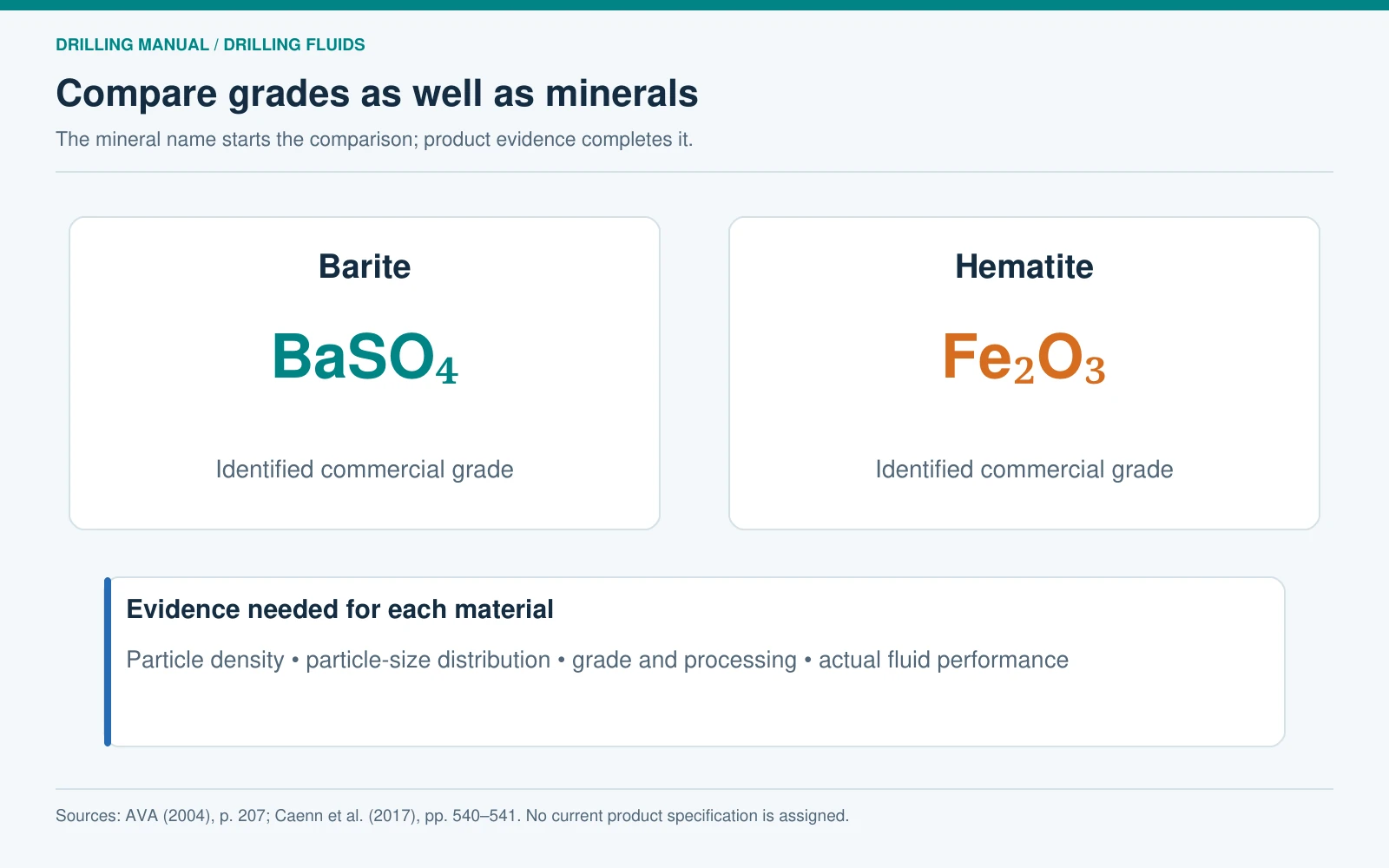
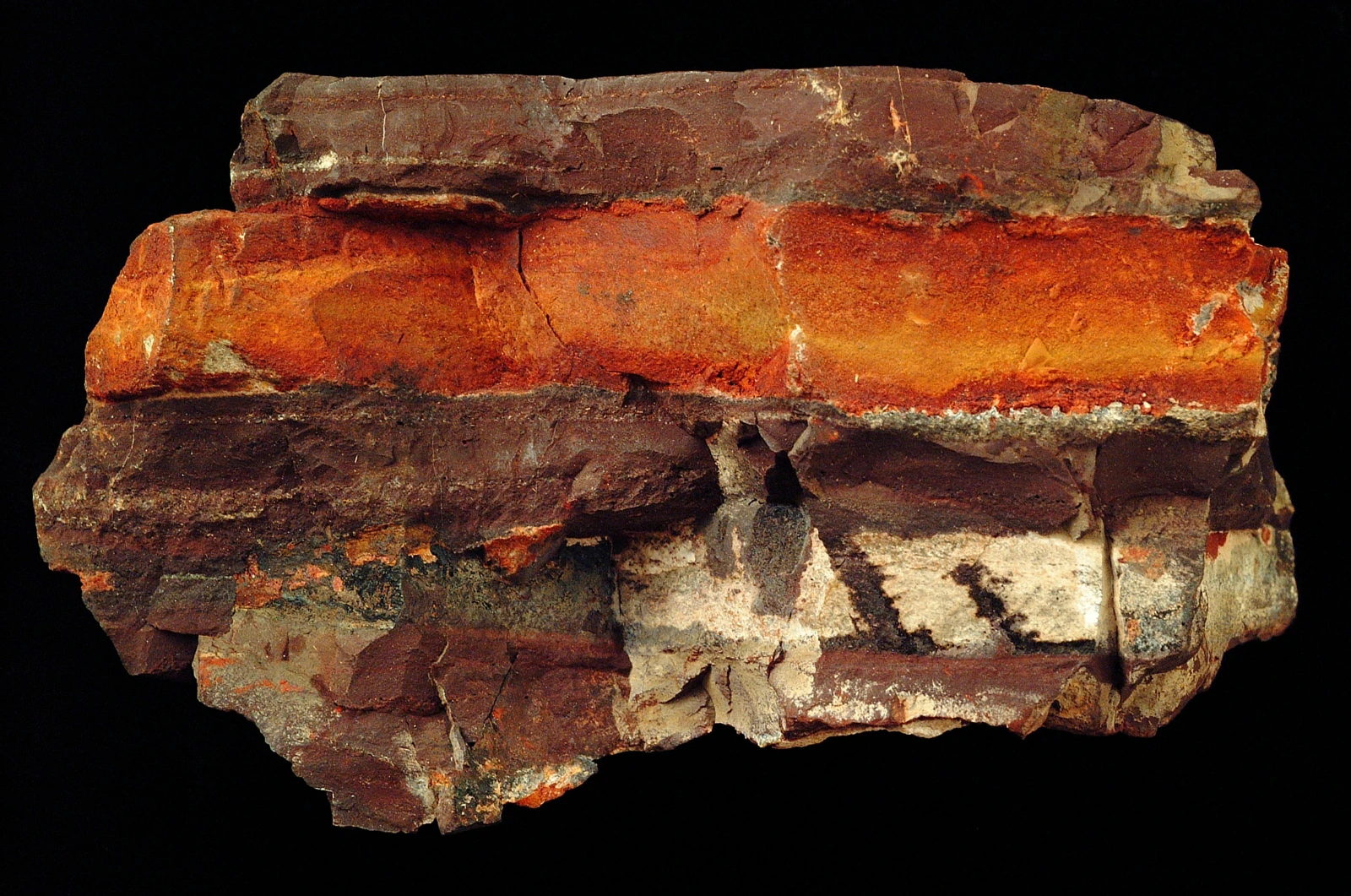
Barite is principally barium sulfate, BaSO4; hematite is ferric oxide, Fe2O3. AVA’s weighting-material table lists higher specific-gravity and hardness ranges for hematite than for barite. Caenn and colleagues discuss the ground mineral products used to increase drilling-fluid density. [2, p. 207] [1, pp. 540–541]
Those mineral descriptions are a starting point. A commercial material also has a grade, particle-size distribution, purity and processing history. Identify the actual product and its supporting test information rather than assigning all products the same assumed density or the same performance.
The numerical specifications quoted in historical manuals are edition-specific. This article uses explicitly stated illustrative densities for its arithmetic; it does not reproduce those historical limits as current procurement requirements. For a purchase or qualification, retain the specification and test basis that apply to the actual material.
Keep particle density separate from bulk powder density. The former enters the ideal mixture calculation below. The latter includes spaces between particles and belongs to storage and handling. A high mass of powder in a silo is not, by itself, evidence of the density or behavior of the finished mud.

Why higher particle density can reduce solids volume
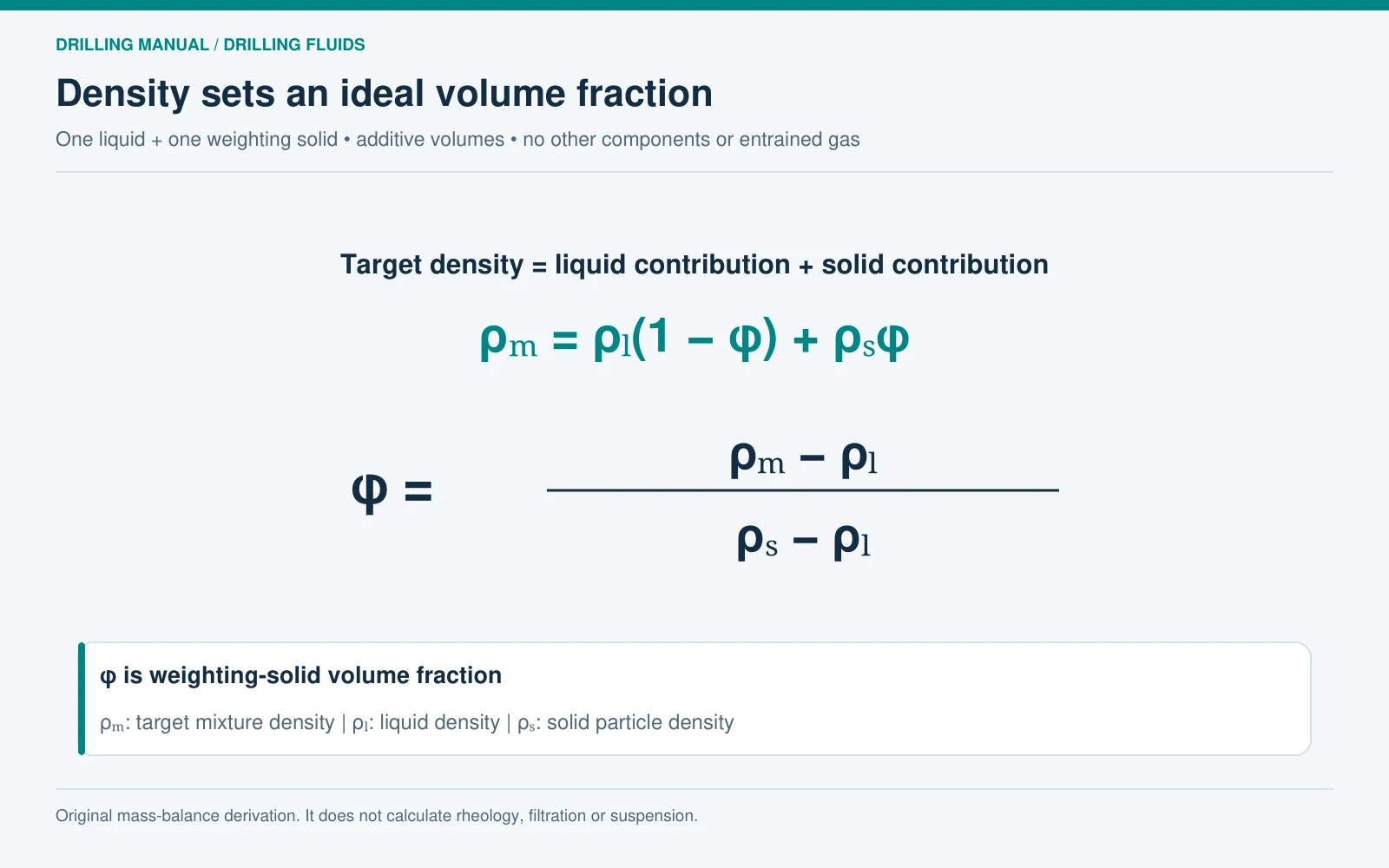
For an ideal two-component mixture with additive volumes, the final mud density is the liquid density multiplied by its volume fraction plus the solid density multiplied by its volume fraction. Let φ be the weighting-solid volume fraction. Then ρm =ρl(1−φ)+ρsφ, and rearranging gives φ =(ρm−ρl)/(ρs−ρl).
At the same target mud density and liquid density, a larger solid density increases the denominator and reduces the required solid volume fraction. This is the mass-balance reason for the lower weighting-solids volume discussed by Caenn and colleagues. It is not a prediction of the viscosity or filtration result. [1, pp. 540–541]
The simple relation assumes one uniform liquid phase, one weighting solid, no other solids, no entrained gas and additive volumes. Actual mud contains additional components and requires the appropriate formulation calculation. Use the drilling-fluid calculation guide for the broader weight-up context.
In a hematite vs barite comparison, hold the desired final density constant before comparing solids demand. Comparing equal sacks or equal masses answers a different question and can leave the two final fluids at different densities.
The same issue can be seen without formulating a mud. At the illustrative solid densities used below, 1000 kg of barite occupies about 0.238 m³ of particle volume, whereas 1000 kg of hematite occupies 0.200 m³. Those are solid-particle volumes calculated from mass divided by density. They are not the volumes occupied by the powders in storage, because a powder bed also contains void spaces. Nor do they define the final density obtained after mixing with an unspecified amount of liquid.
Worked example at equal final mud density
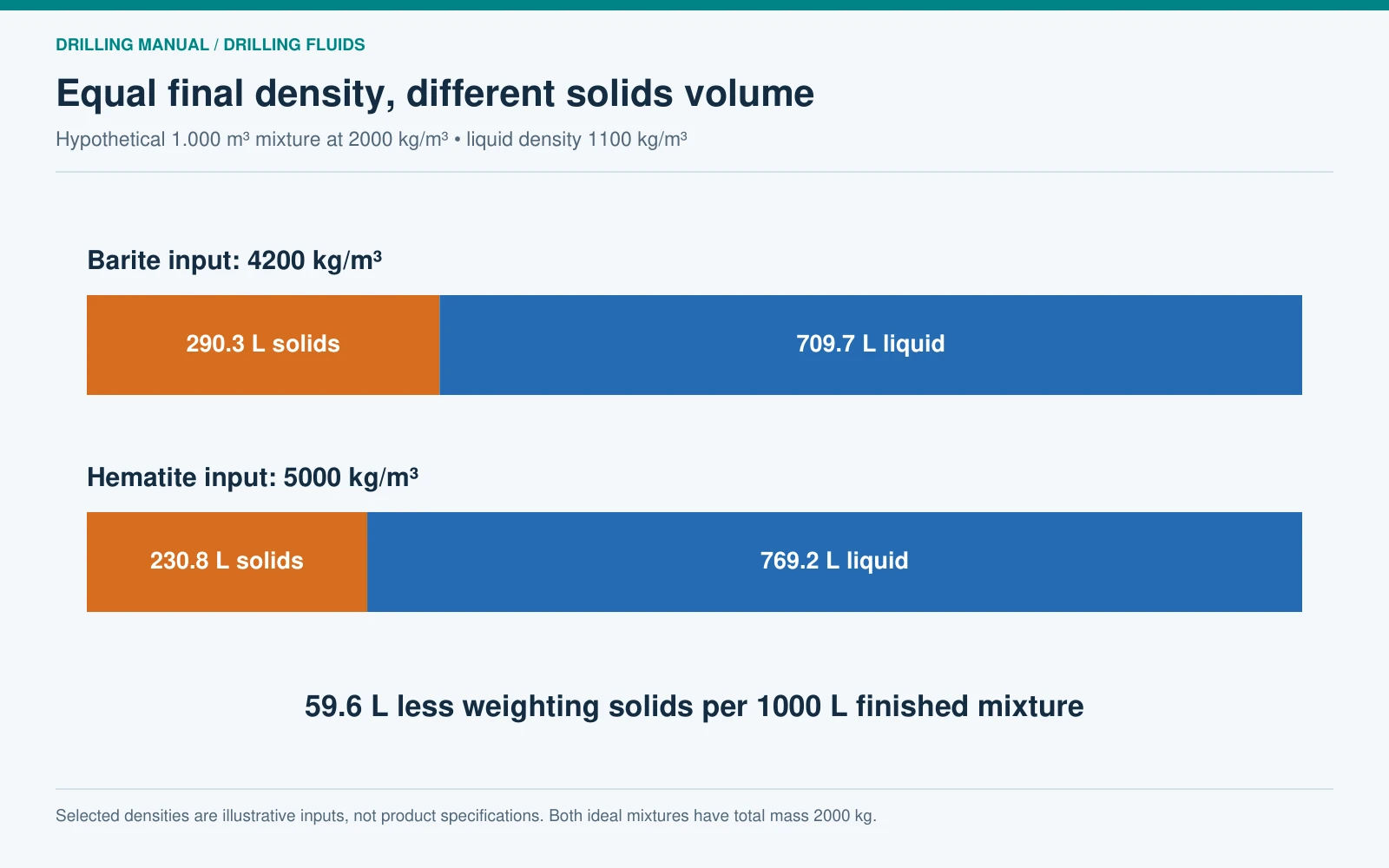
Consider an invented ideal mixture with a liquid density of 1100 kg/m³ and a target final density of 2000 kg/m³. Use 4200 kg/m³ for the illustrative barite and 5000 kg/m³ for the illustrative hematite. These are selected calculation inputs, not acceptance specifications for any current commercial grade.
| Quantity per 1.000 m³ finished mixture | Illustrative barite | Illustrative hematite |
|---|---|---|
| Weighting-solid density, kg/m³ | 4200 | 5000 |
| Weighting-solid volume fraction | 0.2903 | 0.2308 |
| Weighting-solid volume, L | 290.3 | 230.8 |
| Liquid volume, L | 709.7 | 769.2 |
| Weighting-solid mass, kg | 1219.4 | 1153.8 |
| Total mixture mass, kg | 2000.0 | 2000.0 |
The hematite example uses about 59.6 L less weighting-solid volume per cubic metre of finished mixture, or 20.5% less than the barite example’s weighting-solid volume. That is a relative reduction in weighting solids; it is not a 20.5% reduction in final mud density or total mixture mass.
The weighting-solid mass also changes in this particular fixed-final-volume comparison. Keep the basis beside the result: one cubic metre of finished mixture at the same density. Rounding the displayed values does not change the underlying mass balance. Other mud constituents, volume change and actual product density would have to be included in a field formulation.
An arithmetic check is to add the liquid and weighting-solid masses independently for each column. The liquid masses are approximately 780.6 kg in the barite example and 846.2 kg in the hematite example; adding the respective solid masses returns 2000 kg in both cases. The denser solid therefore occupies less volume while the liquid occupies more of the fixed final volume. This check also exposes a basis error if someone retains the first liquid quantity while substituting the second solid quantity and still labels the result as the same one-cubic-metre mixture.
Particle-size distribution can change the tradeoff
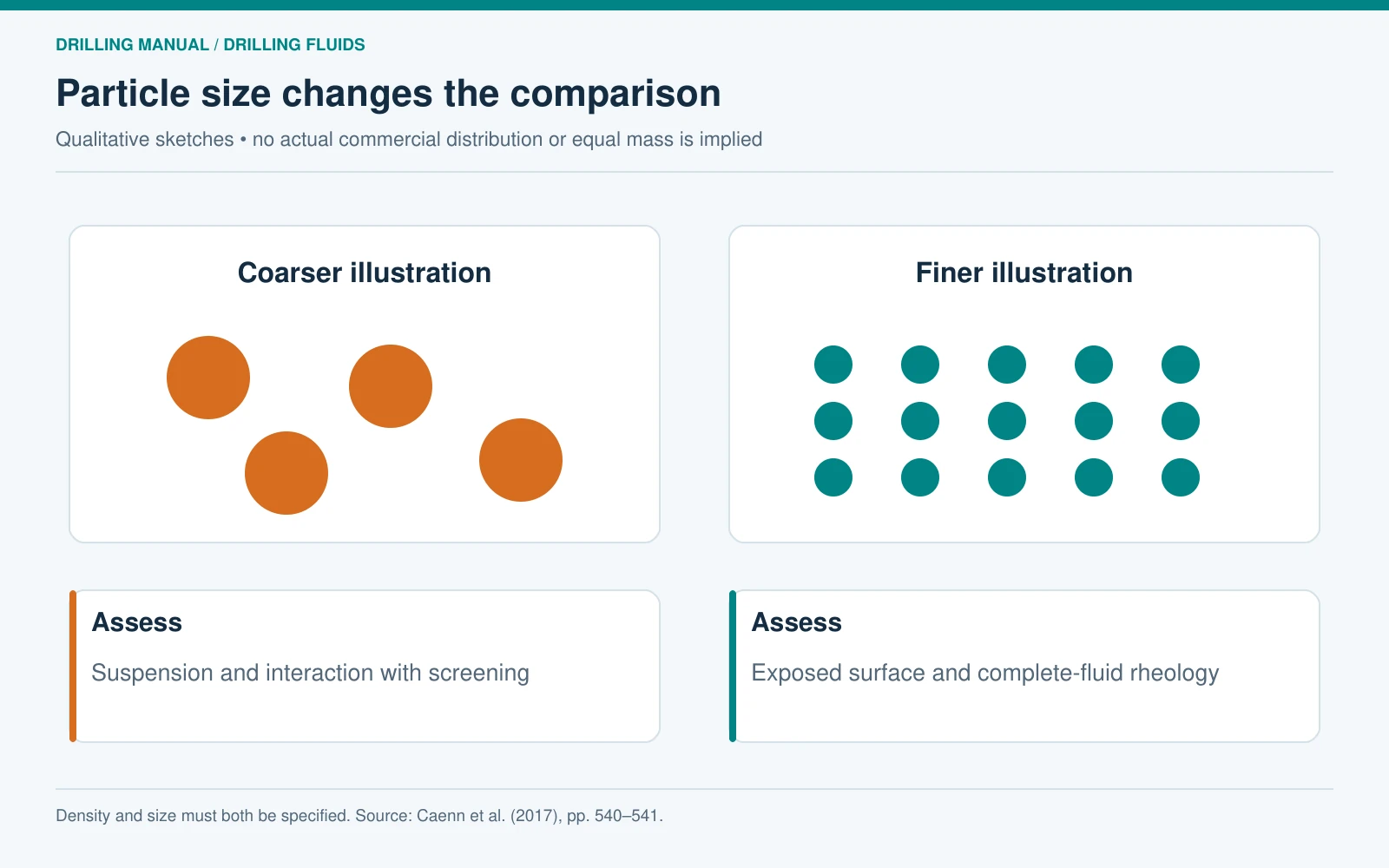
Caenn and colleagues explain that coarse weighting particles can be difficult to suspend and can be removed at the shaker, while very fine particles expose more surface area to the liquid. Their discussion of barite therefore treats particle size as a functional variable, not simply a manufacturing detail. [1, pp. 540–541]
For hematite vs barite, the compared products may differ in both density and grind. A lower-solids-volume formulation containing one particle-size distribution is not equivalent to another formulation with the same volume fraction but a different distribution. Record the grade and particle-size evidence alongside the density.
A useful comparison should also identify whether the material changes during circulation or preparation. The book discusses particle attrition as part of the hematite comparison. The relevant observation is the actual product’s behavior in the intended system; the mineral name alone cannot quantify the change. [1, p. 541]
The solids-control equipment guide covers the separate removal processes. In the selection record, state what material is intended to remain in the mud and how the proposed grade interacts with the actual solids-control arrangement.
When comparing particle-size data, retain the measurement method and the distribution basis. A statement such as “finer” is incomplete without identifying which part of the distribution changed. The coarse end, central tendency and fine fraction can inform different questions about suspension, screening and exposed surface. Avoid treating a single quoted average as a complete description. This reporting detail follows from the book’s separate discussion of the consequences of coarse and very fine weighting particles. [1, pp. 540–541]

Hardness and abrasion need their own assessment
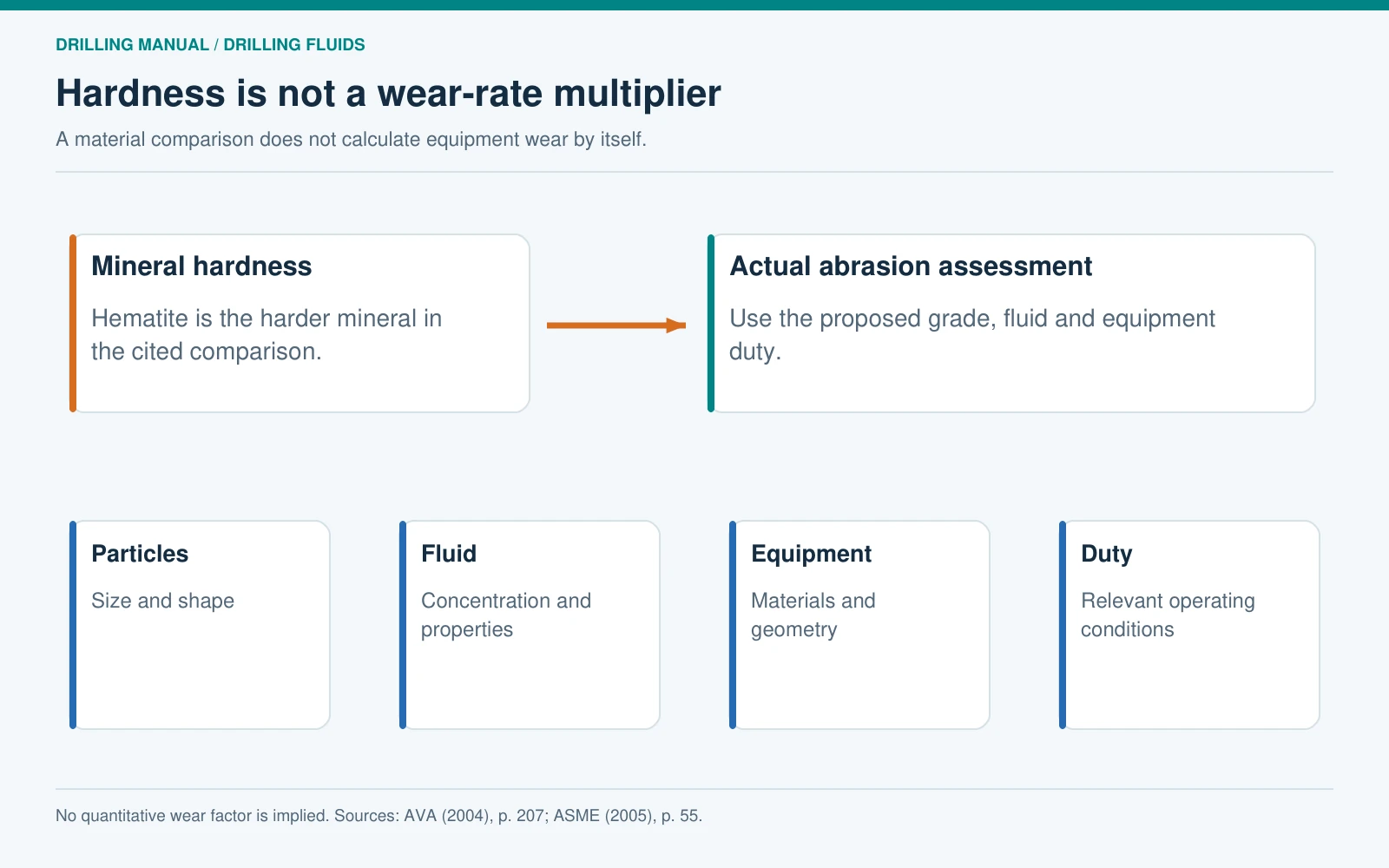
AVA lists hematite as the harder of the two minerals in its weighting-agent comparison. The ASME handbook describes abrasion concerns associated with harder weighting materials, including effects on solids-control equipment and shaker-screen life. [2, p. 207] [3, p. 55]
Hardness is not the same measurement as a wear rate. A mineral-hardness comparison cannot be converted into a multiplier for pump wear or screen consumption. Particle size, shape, concentration, equipment and duty remain part of the actual assessment.
For hematite vs barite, ask what evidence supports acceptable wear for the proposed grade and fluid. Keep the material-quality assessment separate from general statements about higher density or lower solids volume. A product may offer a useful formulation advantage while requiring closer attention to a particular equipment interface.
The handbook discusses finer grinding among possible approaches to abrasive weighting-material systems, but that also changes surface area and rheological behavior. It should be evaluated as a new product-and-fluid combination rather than assumed to solve every tradeoff automatically. [3, p. 55]
Suspension and sag are not settled by the density calculation
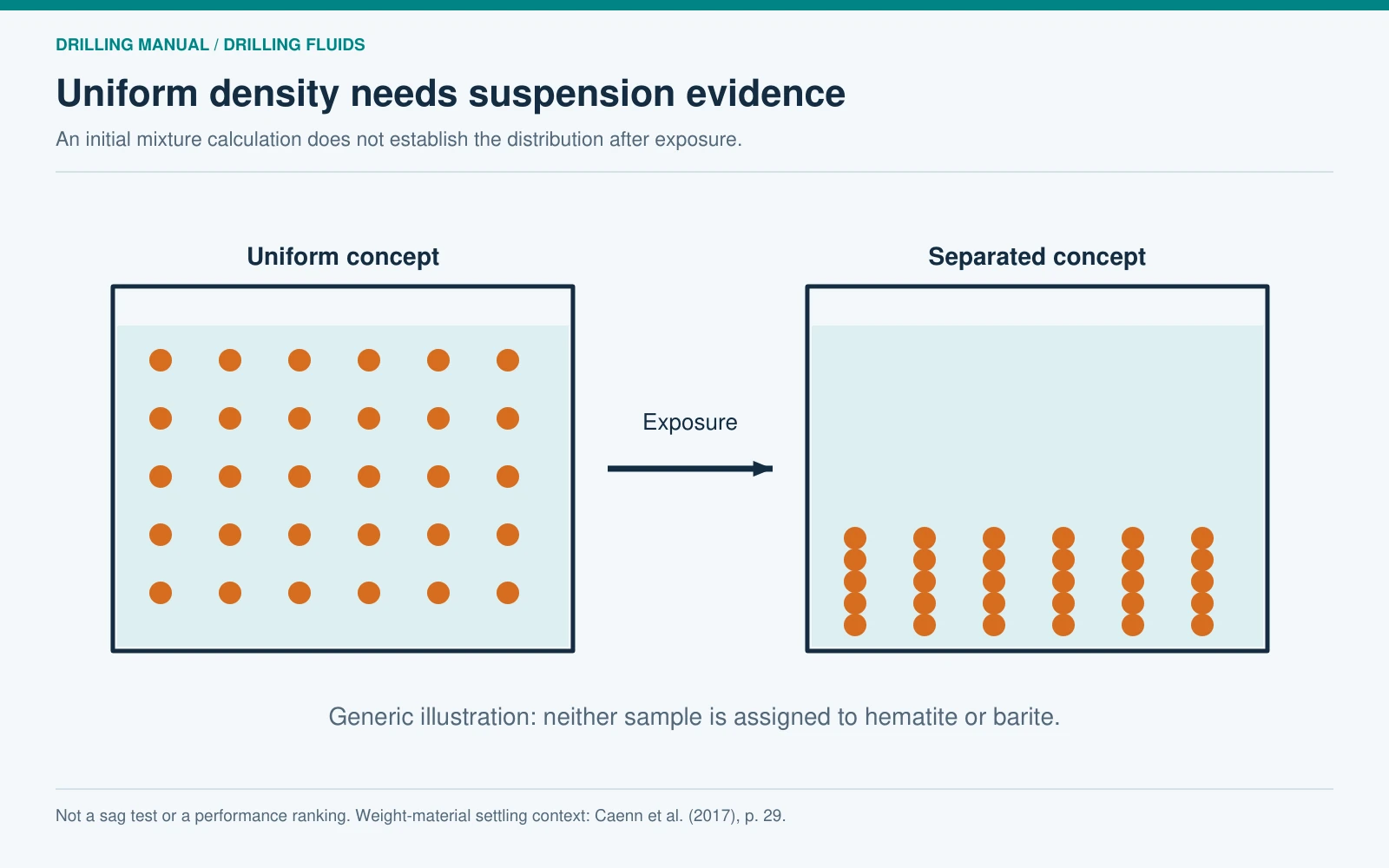
The original calculation specifies how much solid is present in an ideal uniform mixture. It does not establish whether that mixture remains uniform during a hold or under low-shear circulation. Caenn and colleagues discuss weight-material settling and dynamic sag as distinct problems, particularly in nonaqueous fluids. [1, p. 29]
A hematite vs barite test therefore needs suspension evidence suited to the intended fluid and exposure. Record the composition, density, conditioning history, temperature, rest or flow conditions and the method used to assess any separation. A satisfactory initial mud-weight reading is not evidence that the distribution remains unchanged.
Do not infer a universal sag ranking from density alone. The complete fluid’s rheology, the weighting material’s particle-size distribution and the imposed conditions must be considered. Equally, a lower total volume of weighting solids does not remove the need to check suspension.
The barite-sag guide covers that neighboring problem. This comparison uses its subject as a separate selection requirement; it does not replace a full sag investigation or prescribe treatment from one density result.
Compare rheology and filtration at matched conditions
Lower weighting-solids volume offers a reason to investigate the rheological benefit of a denser material. It is not a guaranteed percentage reduction in plastic viscosity, gel strength or pressure loss. Caenn and colleagues discuss the advantages of reduced solids, while ASME also emphasizes the influence of weighting materials on the rheological profile. [1, p. 541] [3, p. 55]
For a controlled hematite vs barite comparison, use the same target final density and identify the full formulation. Record the product quantities, the water or brine composition, other additives and preparation history. If different treatments are required to make the two fluids functional, show those differences rather than presenting them as identical fluids.
Measure filtration separately. A change in particle distribution or total solids can affect the cake and filtrate response; the density balance does not calculate either result. Preserve the test medium, temperature, differential pressure, time and cake observations. The HPHT filtration guide provides the wider testing context.
For an oil-based system, the material is also part of an emulsion and wetting package. The existing oil-based mud additives guide covers those functions. A weighting-material substitution should be assessed within that complete system rather than accepted from a dry-mineral density comparison.
Use a selection record that preserves the tradeoffs
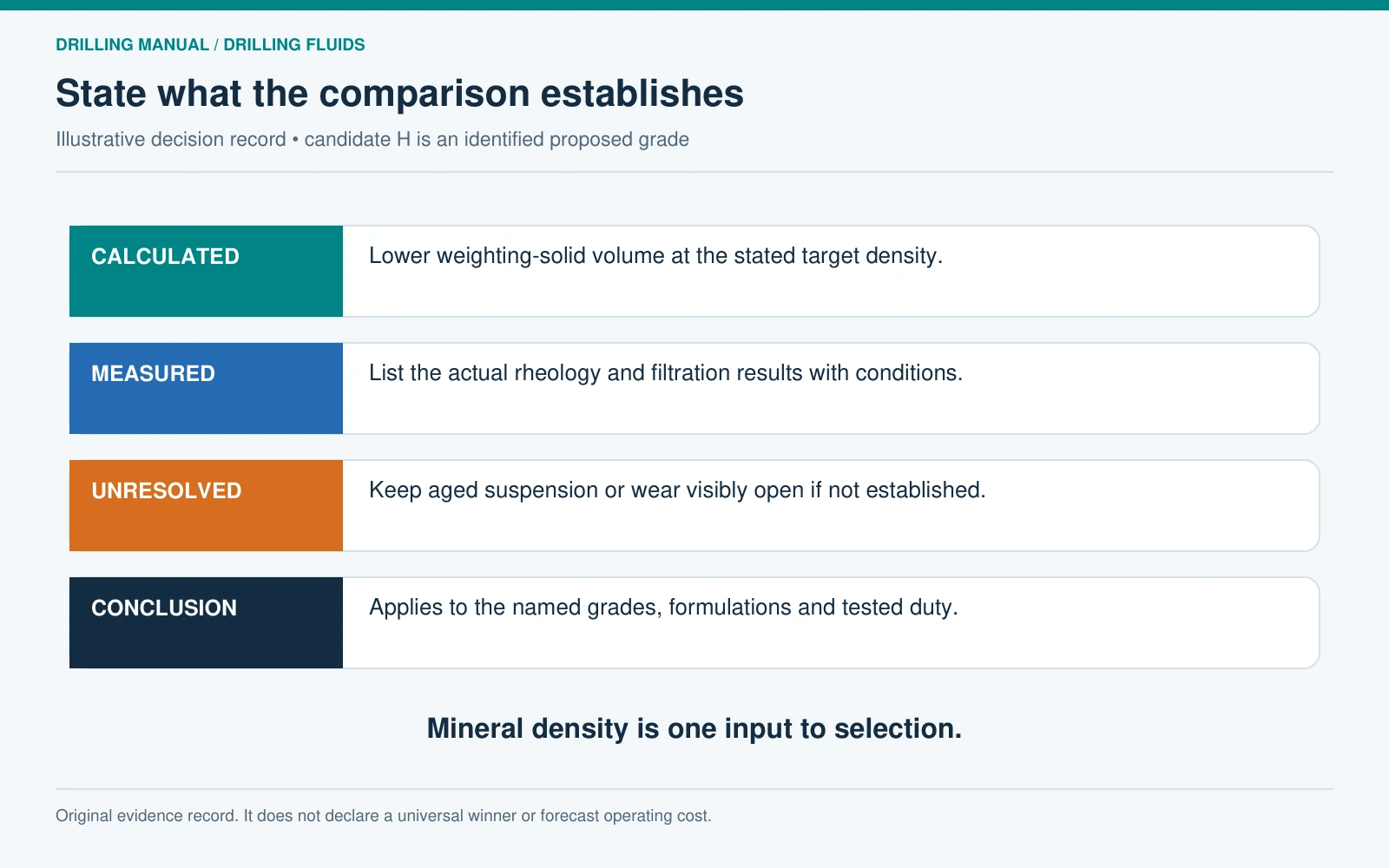
An original comparison sheet can use one row for each requirement: target density, weighting-solid volume, particle-size evidence, rheology, suspension, filtration, wear and handling. For every row, state the test or calculation basis, the result and what remains unresolved. Leave an unmeasured item visibly open.
For example, a report may conclude that candidate H requires less calculated weighting-solid volume at the chosen density, while wear and aged suspension remain under review. That is a useful bounded conclusion. It does not justify rewriting the result as “hematite is better than barite”.
Keep cost and logistics on the same defined basis. Price per tonne alone does not compare the mass needed per unit of finished fluid, and a calculation that excludes treatment or handling differences cannot establish total operating cost. These are accounting limits of the comparison, not a forecast of current prices.
The final hematite vs barite decision should name the actual grades and tested conditions. The mineral-density advantage is one input; the selected complete fluid must satisfy the rest of the duty with evidence appropriate to each requirement.


Frequently asked questions
Is hematite denser than barite?
The cited manuals list higher particle-density ranges for hematite. Actual calculations still need the density of the proposed grade. The numerical example here deliberately states its assumed inputs. [2, p. 207] [1, pp. 540–541]
Does higher density mean less weighting-solid volume?
At the same target mixture density and liquid density, the ideal two-component balance gives a lower required solid volume fraction when the solid density is higher. The assumptions and final-volume basis must remain explicit.
Will hematite always reduce mud viscosity?
No universal reduction follows from mineral density alone. Product grind, concentration, fluid formulation and conditions affect the measured rheology. Compare complete fluids at matched target density. [1, p. 541] [3, p. 55]
Is hematite always more abrasive in operation?
The manuals identify greater hardness and abrasion concerns, but they do not provide one wear-rate multiplier for all products and duties. Evaluate the proposed grade, equipment and fluid together. [2, p. 207] [3, p. 55]
Does replacing barite with hematite eliminate sag?
The density calculation does not demonstrate suspension. The complete fluid requires appropriate evidence under its intended static and flowing conditions. A universal sag outcome cannot be inferred from the mineral substitution. [1, p. 29]
Can this comparison be used directly for cement slurry?
No. The worked example is an ideal drilling-fluid mixture comparison. Cement has a different composition, water requirement and performance criteria. It requires its own slurry design and qualification.
References
- Caenn, R.; Darley, H.C.H.; Gray, G.R. Composition and Properties of Drilling and Completion Fluids. Seventh edition. Gulf Professional Publishing/Elsevier, 2017. ISBN 978-0-12-804751-4. Printed pages: 29; 540–541. PDF pages in the edition consulted: 35; 541–542.
- AVA Drilling Fluids & Services. Drilling Fluids Manual. Version 1, November 2004. Section 7.4.2, Weighting Agents. Printed pages: 207. PDF pages in the edition consulted: 209.
- ASME Shale Shaker Committee. Drilling Fluids Processing Handbook. Gulf Professional Publishing/Elsevier, 2005. Chapter 2, Drilling Fluids. ISBN 0-7506-7775-9. Printed pages: 55. PDF pages in the edition consulted: 82.