An oxygen scavenger for drilling fluid reacts with dissolved oxygen to reduce an important contributor to corrosion. Its performance depends on the fluid chemistry, reaction conditions and continued entry of oxygen into the system. Adding a chemical is therefore only one part of the assessment: identify the oxygen source, distinguish dissolved oxygen from entrained air and verify the result with complementary evidence. [1, pp. 451–453]
This guide addresses aqueous drilling-fluid systems. It explains sulfite chemistry, selection questions, sampling records and the difference between oxygen concentration, scavenger residual and corrosion response. The worked example is ideal stoichiometric bookkeeping, not a field dose. Clear-brine storage and other long-term services require their own qualification; a result in circulating mud should not be transferred to them automatically.
Where does oxygen enter a drilling-fluid system?
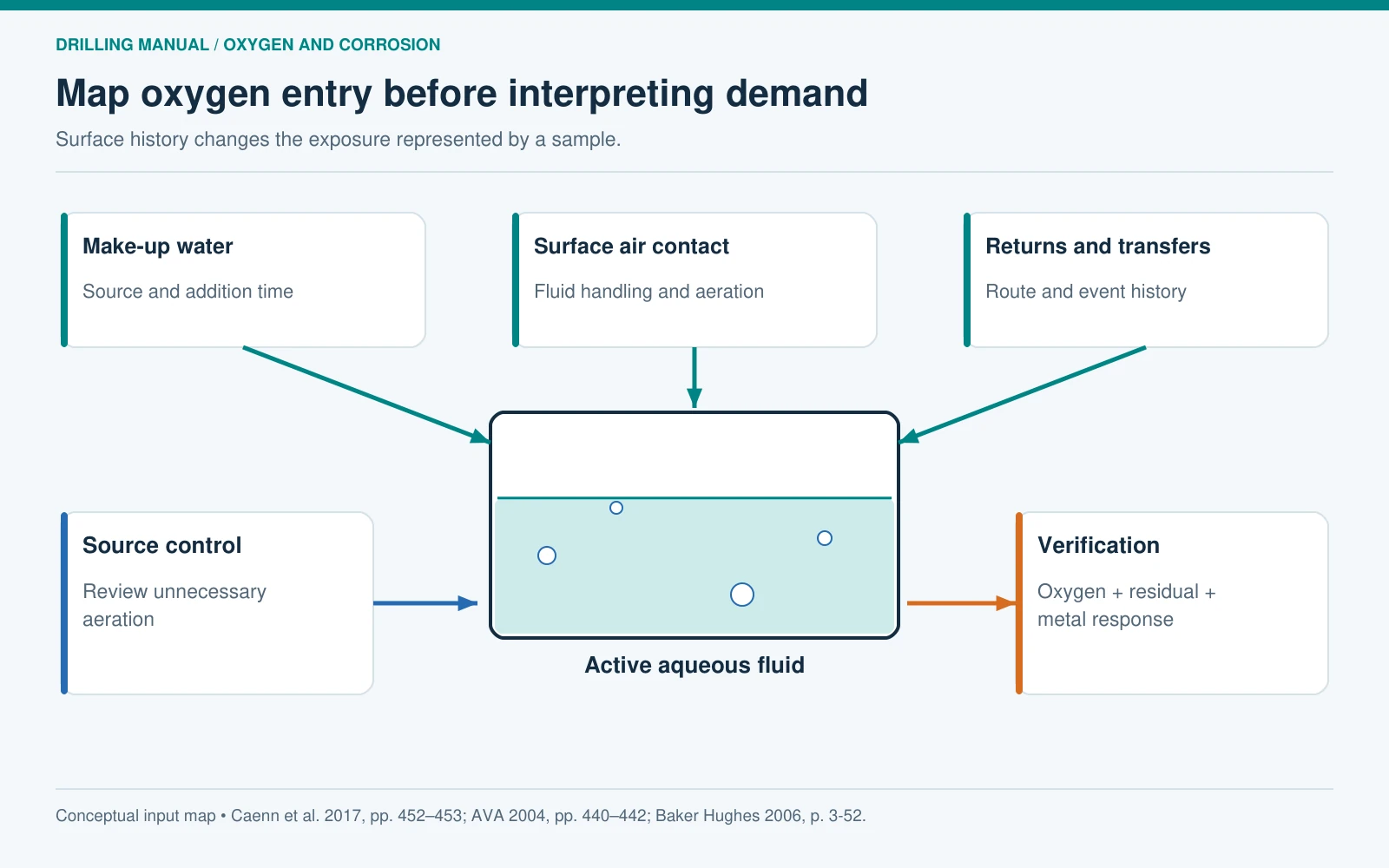
Surface contact with air is a continuing source of oxygen. The books identify aeration associated with fluid handling, including hoppers, mud guns and surface returns. Make-up water also belongs in the investigation because it enters the aqueous inventory. Map these inputs against the actual mud circulating system, including active and reserve tanks. [1, pp. 452–453] [2, pp. 440–442]
Record when additions, transfers or equipment changes occurred. A sample collected before a make-up-water addition describes a different moment from a sample collected afterward. A chemical treatment that appears adequate during a quiet holding period may face a different oxygen input when the fluid is vigorously handled.
Reducing unnecessary aeration and assessing scavenger performance are complementary tasks. Baker Hughes includes both oxygen-scavenger maintenance and avoiding entrained air in its polymer-fluid discussion. The objective is to understand the complete oxygen exposure, rather than interpret chemical consumption without its operating history. [3, p. 3-52]

Dissolved oxygen and entrained air are different measurements
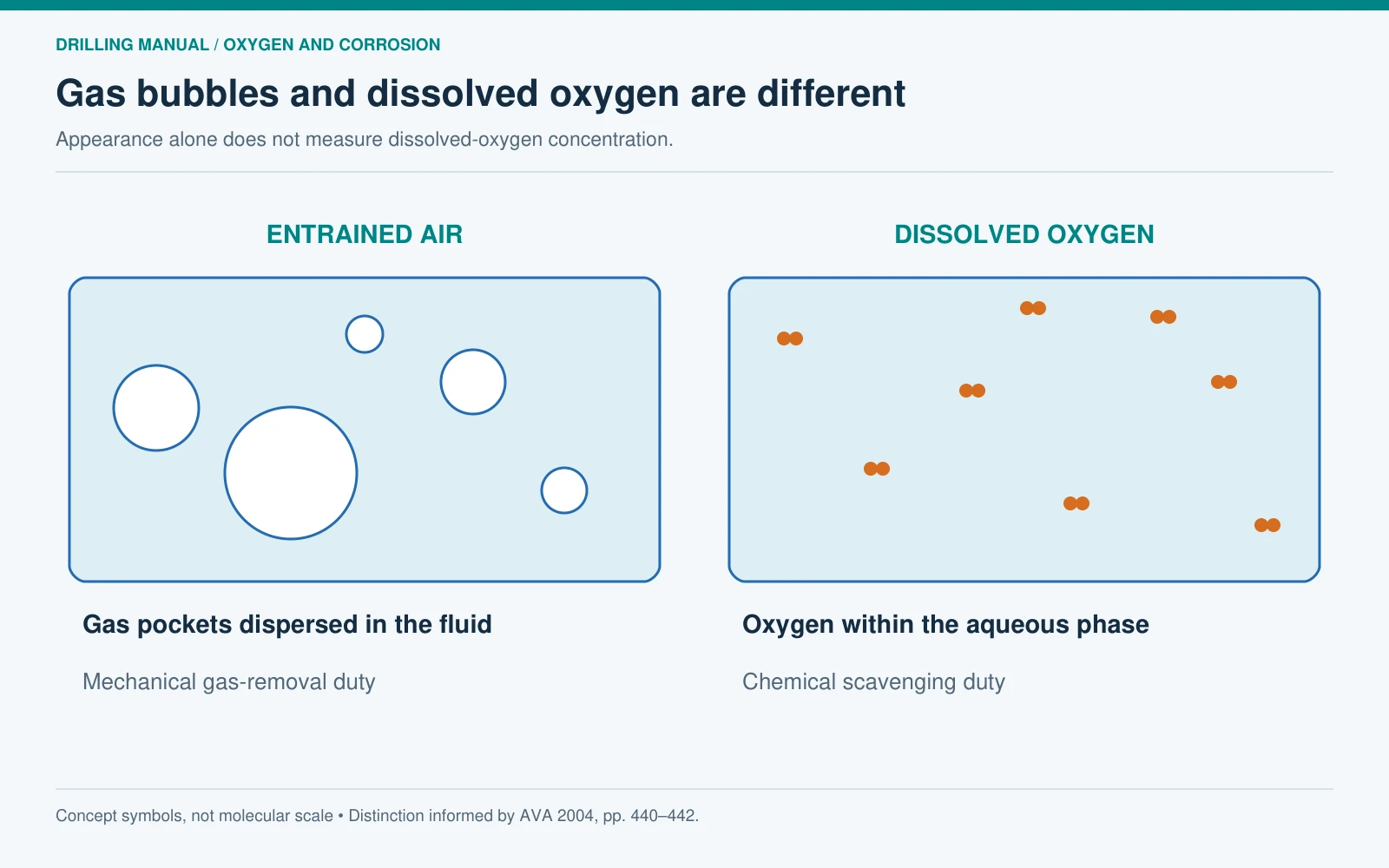
Entrained air consists of gas bubbles dispersed in the liquid. Dissolved oxygen is present within the aqueous phase and is not established by looking for bubbles. A sample can look free of visible gas while still containing dissolved oxygen. Conversely, a visibly aerated sample does not provide a numerical dissolved-oxygen concentration. The manuals distinguish mechanical gas handling from chemical oxygen removal. [2, pp. 440–442]
This difference explains why a degassing observation cannot substitute for a dissolved-oxygen result. Mechanical gas removal and chemical scavenging address different parts of the gas inventory. Their effectiveness must be evaluated for the relevant duty and actual operating conditions.
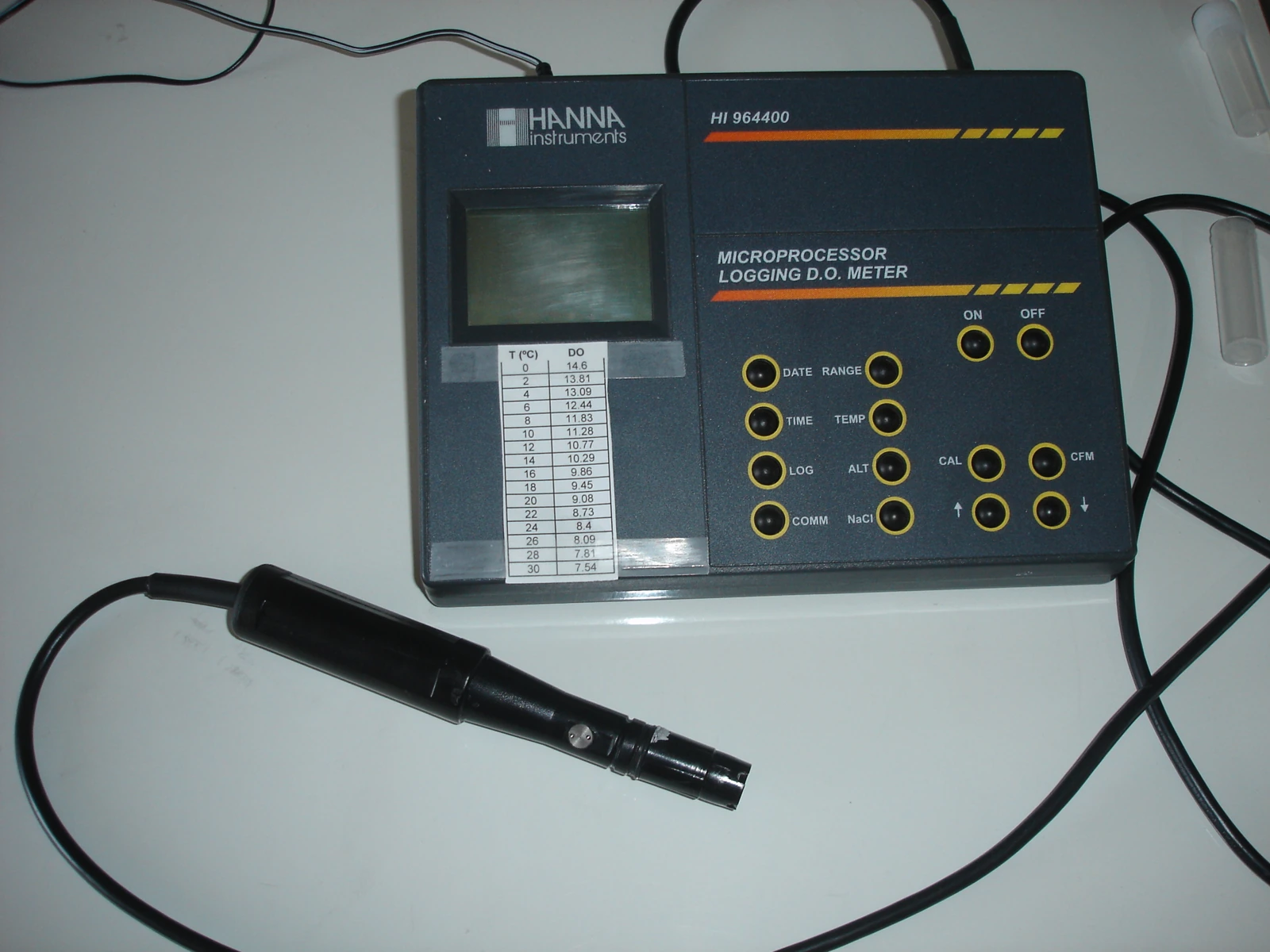
Keep sample handling in the record as well. If the objective is to characterize oxygen in a particular fluid stream, describe where and when the sample was obtained and the measurement arrangement. Ask the responsible laboratory or instrument specialist to define suitable handling for the selected method. Do not present an exposed, delayed sample as a complete reconstruction of conditions at an earlier point in the system.
How sulfite oxygen scavengers react
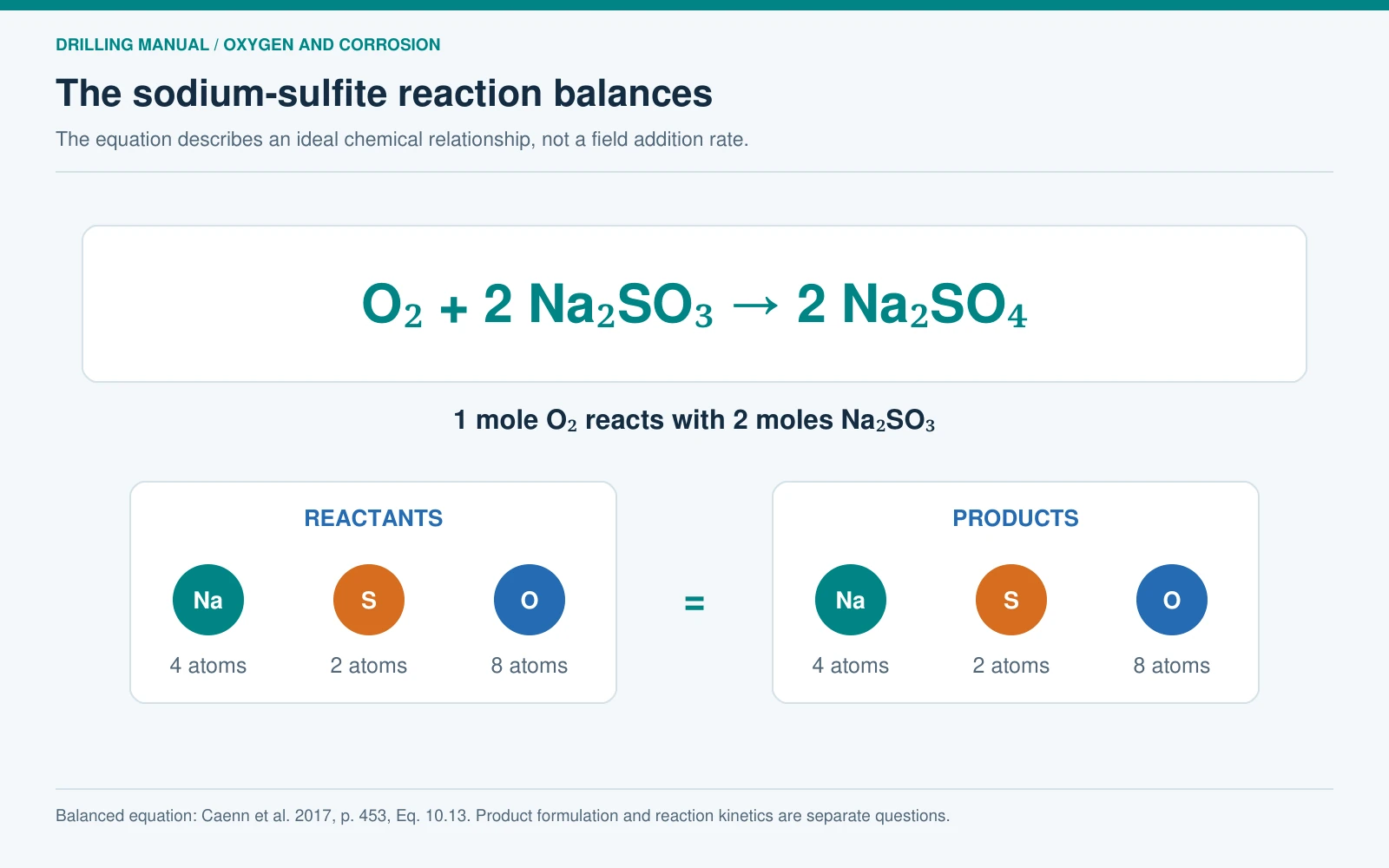
Sulfite compounds consume oxygen by conversion to sulfate. Caenn, Darley and Gray give the following balanced sodium-sulfite reaction: [1, p. 453, equation 10.13]
O2 + 2 Na2SO3 → 2 Na2SO4
The coefficients express the ideal chemical relationship: one mole of oxygen reacts with two moles of sodium sulfite. They do not specify how quickly a commercial product will react in a particular mud or how much oxygen will enter during the treatment period.
AVA lists sodium sulfite and ammonium bisulfite among oxygen-scavenging materials and discusses the importance of reaction behavior and catalysts. Product chemistry therefore matters; “oxygen scavenger” describes a function, not one interchangeable formulation. Some organic drilling-fluid ingredients can also consume oxygen, so interpretation belongs to the full system. [2, pp. 214, 442] [1, p. 453]
Chemical demand changes when oxygen keeps entering
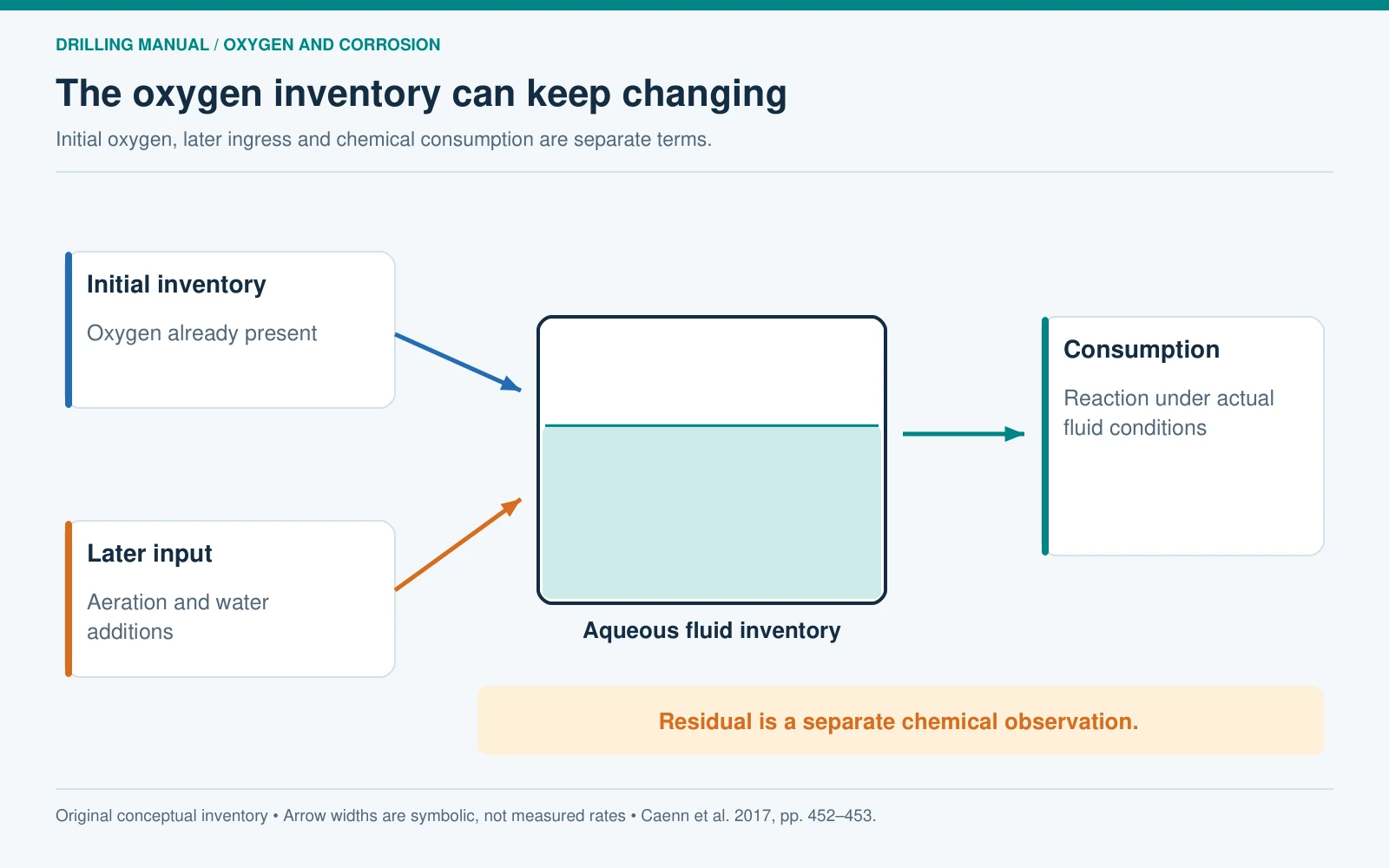
A closed-batch calculation starts with an identified amount of oxygen. A circulating mud system can receive more oxygen while the chemical is reacting. This makes time, exposure and location essential to the interpretation. The original schematic below separates initial oxygen inventory, later oxygen input and chemical consumption; it is not a kinetic model.
A decreasing residual could reflect consumption during the assessed exposure, but it does not identify the cause of every chemical demand. Similarly, a remaining residual does not establish that dissolved oxygen is low everywhere in the system. Those conclusions require the associated oxygen measurements, chemical method and flow history.
Temperature, salinity and pH affect the corrosion environment and oxygen behavior. Caenn discusses these interacting effects rather than a single universally protective condition. Record them as part of the assessed fluid state. The water-based drilling-fluid systems guide provides the broader formulation context, while the selected scavenger requires its own performance assessment. [1, pp. 451–453]
How to select an oxygen scavenger for drilling fluid
Selecting an oxygen scavenger for drilling fluid starts with the full aqueous system: water or brine composition, solids and polymer package, pH, temperature range and intended service. Establish the product’s active-component basis and the evidence supporting use in that environment. The manuals describe several scavenging materials and fluid-dependent behavior; they do not justify selecting solely by product name or a generic residual target. [2, pp. 214, 442]
Compatibility assessment should retain the required mud properties as well as demonstrate oxygen removal under the evaluated conditions. Record other treatment chemicals because the candidate is entering a mixture, not isolated laboratory water. For an assessment involving storage, specify the storage exposure separately from the circulating duty.
Keep pH and alkalinity distinct in the report. Use the drilling-mud pH test and filtrate alkalinity tests as related measurement references. Neither result is a direct dissolved-oxygen measurement. Raising pH should not be treated as proof that all oxygen-related corrosion has been controlled. [1, pp. 451–453]
Tie oxygen results to location and elapsed time
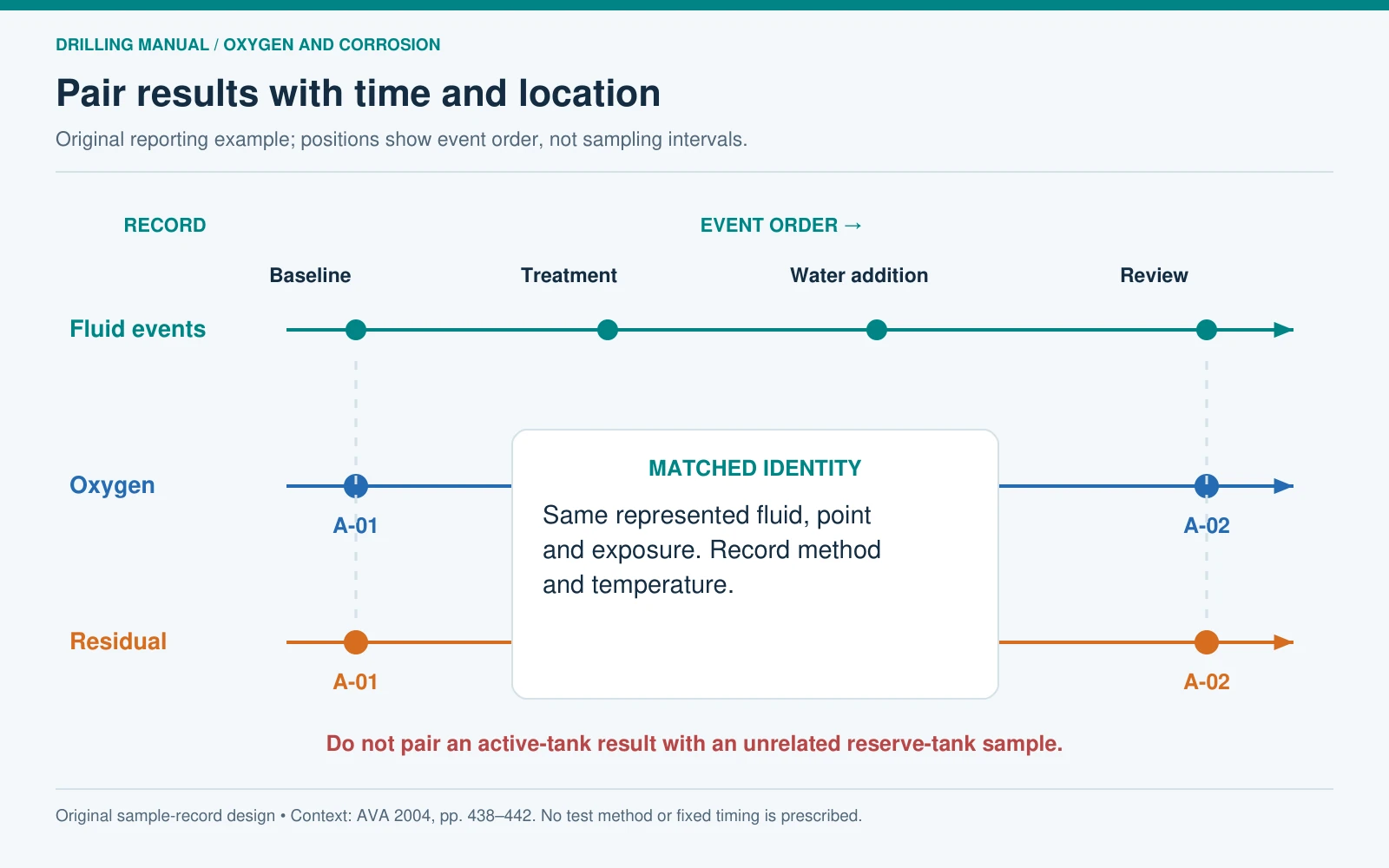
A useful test record identifies the sample or measurement point, collection time, treatment time, fluid temperature and relevant handling. It also records additions or transfers between the observations. “Before treatment” and “after treatment” need timestamps and a defined fluid identity to support a meaningful comparison.
The original timeline below illustrates this reporting principle. It is not a prescribed sampling interval. Select measurement points and timing that answer the actual question: reaction in a held sample, performance after a process step, or behavior during a particular circulation period. Use a method appropriate to the fluid and report its limitations.
Place residual measurements on the same timeline. If the oxygen result came from the active tank but the residual sample came from a reserve tank, the values should not be interpreted as a matched pair without a justified connection. Consistent sample identity is especially useful when the system receives water additions or undergoes transfers between checks.

How to verify an oxygen scavenger for drilling fluid
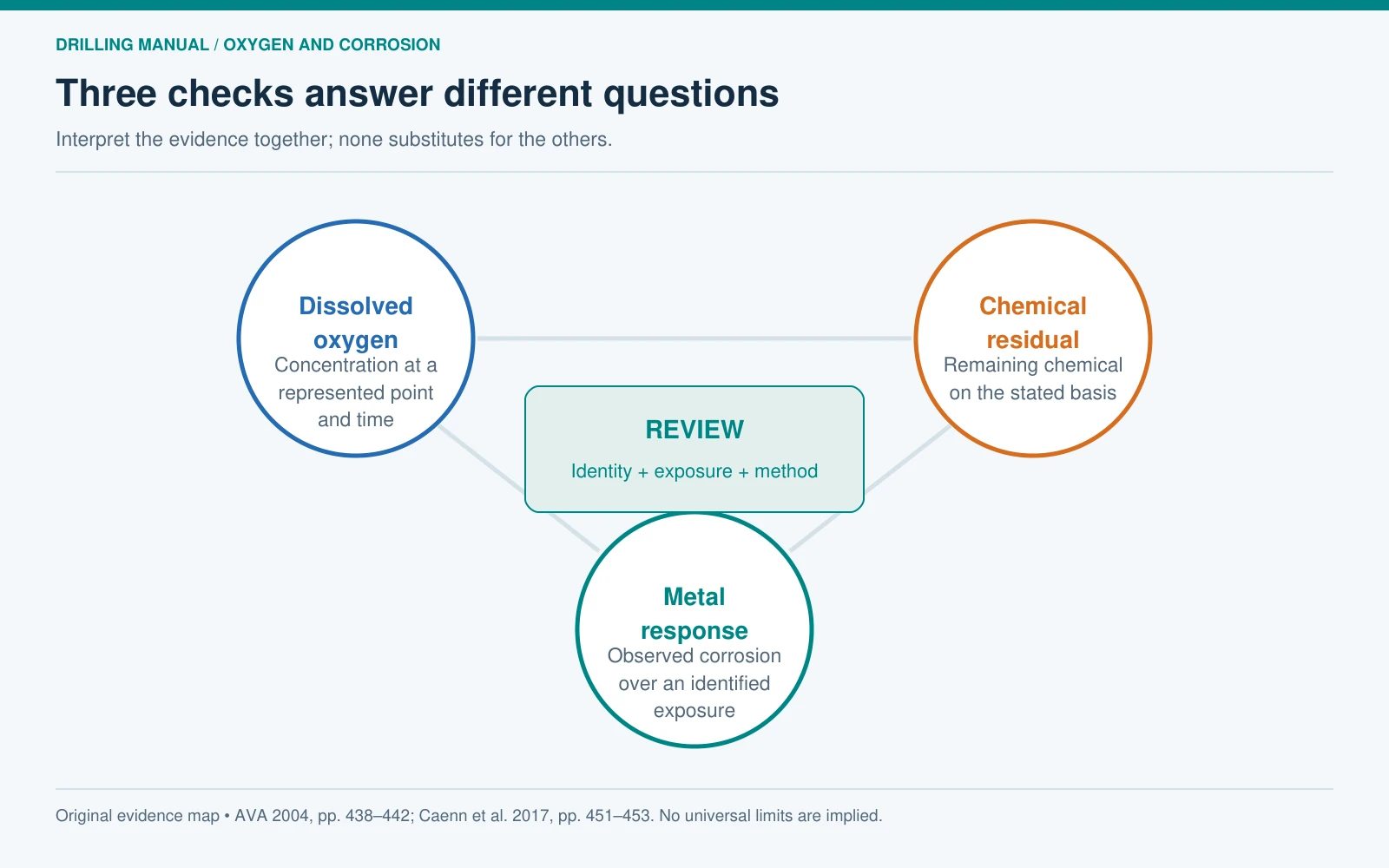
The manuals describe monitoring the corrosive environment and observing the metal’s response. A defensible oxygen-scavenger assessment therefore separates three questions rather than trying to answer all of them with one measurement. [2, pp. 438–442] [1, pp. 451–453]
| Evidence | What it addresses | What it does not establish alone |
|---|---|---|
| Dissolved-oxygen result | Oxygen concentration at the represented point and time | Long-term metal condition throughout the system |
| Scavenger residual | Remaining measurable chemical on the stated analytical basis | Complete oxygen removal or acceptable corrosion |
| Corrosion observation | Metal response over its identified exposure | Which single chemical mechanism caused every observed feature |
For corrosion coupons or probes, retain identification, location and exposure history. Coupon mass-loss information and evidence of localized attack are different observations. Keep the examination method and reporting basis attached to the result rather than reducing the entire assessment to an unexplained pass/fail label. No universal acceptable corrosion rate is proposed here.
Ideal sodium-sulfite requirement: a worked arithmetic example
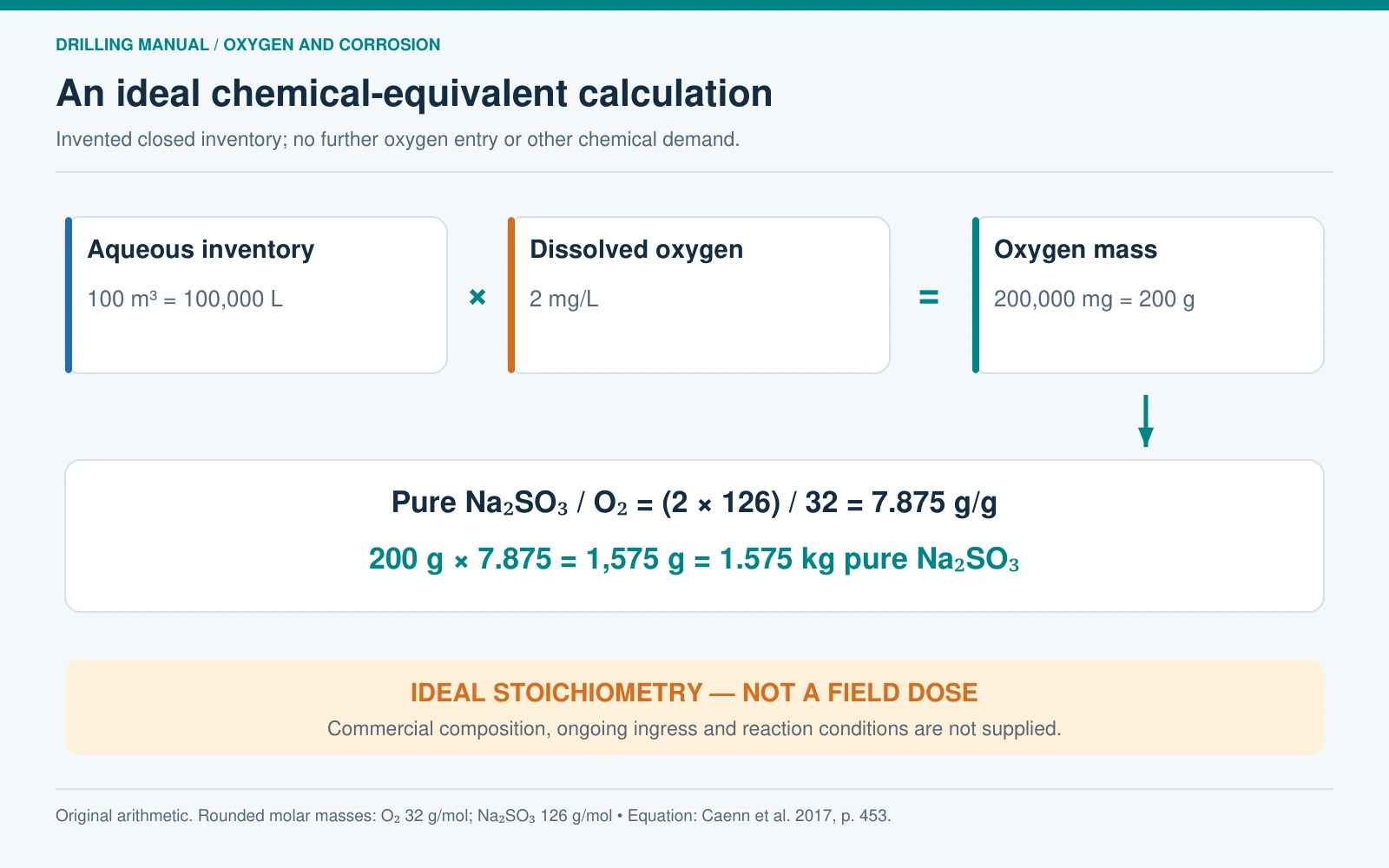
Assume an invented, perfectly defined aqueous inventory of 100 m³ containing 2 mg/L of dissolved oxygen. Exclude ongoing oxygen entry and other chemical demand. Since 100 m³ equals 100,000 L, the initial oxygen mass is:
100,000 L × 2 mg/L = 200,000 mg = 200 g O2.
Using rounded molar masses of 32 g/mol for O2 and 126 g/mol for anhydrous Na2SO3, the balanced reaction gives:
Pure Na2SO3 / O2 = (2 × 126) / 32 = 7.875 g/g.
The ideal equivalent is 200 × 7.875 = 1,575 g, or 1.575 kg of pure anhydrous sodium sulfite. This calculation illustrates the chemical equation; it is not a commercial-product addition rate. [1, p. 453, equation 10.13]
A field recommendation would require information absent here, including product composition, continuing oxygen entry, actual reaction conditions and the required verification. Even a precise initial oxygen measurement cannot supply those missing details. If the dissolved-oxygen result represents only part of the inventory, multiplying it by the entire system volume would add another unsupported assumption.
Investigate disagreement without assuming the answer
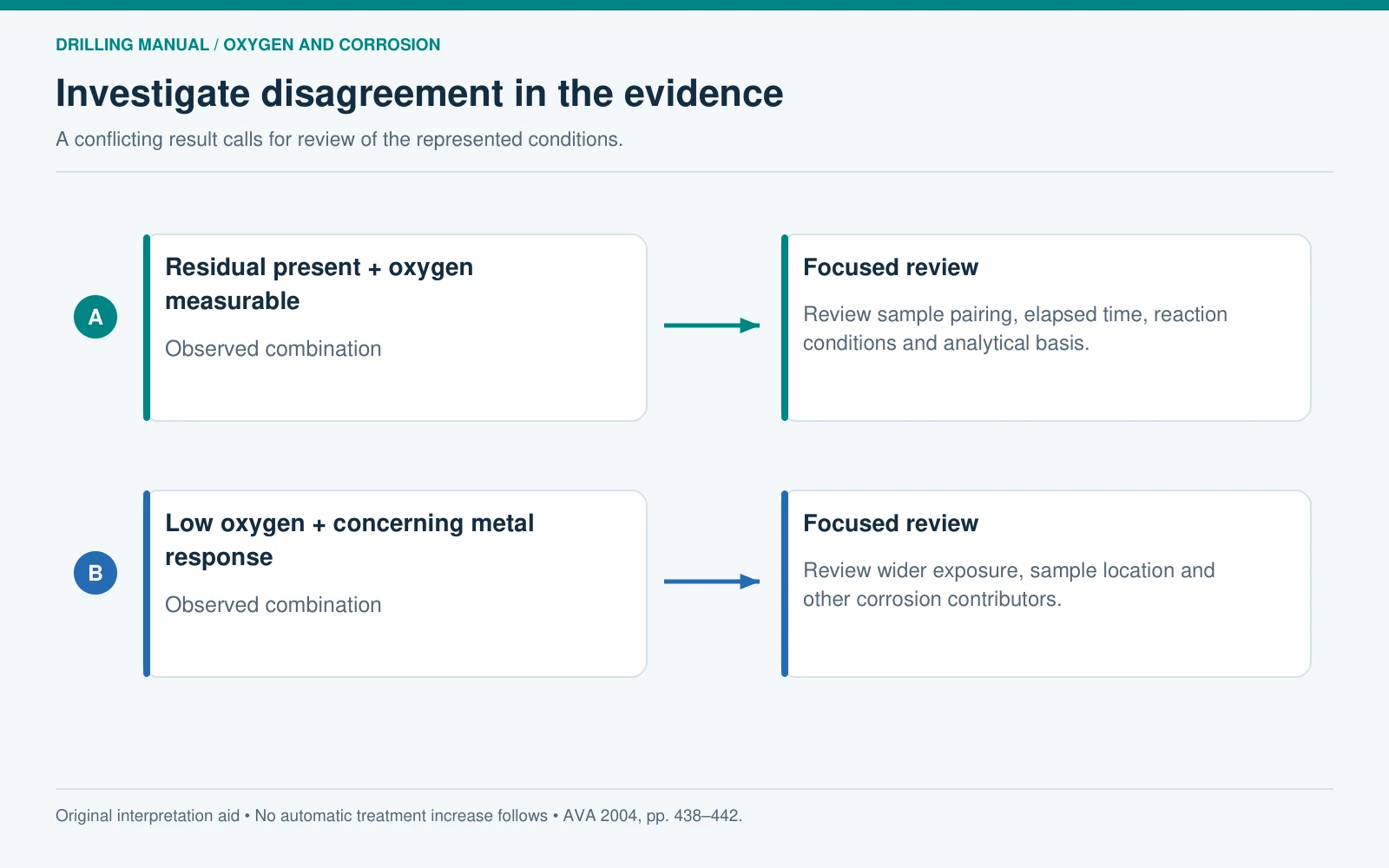
Different results can reveal an incomplete explanation. If a residual is reported while oxygen remains measurable, review sample pairing, elapsed time, reaction conditions and analytical basis. If oxygen is low at the sampled point but corrosion evidence remains concerning, examine the wider exposure and other contributors before concluding that more scavenger is the answer.
The books discuss carbon dioxide, hydrogen sulfide and other influences alongside oxygen. Their management requires a separate assessment of the actual hazard and mechanism. An oxygen-scavenger result does not establish control of hydrogen sulfide, microbial activity or every form of corrosion. The carbon-dioxide contamination guide covers one related but distinct fluid problem. [2, pp. 438–441]
An assessment of an oxygen scavenger for drilling fluid should state what was measured, where, over which exposure and with what remaining uncertainty. Carry forward the source-control actions, product identification and supporting records so the next assessment can distinguish a chemical change from a changed operating condition.

Frequently asked questions
What does an oxygen scavenger for drilling fluid do?
It chemically consumes dissolved oxygen, which can contribute to corrosion. The treatment should be assessed together with oxygen ingress and the actual fluid environment. Its addition does not prove that all corrosion mechanisms are controlled. [1, pp. 451–453]
Is an oxygen scavenger the same as a degasser?
No. A degasser addresses a gas-removal duty mechanically, while an oxygen scavenger reacts chemically with dissolved oxygen. Visible bubble removal is not a dissolved-oxygen measurement. Assess each duty with evidence appropriate to the gas state and the equipment or chemical being evaluated. [2, pp. 440–442]
Does a scavenger residual prove oxygen has been removed?
A residual reports remaining measurable chemical on the selected analytical basis. It should be interpreted with dissolved-oxygen results, sample location, elapsed time and fluid conditions. On its own, it does not establish complete oxygen removal or acceptable metal condition throughout the system. [2, pp. 438–442]
Can sodium-sulfite stoichiometry determine the field dose?
The balanced equation determines an ideal pure-chemical equivalent for a defined oxygen mass. It does not account for commercial-product composition, ongoing oxygen entry, reaction conditions or other demand. Those missing inputs and the verification requirement prevent the illustrative calculation from serving as a field dosing instruction. [1, p. 453]
Why can corrosion continue when dissolved oxygen is low?
The measurement may represent only one location and time, while corrosion evidence covers a longer or different exposure. Other corrosive influences may also be present. Review the sample history, metal evidence and fluid chemistry together instead of assuming that every corrosion observation reflects inadequate oxygen scavenger. [2, pp. 438–441]
Will an oxygen scavenger also control hydrogen sulfide?
Do not assume that it will. Oxygen, hydrogen sulfide and carbon dioxide are distinct chemical contributors discussed separately in the manuals. A product’s suitability and evidence for one duty do not establish performance for another. Hydrogen-sulfide management requires its own assessment and applicable operating arrangements. [2, pp. 438–442]
References
- Caenn, R., Darley, H.C.H. and Gray, G.R. Composition and Properties of Drilling and Completion Fluids, 7th edition. Gulf Professional Publishing/Elsevier, 2017. ISBN 978-0-12-804751-4. Printed pages: 451–453. PDF pages in the edition consulted: 453–455.
- AVA. Drilling Fluids Manual, Version 1, November 2004. Oxygen-scavenger and corrosion sections. Printed pages: 214, 438–442. PDF pages in the edition consulted: 216, 440–444.
- Baker Hughes Drilling Fluids. Drilling Fluids Reference Manual, Revision 2006. Polymer-fluid maintenance. Printed pages: 3-52. PDF pages in the edition consulted: 133.