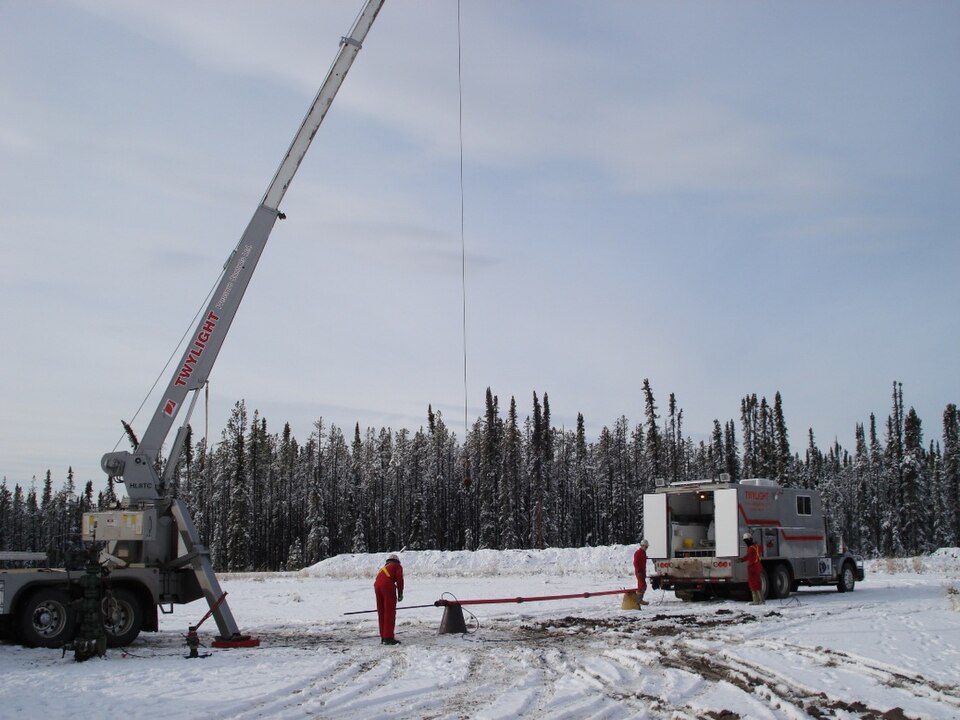
Rigless well intervention uses service equipment that can work over the well without a conventional rig. The term describes the surface arrangement. Method selection starts downhole: identify what has to move, what must flow and what result must come back to surface. A compact package can be attractive on a crowded platform and still leave the main objective out of reach.
Start with four requirements that exclude unsuitable methods
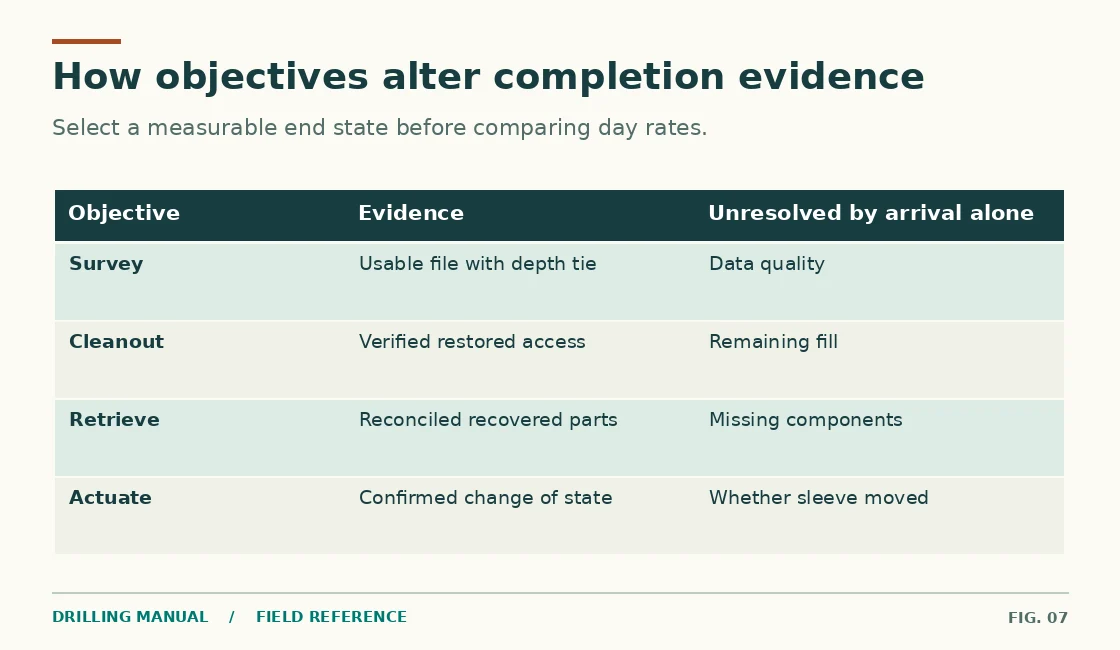
Write the requested operation as a physical change. A pressure survey requires a sensor at the right place and time. Removing fill requires a transport path for the solids. Recovering a stuck tubular requires an engagement, a load path and a credible release if the fish does not move. Assign a measurable end point before comparing mobilization costs.
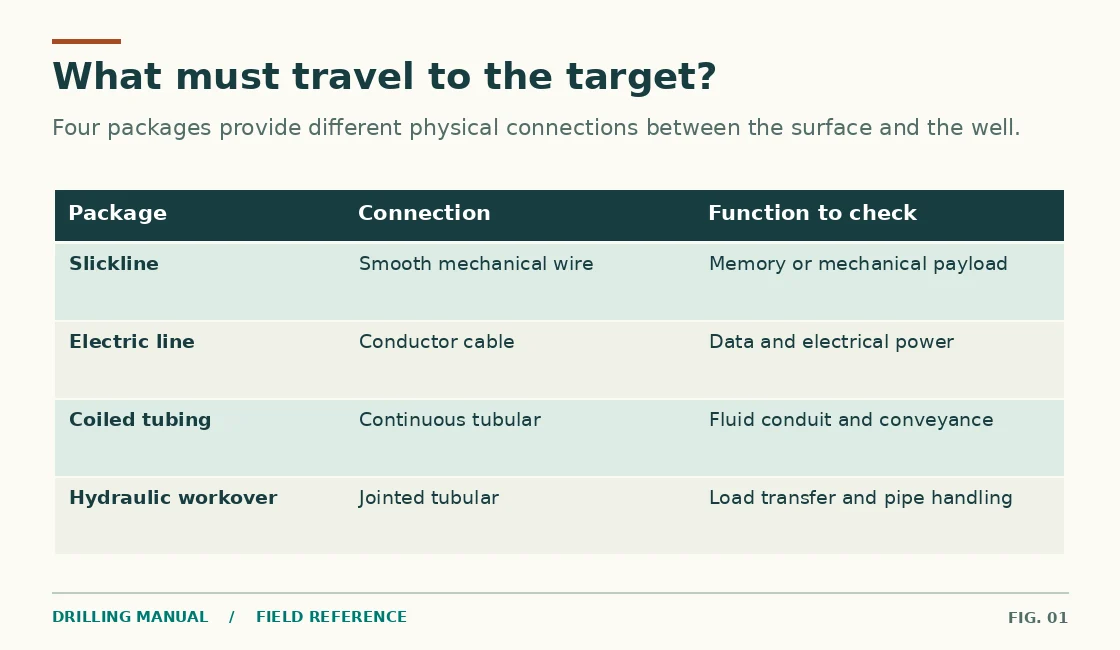
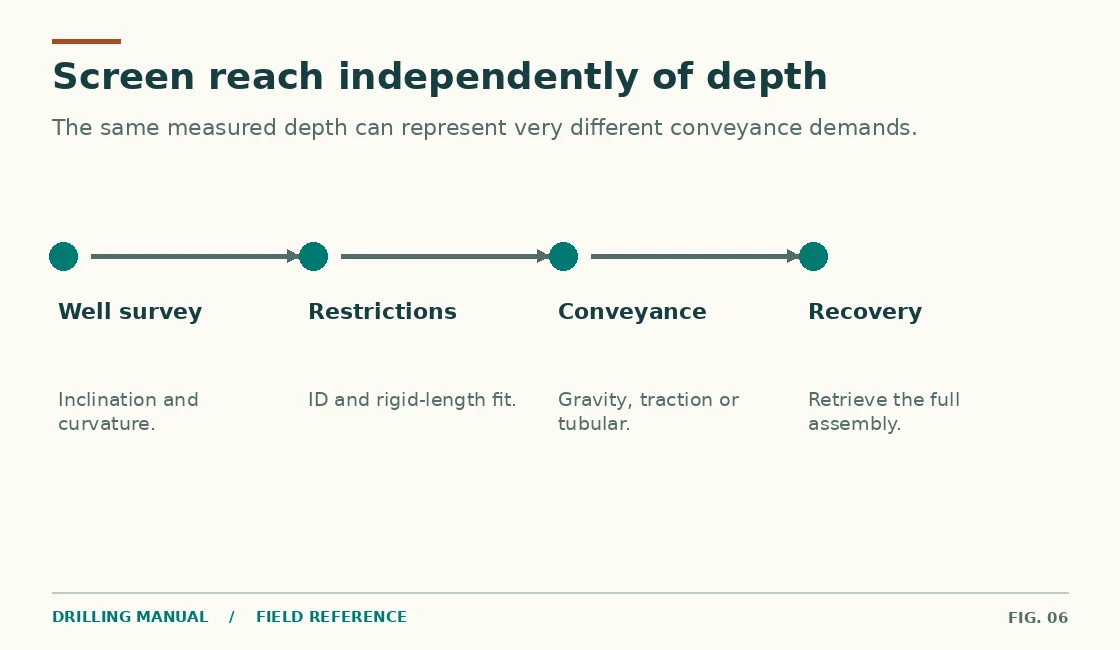
Next separate conveyance, power, fluid delivery and recovery. Gravity can take a wireline tool down a favorable trajectory. Electric line can supply power and data within its system limits. Coiled tubing adds a continuous pressure conduit and a means of pushing a string. A suitably configured hydraulic workover package handles jointed pipe. None of those descriptions by itself proves reach or establishes the allowable load at the target.
Two jobs at one depth can call for different equipment
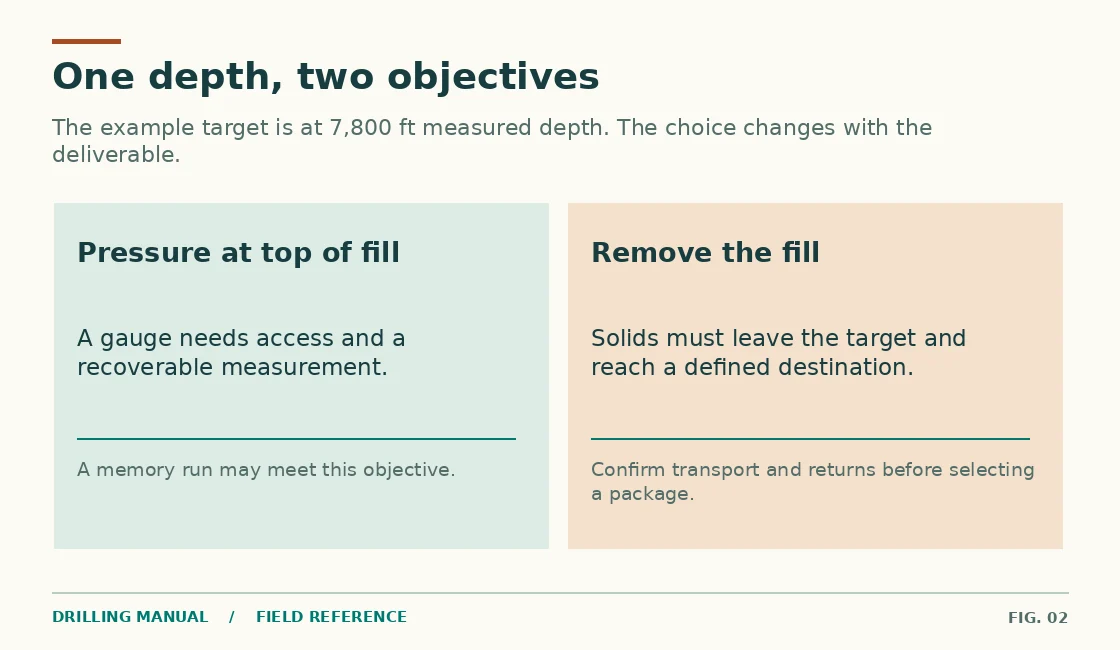
Imagine a gauge and a short interval of settled fill at 7,800 ft measured depth. The first proposal asks for pressure at the accessible top of fill and can accept a recorded result after recovery. A memory gauge on slickline may answer it if passability, descent and pressure-control requirements are satisfied. The second proposal asks to remove fill and restore access below it. A successful pressure survey leaves that objective untouched.
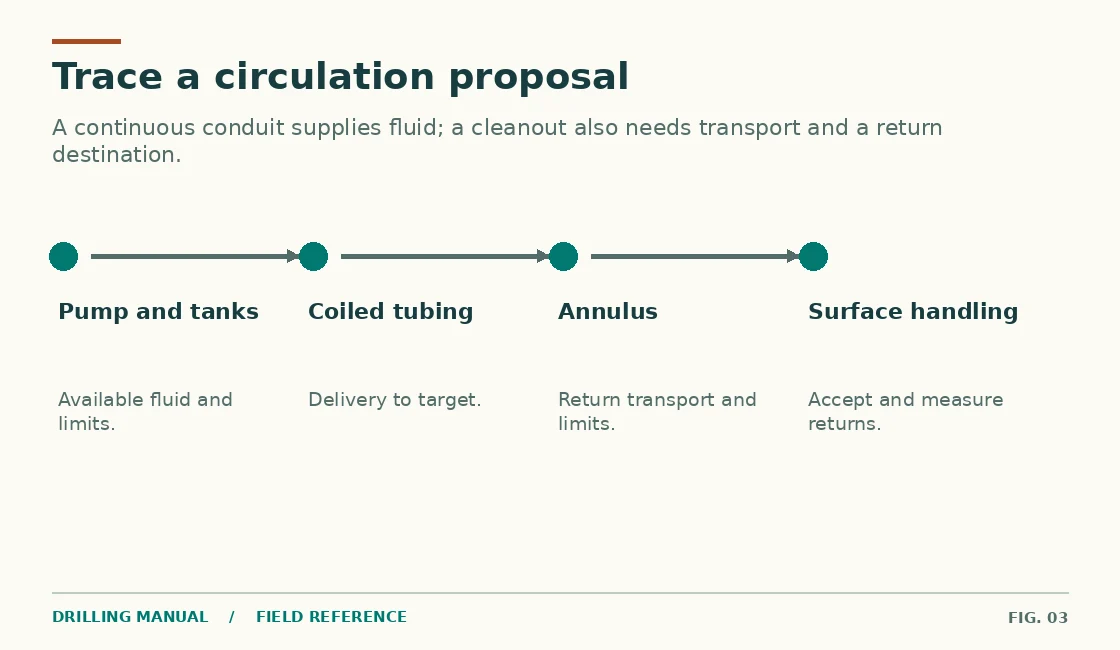
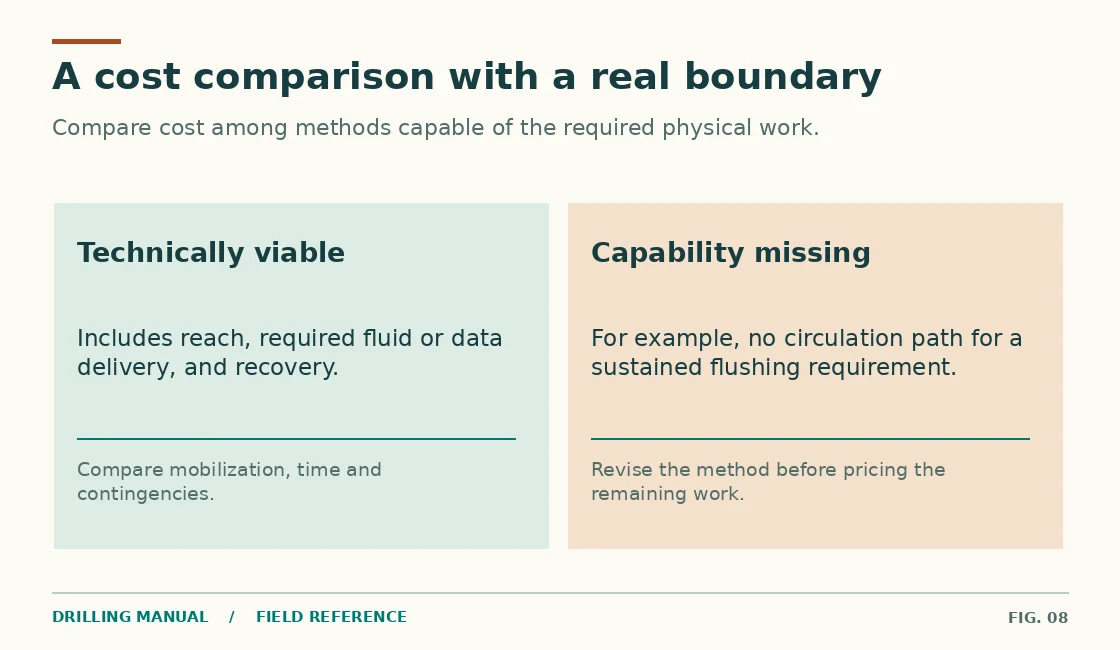
Coiled tubing may offer a circulation route for the second job, but selection depends on annular returns, transport capability, pumping limits and disposal arrangements. If there is no acceptable return path, stocking a larger pump does not resolve the fundamental problem. For a localized deposit, distinguish a sample bailer from a sand pump bailer intended to clear debris above a component. The NOV Elmar wireline tools catalogue describes both. For example, assume 18 L of settled debris and 3 L recovered per trip on the same settled-volume basis. That would take six productive runs if no fresh fill enters. If recovery averages 1.5 L, it takes twelve. Use actual recovered debris volume for this estimate. Liquid in the bailer also occupies chamber space. Confirm restored access against the required depth and tool diameter.
Compare the coiled tubing system with the snubbing unit when the job calls for circulation, axial force or both. The workover overview puts those options beside rig-based work.
Compare what can be delivered at the working point
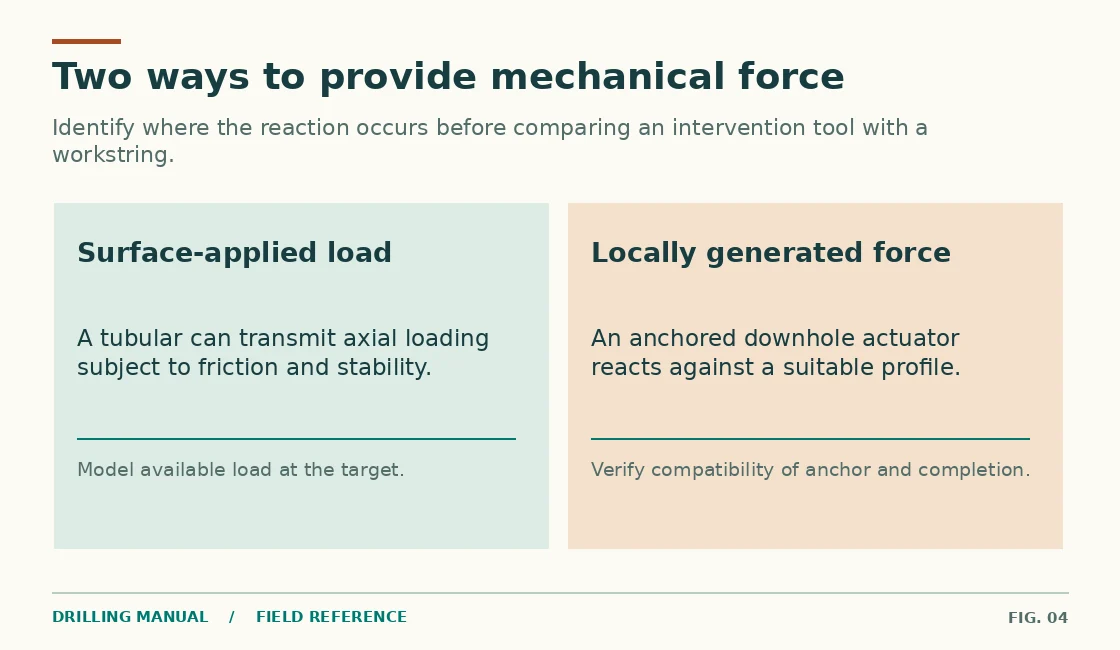
A wireline tractor can help move a compatible payload along a high-angle interval. It does not by itself add a fluid circulation conduit. A powered intervention tool may generate local axial force while anchored, although the cable cannot deliver sustained push from surface. Identify where force is generated and against what the tool reacts. Compare the reaction load with what the completion can accept.
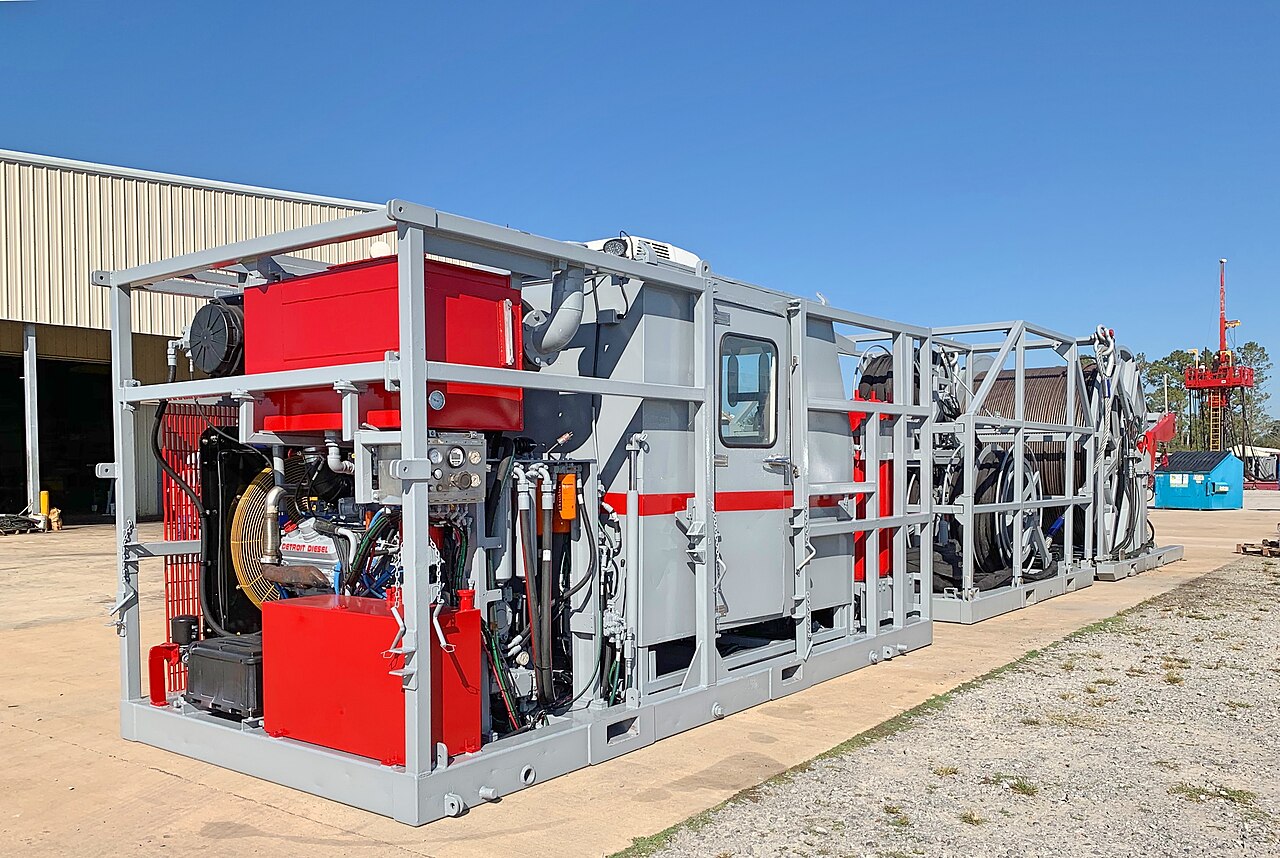
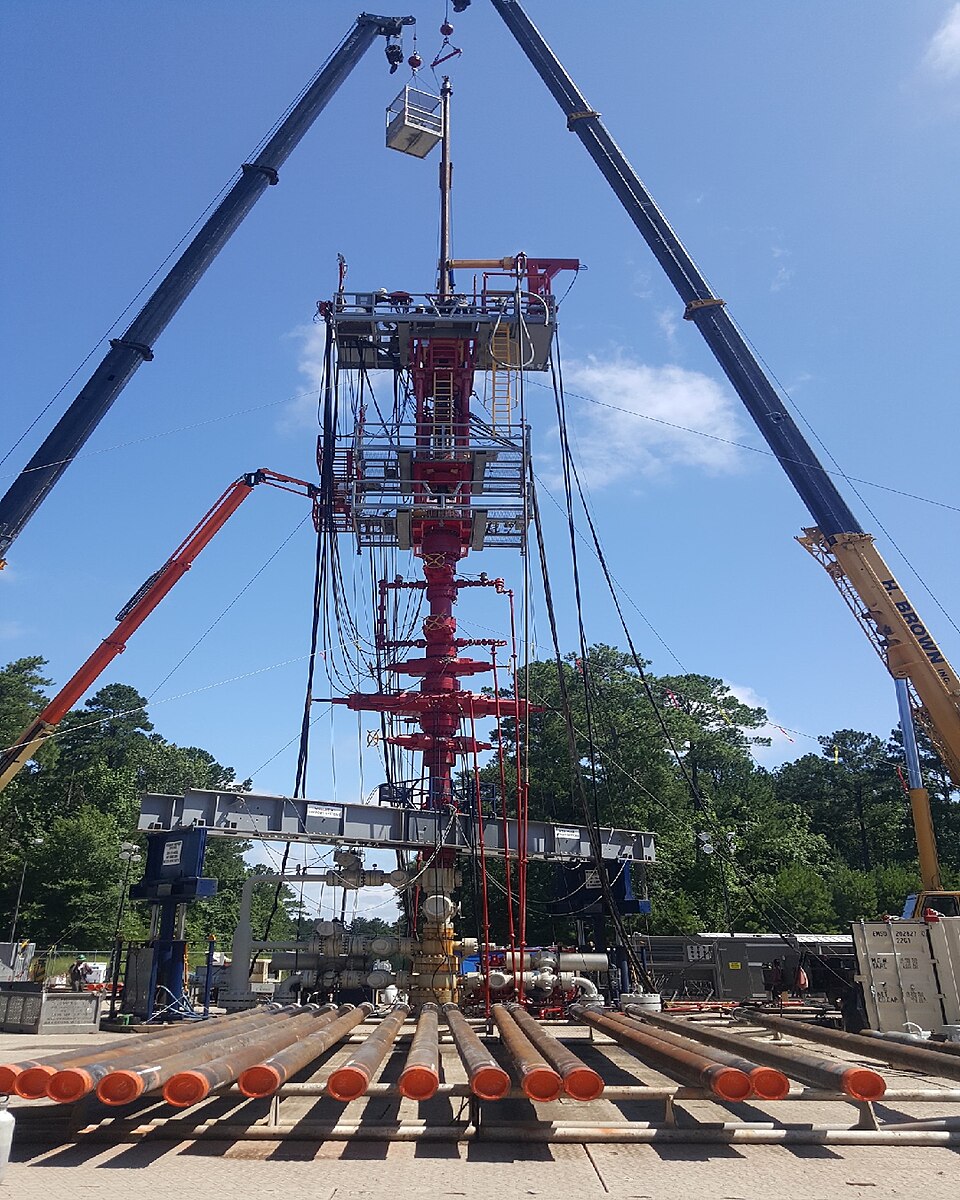
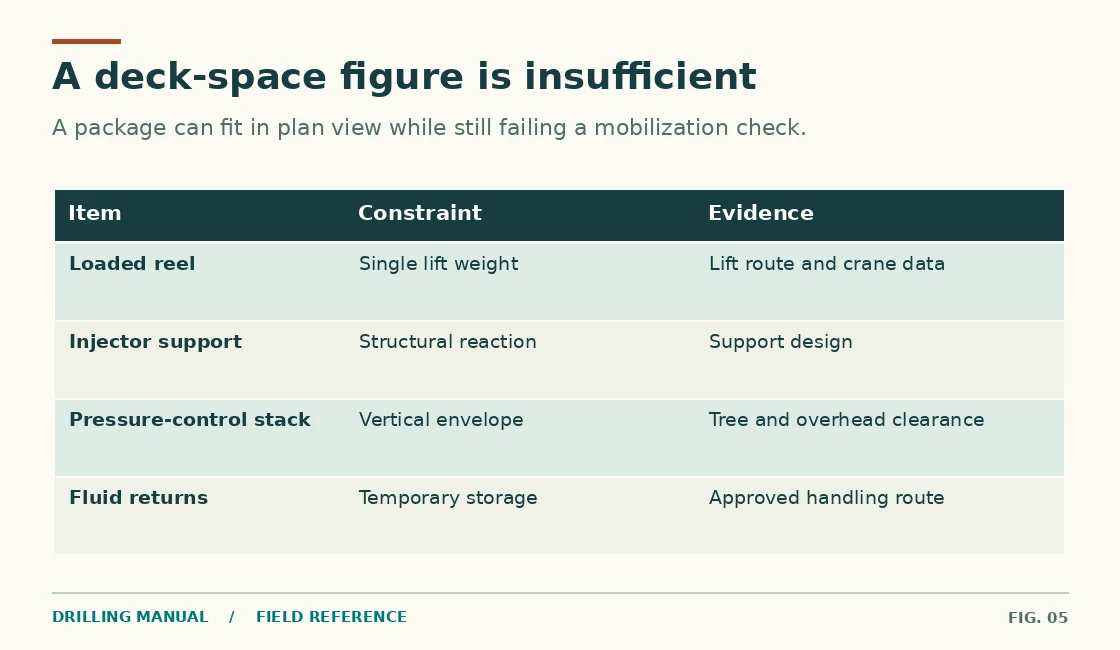
Screen the complete surface package along with the downhole assembly. The reel lift, injector support, fluid tanks, power supply, lubricator envelope, returns equipment and tree interfaces can govern whether an otherwise suitable package fits. On a platform, specify individual lift weights and staging space. A total deck area with no access route tells the planner little about mobilization.

Record the point where a method stops being viable
Put alternatives on one sheet. For each, show the critical unknown, the evidence needed to close it and the fallback if the assumption fails. A vendor statement that a tool has reached the same measured depth elsewhere is weak evidence when the trajectory, restriction, fluid or payload differs.
Conclude with separate technical and commercial decisions. If two packages can deliver the same verified outcome, compare vessel or rig time, number of runs, support services and consequence of a failed first attempt. If one package cannot deliver the required circulation or force, a low day rate has no relevance to that objective.
Screen the circulation objective against actual return volume
Suppose the completion drawing gives 18 bbl of return-path volume from the working interval to the sampling point. At a steady verified return rate of 0.30 bbl/min, one nominal transit takes 18 ÷ 0.30 = 60 minutes. A clean sample after 20 minutes cannot yet establish that returns originating at the target are free of solids under these assumptions.
Use the measured return rate rather than assuming it equals the pump rate. A loss zone, a different routing or material stored in the well changes the interpretation. One nominal transit is a fluid-volume check and cannot predict solids lifting or certify a clean interval. Specify how the proposed conveyance, returns handling and depth evidence together will demonstrate that access below the fill has been restored.
Field comparison
| Method | Capability to evaluate | Common missing input |
|---|---|---|
| Slickline or braided mechanical line | Mechanical service or recovered memory data | Profile, gravity reach and recovery load |
| Electric line, with tractor if required | Telemetry, powered tools and assisted conveyance | Power at tool and complete-string reach |
| Coiled tubing | Continuous fluid conduit and mechanical deployment | Returns route, friction and solids transport |
| Hydraulic workover on jointed pipe | Jointed workstring and engineered axial loading | Structural support, load envelope and well barriers |

What to record in the field
| Check or record | Job-specific entry |
|---|---|
| Required result and measurement proving it | |
| Depth, restrictions, trajectory and return path | |
| Fluid, force, local power and communications required | |
| Surface footprint, lift, fallback and decision owner |
Additional technical figures (5)
Questions from the field
Does rigless mean the well stays live?
It describes the equipment arrangement. The well condition and required barrier configuration are independent design decisions.
Can wireline replace coiled tubing for cleanout?
Wireline bailers may recover limited debris. A job that requires sustained pumping and solids circulation needs an engineered flow path.
Why compare the recovery plan when selecting conveyance?
An assembly that can reach and complete the task can still become unrecoverable. Recovery requirements can change the preferred method.

Technical references
Well Intervention Pressure Control, training handout. PDF pp. 114–116, 147–149 and 179–182.
Cased Hole Evaluation Guidelines, EP 93-1585. PDF pp. 137–138, deployment alternatives.
SLB Energy Glossary, Rigless operation. Industry definition.
SLB, Coiled tubing intervention. Coiled tubing services and applications.