What a defoamer for drilling mud is selected to do
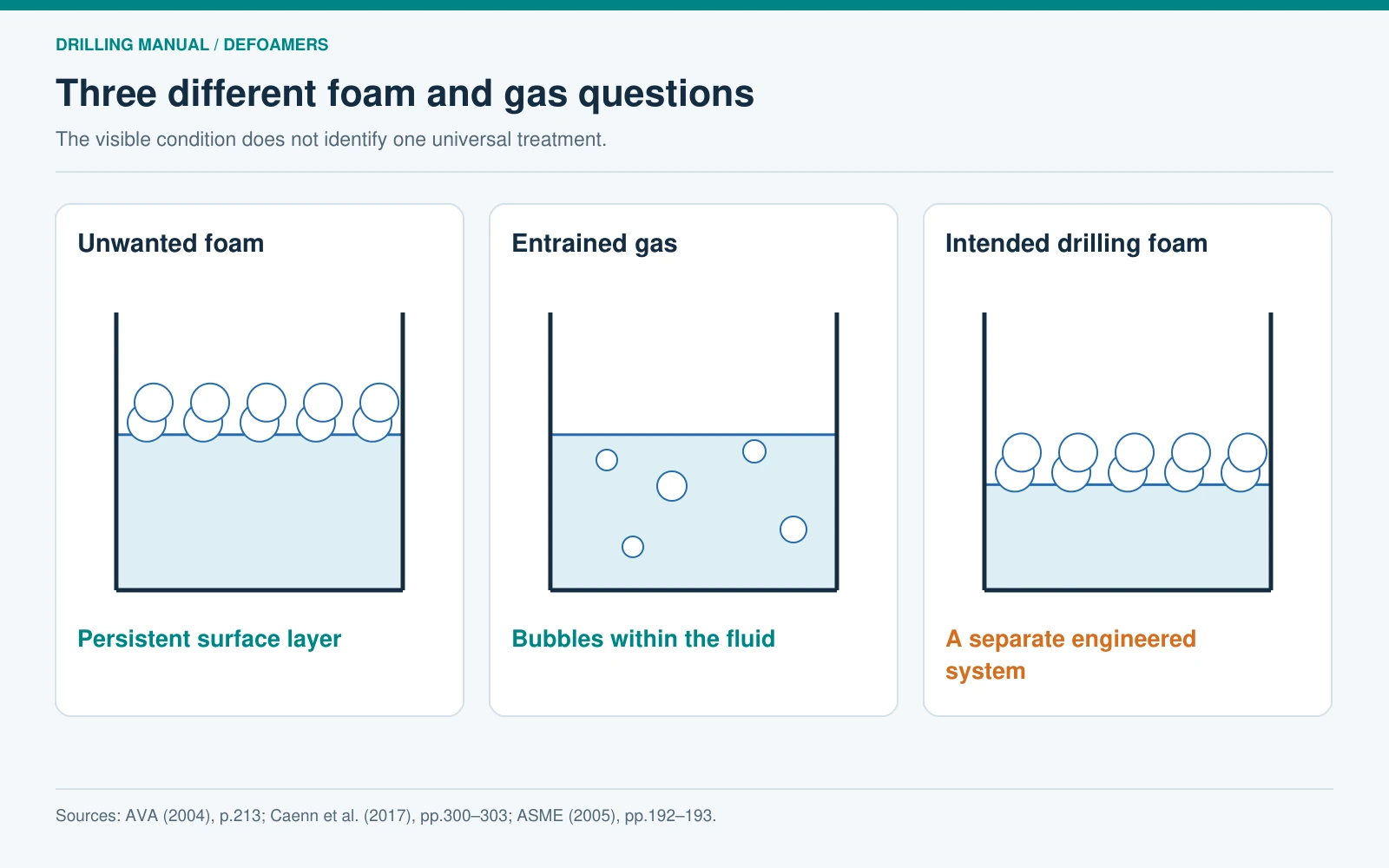
A defoamer for drilling mud is selected to reduce unwanted foam in a particular fluid. The decision starts with the observed problem: persistent surface foam, a tendency to foam during handling, gas dispersed within the mud, or a combination of these. The appearance of bubbles alone does not establish their source or identify one treatment that solves every associated problem.
AVA describes foaming as a problem for pumping, solids equipment and interpretation of pit-volume measurements. Caenn, Darley and Gray emphasize empirical selection and distinguish foam chemistry from gas retained by the fluid’s gel structure. The ASME handbook adds a separate equipment perspective: free-gas handling, entrained-gas removal and foam at the shaker are related but different duties. [1, p. 213] [2, p. 303] [3, pp. 192–196]
This guide explains how to frame a comparison and interpret its limits. It provides no universal dose or field treatment sequence. Chemical foam control cannot establish that an unexpected gas condition is benign, and it does not replace the well’s approved gas-assessment and well-control arrangements.


Separate foam formation, trapped gas and intended foam
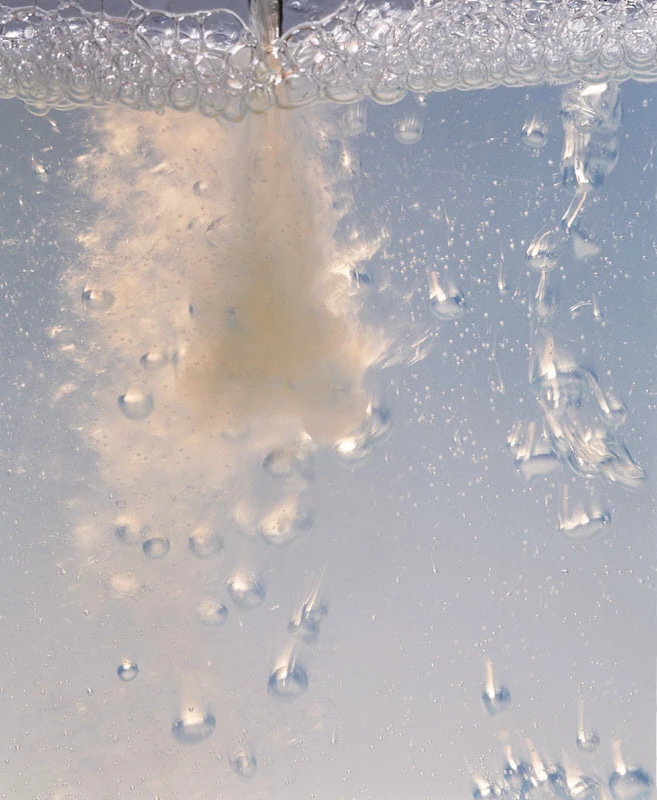
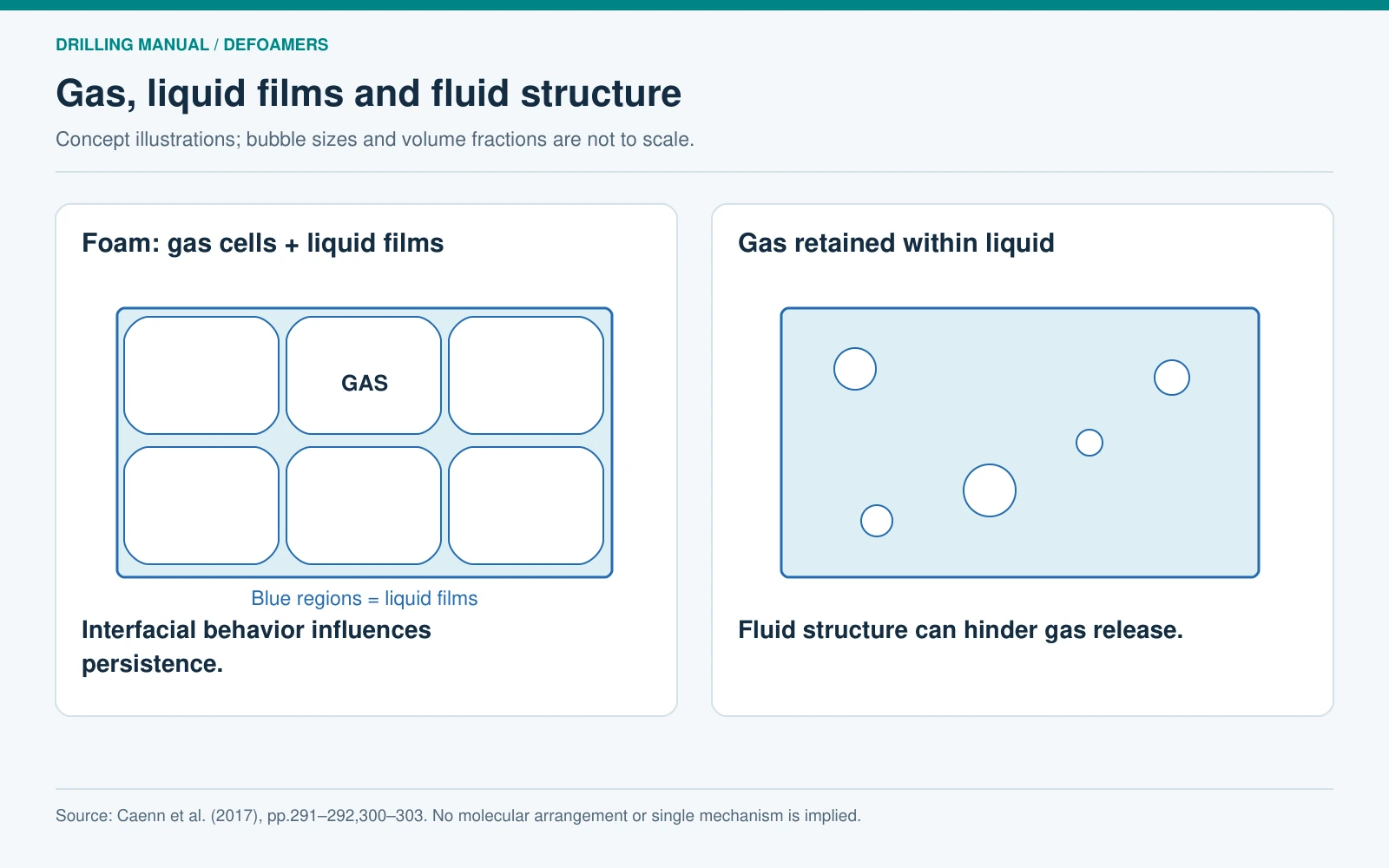
Foam contains gas separated by liquid films. Its persistence depends on more than the visible number of bubbles. Surface-active substances change interfacial behavior, while the fluid’s structure can also hinder the escape of gas. A stable foam layer and tiny bubbles distributed through a viscous mud therefore need not respond in exactly the same way. [2, pp. 291–292, 300–303]
| Observation or application | Question to resolve | What appearance alone cannot prove |
|---|---|---|
| Unwanted persistent foam | Which fluid and conditions sustain the foam? | That every gas bubble has the same origin |
| Gas retained within mud | How do fluid structure and gas-removal equipment affect release? | That disappearance of a surface cap removes all entrained gas |
| Deliberately formulated drilling foam | What are the objectives of that separate engineered system? | That an unwanted-foam treatment belongs in it |
Caenn discusses intentional foam drilling separately from defoamers. That distinction matters: destroying a deliberately designed foam can conflict with its purpose. The following selection framework concerns unwanted foaming in a liquid drilling-fluid system, not the design or operation of air or foam drilling. [2, pp. 300–303]
Antifoam and defoamer describe different objectives
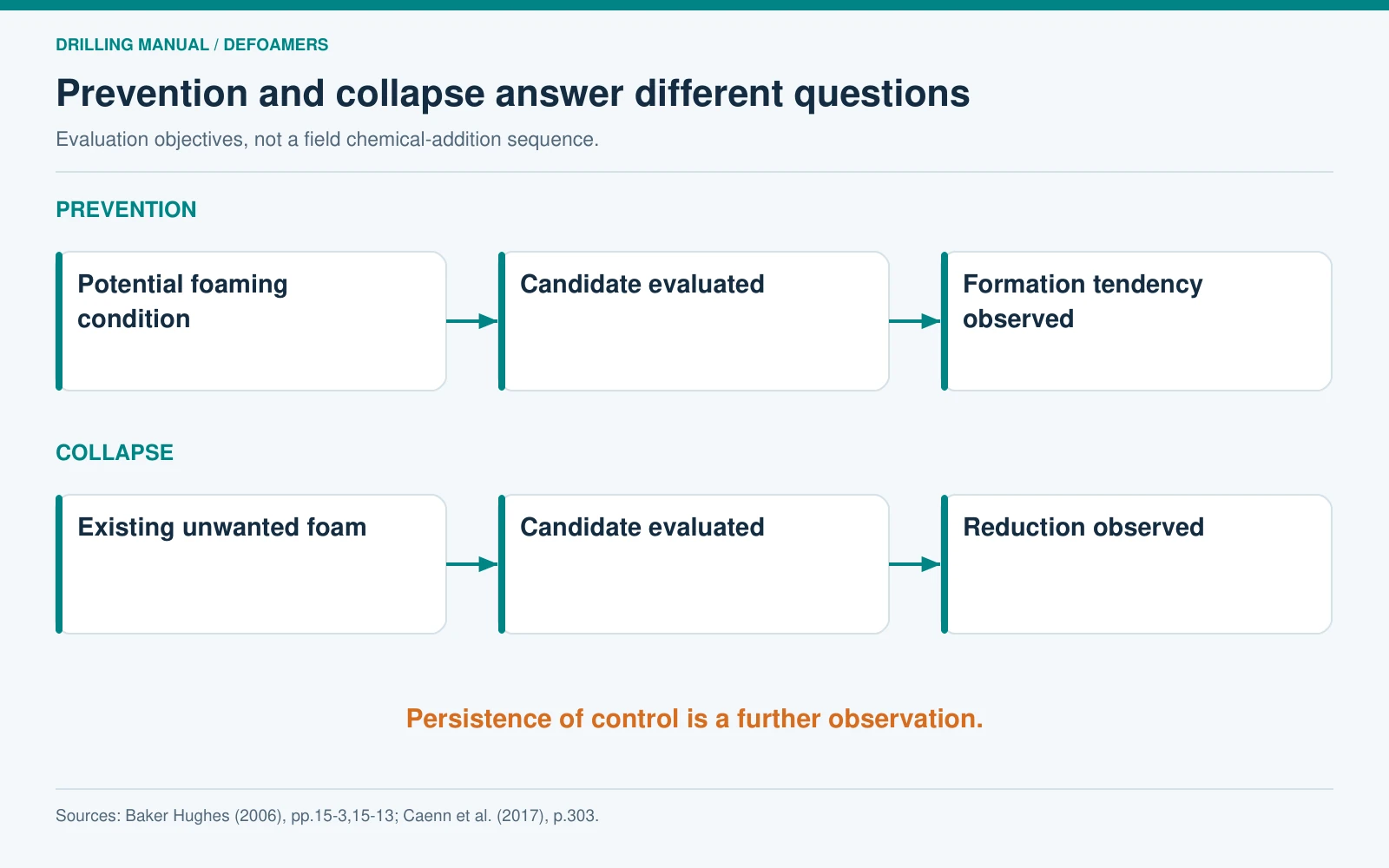
Baker’s glossary distinguishes an antifoam used to prevent foam from a defoamer used to reduce or remove foam already present. Use that distinction to define the comparison objective, while recognizing that a commercial material may be evaluated for more than one role. Preventing renewed foam and collapsing an existing layer are not identical observations. [4, pp. 15-3, 15-13]
For a defoamer for drilling mud, record whether the question concerns initial collapse, persistence of control, or both. A sample that clears quickly may answer the first question while leaving the second unresolved. Conversely, a formulation selected for prevention needs evidence of that tendency under the conditions represented. These are reasons to define observations and their timing, not instructions for where or when to add a chemical in the field.
Do not turn a familiar product label into a universal mechanism. The source glossary uses simplified surface-tension language, but Caenn’s fuller discussion says that surface tension alone does not determine foam stability. This article therefore uses the prevention/collapse distinction for purpose and the broader interfacial discussion for interpretation. [2, pp. 300–303]
Why the actual fluid matters when choosing a defoamer for drilling mud
Surfactants are a broad class, not one interchangeable additive. AVA lists different functions at air/water, oil/water and fluid/solid interfaces; Caenn includes foamers, defoamers, emulsifiers and wetting agents within the wider surface-active family. A product intended for one interfacial job cannot be assumed suitable for another simply because both are described as surfactants. [1, pp. 74, 159] [2, pp. 291–292]
The fluid system provides the selection context. Freshwater mud, brine-based mud and a polymer-containing formulation are not identical test media. AVA’s foam discussion covers brackish and saline fluids as well as air or gas retained in freshwater fluids, and calls for pilot evaluation because many variables influence foaming. Baker also gives a specific polymer-brine application in which antifoam may be needed during mixing; that example should not become a blanket requirement for every polymer. [1, p. 213] [4, p. 6-79]
Use the actual formulation and its condition when evaluating a defoamer for drilling mud. The water-based fluid systems guide provides the broader system context. Product choice here depends on observed performance and compatibility, rather than copying a treatment from a different mud family.


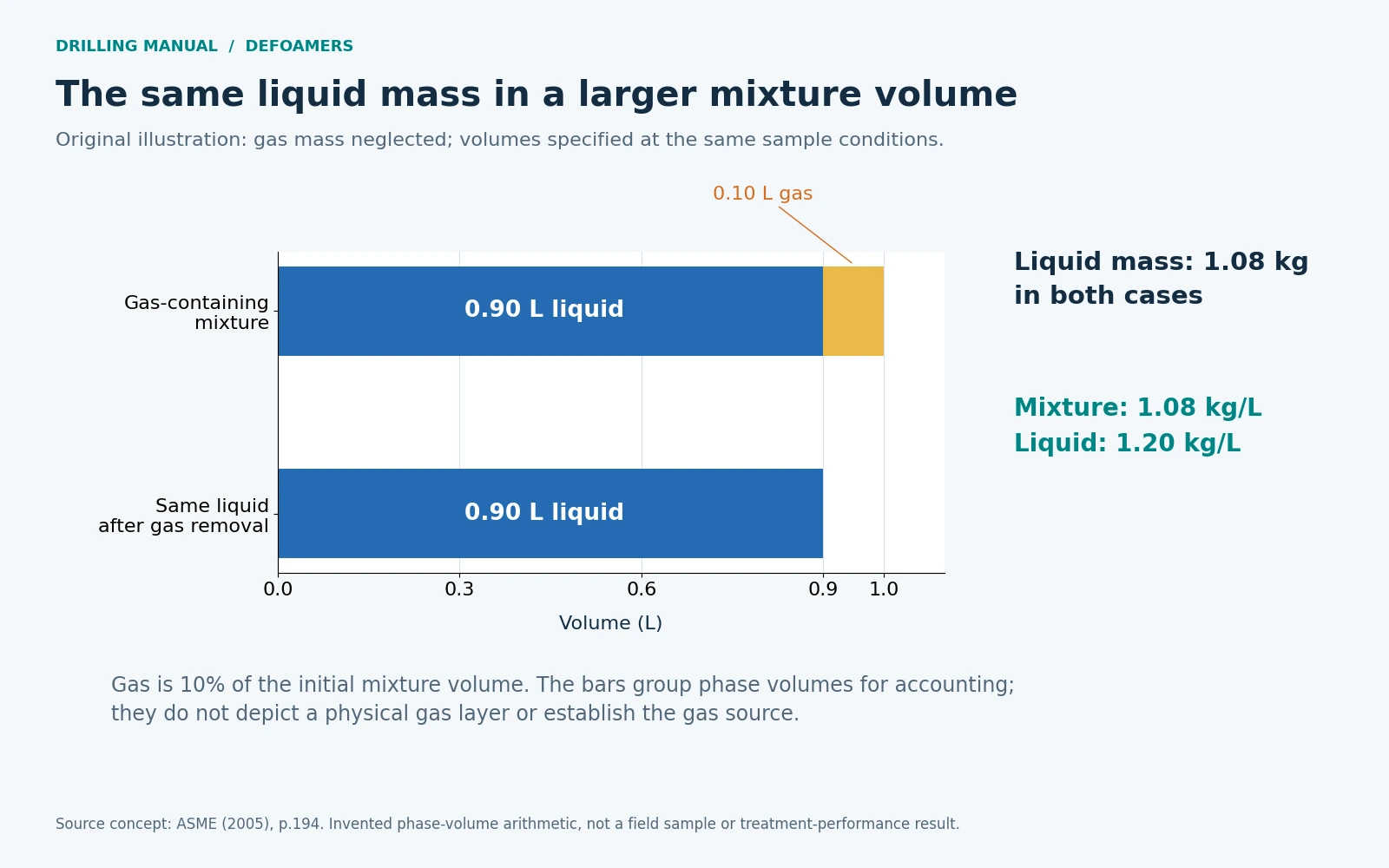
Gas can change the apparent density without removing liquid mass
Consider an original, deliberately simplified example at one stated comparison condition. There are 0.90 L of liquid with density 1.20 kg/L, plus 0.10 L of dispersed gas whose mass is neglected. Assume the phase volumes add to 1.00 L: gas occupies 10% of that mixture volume at the stated sample conditions. The liquid mass is 0.90 × 1.20 = 1.08 kg, and the mixture density is 1.08 ÷ 1.00 = 1.08 kg/L.
| Quantity | Illustrative value |
|---|---|
| Liquid volume and density | 0.90 L at 1.20 kg/L |
| Gas volume, negligible mass assumption | 0.10 L |
| Total mixture volume and mass | 1.00 L and 1.08 kg |
| Apparent mixture density | 1.08 kg/L, 10% below the liquid density |
No liquid or solid mass has been removed in this example. The change arises because the gas occupies part of the measured volume. If that gas is separated and the same liquid remains, its density is still 1.20 kg/L under the stated assumptions. ASME discusses the effect of gas cutting on density; the numbers here are invented and do not reproduce the book’s pressure example. [3, p. 194]
This calculation cannot identify the gas source, diagnose an influx or determine a treatment. It explains why a density observation must retain its sample condition. The mud properties guide and water-based mud testing guide provide the wider measurement context.
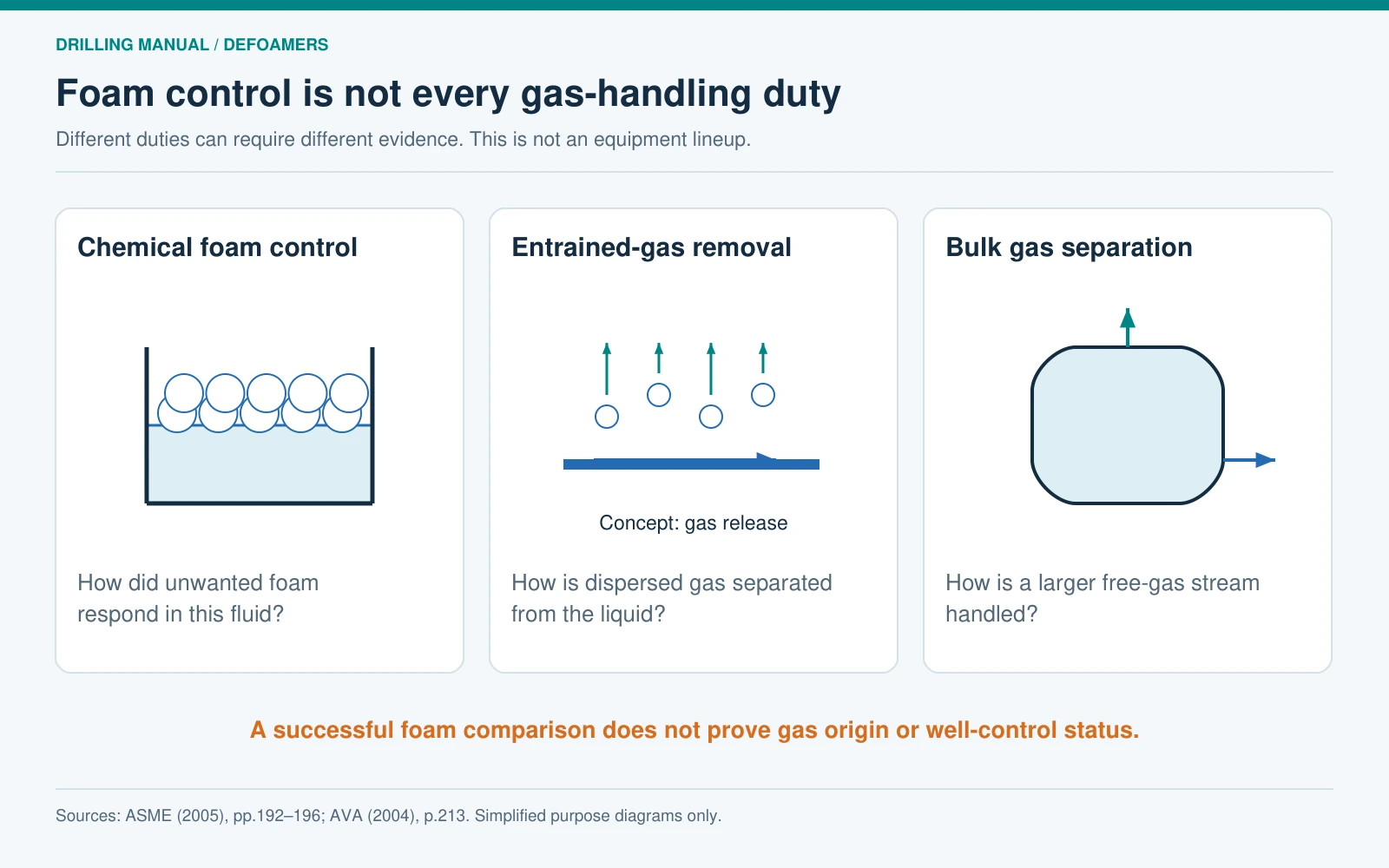
Chemical foam control and mechanical gas removal have different jobs
A defoamer for drilling mud is not a replacement for gas-removal equipment. ASME describes several ways gas can disturb solids processing: rapidly expanding gas can create surges, dispersed bubbles can interfere with screen openings, and a light foam film can carry liquid across a shaker. Those observations should not all be reduced to “add more defoamer.” [3, pp. 192–193]
The handbook distinguishes bulk gas separation from removal of entrained gas. It describes thin-film exposure and reduced-pressure separation as ways of helping gas escape from liquid. These are mechanical separation concepts, whereas a chemical candidate is evaluated for its effect on unwanted foam in the fluid. The two may be relevant together, but evidence of one function does not establish that the other is satisfactory. [3, pp. 193–196]
Consult the existing mud-gas separator guide and the degasser section of the rig equipment guide for equipment context. This article does not specify a gas-handling lineup, capacity or well-control response. A cleaner-looking surface cannot be used as confirmation that the gas situation has been resolved.
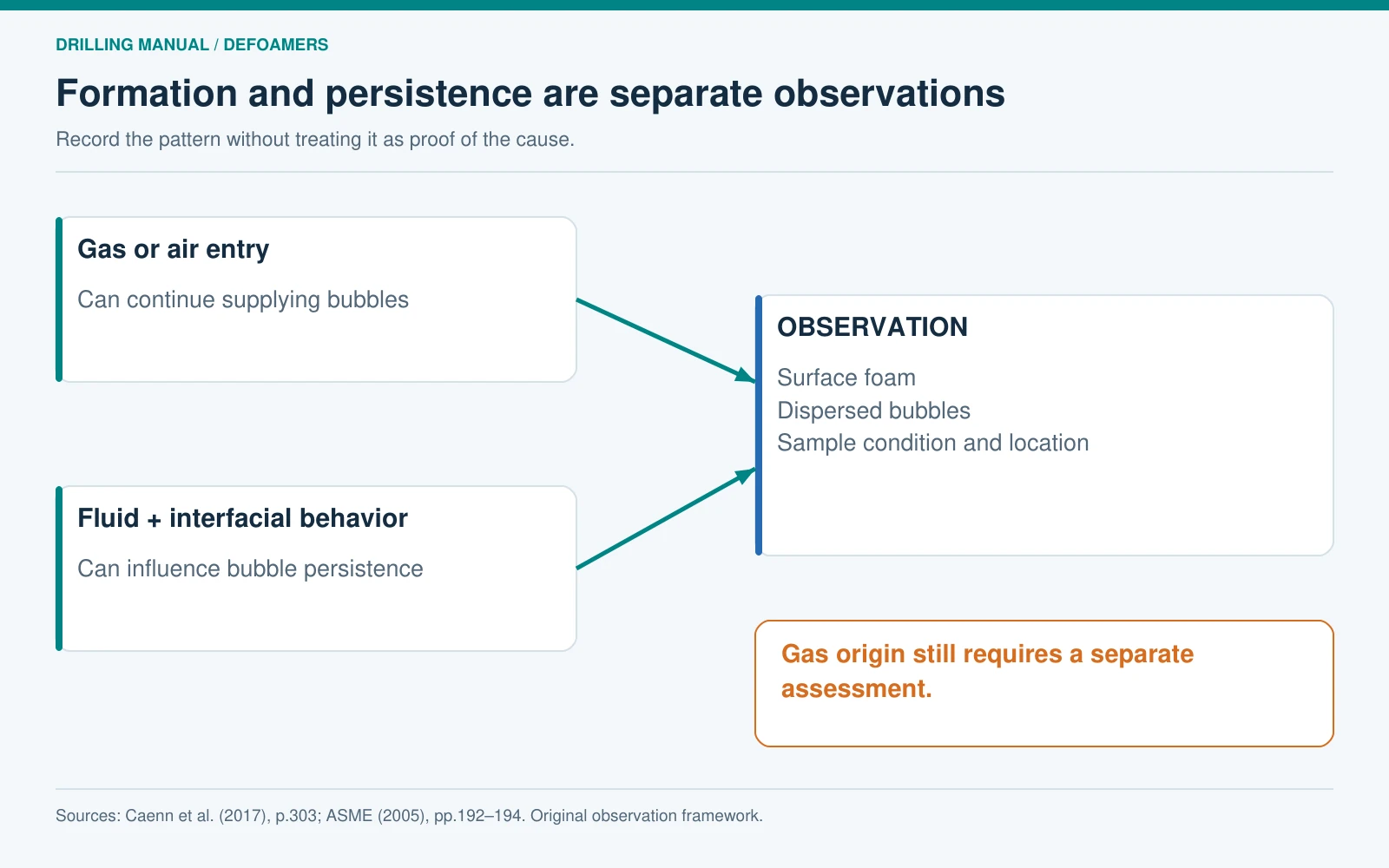
Diagnose the observation before ranking a defoamer for drilling mud
Write down what changed and where it was observed. A foam layer at a sample surface, changing apparent density and poor shaker behavior are different pieces of evidence. Record the fluid identity, recent changes in its condition and the operating context rather than replacing all three with a single word such as “foaming.” AVA’s warning about volume interpretation and ASME’s separate gas effects support keeping those observations distinct. [1, p. 213] [3, pp. 192–194]
Also separate formation of bubbles from their persistence. Continued gas or air entry can maintain an observation even when some foam collapses; a fluid that retains bubbles through its structure presents another limitation. Caenn specifically identifies mechanical retention by gel structure in gas-cut mud. The useful question is whether the proposed evaluation represents the behavior actually being investigated. [2, p. 303]
This is a framework for documenting evidence, not a diagnosis of any individual well. The timing of an observation can guide further investigation, but it does not prove the origin of the gas. Keep the approved operational assessment separate from the additive comparison.
Compare a defoamer for drilling mud without hiding side effects
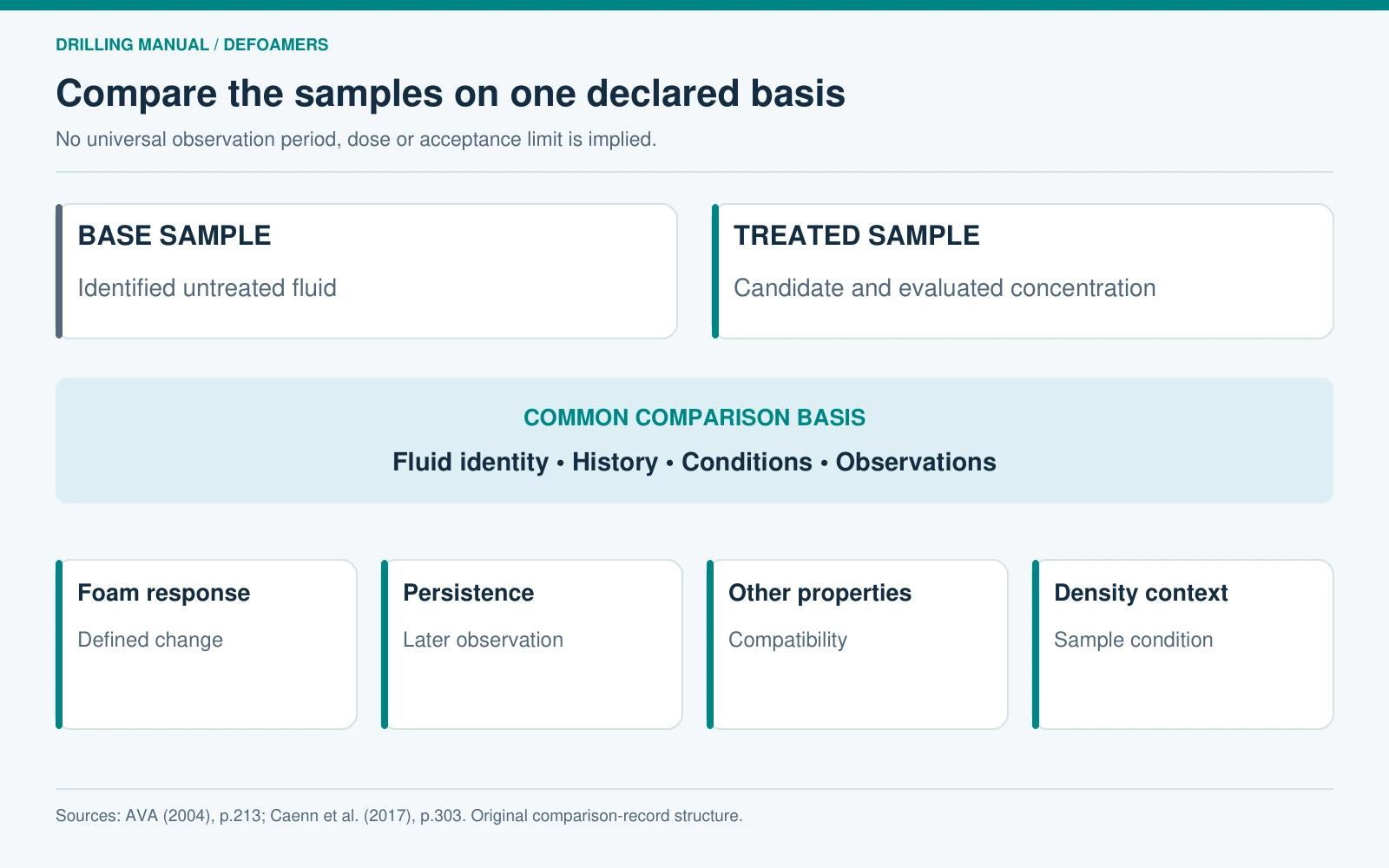
A useful comparison preserves an untreated sample and records what differs in the treated one. Declare the fluid composition and history, the evaluation conditions, the concentration being evaluated and the observation schedule. Use the same agreed basis across candidates. The purpose is to make the evidence interpretable; the exact method and acceptance limits belong to the applicable fluid-evaluation plan. AVA and Caenn both emphasize empirical selection rather than a universally successful material. [1, p. 213] [2, p. 303]
| Evidence field | What to record | What it does not establish alone |
|---|---|---|
| Foam response | The defined observation before and after evaluation | Long-term control from one immediate reading |
| Persistence or renewed foaming | The agreed observation period and conditions | Performance under every future condition |
| Fluid compatibility | Relevant property and appearance changes | Suitability from a clear-looking surface |
| Gas and density context | Sample condition and measurement basis | Gas origin or well-control status |
Do not rank candidates only by the most dramatic initial collapse. Retain the other fluid requirements and any unresolved questions. A comparison is especially weak when the untreated fluid and treated fluid have different histories and the report attributes every difference to the additive. A documented limitation is more useful than a confident product ranking unsupported by comparable samples.

Keep the decision and its limits in the fluid record
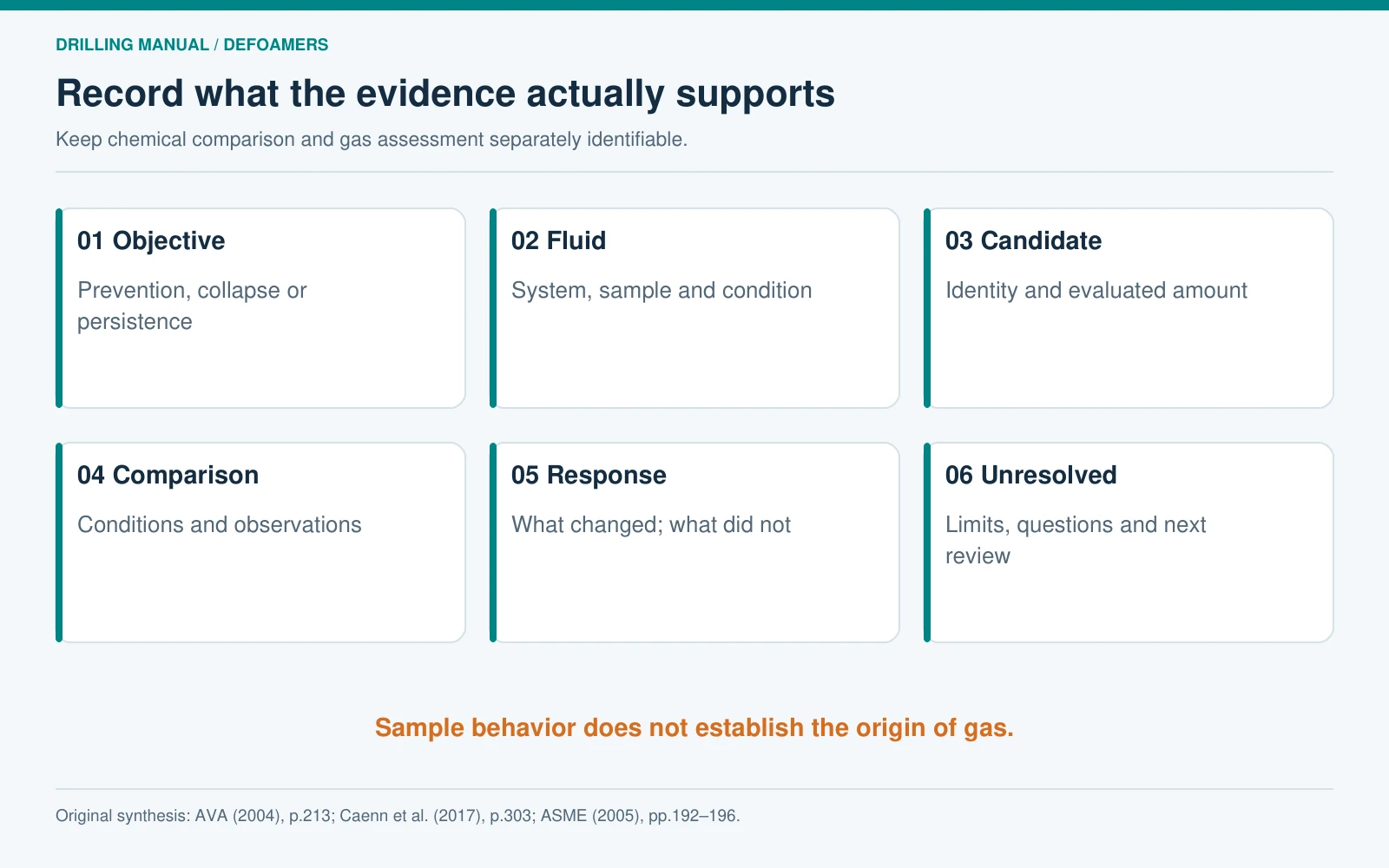
A compact review record for a defoamer for drilling mud should identify the objective, fluid, candidate, comparison conditions, observed response and remaining uncertainty. State whether the evidence concerns prevention, collapse or persistence. Keep mechanical gas-removal observations and the separate gas-origin assessment identifiable rather than burying them in the chemical-treatment entry.
Use the daily mud report to retain that context alongside the fluid measurements. The final selection statement should say what was demonstrated in the evaluated fluid and which questions remain open. It should not claim universal effectiveness, a fixed field dose or proof of a resolved gas condition.
Frequently asked questions
These questions address the limits that commonly matter when comparing foam-control additives.
Is antifoam the same as defoamer?
The terms can overlap in product descriptions, but the objectives are distinguishable. Baker describes antifoam as prevention and defoamer as reduction or removal of existing foam. Record which behavior was evaluated; one immediate collapse observation does not establish lasting prevention. [4, pp. 15-3, 15-13]
Does every surfactant reduce foam?
No. The broad surface-active family includes foamers, defoamers, emulsifiers and wetting agents. Their functions depend on the interfaces and formulation involved. The class name alone does not identify the right additive for an unwanted-foam problem. [1, p. 159] [2, pp. 291–292]
Can a defoamer for drilling mud replace a degasser?
No. A foam-control comparison does not establish mechanical removal of entrained gas. ASME describes degassing and bulk gas separation as distinct equipment duties, alongside the effects of foam on solids processing. The chemical and equipment evidence must remain separately reviewable. [3, pp. 192–196]
Does a clear surface prove the mud is gas-free?
No. Gas may be dispersed within the liquid, and fluid structure can hinder its release. Surface appearance alone does not establish sample density, gas origin or the state of the well. Retain the relevant measurements and approved operational assessment. [2, p. 303] [3, pp. 192–194]
Why can the measured density rise after gas removal?
Gas can add volume with comparatively little mass. Removing it can reduce the measured mixture volume while leaving the liquid mass. The hypothetical example illustrates this arithmetic; it does not establish that a particular field density change was caused only by gas. [3, p. 194]
Is there one correct dose for every mud?
No universal dose follows from these sources. AVA calls for pilot evaluation because multiple variables affect foaming, and Caenn stresses empirical selection. The actual product, fluid and conditions must define the comparison and any approved application; this guide supplies no mixing recipe. [1, p. 213] [2, p. 303]
References
- AVA S.p.A., A Newpark Company. Drilling Fluids Manual, Version 1, November 2004. Printed pages: 74, 159, 213. PDF pages in the edition consulted: 76, 161, 215.
- Caenn, Ryen; Darley, H.C.H.; and Gray, George R. Composition and Properties of Drilling and Completion Fluids, Seventh Edition. Gulf Professional Publishing/Elsevier, 2017. ISBN 978-0-12-804751-4. Printed pages: 291–292, 300–303. PDF pages in the edition consulted: 294–295, 303–306.
- ASME. Drilling Fluids Processing Handbook. Gulf Professional Publishing/Elsevier, 2005. Chapter 9, “Gas Busters, Separators, and Degassers.” ISBN 0-7506-7775-9. Printed pages: 192–196. PDF pages in the edition consulted: 219–223.
- Baker Hughes Drilling Fluids. Drilling Fluids Reference Manual, revised 2006. Chapters 6 and 15. Printed pages: 6-79, 15-3, 15-13. PDF pages in the edition consulted: 363, 728, 738.