Oil well swabbing deliberately removes liquid from the production tubing to reduce the liquid column opposing formation inflow. A wireline-carried cup assembly lifts liquid toward the surface, and the resulting pressure change may help a completed well start flowing. Recovering liquid, observing formation inflow and demonstrating sustained production are three different findings. [1, p. 449] [2, pp. 274, 299]
This article explains what swabbing observations can support and where interpretation must stop. It covers the mechanism, fluid returns and the distinction between activation and production evaluation. It provides no operating sequence, tool speed, permitted drawdown, pressure setting or acceptance criterion for a field job.
How Oil Well Swabbing Lifts Liquid
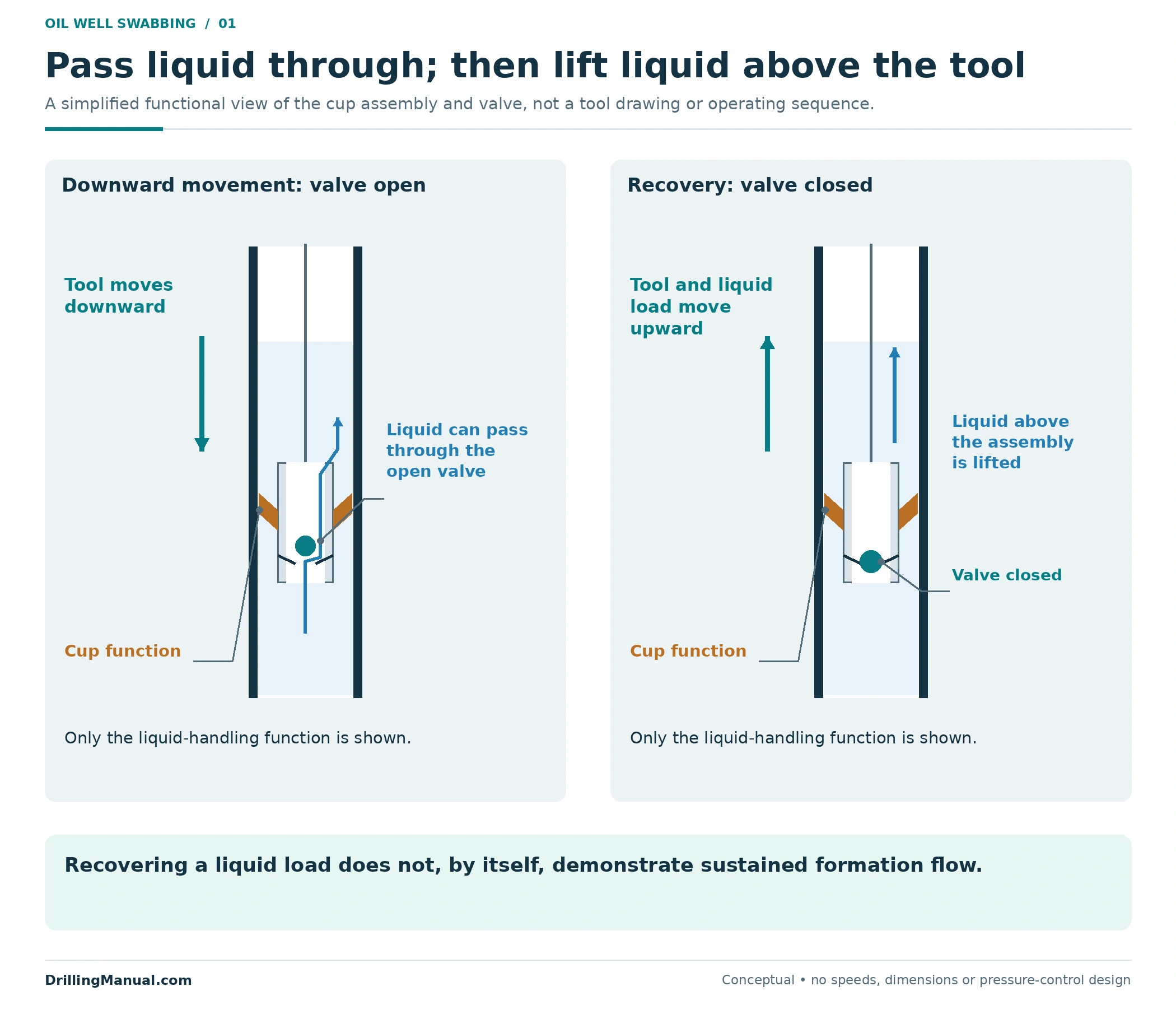
The ONGC manual describes a swabbing assembly with rubber cups and an upward-opening valve, carried on a line through the tubing. During downward movement, liquid can pass through the valve and reach the space above the tool. During recovery, the valve closes and the liquid above the assembly is lifted. The conceptual distinction is between allowing passage through the tool and carrying a liquid load upward. [1, p. 449]
Perrin lists swabbing tools among equipment used to start or kick off a well and discusses wireline swabbing in the context of restarting after servicing. That purpose matters: the operation changes the well’s liquid burden so the formation may contribute. It is not, by itself, a measurement of what the reservoir will deliver continuously under a different production condition. [2, pp. 274, 299]
Oil well swabbing should therefore be described with the actual objective attached. Is the objective to assist startup, recover liquid while observing the well’s response, or support a separately designed evaluation? The same physical removal of liquid does not make those objectives equivalent.

Why Removing Liquid Can Permit Inflow
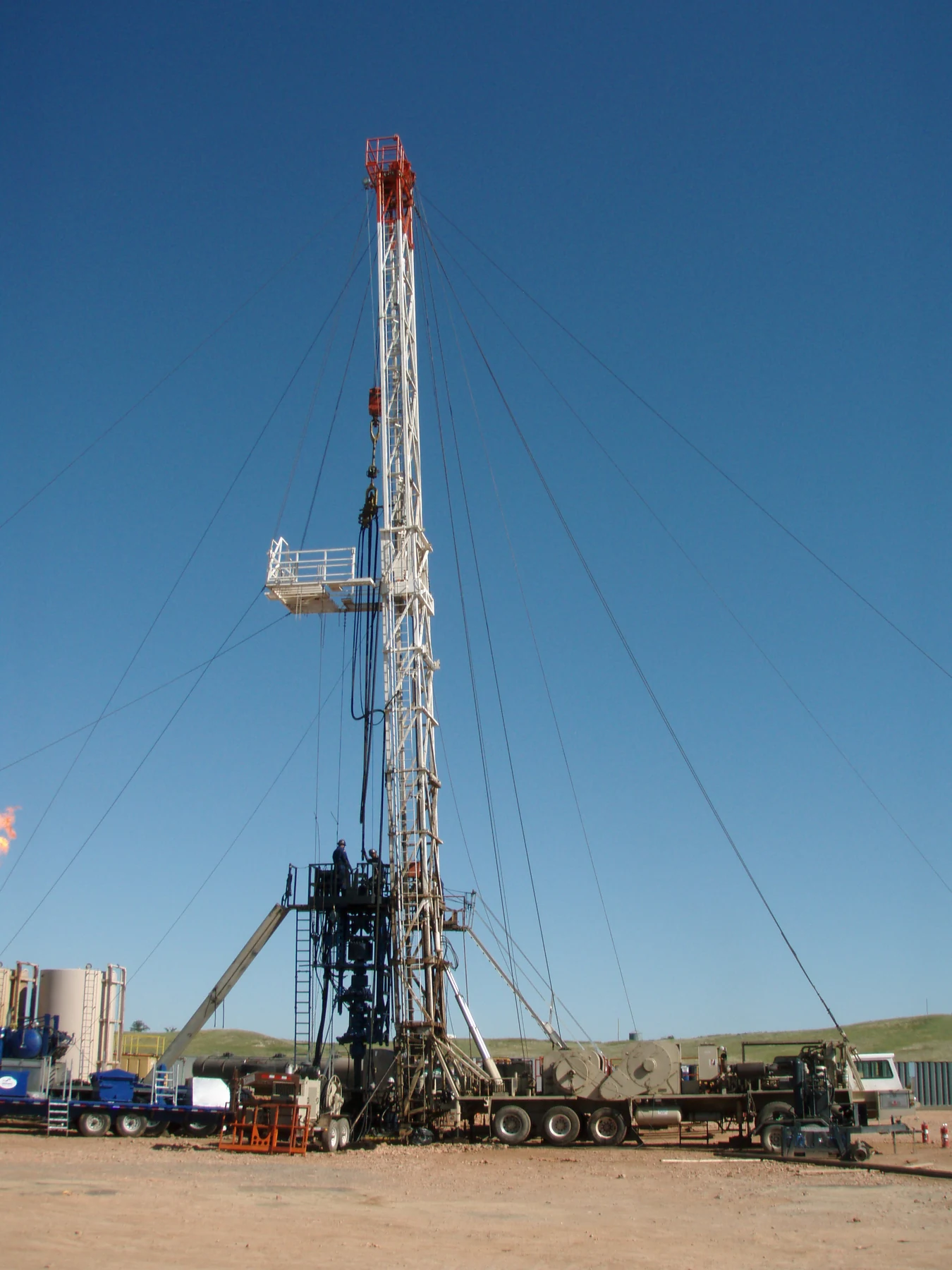
A liquid column contributes pressure at depth. Lowering the level reduces that contribution when the relevant fluid and geometry are considered. The ONGC description links progressive liquid removal with reduced backpressure at the formation and the possibility of formation fluids entering when the pressure relationship permits. The explanation concerns the pressure burden, not a promise that every well will become self-flowing. [1, p. 449]
Keep the source of the driving pressure separate from the act of lifting liquid. The tool carries a quantity already above it; the formation’s response depends on the conditions at the producing interval and the available flow path. An observed return at surface can occur while the tool is doing the lifting. That observation alone does not show that reservoir energy is carrying the same stream to surface unaided. [1, pp. 448–449]
This distinction also explains why the starting well condition belongs in the record. The fluid already present, the liquid level and the state of the completion influence what is being unloaded. Without that context, a statement such as “the well returned liquid” leaves both the origin of the liquid and the cause of its movement unresolved.
Oil Well Swabbing Returns Can Include Stored Liquid
At the start of an unloading operation, liquid can already occupy the well. Some of the recovered quantity may therefore be that initial inventory. Formation inflow may subsequently add liquid as the pressure burden changes. A surface collection measurement is an observation at the outlet; it is not automatically an allocation between those two sources. This is the accounting consequence of the source’s liquid-removal and subsequent-inflow description. [1, p. 449]
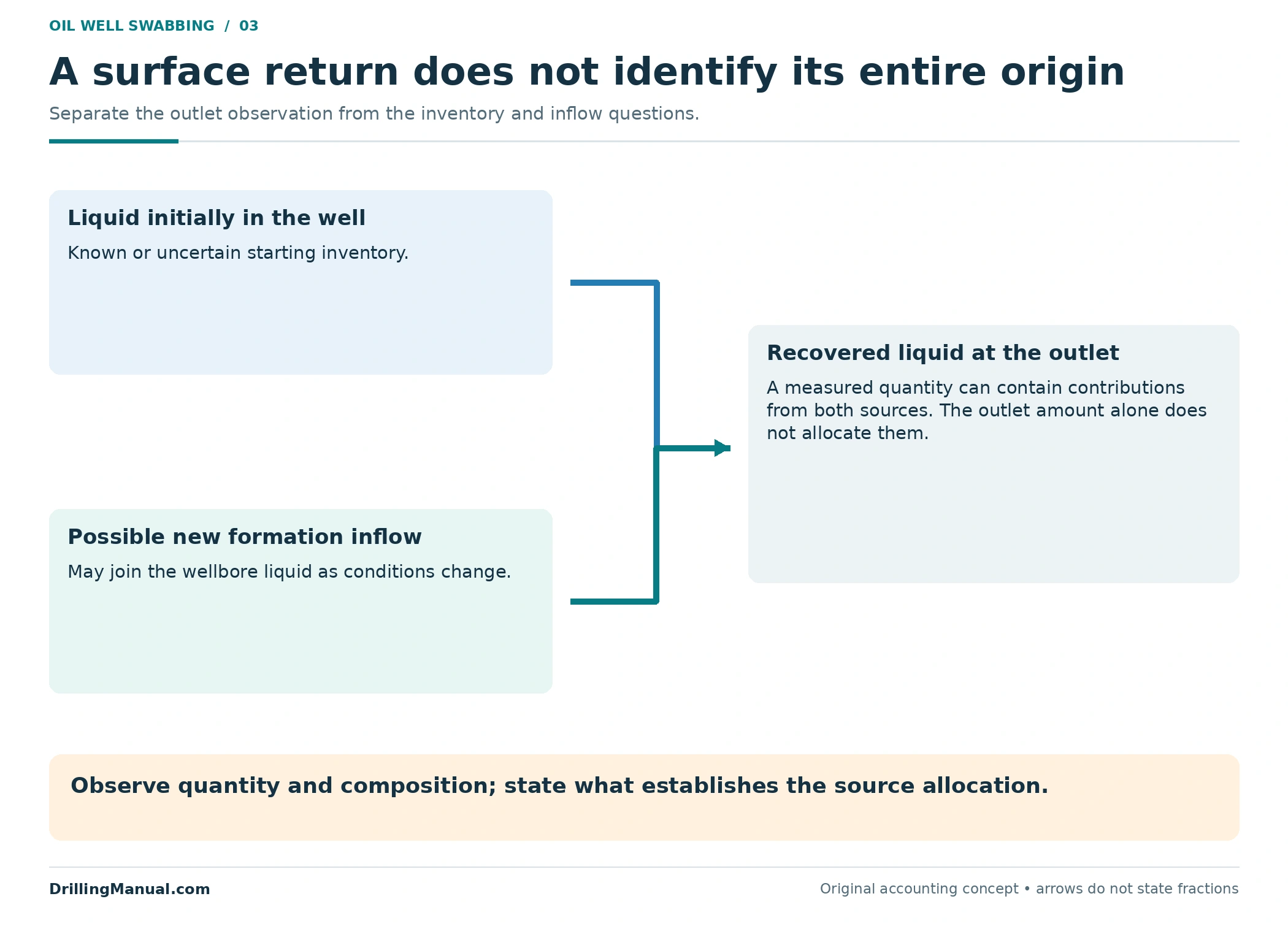
For oil well swabbing, distinguish three questions in the report: how much liquid was recovered, what is known about its composition, and what supports attributing it to new inflow. They require related but different evidence. The appearance of oil, water or mixed liquid may be useful to the investigation, but a sample does not supply the missing inventory or pressure history.
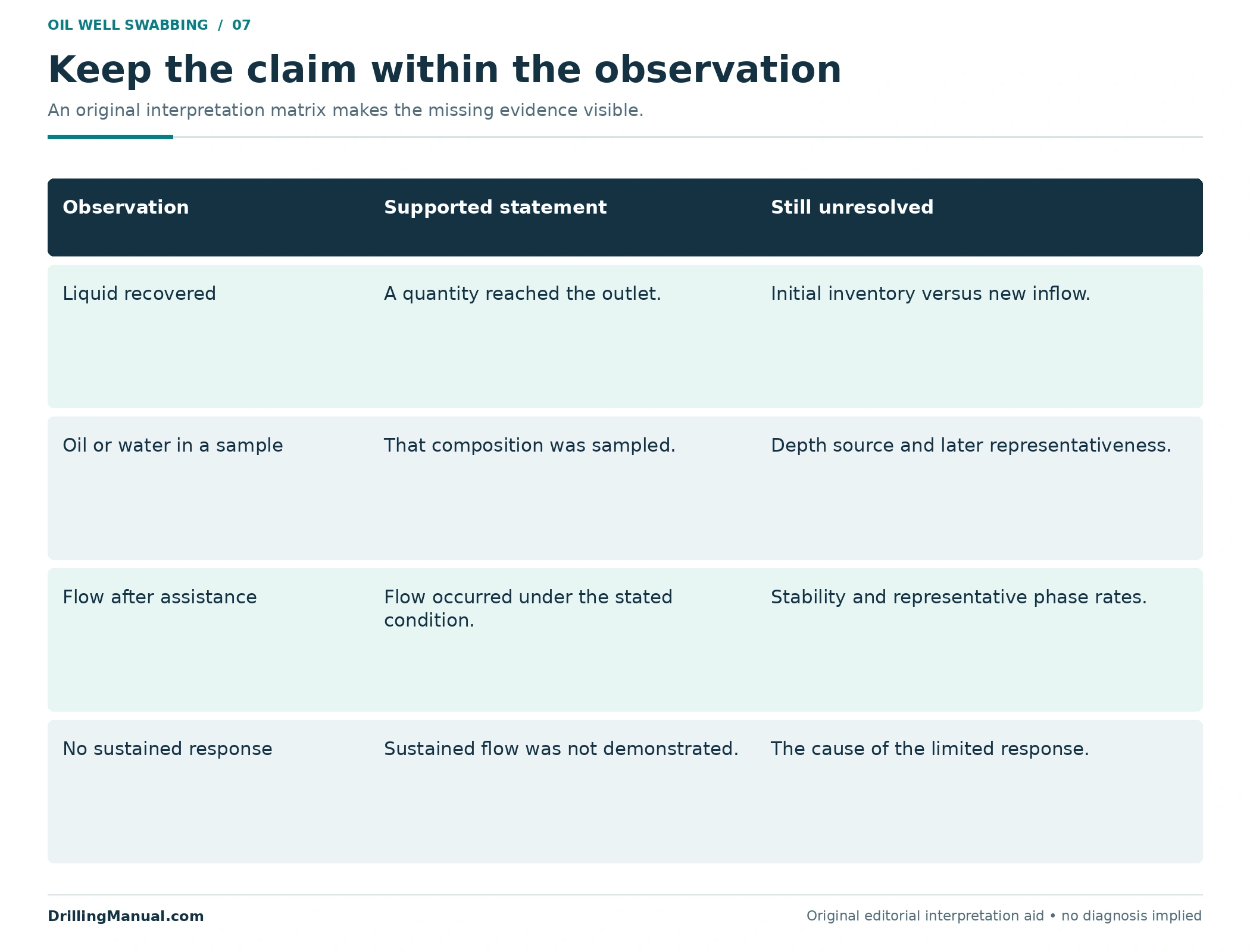
| Observation | What it supports | What still needs evidence |
|---|---|---|
| Liquid reaches the surface during assisted recovery. | A quantity was recovered from the well through the observed operation. | How much was initial wellbore inventory and how much was newly supplied. |
| The recovered liquid contains oil or water. | The composition of the sampled return under the stated sampling conditions. | The contributing interval and whether the sample represents later production. |
| The well flows after the lifting assistance ends. | Flow occurred under that subsequent condition. | Its stability, duration and representative phase rates. |
| No sustained flow is established. | The intended sustained response has not been demonstrated. | The reason, including the pressure state and the available flow path. |
The table deliberately limits the conclusion to the observation. It should not be read as a diagnostic rule that assigns one failure mechanism to every outcome. The manual treats activation and subsequent production testing separately, which is the essential boundary. [1, pp. 448–449]
A Simple Volume Balance Shows the Interpretation Limit
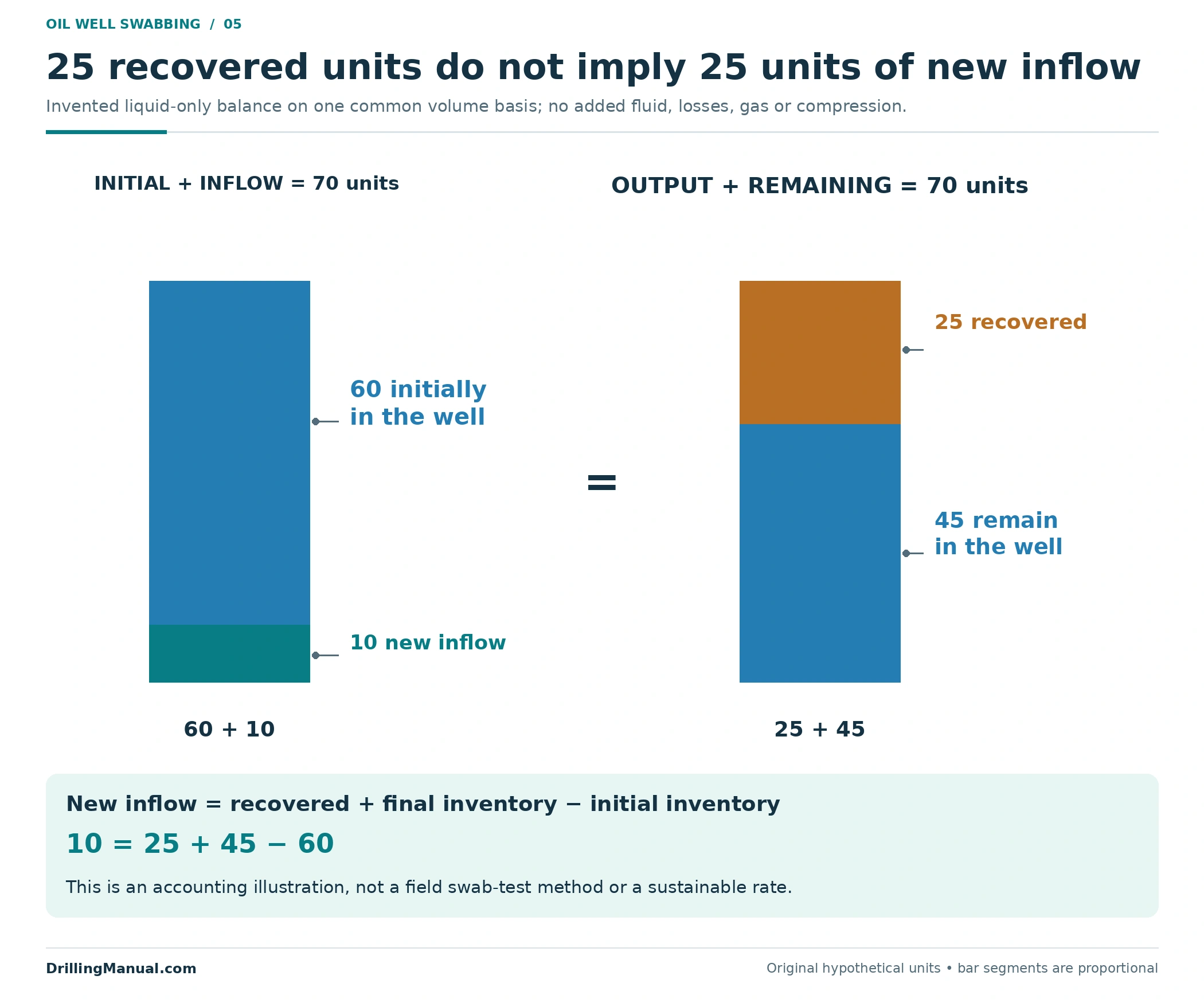
Consider an invented liquid-only accounting example. Begin with 60 volume units in the defined wellbore control volume. Recover 25 units at the outlet and finish with 45 units remaining. Assume every quantity uses the same volume basis, and exclude added fluid, losses, gas, compression and measurement error. These are teaching assumptions, not a description of a field swab test.
The balance is: initial inventory + new inflow = recovered liquid + final inventory. Therefore new inflow = 25 + 45 − 60 = 10 units. Of the 25 units recovered, 15 are accounted for by the decrease in stored inventory. Counting the entire return as new inflow would overstate it in this example.
| Quantity in the hypothetical balance | Illustrative volume units | Role |
|---|---|---|
| Initial inventory | 60 | Liquid present before the interval considered. |
| Final inventory | 45 | Liquid still present afterward. |
| Recovered liquid | 25 | Measured outlet quantity in the example. |
| Calculated new inflow | 10 | The quantity required to close this simplified balance. |
Oil well swabbing in an actual well cannot be reduced to that arithmetic without establishing the assumptions and accounting for the relevant fluids and measurements. If the final inventory is unknown, the same recovered quantity can be consistent with more than one inflow history. The example demonstrates why an outlet volume alone is insufficient; it is not a recommended field calculation.
Even a defensible net inflow quantity is not automatically a sustainable rate. A rate needs a time basis, and a production interpretation needs the conditions under which it was obtained. This balance assigns neither a reservoir productivity index nor a forecast after unloading. It also makes no allocation between multiple completed intervals.
Oil Well Swabbing and Sustained Production Are Different Tests
The manual moves from activation to a separate discussion of testing a self-flowing pay zone. It describes cleanup, stabilization and measuring phase rates and pressures under recorded conditions. That separation is useful: initiating a response is one achievement; obtaining representative production data is another. The article adopts that distinction without reproducing the manual’s test durations, choke sequence or operating instructions. [1, p. 449]
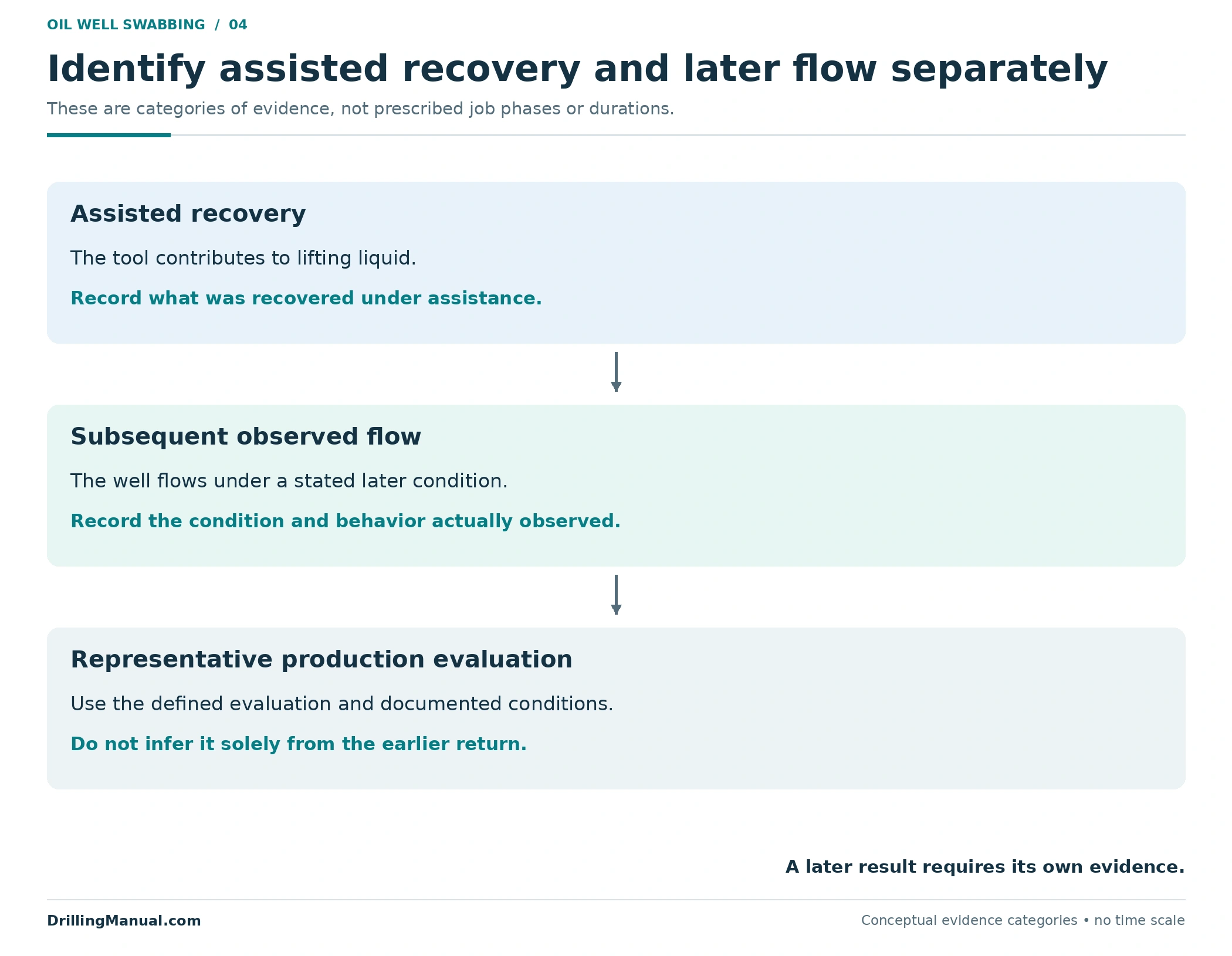
During oil well swabbing, keep records of assisted recovery distinguishable from any subsequent self-flow observation. Combining them into one unlabeled total can hide when mechanical lifting contributed to the surface result. A statement about what the well does after assistance must be supported by that later period, not inferred from earlier tool-assisted returns.
The source emphasizes that changing the flowing condition during a production evaluation can undermine the representativeness of the data. Stable and documented conditions are therefore central to the interpretation. This does not supply a universal stabilization period: the source explicitly treats stabilization as dependent on the well. [1, p. 449]
A useful report distinguishes “flow initiated,” “flow continued under the stated condition” and “representative performance established by the specified evaluation.” Each statement carries a different evidential burden. Calling all three “the well came in” makes the report shorter but leaves the production decision less clear.

Interpreting a Weak or Short-Lived Response
A well may respond to activation and then stop flowing. The ONGC discussion identifies the pressure relationship and the condition of flow paths as relevant to activation behavior. Perrin also places restart difficulties alongside formation damage and other servicing constraints. These references support investigating the condition of the system rather than treating one unsuccessful startup attempt as a complete reservoir diagnosis. [1, p. 448] [2, p. 299]
Oil well swabbing cannot, from a weak return alone, distinguish every combination of inadequate driving pressure, restricted flow or an incompletely understood initial well state. It would be equally unjustified to conclude that the formation has no useful inflow or that a further intervention must succeed. Identify the unresolved question before choosing additional evaluation.
A useful uncertainty statement for oil well swabbing names both the observation and the missing information. For example: “Liquid was recovered during assisted unloading; the available record does not establish the new-inflow fraction or a representative subsequent production rate.” That is an original reporting example, not a quotation from a field report. It preserves information that would be lost by describing the well as either productive or nonproductive without qualification.
The next question then follows from the gap. If the uncertainty concerns the liquid source, recovering a larger unallocated quantity does not automatically resolve it. If it concerns sustained behavior, the relevant evidence is the later response under documented conditions. This is a way to organize interpretation, not a prescribed sequence of interventions.
The separate formation damage guide addresses one group of possible restrictions. Mentioning damage as a candidate is not a diagnosis. The evidence should establish why it is relevant to this well and which observations would discriminate it from a pressure-related startup problem.
Keep Oil Well Swabbing Separate From Trip-Induced Swab
The word “swab” also appears in drilling well control. The manual explains that withdrawing drillstring or full-gauge tools can reduce wellbore pressure sufficiently to allow unwanted influx. That is a pressure effect associated with movement through the well, and its operational context differs from deliberately using a cup assembly to unload a completed producer. [1, section 14.1.2, physical PDF p. 305]
| Use of the term | Physical context | Meaning of an influx |
|---|---|---|
| Production swabbing | A dedicated assembly recovers liquid to help activate a completed well. | A formation response may be part of the objective, under the applicable well-control arrangements. |
| Trip-induced swab | Withdrawal of pipe or tools changes wellbore pressure during drilling or intervention. | An unplanned formation influx can represent loss of primary control. |
The comparison explains terminology; it is not permission to create an influx by pulling pipe. The existing surge and swab pressure guide addresses the drilling pressure effect. No trip-speed calculation or operating recommendation is transferred into this production-swabbing article.
Oil Well Swabbing Can Support a Specific Evaluation Objective
Petroleum Well Construction describes evaluating a squeeze treatment by applying a pressure differential to the treated interval. One approach increases pressure from inside the well; another reduces the wellbore’s hydrostatic burden, including by swabbing or using a lighter fluid. The second creates a differential in the production direction. The direction and the interval being evaluated are essential parts of the claim. [3, p. 434]
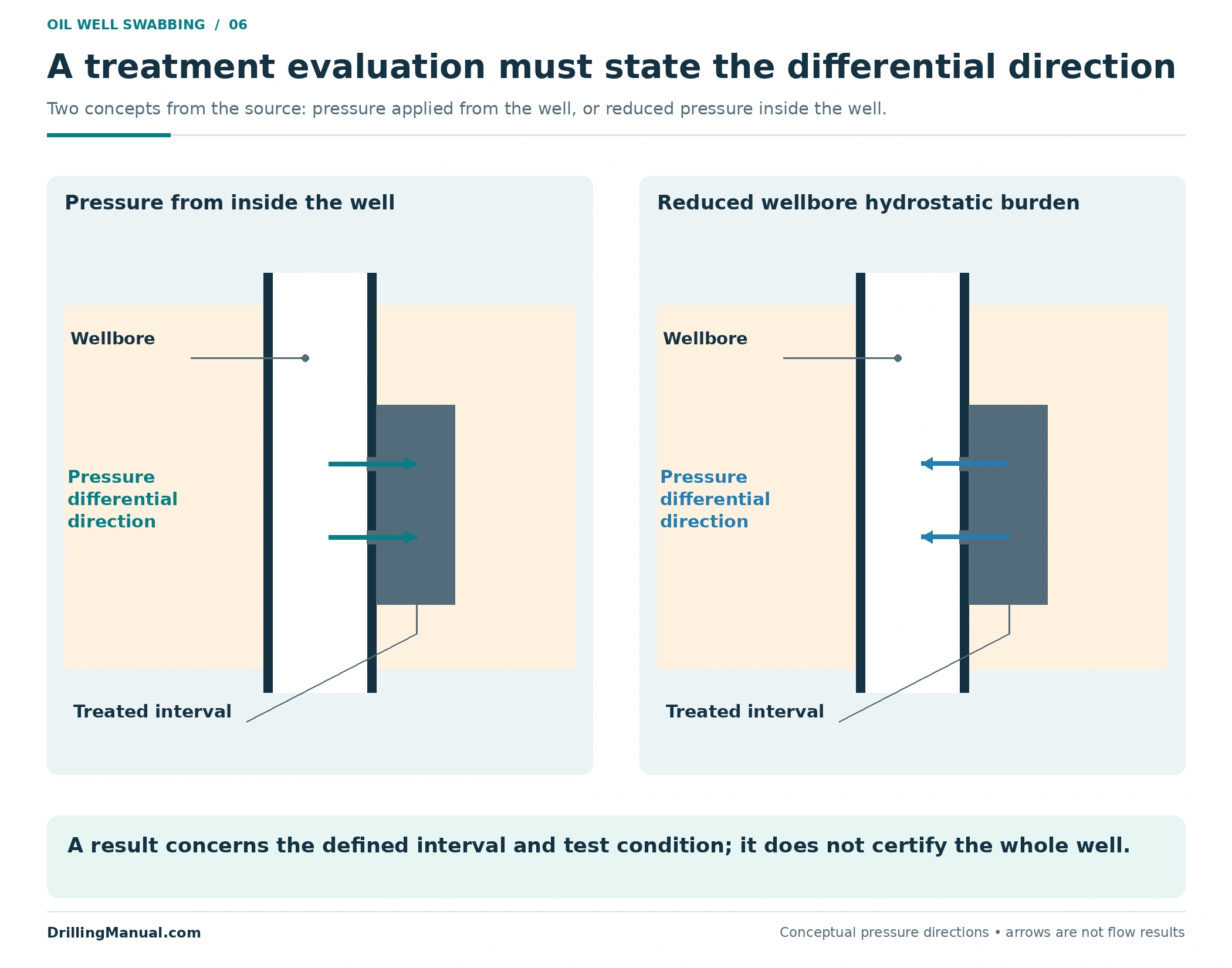
That book passage does not mean any fluid recovery proves a repair successful. A defined evaluation must connect the imposed condition, the target interval and the observed response. Nor does an interval-specific result establish the condition of every other barrier or connection in the well. Those are broader claims that the particular observation has not tested.
The squeeze cementing guide covers the treatment subject, while the well integrity guide addresses the wider barrier context. Here, the point is to make the purpose and limits of the evaluation explicit. This article does not define a pressure test, allowable leak rate or acceptance period.
Pressure-Control Equipment Has a Separate Function
The ONGC manual identifies swabbing as a hazardous activation method and describes a lubricator over the wellhead. That acknowledgement belongs alongside the mechanism: liquid removal changes the conditions opposing formation flow, so pressure control remains an essential part of the actual operation. This article does not depict a complete pressure-control assembly or establish which equipment arrangement is suitable for a particular well. [1, p. 449]
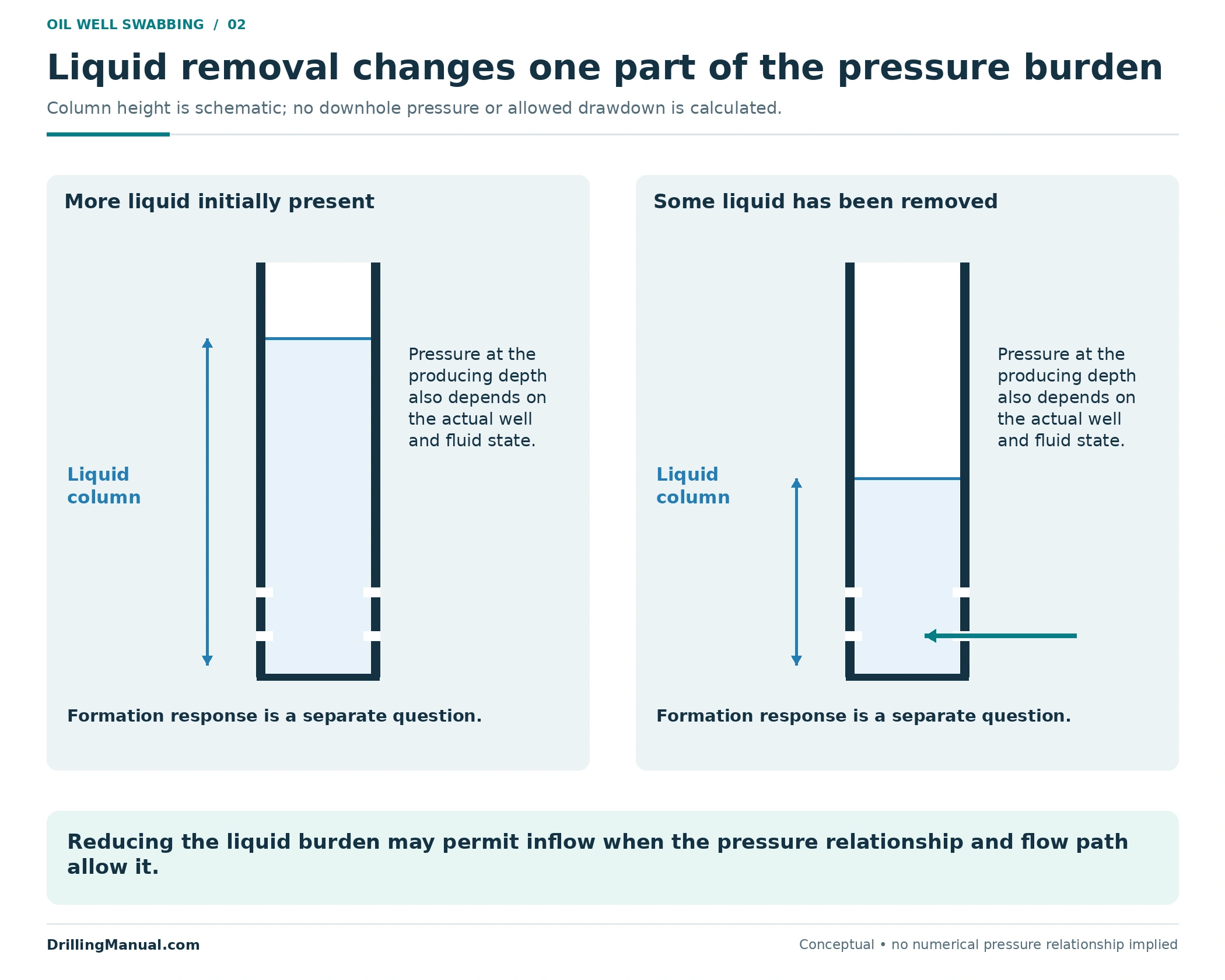
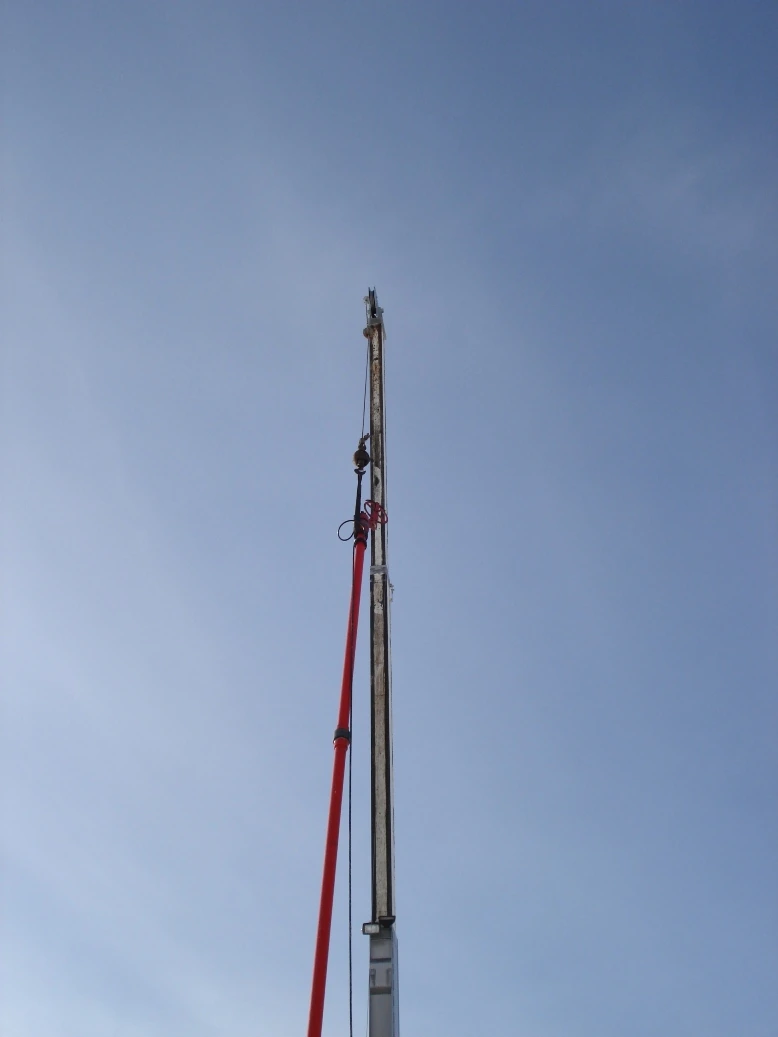
Observations from oil well swabbing do not certify the equipment used to obtain them. Likewise, a photograph of a wireline lubricator illustrates an equipment category; it does not establish a documented swabbing job, the internal tool assembly or the pressure rating of the complete setup. Keep those equipment and job-specific claims separate from the interpretation of recovered fluids.

What to Preserve in the Interpretation Record
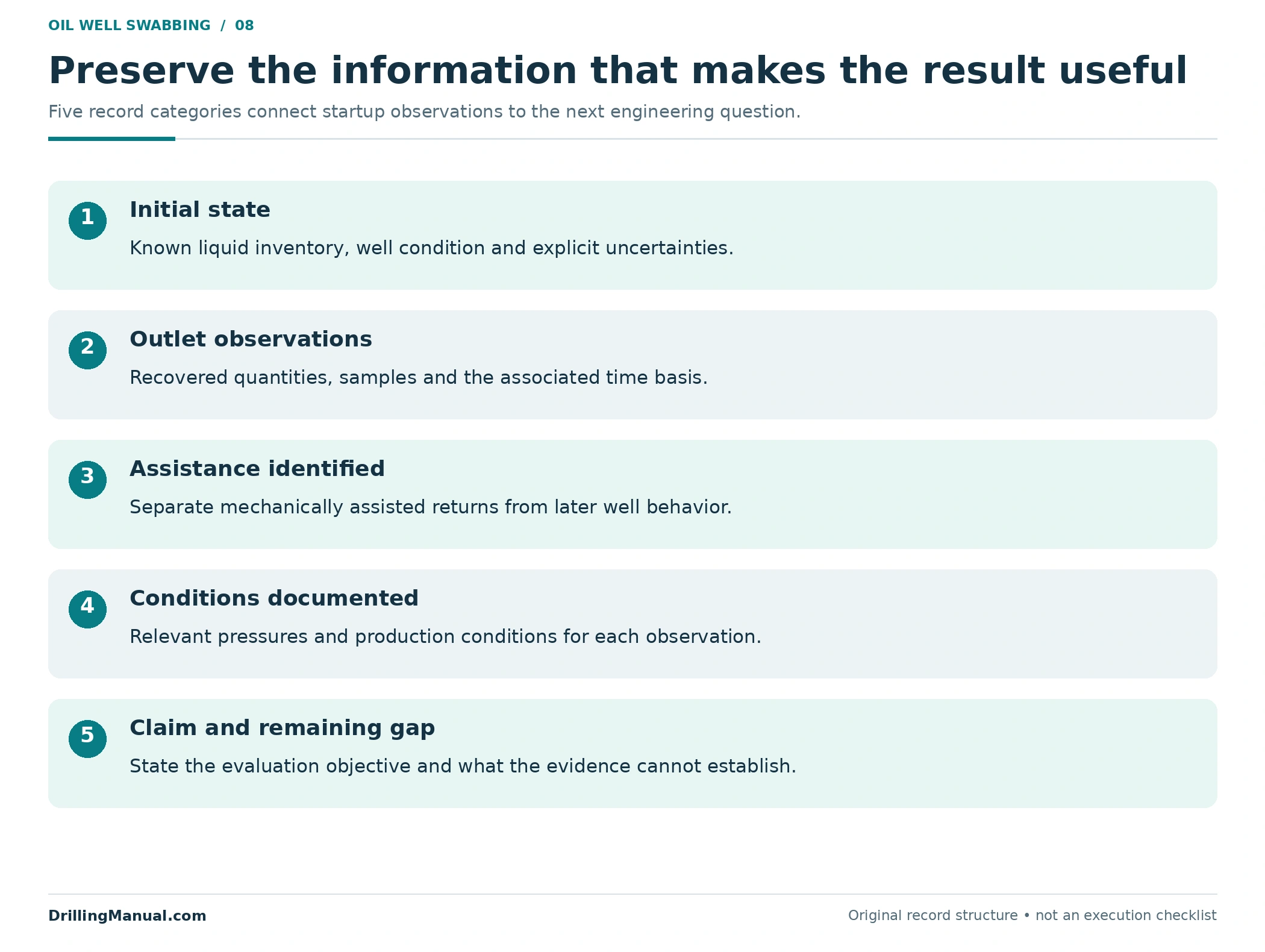
The following record structure is an original synthesis of the books’ startup and evaluation distinctions. It helps separate what was measured from what was inferred. It is not a field execution checklist. [1, pp. 448–449] [2, p. 299] [3, p. 434]
| Record item | Interpretation it supports |
|---|---|
| Initial well condition and known fluid inventory | What the unloading operation started with and what remains uncertain. |
| Recovered quantities, samples and time basis | What was actually observed at the outlet. |
| Assisted and subsequent periods identified separately | Whether the observation concerns mechanical recovery or later well behavior. |
| Relevant pressure and production conditions | The condition under which the response occurred and whether comparisons are meaningful. |
| Evaluation objective and unresolved alternatives | The claim supported by the evidence and the questions requiring further work. |
Place any proposed next step within the wider workover objective. Perrin discusses swabbing alongside other startup approaches, including nitrogen assistance. The companion nitrogen lifting article covers that separate mechanism. A response to one approach does not, on its own, select the best long-term production arrangement. [2, p. 299]
The strongest conclusion is the one the observation can sustain. A limited result may still be useful: it can show that liquid was recovered, that a response occurred under documented conditions, or that a stated evaluation remains incomplete. Preserving those distinctions gives the next engineering decision a sounder basis than declaring the well either “good” or “dead” from a single return.
Frequently Asked Questions
Does Oil Well Swabbing Guarantee That a Well Will Flow?
No. Liquid removal can reduce the pressure burden and help initiate inflow, but activation and subsequent sustained production remain separate outcomes. The source treats the later flowing evaluation as a distinct stage. [1, pp. 448–449]
Are All Recovered Liquids New Reservoir Inflow?
No. Initial wellbore inventory can contribute to the returns. The hypothetical balance shows why the recovered amount alone does not establish new inflow. Actual interpretation needs the relevant inventory, fluid and measurement information; the example is not a field test method.
Does Water in the Return Locate a Water-Producing Zone?
A sample identifies what was recovered under the stated conditions. By itself, it does not allocate that liquid to a particular completed interval or distinguish initial wellbore liquid from newly supplied fluid. The swabbing mechanism supplies no automatic depth attribution. [1, p. 449]
Can Oil Well Swabbing Establish a Sustainable Production Rate?
Assisted returns alone do not establish it. The later interpretation requires an appropriate time basis and representative pressure and phase-rate observations under documented conditions. A recovered volume or brief flow response is a more limited finding. [1, p. 449]
Does a Response Prove That a Squeeze Repair Is Sound?
Only a defined evaluation can support a claim about the treated interval. The source describes applying a differential to evaluate a squeeze; it does not treat any swab return as proof of a sound repair or complete well integrity. [3, p. 434]
Why Are There No Swabbing Speeds or Pressure Limits Here?
This is an interpretation article. The supplied descriptions do not establish a universal operating envelope for different wells, tools, fluids and pressure-control arrangements. Applying a generic number would go beyond what the article’s evidence supports.
Technical References
[1] Oil and Natural Gas Corporation, Institute of Drilling Technology. Drilling Operations Manual, first edition, 1994; published by P. S. Bais, Dehradun. Supplied filename: Drilling Operational Manual.pdf. Chapter 20, printed pp. 448–449 / physical PDF pp. 461–462, for activation, swab cups/valve and subsequent production evaluation; Chapter 14, section 14.1.2 / physical PDF p. 305, for the separate trip-induced swab effect. Historical operating settings and statements about method popularity are not adopted as current recommendations.
[2] Perrin, Denis, with Michel Caron and Georges Gaillot. Well Completion and Servicing. Editions Technip, English edition, 1999. Chapter 5, printed pp. 274 and 299 / physical PDF pp. 286 and 311, for swabbing tools and startup after servicing.
[3] Economides, Michael J., Larry Watters and Shari Dunn-Norman, editors. Petroleum Well Construction. John Wiley & Sons. Consulted 903-page digital copy, visible/physical PDF p. 434, “Job Evaluation,” for applying a differential to evaluate a treated interval.
Engineering explanations come from these books. The volume balance, tables, review structure and drawings are original educational constructions. Photograph sources and reuse information appear with the photographs.