Starch in drilling fluid is primarily a filtration-control material. Natural and modified grades help restrict liquid movement through the filter cake, but their dispersion, temperature response and biological stability differ. Choosing a grade starts with the fluid system and the exposure it must tolerate, rather than the word “starch” on a bag. [1]
A useful comparison asks four questions: Does the material disperse in the intended fluid? Does it provide the required filtration response? Does that response survive the relevant temperature and storage history? What happens to the rest of the fluid properties? This guide separates those questions and explains how to keep a fresh laboratory result from becoming an unsupported claim about downhole service.
For the broader system context, use the water-based drilling fluid systems guide. The discussion below focuses on starch grade and filtration behavior rather than complete mud formulations.
What does starch in drilling fluid actually mean?
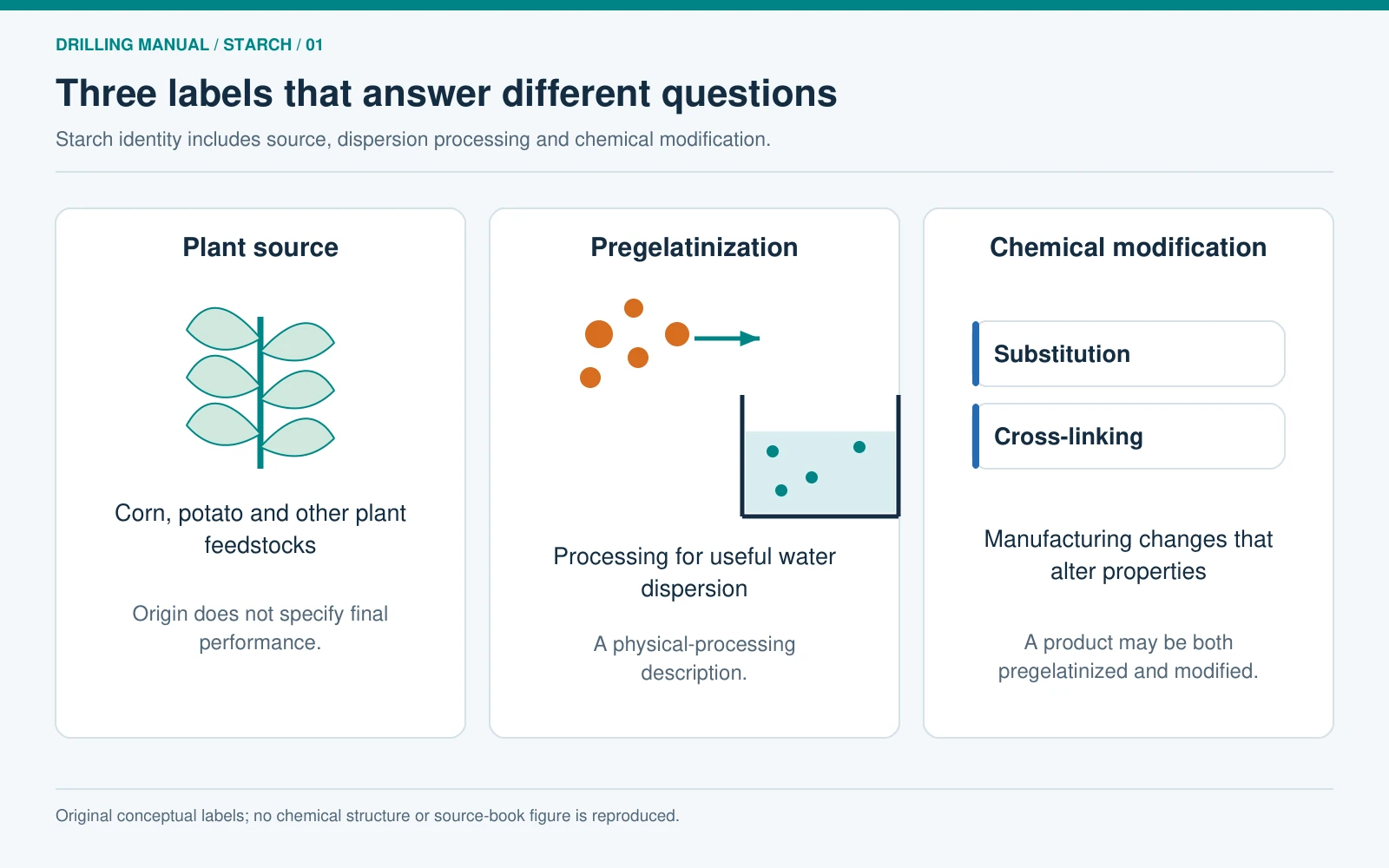
Starch is a plant-derived polysaccharide. Its main polymer components are amylose, which is predominantly unbranched, and amylopectin, which is branched. Corn and potatoes are familiar feedstocks, but feedstock alone does not identify the properties of the final drilling-fluid product. Processing and any chemical modification are equally important. [1]
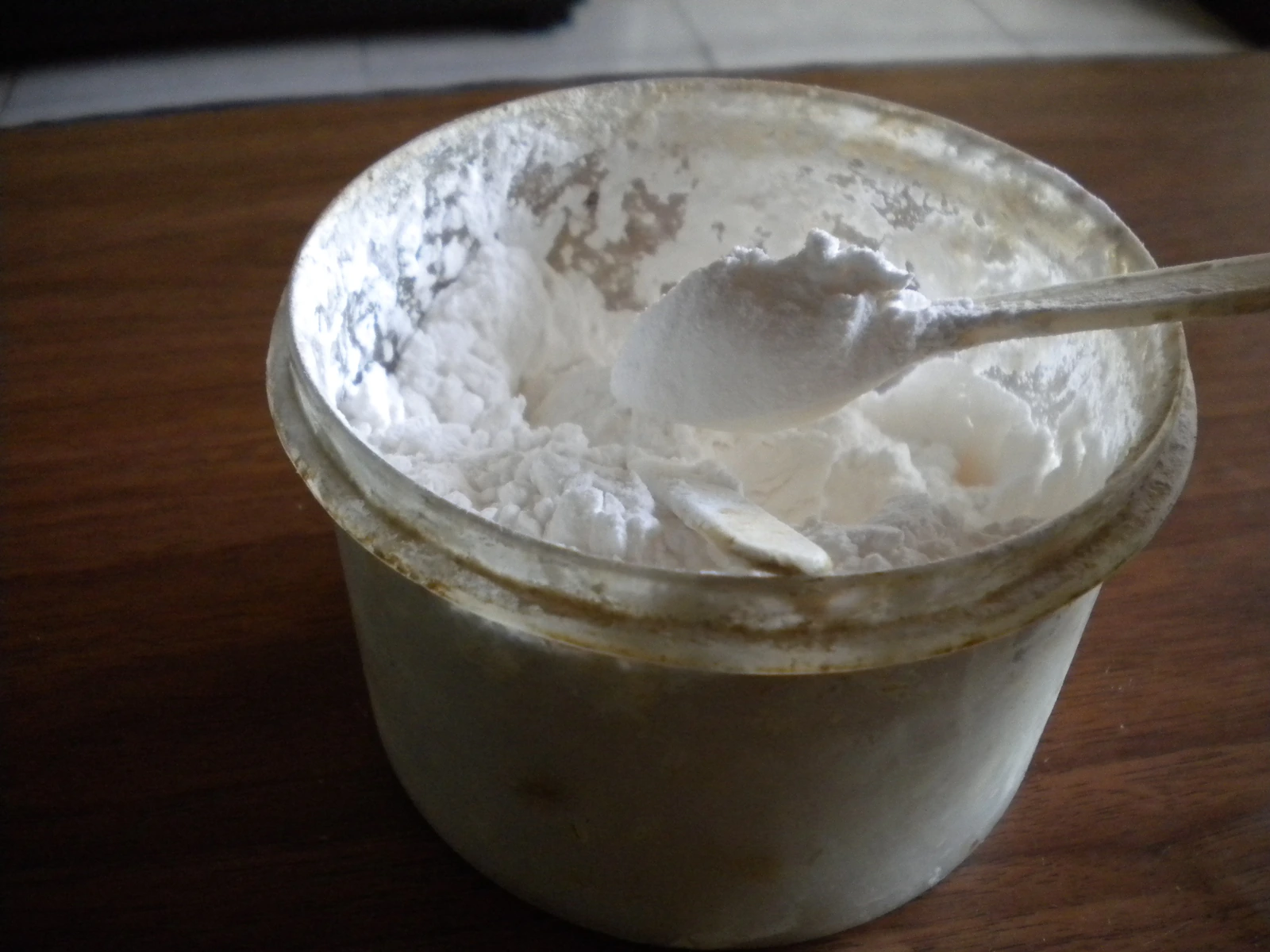
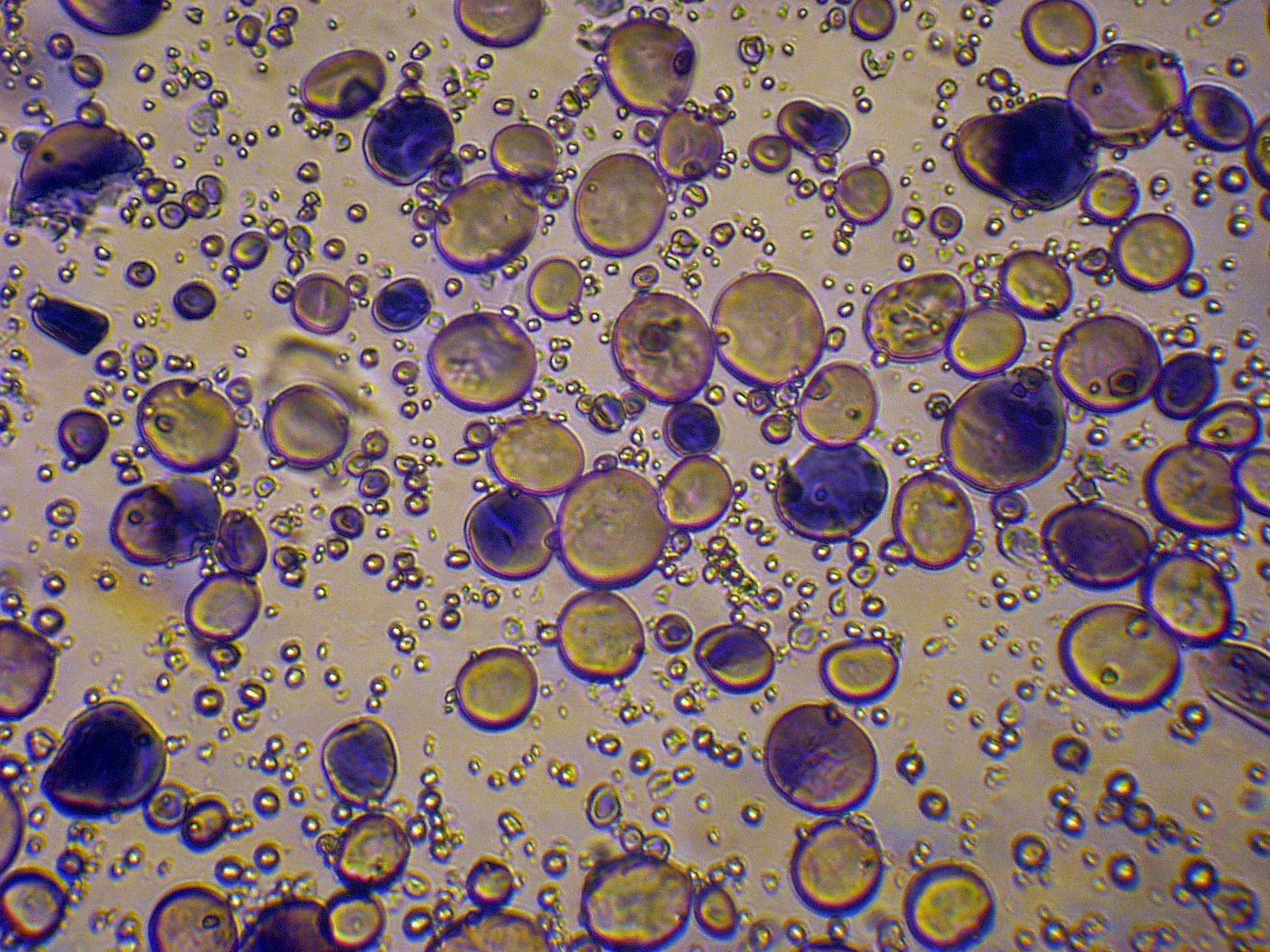
Ordinary native starch does not disperse readily in cold water. Oilfield starch is commonly supplied after pregelatinization, a manufacturing treatment that makes the material water dispersible. “Natural starch” in a drilling-fluid discussion can therefore mean a processed product derived from natural starch; it does not necessarily mean untreated flour or an unprocessed plant granule. [1]
Pregelatinization and chemical modification describe different changes. The first addresses the physical processing needed for useful dispersion. Chemical modification changes the polymer through treatments such as substitution or cross-linking. A product can be both pregelatinized and chemically modified. Treating those labels as mutually exclusive makes product comparisons confusing. [1] [2]
For starch in drilling fluid, an informative product description therefore includes the grade, processing or modification claimed, intended fluid system and evidence behind that claim. The plant source is useful background, but it cannot replace those details.

Natural and modified starch grades
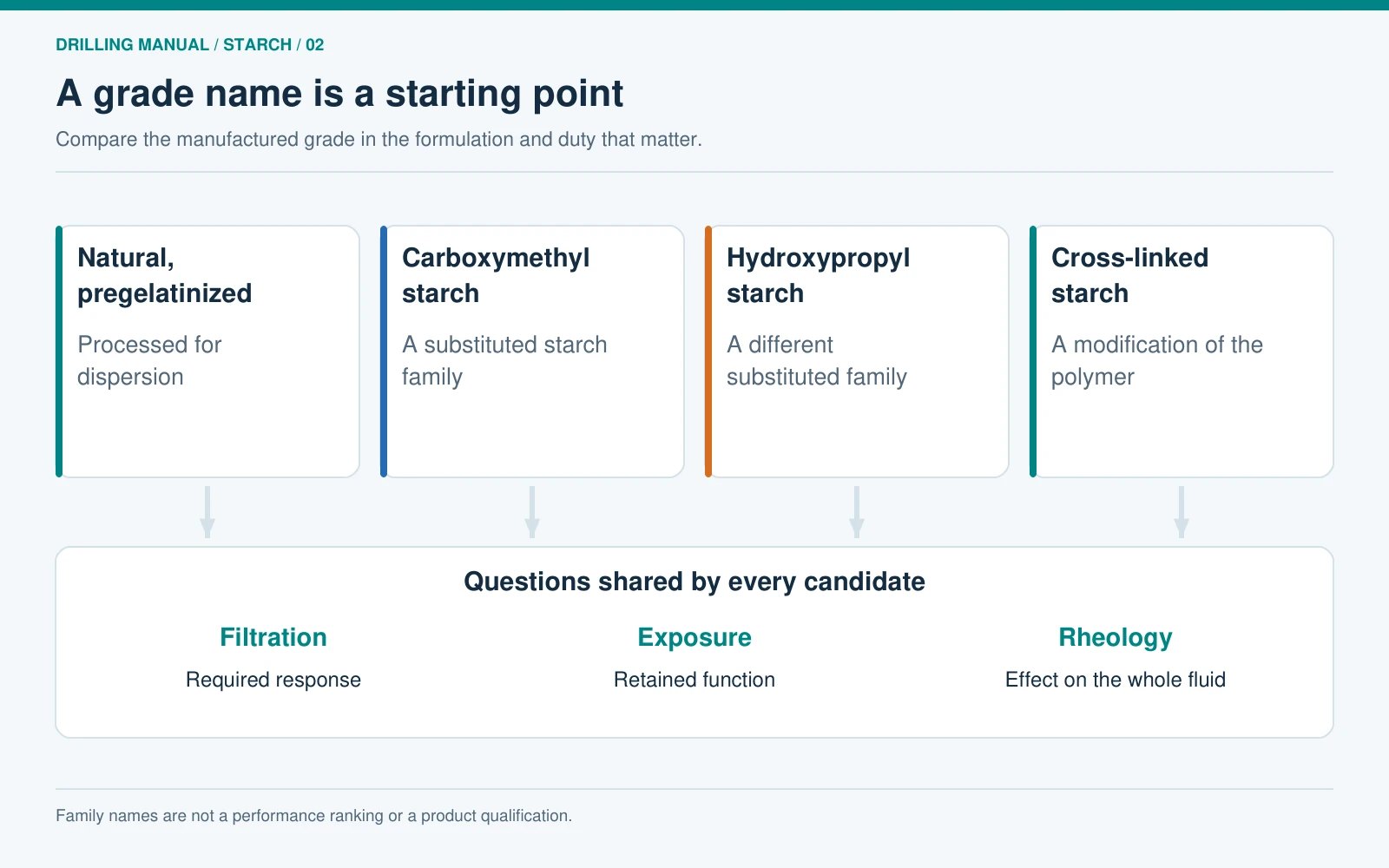
The practical distinction is the behavior delivered by the manufactured grade. Natural pregelatinized starch can provide effective filtration control, particularly in saline fluids. Modified starches broaden the options by changing properties such as thermal response, biological resistance or rheological contribution. The term “modified” describes a family, not one performance specification. [1] [2]
| Grade description | What the description establishes | What still needs evidence |
|---|---|---|
| Natural, pregelatinized starch | Plant-derived starch processed for water dispersion | Filtration response, exposure tolerance and preservation needs |
| Carboxymethyl starch | A chemically substituted starch family | Behavior of the actual grade in the intended brine and solids system |
| Hydroxypropyl starch | A different substituted starch family | Performance after the relevant preparation and exposure history |
| Cross-linked starch | A modification that can improve stability | The extent and conditions of the claimed improvement |
Caenn and colleagues discuss carboxymethyl and hydroxypropyl grades, while the AVA manual describes cross-linking and other manufacturing changes. These descriptions explain why two materials called starch can behave differently; they do not establish a universal ranking among commercial products. [1] [2]
Compare starch in drilling fluid by the function required from it. A lower fresh filtrate volume may be useful, but a grade intended for a long static exposure needs supporting evidence after that exposure. A rheological contribution may be helpful in one system and undesirable in another. Neither “natural” nor “modified” answers both questions automatically.
How starch contributes to filtration control
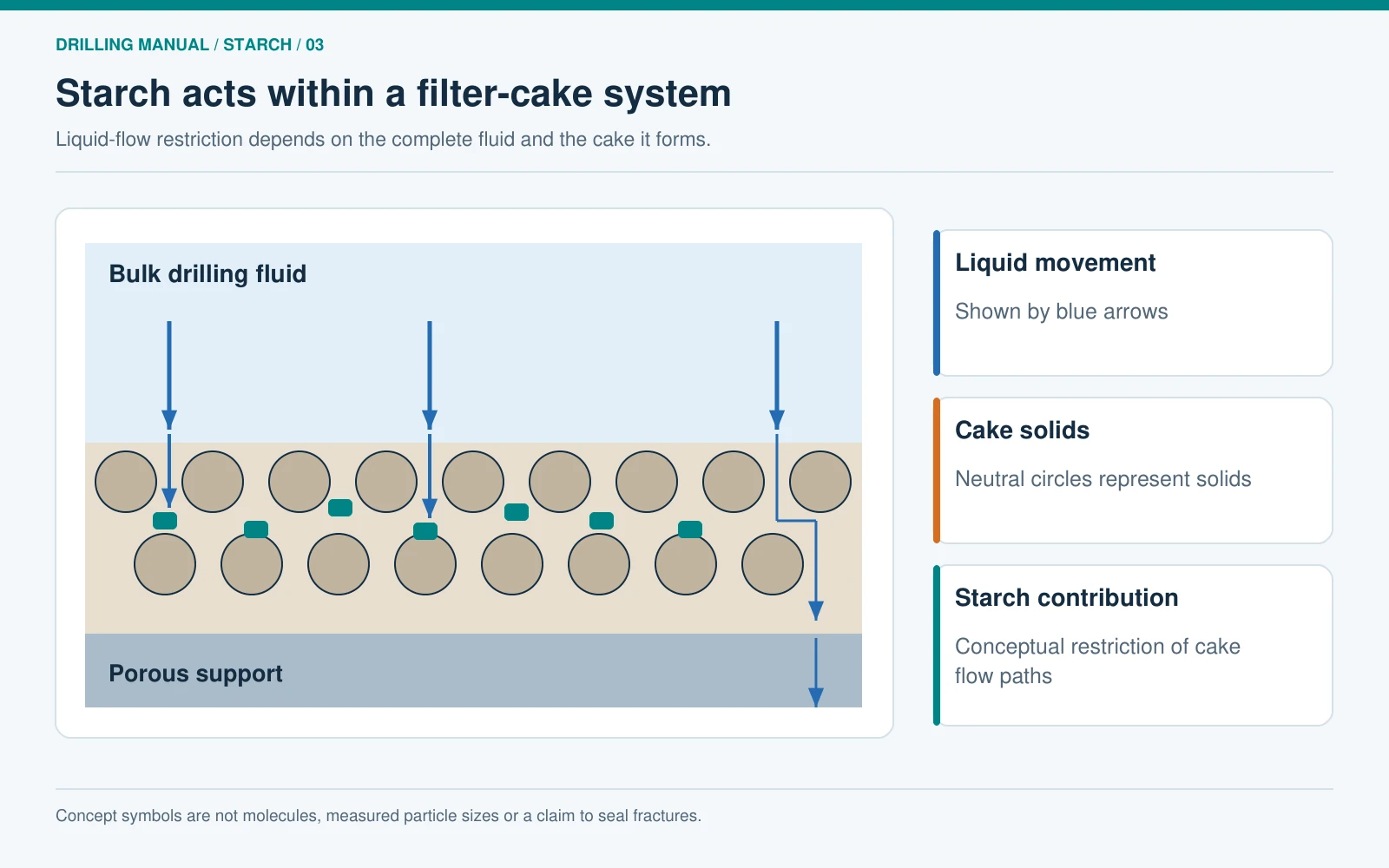
Filtration control concerns liquid passing through a developing cake and its porous support. Starch can contribute by restricting flow paths within the filter cake. The AVA manual describes dispersed starch as helping plug cake pores; it also explains that filtration-control additives can influence liquid-phase viscosity and the arrangement of other particles. The complete fluid therefore determines the result. [2]
Starch in drilling fluid can complement bentonite in freshwater systems or provide filtration-control functionality in brines where a bentonite-based approach is less suitable. That is a statement about function within a formulation. It is not a claim that starch independently seals every permeable rock, bridges a fracture or replaces the whole solids package. [1]
Keep the test description with the filtration value. A volume obtained under one temperature, differential pressure, duration and filter medium cannot be treated as interchangeable with a volume obtained under another set of conditions. For grade comparisons, state the chosen method and keep those conditions matched. This is an interpretation requirement, not a new test procedure.
Filtration and rheology also need separate readings. Some modified starches can contribute to low-shear-rate viscosity, but low filtrate volume does not establish adequate suspension or hole cleaning. Equally, a visibly thicker sample does not prove that its filter cake gives the required control. Review the relevant measurements together; the mud properties guide provides a broader map of the properties being monitored. [1] [2]
Starch in drilling fluid containing salt or hardness
Starch has a long-established role in saline drilling fluids. Natural starch is largely nonionic, and the supplied manuals describe useful applications in saltwater, saturated-salt systems and hard brines. This helps explain its place among filtration-control materials when the aqueous phase contains substantial dissolved salts. [1] [2]
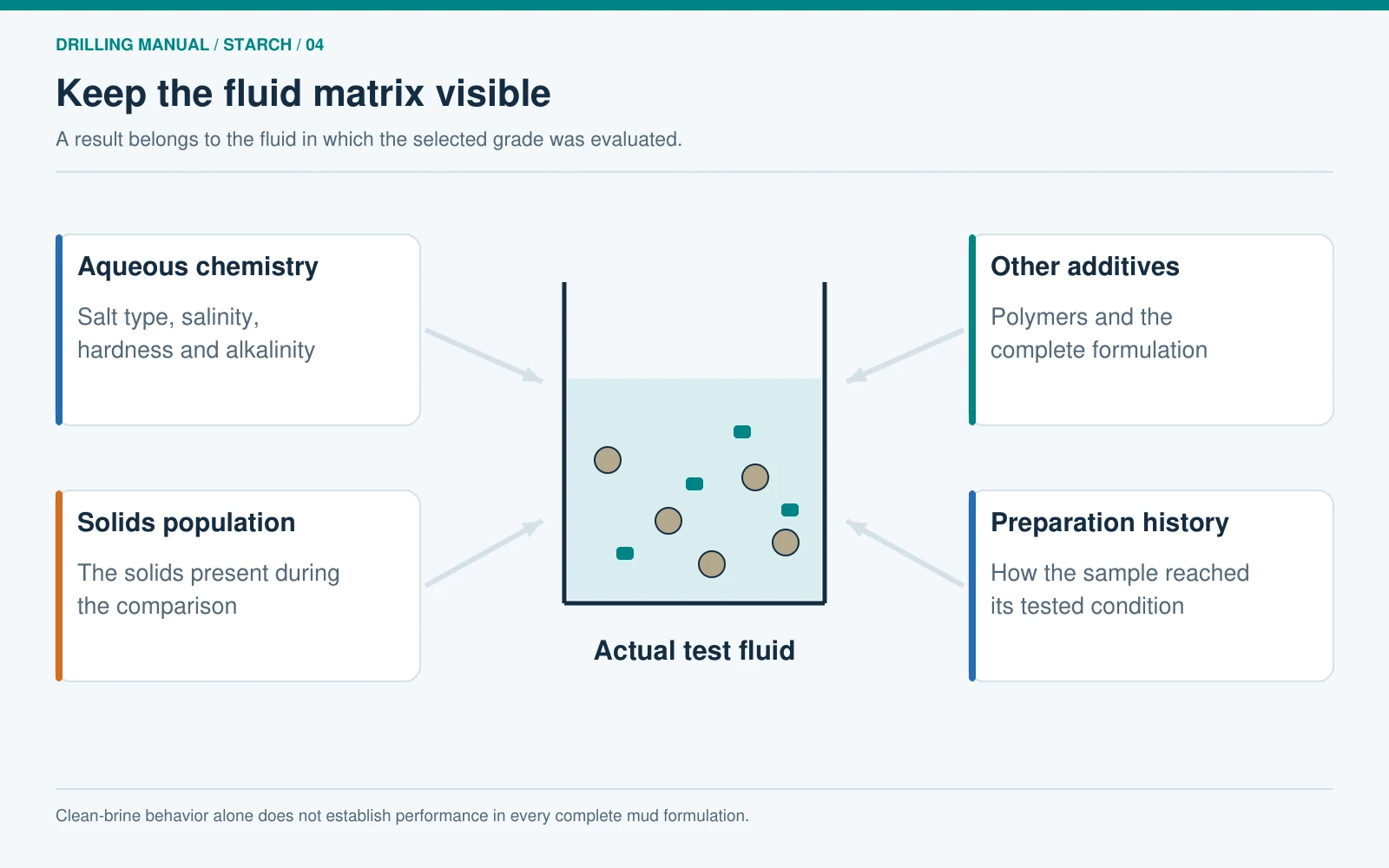
However, “salt tolerant” is not a complete fluid specification. The type of salt, hardness, alkalinity, solids population and other polymers all describe the environment in which the grade must work. A chemically modified starch also cannot automatically be assigned the same response as a natural grade. The useful evidence is the response of the selected product in the intended fluid matrix.
A freshwater demonstration leaves a brine application unresolved. Likewise, successful dispersion in a clean brine does not establish performance after drilled solids or contaminants enter the system. Record the actual preparation medium and formulation when interpreting a comparison. The distinction is especially useful when two laboratory reports use the same trade description but different base fluids.
Filtration changes should also be read alongside changes in solids. The solids control overview explains the wider solids-management context. Adding a filtration-control material and changing the solids population are different interventions; a report should not attribute the combined response to starch alone.


Temperature history matters more than a single label
Temperature stability is one reason to consider modified grades. The supplied books describe improvements from chemical modification and cross-linking, but their historical temperature ranges differ with grade and test context. Those ranges are not interchangeable product guarantees. A generic “starch temperature limit” is therefore an inadequate basis for selecting a current material. [1] [2]
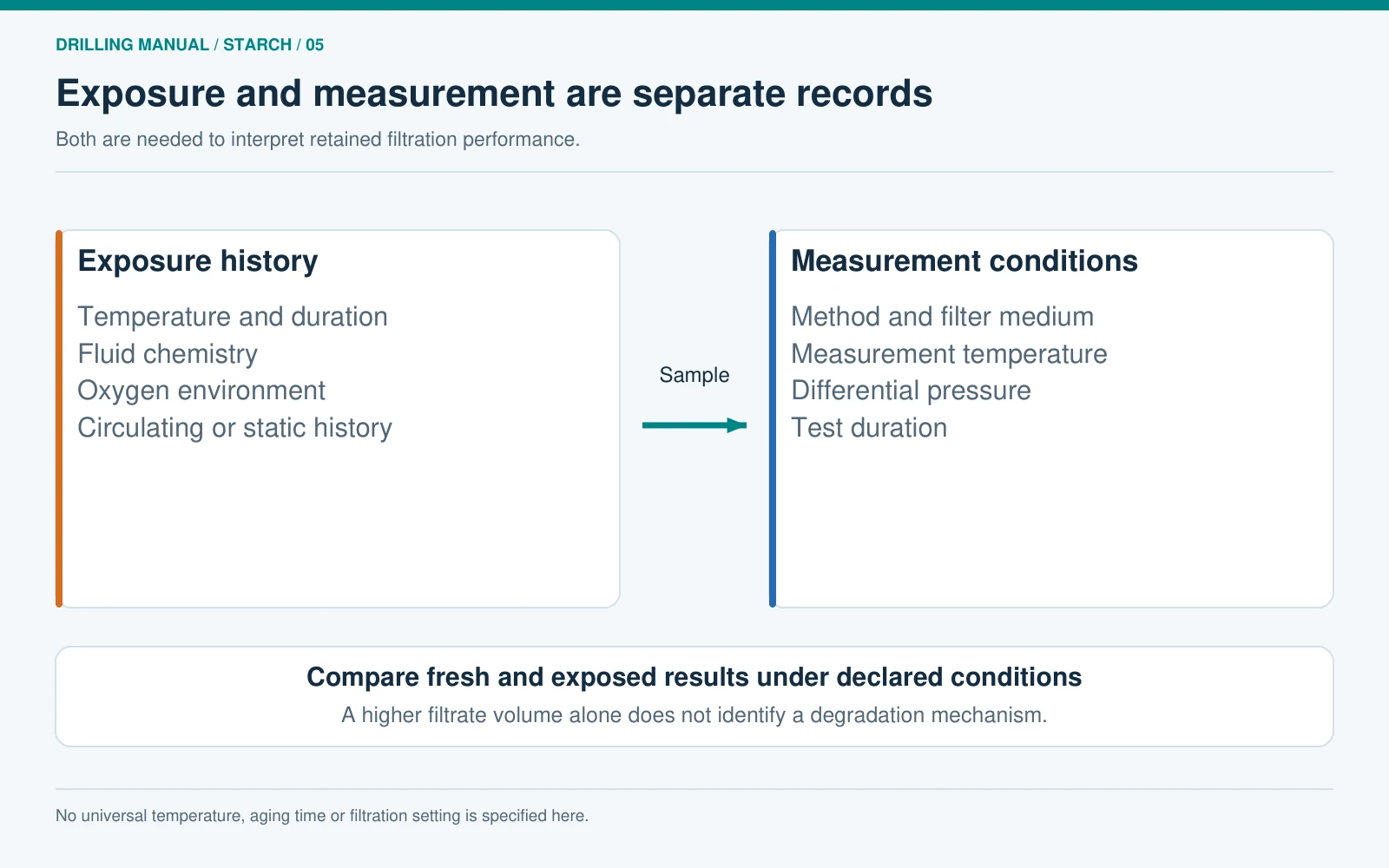
The useful question for starch in drilling fluid is whether its required function survives the expected exposure. Temperature, time, aqueous chemistry and oxygen history can affect polymer degradation. Conditions during circulation, a static period and laboratory aging are not necessarily the same. Caenn and the AVA manual both discuss why the surrounding fluid and exposure history influence thermal behavior. [1] [2]
Distinguish chemical degradation from every observed loss of performance. Chain breakdown can impair function, but a higher filtrate volume alone does not prove that mechanism. A different sample composition, changed test conditions or another formulation change can also undermine the comparison. Establish that the measurements are comparable before assigning a chemical explanation.
A reviewable qualification records both the exposure and the subsequent measurement: what was heated, for how long, under what environment, and how the properties were measured afterward. Include the fresh condition as a reference, while making the exposed condition central to a decision about retained performance.
Biological stability, storage and fermentation
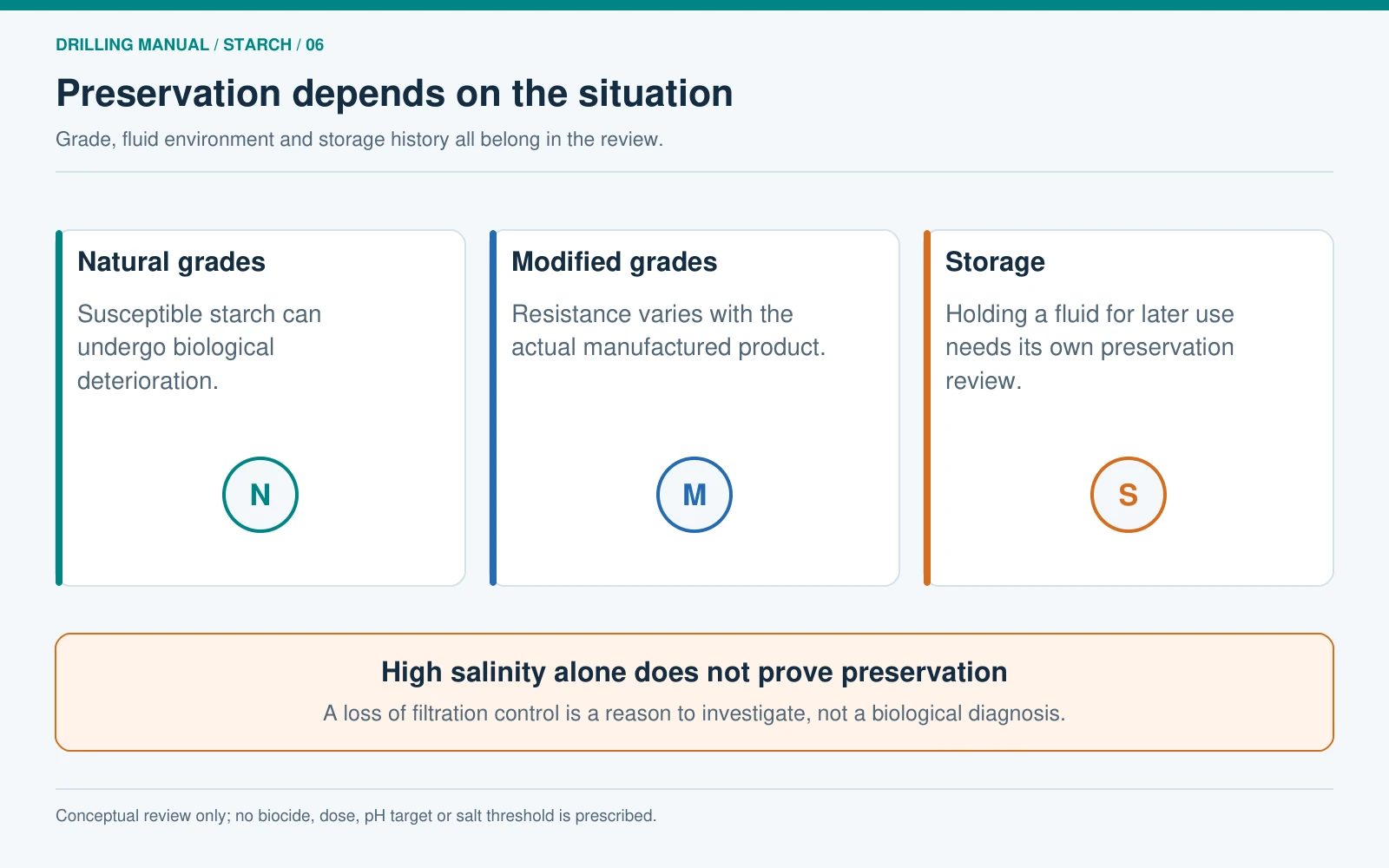
Natural starch is susceptible to biological degradation. The manuals discuss bacteria and other microorganisms consuming susceptible starch material, with resulting loss of useful fluid properties. Modified products can have different resistance, and commercial grades may incorporate preservation measures. The correct treatment depends on the actual product and fluid conditions. [1] [2]
A critical qualification concerns salt. High salinity can reduce some biological activity, but it does not guarantee preservation. The Baker Hughes manual specifically notes that high-salinity produced brines can contain anaerobic bacteria. It would therefore be misleading to use “salt saturated” as proof that biological deterioration cannot occur. [3]
Storage also deserves its own review. A grade that performs during active circulation may have different preservation requirements while held for later use. Caenn distinguishes these conditions for modified starches, but its description should not be turned into a blanket instruction to omit preservation from every circulating system. Use the selected grade’s documented requirements and the actual storage conditions. [1]
When starch in drilling fluid appears to lose filtration control, document temperature history, storage duration, chemistry and signs of contamination before labeling the problem “fermentation.” A performance change is a reason to investigate; it is not by itself a microbiological diagnosis. This article intentionally does not prescribe a universal biocide, dosage, pH target or salt concentration.
A worked comparison of starch in drilling fluid
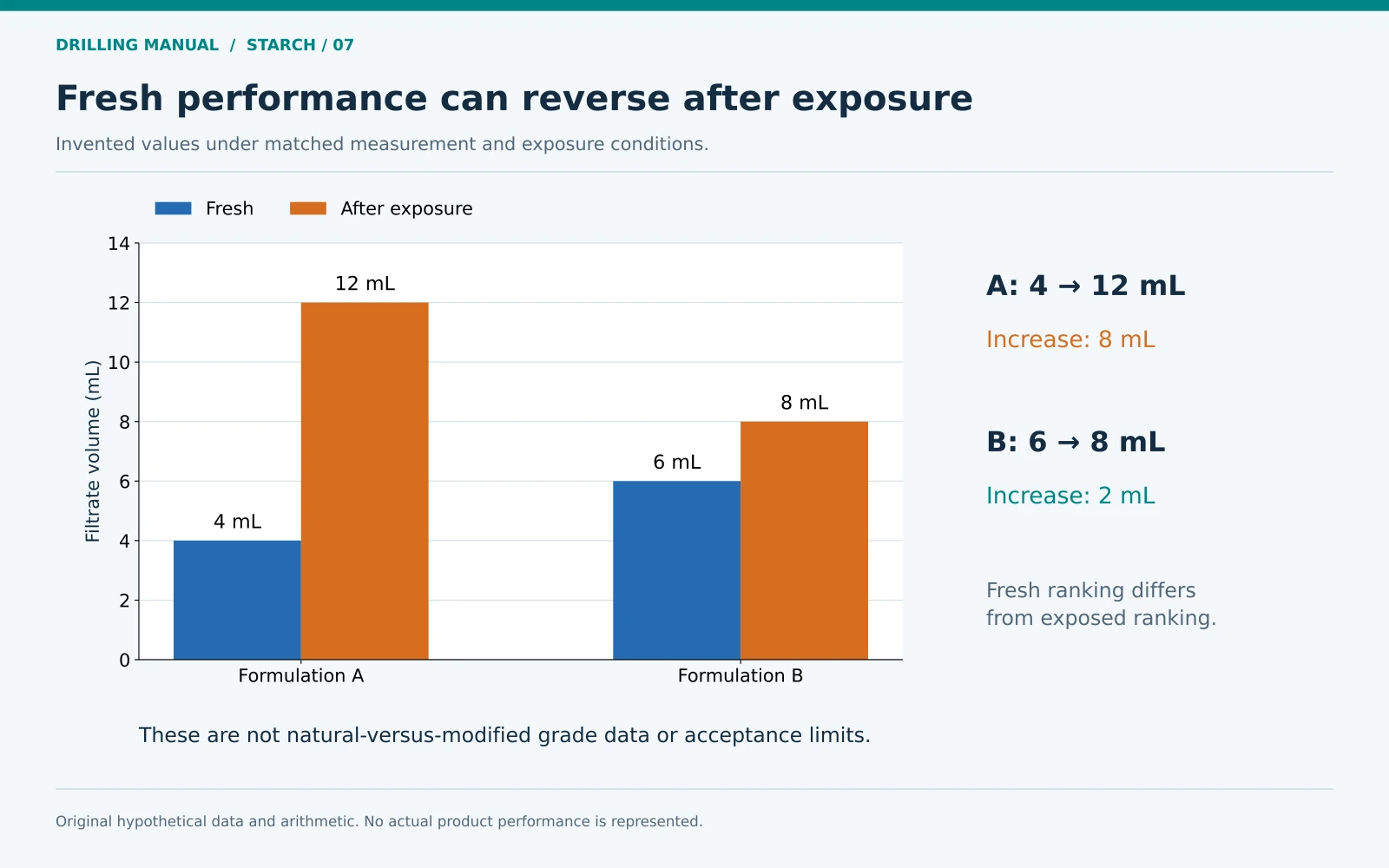
Consider two hypothetical formulations, A and B, measured using the same declared filtration method before and after the same exposure. The numbers below are invented to demonstrate interpretation. They are not natural-versus-modified product data, an acceptance standard or recommended operating conditions.
| Hypothetical formulation | Fresh filtrate | Filtrate after exposure | Increase |
|---|---|---|---|
| A | 4 mL | 12 mL | 8 mL |
| B | 6 mL | 8 mL | 2 mL |
A has the lower fresh result. B has the lower result after exposure. If the decision concerns retained filtration control under that exposure, choosing A solely because 4 is lower than 6 would miss the relevant comparison.
The relative increases are 200% for A, calculated as (12 − 4) ÷ 4 × 100, and approximately 33% for B, calculated as (8 − 6) ÷ 6 × 100. Those percentages describe changes in measured filtrate volume. They are not percentages of starch destroyed, and they do not establish the degradation mechanism.
Neither sample can be declared acceptable without the applicable project criterion and the rest of the fluid-property evidence. A decision might also require another exposure or a different filtration medium. The example shows why a fresh result and a retained-performance result should appear together, with their conditions visible.
What to record before selecting a starch grade
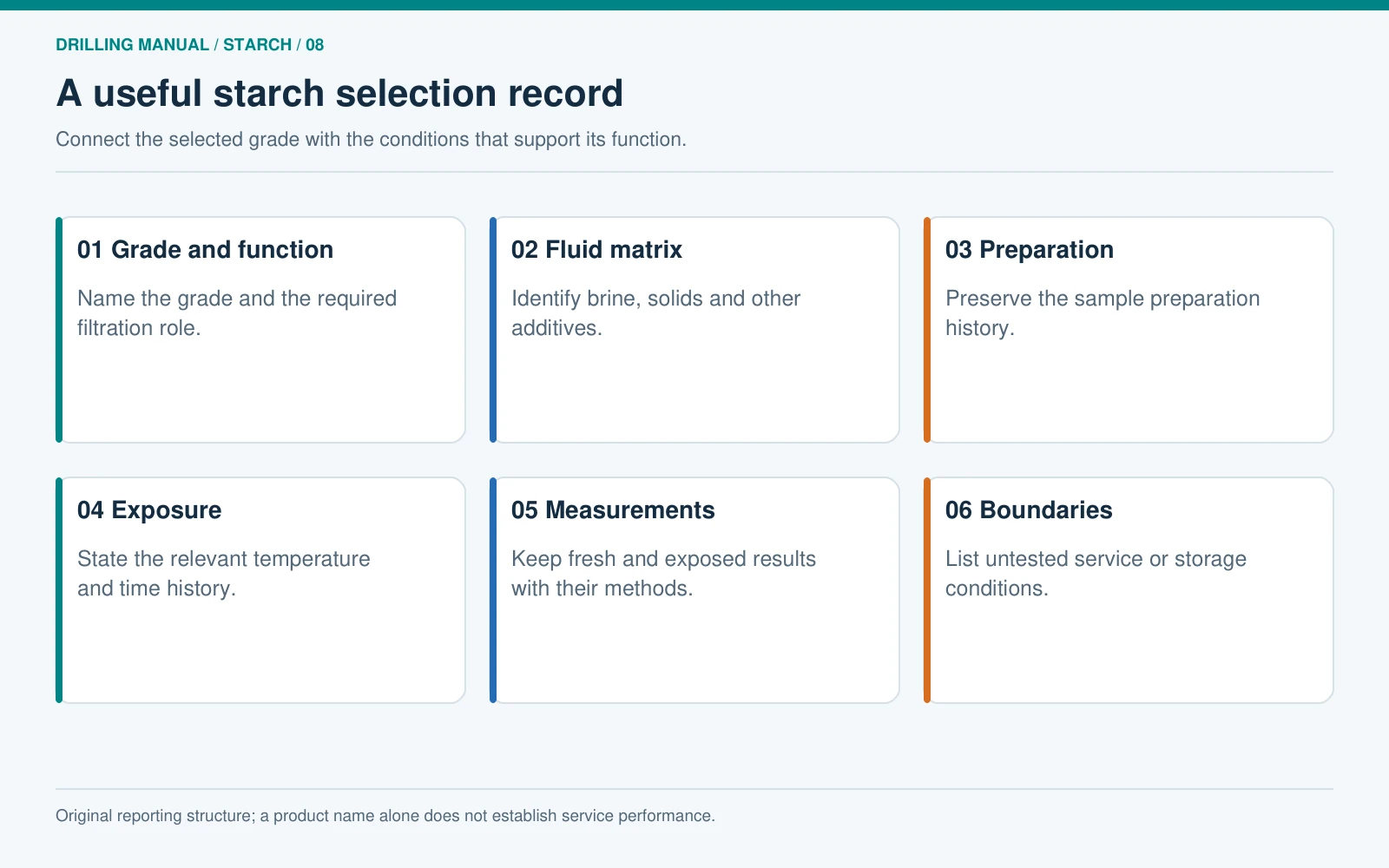
Build the selection record around the function and the conditions that justify it. For starch in drilling fluid, a useful record identifies the grade, its role, the base-fluid chemistry, the solids system and the preparation history. Add the chosen filtration method, exposure history, fresh and exposed results, and accompanying rheological measurements.
Include the unanswered questions. A laboratory comparison may support filtration control in one brine without resolving long storage, a different contamination level or a reservoir cleanup requirement. Writing that boundary is more useful than describing the product simply as “high performance.”
Commercial descriptions can help locate candidates. The existing drilling-fluid product and datasheet directory provides that wider product context. Use the actual product documentation to identify the grade, then evaluate evidence for the intended service rather than assuming all starch products are equivalent.
Once used, keep grade changes and relevant fluid trends visible in the daily mud report. If the starch grade, base fluid or exposure changes, the historical comparison may need a new baseline. The final selection should explain why the measured response addresses the required function and which conditions remain untested.

Frequently asked questions about starch in drilling fluid
These answers separate product labels from the evidence needed to use them.
Is oilfield starch the same as ordinary food starch?
It shares a plant-derived starch basis, but oilfield products are commonly processed for water dispersion and may be chemically modified or preserved. Food-grade identity alone does not demonstrate the dispersion, filtration performance or exposure tolerance required by a drilling-fluid application. [1]
Is pregelatinized starch always chemically modified?
No. Pregelatinization describes processing that makes starch water dispersible. Chemical modification describes changes such as substitution or cross-linking. A commercial product may include both, so the two labels should be checked independently in the grade description. [1] [2]
Does modified starch always outperform natural starch?
No universal ranking follows from those names. The useful comparison depends on filtration requirements, brine chemistry, exposure, preservation and effects on other properties. A modified grade may extend a particular capability, but that capability needs evidence under the intended conditions. [1]
Can starch replace a viscosifier?
Its primary role is filtration control. Some modified grades can contribute to low-shear viscosity, but that does not establish that they provide the required suspension or overall rheological response. Measure the functions separately before assigning one material both duties. [1] [2]
Does salt prevent starch fermentation?
It can reduce some biological activity, but salinity alone is not proof of preservation. The Baker Hughes manual notes biological risks in high-salinity produced brines. Review the product, fluid source and storage environment instead of relying on a salt label. [3]
What is the best temperature limit to use?
Use evidence for the selected grade in the intended fluid and exposure history. Generic historical ranges are insufficient because chemistry, modification and exposure conditions differ. A fresh filtration value or a single maximum-temperature label cannot establish retained performance during the actual duty. [1] [2]
References
- Caenn, Ryen; Darley, H.C.H.; and Gray, George R. Composition and Properties of Drilling and Completion Fluids, Seventh Edition. Gulf Professional Publishing/Elsevier, 2017. ISBN 978-0-12-804751-4. Printed pages: 136–142. PDF pages in the edition consulted: 140–146.
- AVA S.p.A., A Newpark Company. Drilling Fluids Manual, Version 1, November 2004. Printed pages: 144–145, 148–149, 153–154, 161–162. PDF pages in the edition consulted: 146–147, 150–151, 155–156, 163–164.
- Baker Hughes Drilling Fluids. Drilling Fluids Reference Manual, revised 2006. Salt-saturated starch systems. Printed pages: 3-35–3-36. PDF pages in the edition consulted: 116–117.