Water coning in oil wells occurs when production drawdown draws underlying water upward toward the producing interval. The resulting water production may justify a change in how the well is operated or completed, but it does not automatically identify a repairable defect. A workover acts on a particular completion or flow path; coning develops within the reservoir around the well. [1, pp. 835–836]
The practical question is whether the evidence supports coning, another water source, or several mechanisms together. This article explains that distinction and the limits it places on a workover. It does not provide a critical-rate calculation, a permitted drawdown or a water-shutoff treatment program.
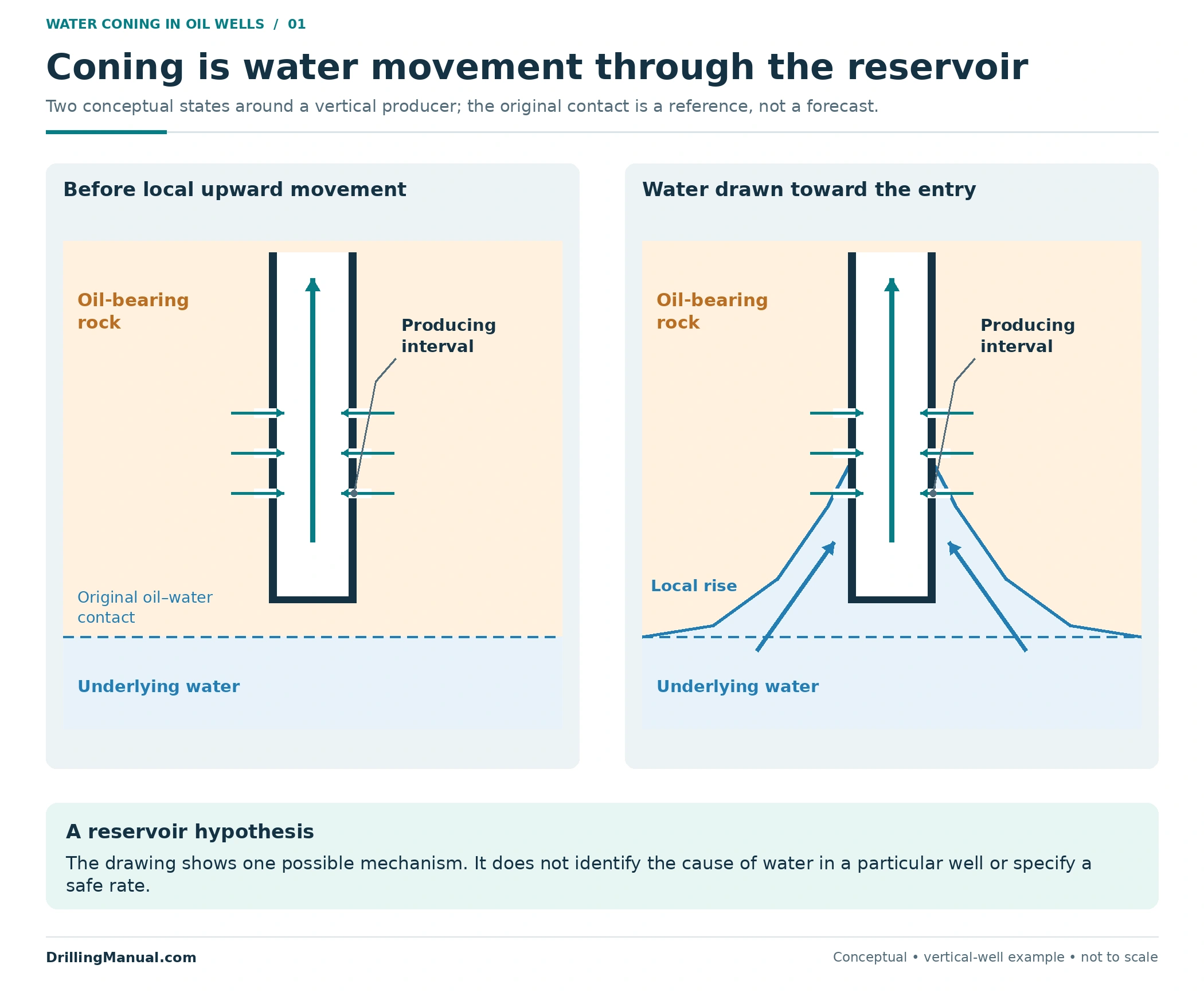
How Water Coning in Oil Wells Develops
Producing a well creates a pressure difference that moves reservoir fluids toward the wellbore. Where oil overlies water, that pressure field can draw the oil–water boundary upward near the producing interval. The shape is described as a cone around a vertical well and as a crest along a horizontal well. These names describe the reservoir response; neither requires a hole in the casing or an external cement channel. [1, p. 835]
The outcome depends on more than production rate. The source discusses the relationship between vertical and horizontal permeability, oil-column thickness, fluid properties, gravity and viscous effects, and the extent to which the completion penetrates the oil interval. Those factors explain why a rate that is acceptable in one reservoir cannot simply be transferred to another. [1, pp. 835–836]
Water coning in oil wells should therefore be described as a supported reservoir interpretation, not merely a label attached to high water cut. A drawing of an upward water shape explains the hypothesis; measurements and reservoir/completion information are needed to establish whether it explains the actual well.

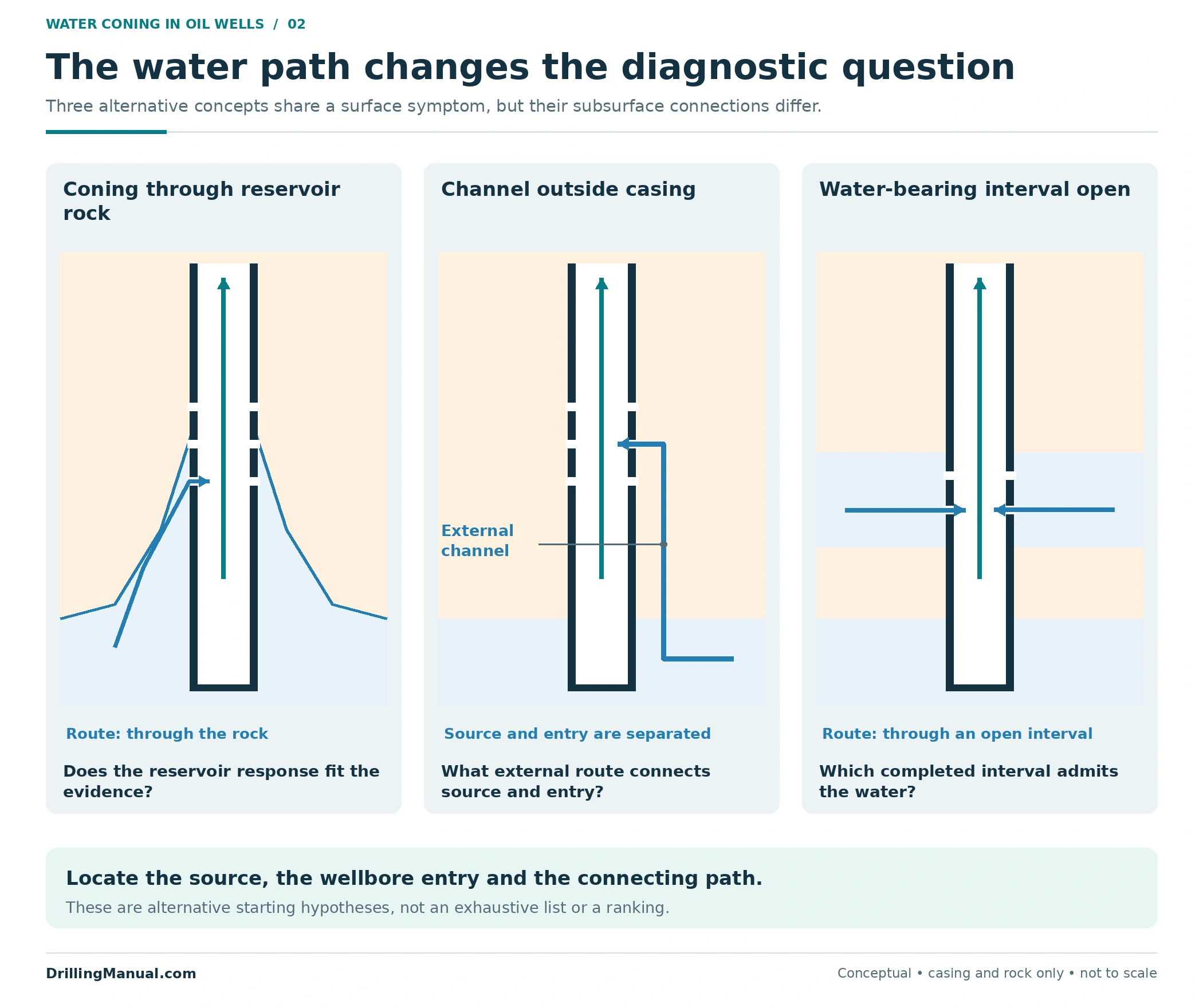
Separate Coning From Other Water-Production Mechanisms
Several mechanisms can put water into the same produced stream. A channel outside casing concerns a completion-related route. A high-permeability channel within the reservoir concerns preferential movement through the rock. Calling both “channeling” without specifying the location obscures an important distinction. The first suggests a different investigation and intervention target from the second. [1, pp. 834, 836–837]
| Candidate explanation | What physically changes or connects | Question that distinguishes it |
|---|---|---|
| Water coning or cresting | Water moves toward the producing interval under the local pressure field. | Do the reservoir geometry, completion position and operating history support that movement? |
| General bottomwater advance | An active underlying aquifer replaces produced fluids as depletion proceeds. | Is the water history better explained by broader contact movement than by a local cone? |
| A behind-casing channel or casing leak | A completion-related connection allows water to reach the well. | Where is the source, and what route connects it to the observed entry? |
| Completion into a water-bearing interval | An open completed interval directly admits water. | Does the completed interval match the interpreted fluid distribution? |
| Preferential reservoir communication | A permeable layer, fracture or stimulation connection carries water toward the well. | What reservoir connection accounts for the timing and location of water arrival? |
These alternatives come from the water-control chapter’s completion and reservoir classifications. They can coexist. For example, establishing that water enters at one perforated interval does not, by itself, determine whether it approached through the adjacent rock or through a channel behind casing. The interpretation must connect the source to the entry. [1, pp. 834–837]
The separate cement bond log guide explains the cement-evaluation subject. A cement-related question should be investigated as such; it should not be silently converted into a coning diagnosis because the well produces water.
Symptoms of Water Coning in Oil Wells Need Context
Increasing water production and a changing oil/water balance are reasons to investigate. They are not unique signatures. The source explicitly associates similar water-production histories with different causes, including bottomwater movement, coning and several completion-related problems. A trend narrows the questions worth asking; it does not independently locate a flow path. [1, pp. 834–837]
Water coning in oil wells may be considered when the behavior is consistent with drawdown-related reservoir movement. However, an abrupt rise after stimulation also requires attention to an out-of-zone connection or another treatment-related change. High water production from the beginning requires checking the original completion and fluid interpretation. The order of events matters because it changes the competing explanations. [1, pp. 834–837]
| Observed history | Useful implication | What it does not establish |
|---|---|---|
| Water cut rises as the well’s operating conditions change. | Relate the water response to the pressure and production history. | A coning diagnosis or a universal acceptable production rate. |
| Water increases soon after stimulation. | Review the treatment timing and possible new communication. | That coning is the only possible cause. |
| Water is high from the beginning of production. | Revisit completion placement, fluid interpretation and initial connections. | That the well developed coning only after a long producing period. |
| Water production gradually becomes more significant. | Compare local coning with broader reservoir-water movement. | A unique distinction between those mechanisms. |
This is a framework for reading observations, not a diagnostic chart with fixed signatures. A persuasive explanation should account for the facts that fit it and the facts that might support another mechanism.
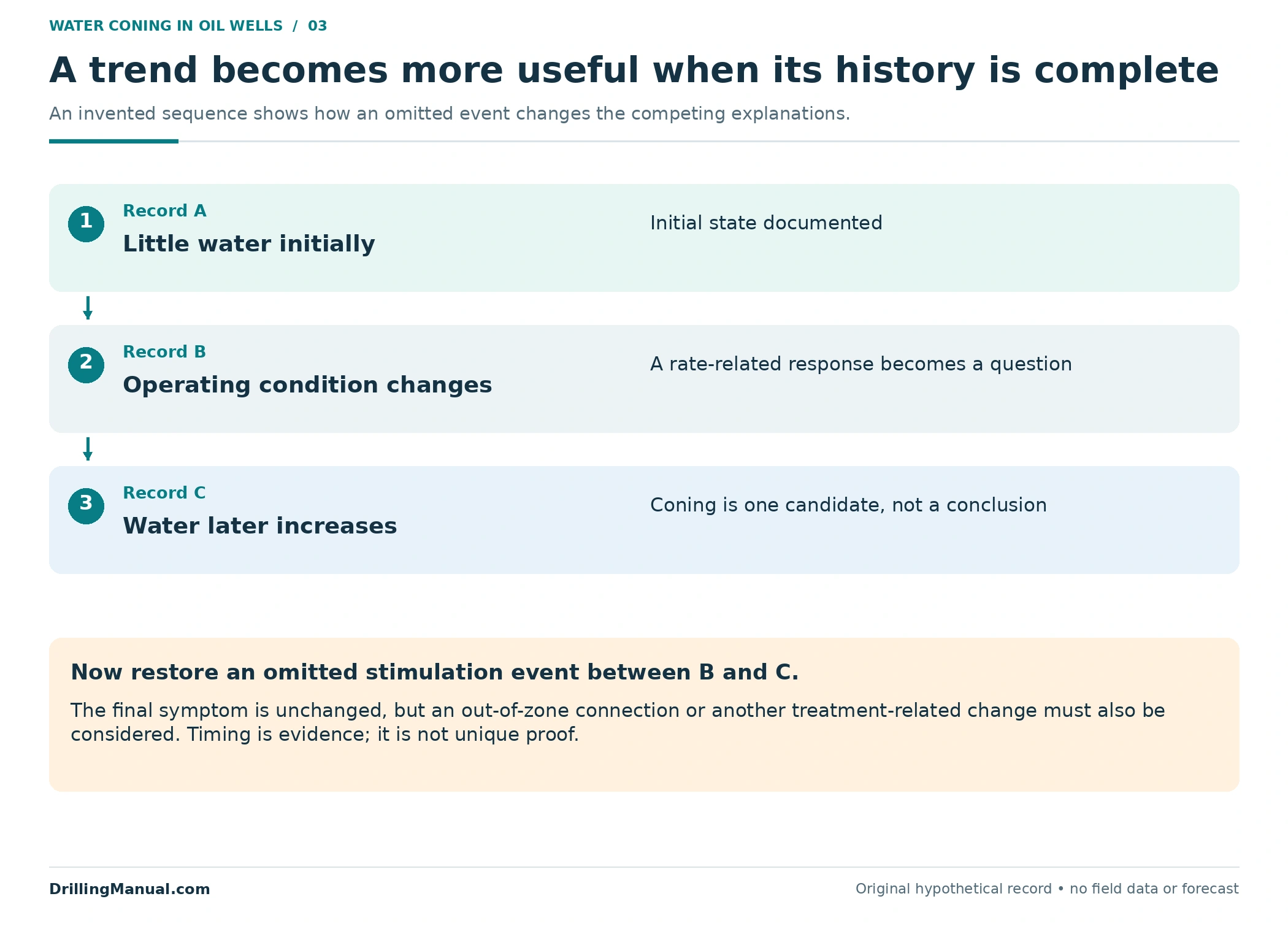
Read Oil Rate, Water Rate and Operating History Together
Water cut expresses the water fraction of the produced liquid on a consistent measurement basis. It compresses two liquid contributions into one ratio. Retaining the oil and water rates alongside that ratio preserves information about what changed. A lower percentage alone does not state how much oil remains, while a higher percentage alone does not locate where water entered.
For water coning in oil wells, a useful history brings production observations together with changes in operation and completion. The book’s examples distinguish behavior present from the start, gradual changes during production, and changes following stimulation. Those distinctions are lost if only the latest water-cut value is retained. [1, pp. 834–837]
Consider an explicitly hypothetical record with three entries: the well initially produces little water; its operating condition changes; water later rises. That sequence makes a rate-related explanation worth examining. Now add a previously omitted stimulation between the second and third entries. The same final symptom has acquired another plausible explanation. The lesson is about the completeness of the record, not a prediction that either mechanism must occur.
Record what was measured, when it was measured and the associated operating condition. Keep an observation such as “water increased after the change” separate from an interpretation such as “the change caused coning.” The latter needs a defensible reservoir and completion explanation. No surface trend should be promoted to proof simply because it follows the expected narrative.
Critical-Rate Models for Water Coning in Oil Wells
The critical-rate concept concerns a modeled maximum rate below which water does not break through under the assumed conditions. It is a useful engineering concept, but a number without its assumptions is incomplete. Petroleum Well Construction describes several approaches and emphasizes selecting a method that represents the well and reservoir being evaluated. [1, pp. 835–836]
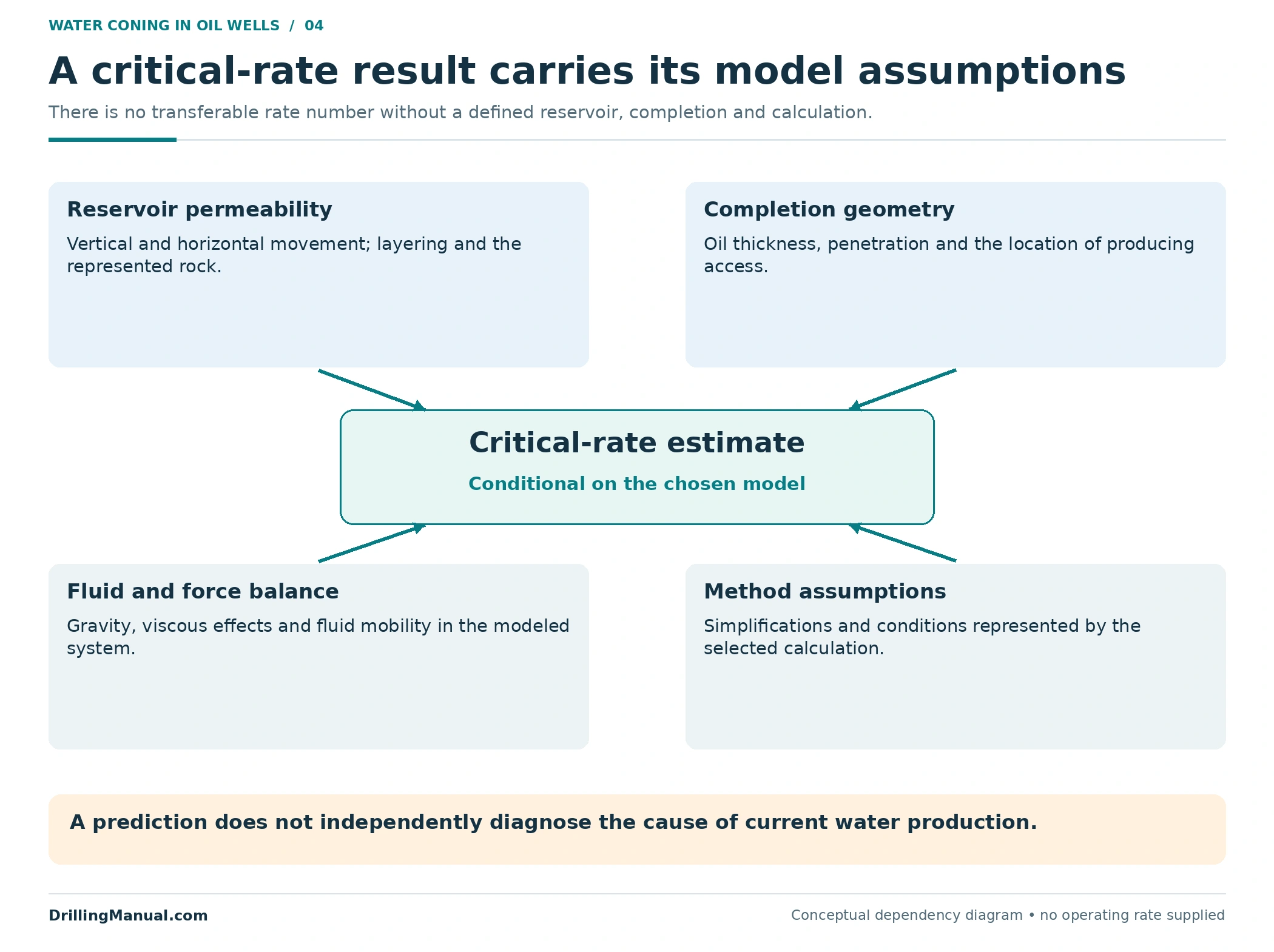
| Model consideration | Why it belongs in the review | Limit on a copied result |
|---|---|---|
| Vertical and horizontal permeability | The relationship influences movement toward the well and across layers. | A value from another permeability arrangement is not directly transferable. |
| Oil thickness and completion penetration | The producing interval occupies a particular position within the fluid-bearing section. | A different completion geometry changes the modeled problem. |
| Fluid behavior and force balance | Gravity, viscous effects and mobility are part of the response. | A rate alone does not describe that balance. |
| Method assumptions | Different calculations simplify the problem differently. | Precision in the output does not remove uncertainty in the assumptions. |
A critical-rate estimate does not independently verify that current water production is caused by coning. Diagnosis and prediction are related tasks, but they answer different questions. The first asks which mechanism best explains the observations; the second asks what a specified model predicts under stated conditions.
Likewise, a calculated water-free criterion should not be presented as a promise that reducing rate will permanently remove water already reaching a well. The source’s model discussion does not justify a universal restart rule or a guaranteed post-breakthrough cure. Any proposed operating change needs evaluation against the actual fluid distribution, completion and reservoir behavior. [1, pp. 835–836, 849]
Workover Options for Water Coning in Oil Wells
A workover can change access to producing intervals, isolate a selected connection or address a supported completion problem. Those are physical changes to the well. Their production value depends on whether the changed connection intercepts the unwanted water path and what useful oil contribution is affected. The broader workover operations guide places these objectives within intervention planning. [1, pp. 845, 849]
Water coning in oil wells does not disappear as a reservoir mechanism simply because equipment has been installed. The book discusses isolating lower perforations and changing the isolation as coning progresses. That is a conditional completion response to evolving inflow, not a statement that one plug permanently solves every coning problem. Restrictions in the installed completion can also limit access for an intended intervention. [1, p. 845]
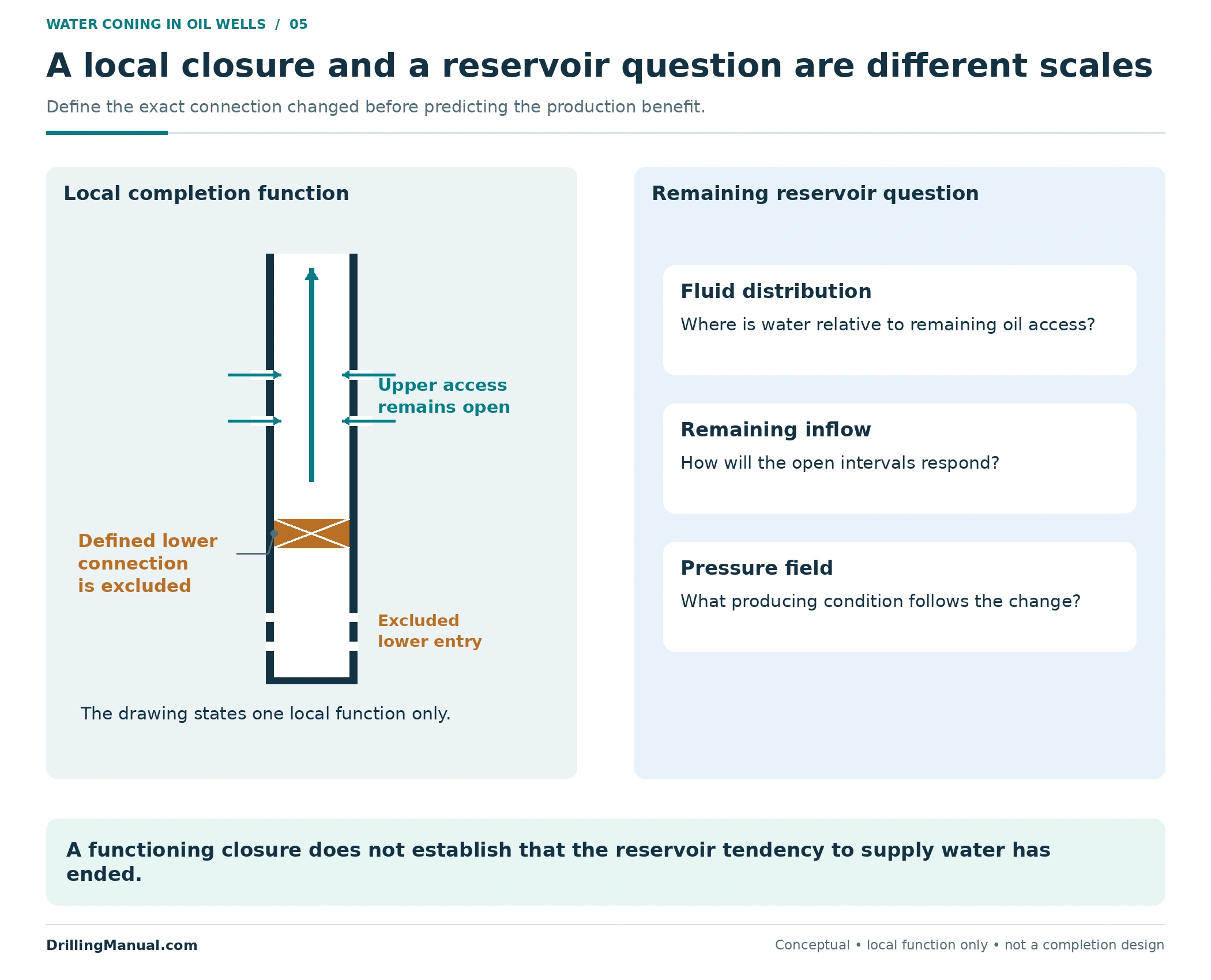
Installed sliding sleeves and appropriate completion packers can provide selective access or isolation in a suitable arrangement. The actual completion determines which connections are available. A generic sketch cannot establish that an existing well has the required access, isolation or remaining production route. [1, p. 845]
If the supported diagnosis is a completion-related channel, the objective may instead concern repairing that connection. The squeeze cementing guide covers that separate operation. Selecting its material and pumping program is beyond a coning diagnosis.
Why Water Coning in Oil Wells Can Outlast Local Isolation
Closing one interval changes the producing system. The source gives an example in which isolating one contribution changes the conditions seen by another zone, with water potentially appearing from a previously different contributor. The important principle is the coupling between the remaining open intervals and the revised operating state. Their pre-job behavior cannot simply be assumed to remain fixed. [1, p. 849]
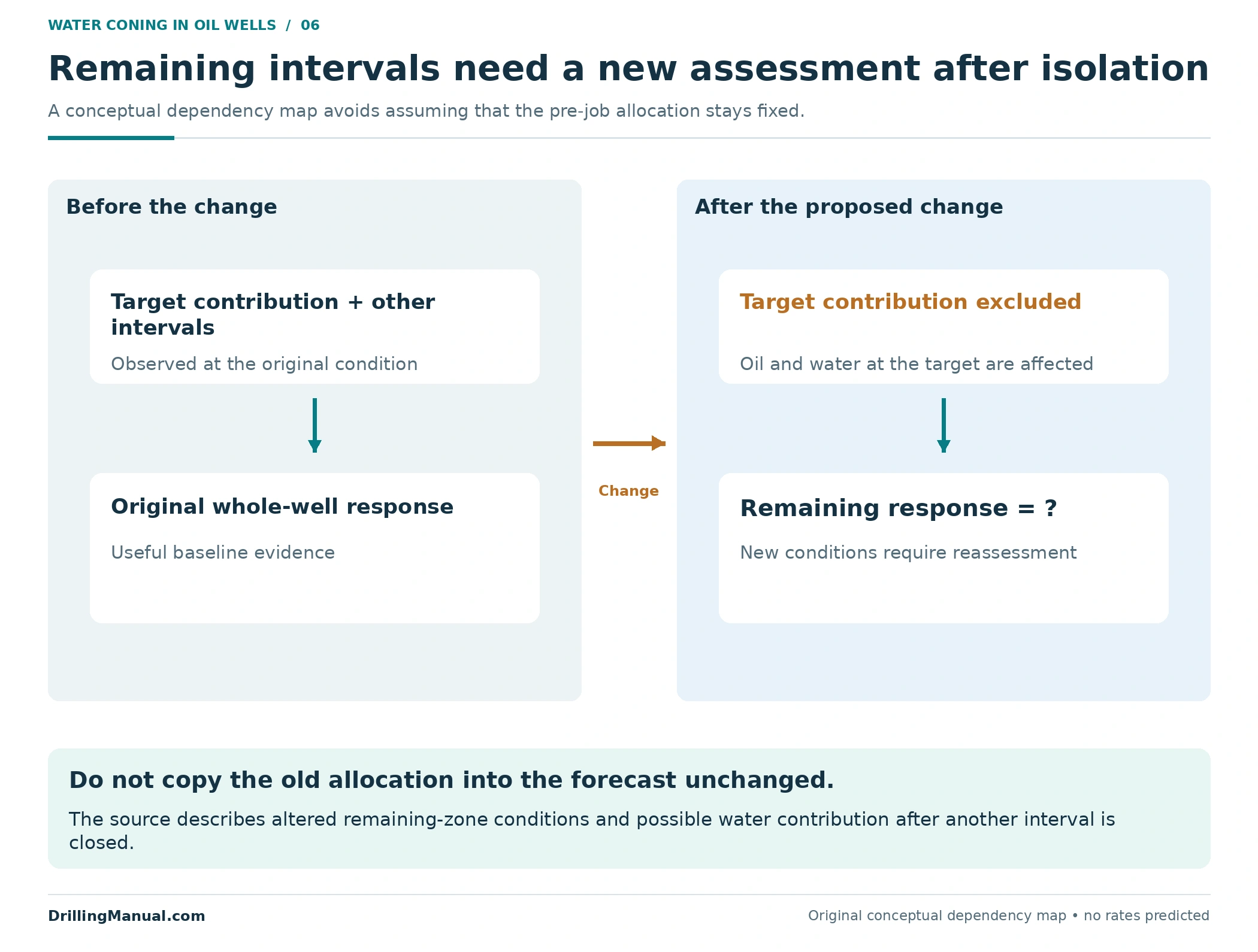
A local seal also has a limited spatial effect compared with the size of the reservoir. The book explains that near-wellbore treatments generally affect a relatively small region. A treatment may interrupt a selected connection without removing the reservoir’s broader tendency to move water toward the producing system. That distinction belongs in the expected outcome, not as an explanation added only after water returns. [1, p. 849]
For water coning in oil wells, the assessment must therefore ask what the remaining interval will experience after the proposed change. Which oil entry is excluded? Which entries remain open? Could the revised producing condition alter their water response? These are consequences to evaluate, not reasons to dismiss all intervention candidates.
Account for Useful Oil Before Calling Water Reduction a Success
The reason for investigating water coning in oil wells should state the production constraint being addressed. The source discusses lifting and water-handling costs alongside consequences such as corrosion and scale. A well with costly water production and a well with restricted access to an interval pose different decision problems, even if their latest water-cut percentages happen to be similar. [1, p. 845]
That stated constraint also determines what an improvement must accomplish. An intervention intended to relieve a water-handling burden needs an assessment of the remaining water load. An intervention intended to preserve oil production needs an assessment of oil lost at the target and oil expected from the intervals left open. Neither objective is fully described by the act of installing equipment.
A water-contributing interval can still supply oil. Completely sealing it excludes that oil along with the water. The source also explains that reducing water movement in a waterdrive reservoir can affect the mechanism that displaces oil. A proposed reduction in water is consequently only one part of the production decision. [1, p. 849]
The required comparison is between the intended water benefit, the oil contribution at risk and the expected behavior of the remaining system. It should identify uncertainty in each rather than treating the most favorable outcome as assured. Successful placement of an isolation device and a beneficial long-term production result are different achievements.
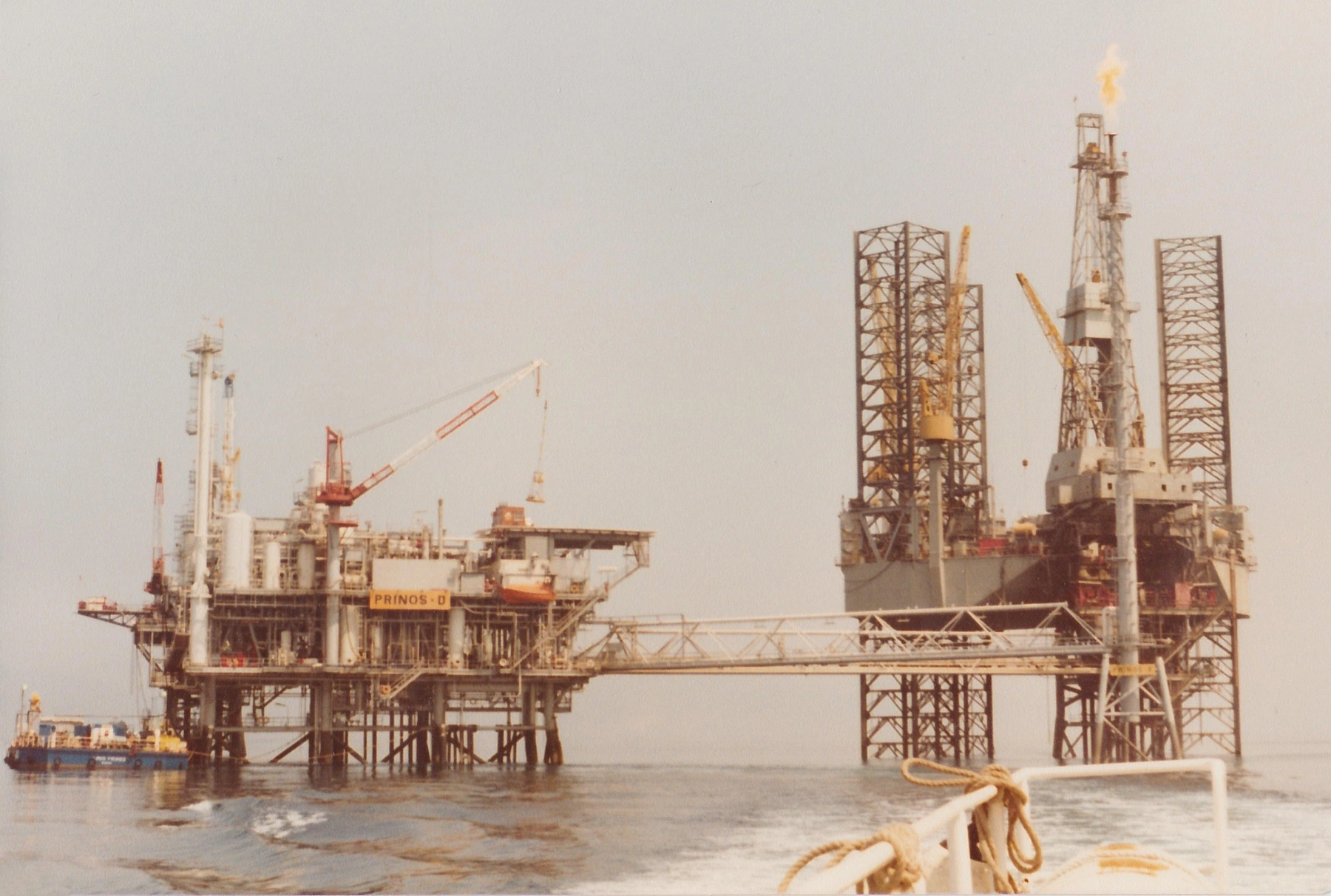

The companion water shutoff in oil wells guide addresses treatment objectives, placement and the tradeoff between water removed and oil excluded. Here, the boundary is earlier: establish what coning explains, what a local intervention can change and what remains a reservoir question.
A Review Framework for Water Coning in Oil Wells
The following review organizes the source’s mechanisms, model assumptions and intervention limits. It is an editorial decision aid, not an operating procedure or a substitute for a well-specific engineering assessment. [1, pp. 834–837, 845, 849]
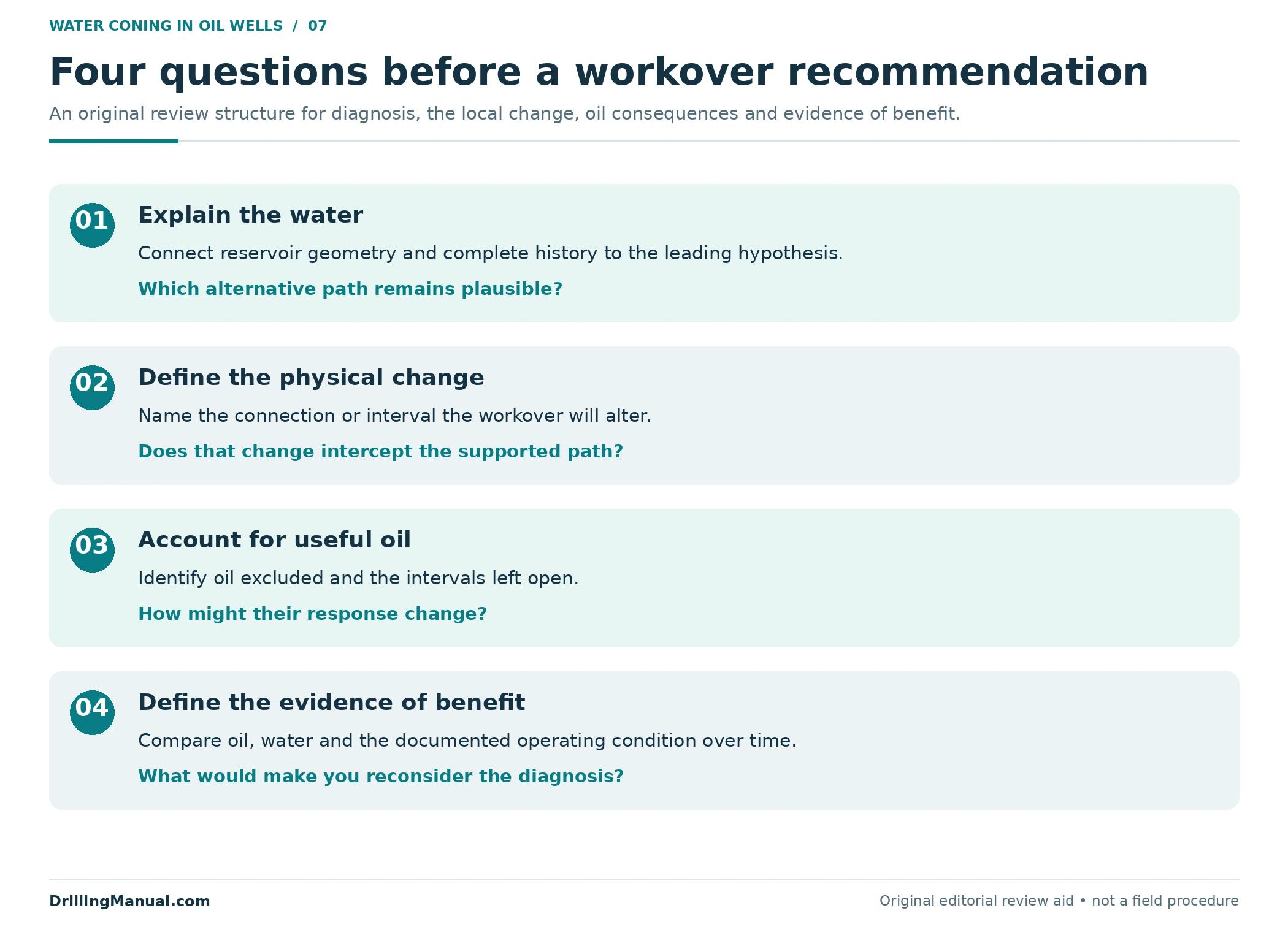
| Decision question | Evidence to assemble | Unresolved issue to state |
|---|---|---|
| Why is coning the leading explanation? | Reservoir/completion geometry and the complete production and intervention history. | Which competing paths remain plausible? |
| What will the workover physically change? | The proposed connection or interval and the actual completion access. | Does that change intercept the supported water route? |
| What useful production is affected? | The target’s oil contribution and the remaining open intervals. | How might remaining inflow change? |
| What would demonstrate benefit? | Oil and water response under documented operating conditions over time. | What would trigger reconsideration of the original diagnosis? |
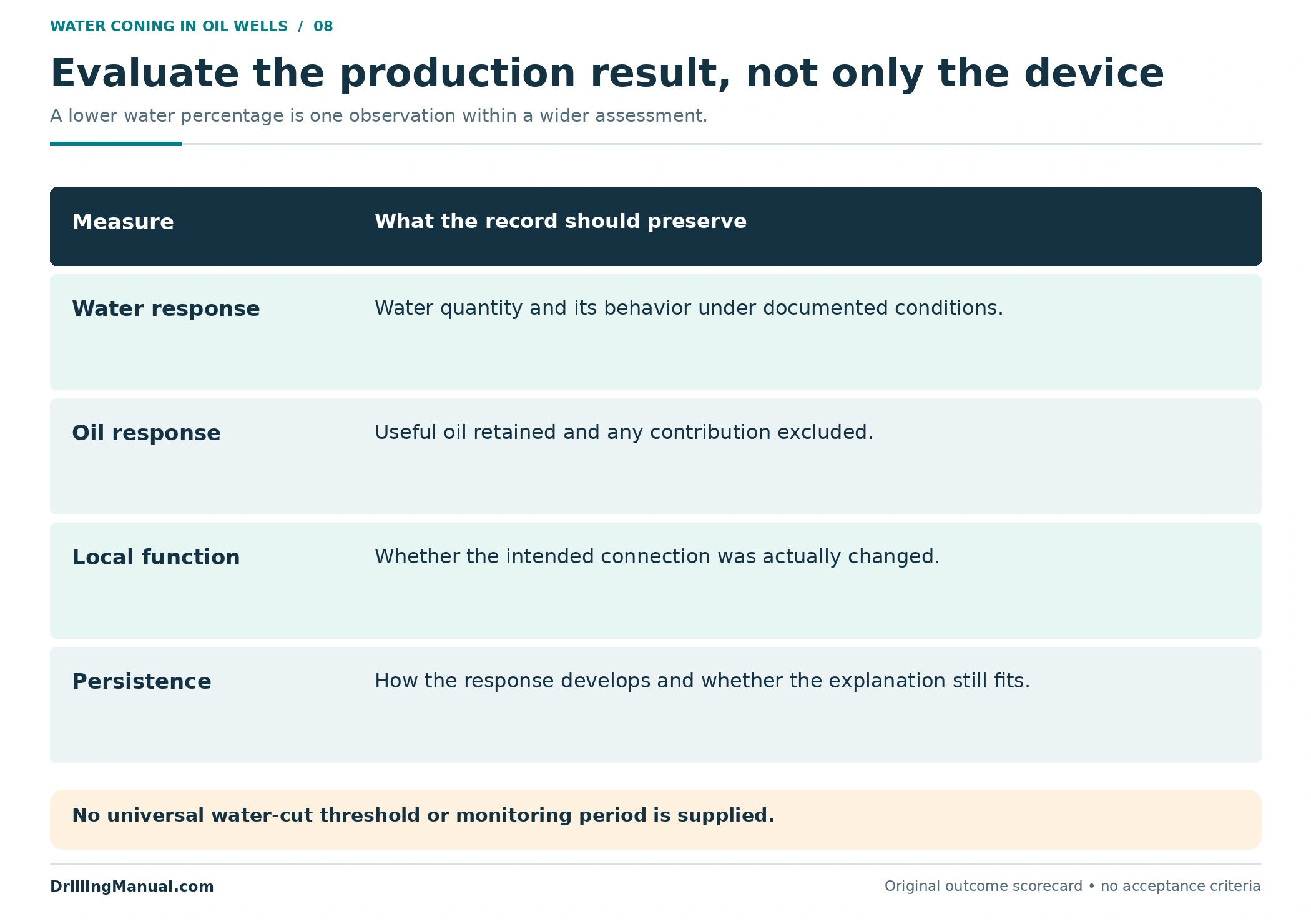
Review the observed result against that stated objective. Measure the oil retained and water response, and revisit the explanation if the behavior differs from the expected one. Reappearance of water alone does not identify a failed component: it may require reassessment of the path, remaining inflow or the reservoir interpretation. The source’s discussion of post-isolation behavior makes that reassessment part of the engineering problem. [1, p. 849]
Frequently Asked Questions
Does High Water Cut Prove Water Coning in Oil Wells?
No. Several reservoir and completion mechanisms can produce similar water histories. High water cut identifies a production observation; a coning diagnosis needs evidence that supports the reservoir mechanism and addresses plausible alternative connections. [1, pp. 834–837]
Will Reducing Rate Always Stop the Water?
No universal result follows from the critical-rate concept. Its prediction depends on the chosen model, inputs and assumptions. A response after breakthrough must be evaluated for the actual reservoir and completion; this article supplies no rate or drawdown threshold. [1, pp. 835–836, 849]
How Is Coning Different From a Behind-Casing Channel?
Coning describes water movement through the reservoir toward the producing interval. A behind-casing channel describes an external completion connection that allows fluid to travel before entering the well. The distinction changes the investigation and the physical target of an intervention. [1, pp. 834–835]
Can a Plug Permanently Cure Water Coning in Oil Wells?
A suitable isolation can exclude a selected wellbore connection. It does not establish that the broader reservoir response has ended. The book discusses progressive isolation and changing inflow after a zone is closed, so permanence cannot be assumed from the device’s local function. [1, pp. 845, 849]
Do Horizontal Wells Have the Same Cone Shape?
The source uses “cresting” for the corresponding upward water movement along a horizontal well. Well geometry changes the shape and belongs in the assessment. A vertical-well illustration should not be treated as a complete horizontal-well model. [1, p. 835]
What Should Be Compared After an Intervention?
Compare oil and water contributions, the documented operating condition and the behavior of the remaining open intervals. A reduced water percentage alone does not establish how much useful oil was retained or whether the expected benefit persists. [1, pp. 845, 849]
Technical References
[1] Hardy, Mary, and Thomas Lockhart. “Water Control,” Chapter 17 in Petroleum Well Construction, edited by Michael J. Economides, Larry Watters and Shari Dunn-Norman; John Wiley & Sons. Consulted 903-page digital copy, visible/physical PDF pp. 834–837, 845 and 849. Used for water-production mechanisms, coning/cresting, critical-rate assumptions, zonal isolation and remaining-inflow limitations.
Engineering explanations are based on the supplied book. Tables, hypothetical records, review frameworks and drawings are original educational constructions. They contain no field operating settings or treatment program. Photograph sources and reuse information appear with the photographs.