Oil well reperforation needs a reason more specific than “the rate has fallen.” Existing entries can become obstructed, the original connection may not reach beyond damaged rock, or part of the intended pay may have poor effective coverage. Those possibilities require different evidence. Petroleum Well Construction explains that debris in perforations can increase completion pressure loss, while its perforating chapter shows why effective entries and penetration relative to damage matter. [1, pp. 478–480] [2, p. 889]
The decision is whether to improve access through existing connections, create additional connections within the same pay, or investigate a different limitation. Here, reperforation means another perforating intervention in the existing pay. Opening a different reservoir interval is treated separately in the well recompletion article. [2, p. 890]
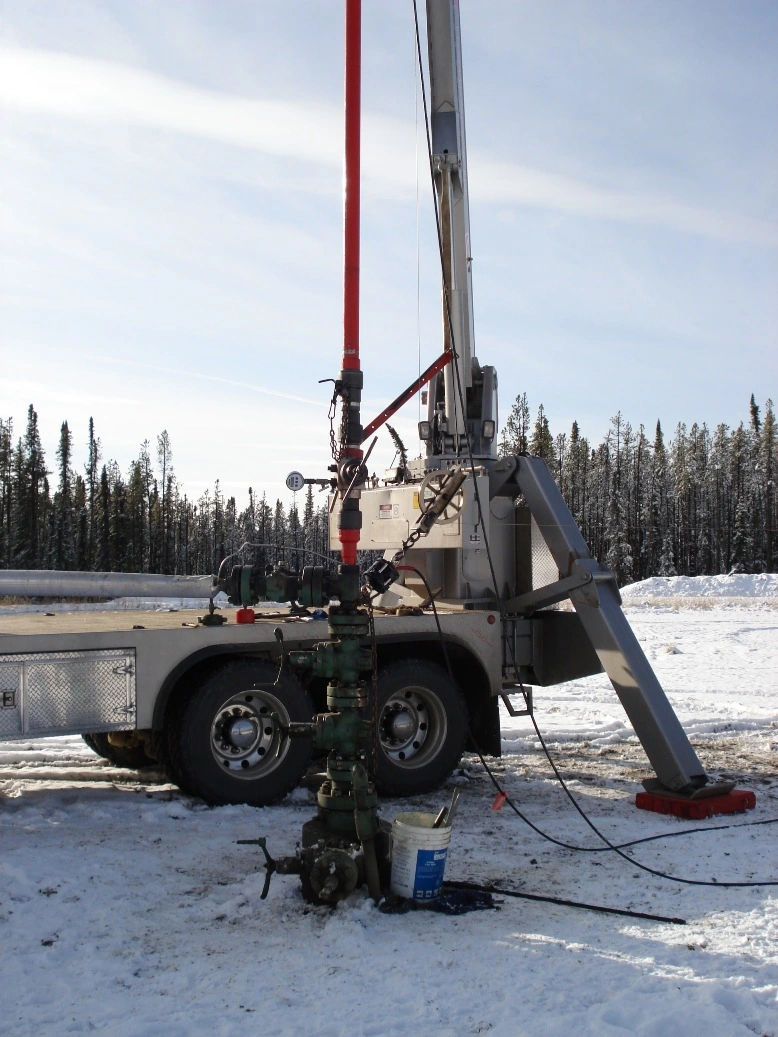

What should oil well reperforation change?
A perforation is part of the connection between formation and wellbore. In a cemented cased completion, that connection passes through the casing and cement into the rock. The useful objective is therefore a functioning flow connection to the intended formation, not simply an increased number of recorded holes. The book distinguishes the number of shots from the entries that actually contact productive rock effectively. [1, pp. 452, 480]
Be precise about “reopening.” Removing an obstruction from an old entry attempts to recover the function of a connection already present. Adding shots creates additional entries; it does not necessarily remove material from the previous tunnels or follow their original paths. Both proposals can target the same pay, but their physical objectives and evidence are different. This distinction applies the source’s separate descriptions of perforation plugging and creation of formation connections. [1, p. 452] [2, p. 889]
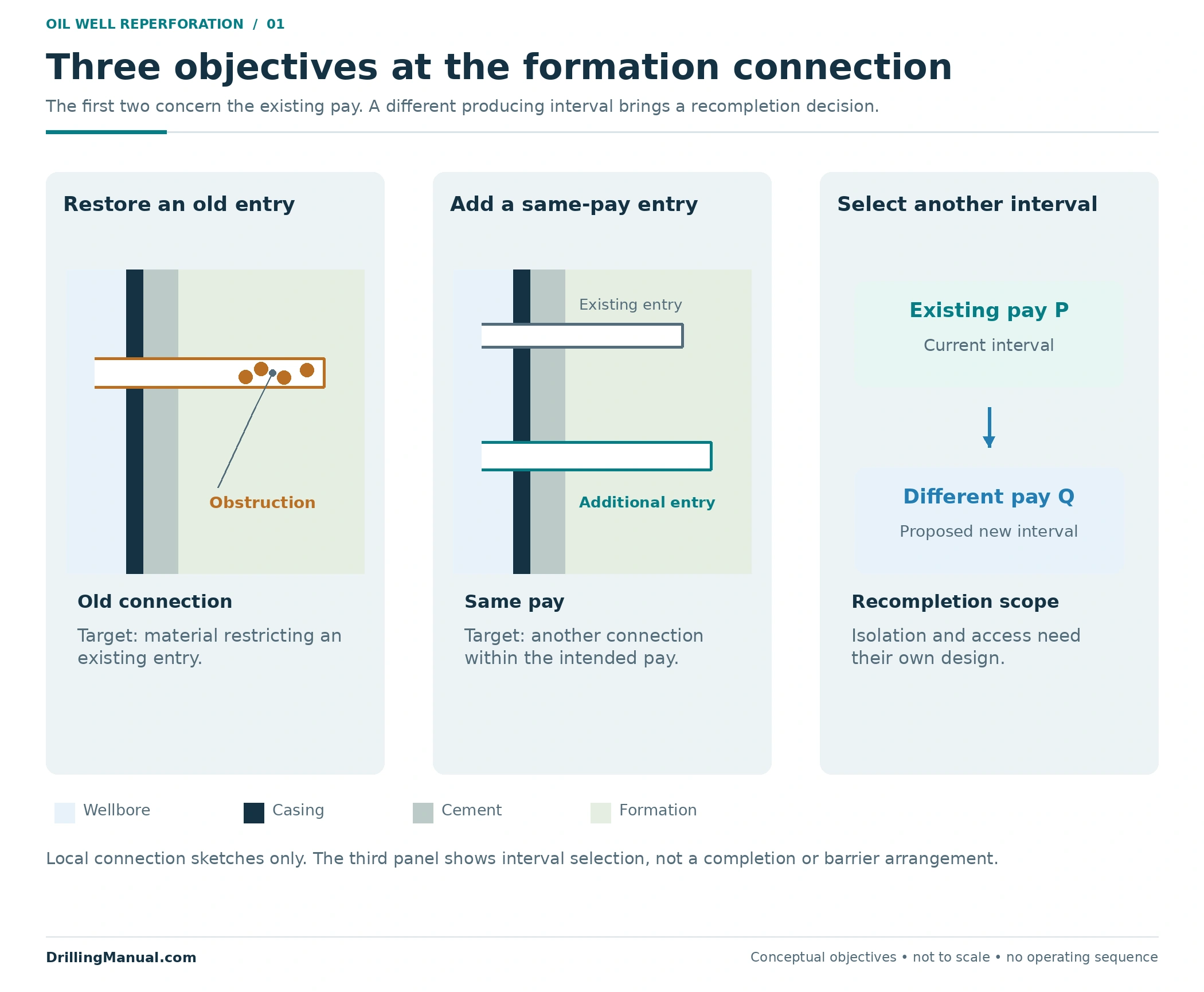
State the intended change before choosing a conveyance system. “Add entries across the already producing interval” is a different proposal from “remove the material restricting existing entries.” The broader perforating methods guide explains the method families; the candidate assessment here asks why another intervention at this pay is justified.
Locate the limitation before prescribing more shots
Perforation obstruction is a credible mechanism, but a rate history does not locate it. Petroleum Well Construction describes fines and scale partly or completely blocking entries, increasing pressure loss and reducing flow capacity. That passage supports investigating an impaired connection. It does not establish that every low-rate well has plugged perforations, or that every such obstruction is best addressed with additional shots. [2, p. 889]
The location of impairment matters. Material inside an existing tunnel, reduced permeability around the well and a mechanical problem in the completion are different physical conditions. The perforating chapter addresses the damaged region around the borehole, while the life-of-field chapter separately addresses equipment failures. A proposal should identify which part of that system it intends to change. [1, pp. 478–479] [2, pp. 889–891]
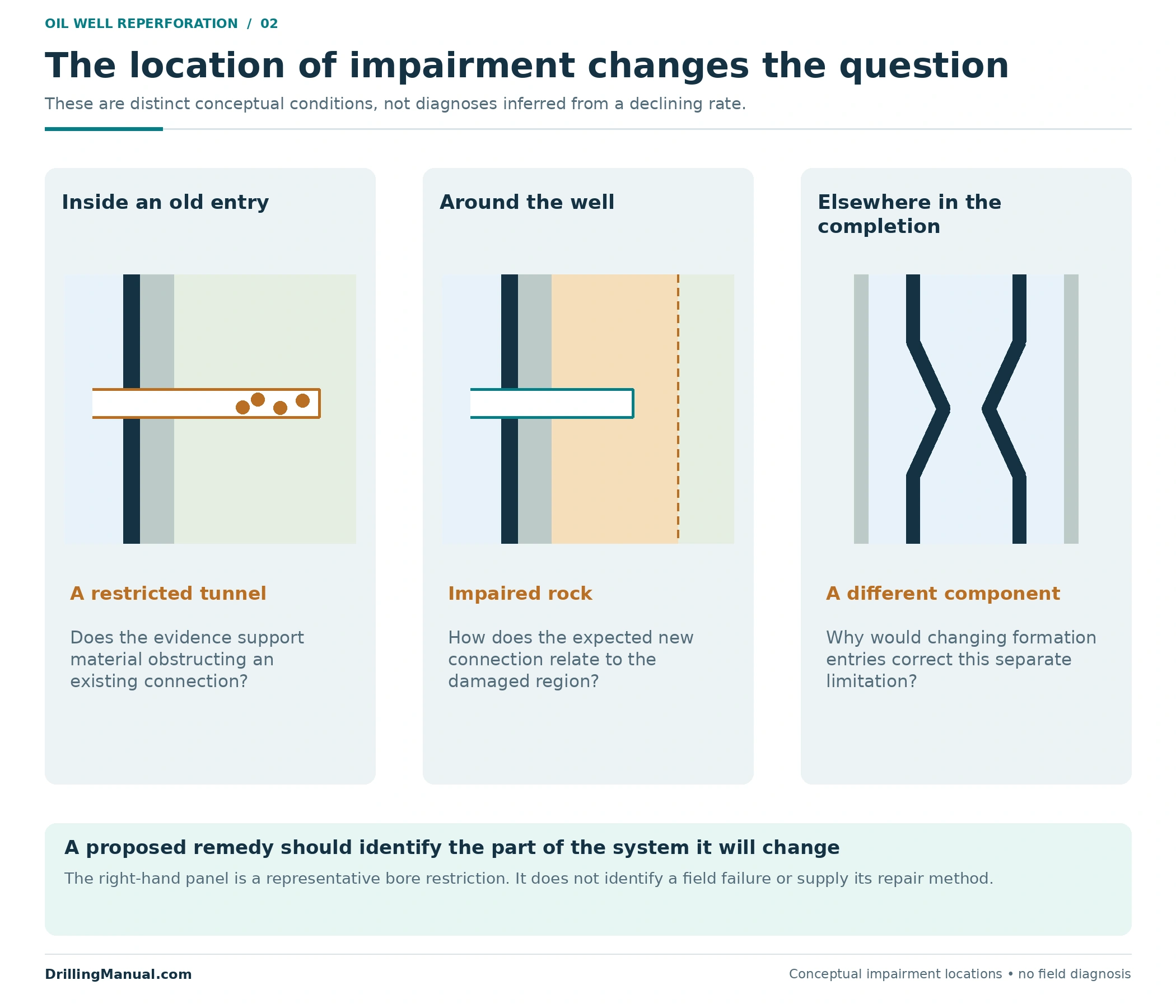
For oil well reperforation, separate the observations from their interpretation. A deteriorating result, a record of deposits and an assumed blocked entry are not interchangeable statements. Preserve the uncertainty if the location or mechanism remains unresolved. Otherwise, the justification can quietly change from “this could explain the decline” to “this has been established,” while the proposed work stays the same.
Also establish what useful formation remains connected to the intended interval. A new opening cannot be evaluated independently of the rock and fluids it reaches. The book relates entry effectiveness to productive formation and notes that partial coverage may have been chosen to limit unwanted water or gas. The original selection may therefore contain an important reason for leaving part of an interval unopened. [1, p. 480]
Compare restoration with oil well reperforation
If the evidence points to obstructed entries, ask whether recovering their function is a credible alternative to making new ones. The life-of-field discussion includes stimulation as a possible response to lost productivity and notes that access depends on the completion arrangement. It does not provide a universal treatment for every obstruction. Deposit identity, placement and the actual completion must support any proposed restoration method. [2, pp. 889–890]
Additional entries have a different case: they must improve the connection to the intended pay despite the condition that limited the original completion. That can involve coverage, effective tunnel geometry or the relationship between penetration and damage. The candidate should explain which of those functions is expected to improve. “More shots” alone does not state a mechanism. [1, pp. 478–480]
| Proposed change | Physical objective | Question that remains |
|---|---|---|
| Restore existing entries | Reduce impairment in a connection already present | What is restricting it, and can the proposed treatment reach and address that restriction? |
| Add entries within the same pay | Create additional formation-to-wellbore connections | Why should the new entries be effective under the current formation and completion conditions? |
| Open a different interval | Bring another reservoir interval into the producing system | What isolation, access and completion changes are needed for recompletion? |
This is a comparison of objectives, not a fixed treatment order. Restoration and additional perforating may both be considered in a well-specific assessment. The table does not say to try one first, prescribe a fluid, or assume that every existing entry can be recovered. Its purpose is to keep the claimed result tied to the work that would produce it. [1, pp. 478–480] [2, pp. 889–890]
Oil well reperforation must address damage reach
A new tunnel can still terminate within impaired rock. Petroleum Well Construction distinguishes perforations ending within the damaged region from those extending beyond it. Reaching less-impaired formation can improve productivity, but the source also cautions that the damage extent is often uncertain. A longer-looking tunnel on a schematic is not proof of a known field connection. [1, pp. 478–479]
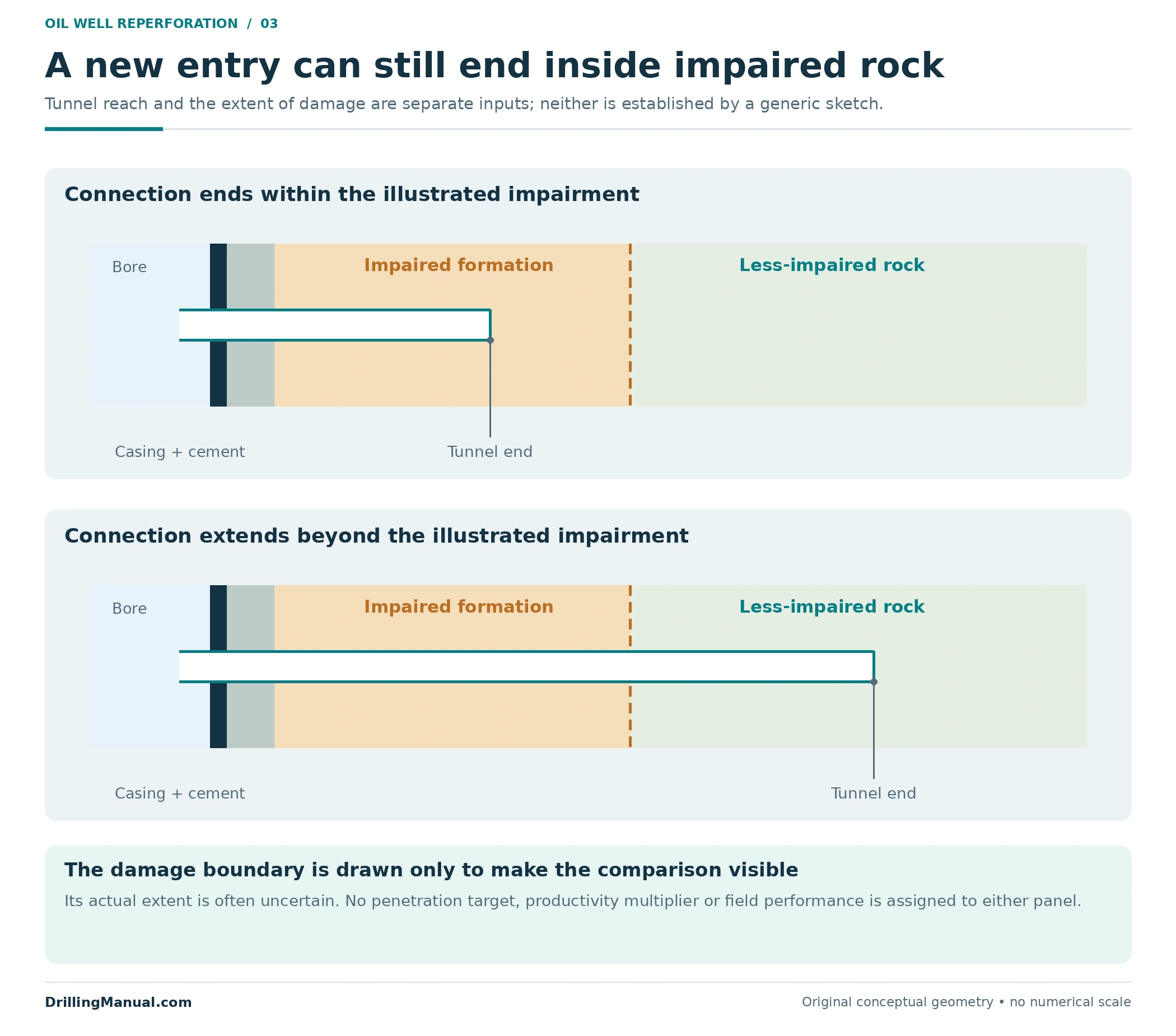
Keep three different inputs visible: the estimated condition around the well, the expected downhole performance of the selected system, and the resulting connection to the intended rock. Uncertainty in the first two affects the third. The NOV CTES manual adds that charge design, carrier characteristics and distance to casing affect perforating performance. A catalog description does not, by itself, establish the exact geometry that will exist in this well. [3, pp. 12-35–12-36]
The article supplies no universal penetration target or shot-density prescription. The conceptual comparison shows why two new entries can have different value even when both pass through casing and cement. It does not assign a productivity multiplier, a damage radius or a minimum acceptable tunnel length. Those would require evidence and design inputs beyond a generic illustration.
Count effective connections, not only planned shots
Oil well reperforation should distinguish nominal coverage from effective contact. The source explicitly warns against assuming that a fixed shot density always produces an openhole-equivalent result. It discusses phasing, formation properties and effective entries, and notes that not every charge necessarily creates a useful productive connection. Historical percentages in that discussion are not used here as a success factor for modern equipment. [1, p. 480]
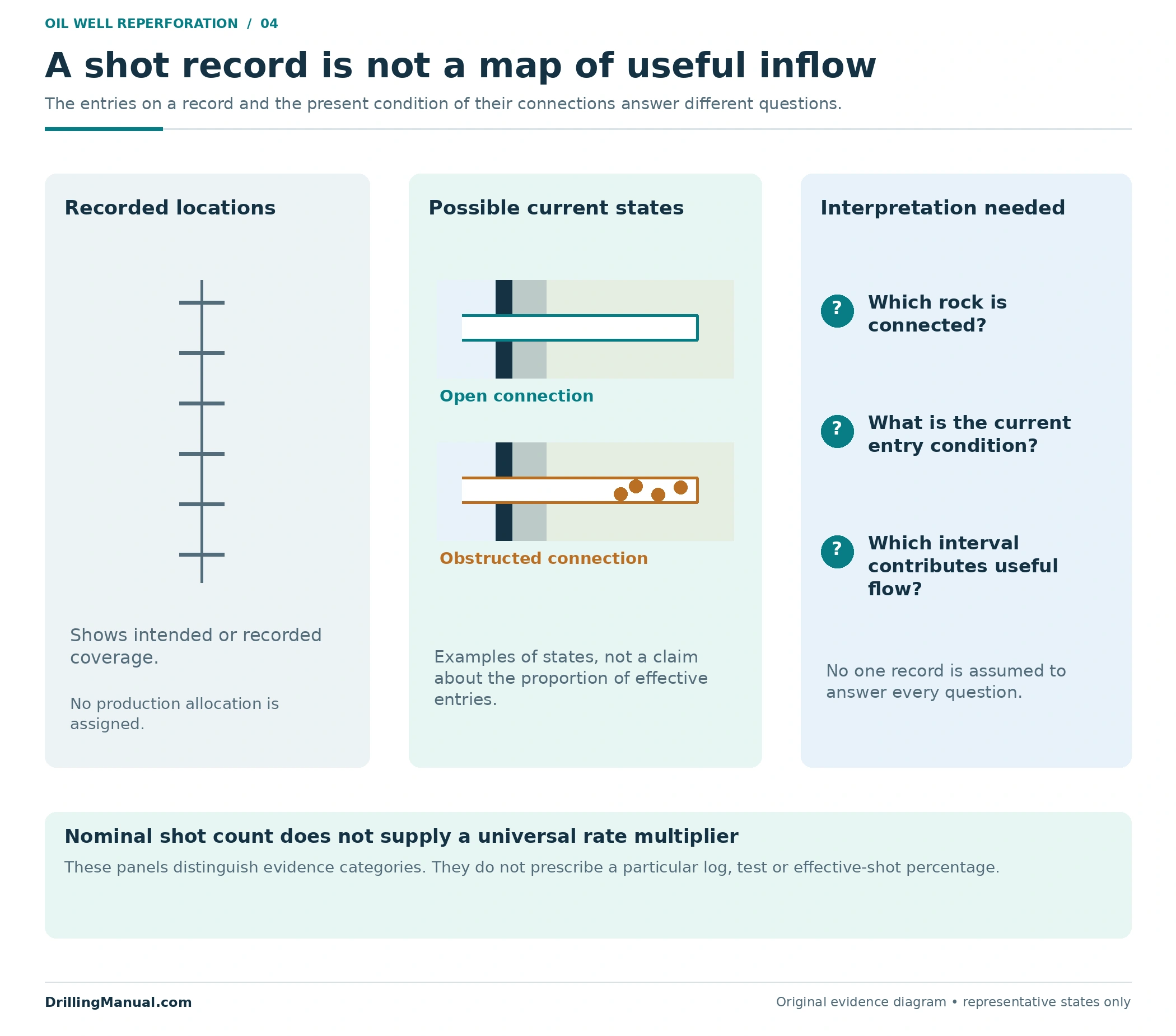
Likewise, adding entries across a previously omitted part of the same pay requires a reason for changing the coverage. Was that section omitted because of an unwanted phase, the original geological interpretation or a completion constraint? A thicker interval on the proposed record is not automatically a better completion. Review the original objective and what evidence now supports extending it. [1, p. 480]
Do not convert the planned count into an assumed production allocation. The sequence “planned, placed, effective, contributing” contains separate questions. This is an evidence distinction drawn from the book’s warning about effective perforations, not a claim that one particular measurement resolves all four. Recording the activity and demonstrating useful inflow serve different purposes.
A historical perforation record is still useful: it defines what was intended and what was recorded at the time. Its limitation is that it is not a current map of the condition of every tunnel. The source’s two observations can coexist: some entries may not have been effective initially, and others can later become obstructed. A candidate review should preserve both possibilities until the available evidence distinguishes them. Treating the old record as either completely ineffective or completely open would hide that uncertainty. [1, p. 480] [2, p. 889]
Check access and recovery for oil well reperforation
The intended interval may be suitable while the proposed assembly is not. The NOV CTES planning discussion calls for the current well configuration, restrictions, equipment locations, directional information, target conditions and surface arrangement. Those inputs determine whether the selected system can reach and work at the required position. The question is broader than whether a nominal gun diameter is smaller than the tubing diameter. [3, p. 12-34]
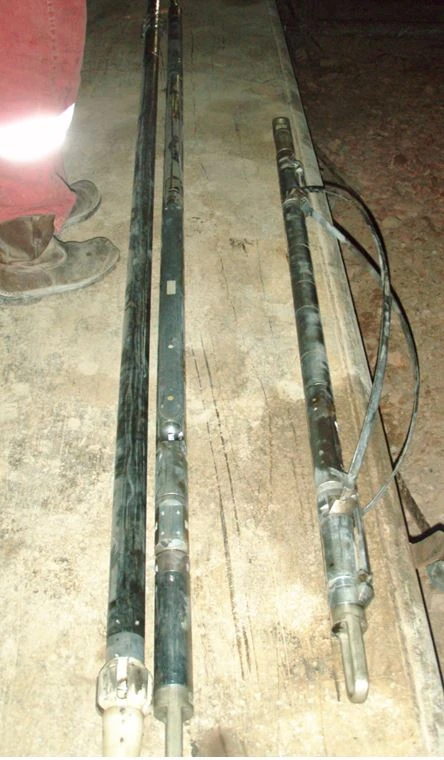

Include the return configuration. The manual notes that a carrier can enlarge during use, making the relevant recovery envelope different from its running envelope. A drawing that checks only passage into the well leaves part of the access question unanswered. Actual dimensions and allowable conditions belong to the selected equipment and well program; the conceptual diagram gives no clearance criterion. [3, pp. 12-35–12-36]

For oil well reperforation, use conveyance as a means of delivering the required result. The manual identifies coiled tubing as an option for deviated or horizontal access and discusses its circulation capability, but those statements do not establish the best choice for every well. The existing pages on wireline deployment, tubing-conveyed perforating and coiled-tubing perforating cover their separate arrangements. [3, pp. 12-34, 12-37]
The through-tubing gun discussion is relevant when the completion remains installed. It should not replace the actual access assessment. The same manual treats pressure, temperature, exposure and material compatibility as equipment-selection considerations, and requires planning for unsuccessful or stuck assemblies. None of those topics is resolved by selecting a small nominal outside diameter. [3, pp. 12-35–12-37]
Keep wellbore preparation distinct from the proposed formation-entry result. NOV CTES includes possible cleanout and preparation in the job plan. Making a travel route available can enable the intervention, but it does not demonstrate that deposits inside an old perforation tunnel have been removed. For oil well reperforation, record access readiness and the intended connection improvement as separate conditions rather than using one as evidence of the other. [2, p. 889] [3, p. 12-37]
Put old and proposed entries on one depth reference
For oil well reperforation, the new proposal must agree with the reference used to identify the pay and the previous entries. Petroleum Well Construction explains correlation between formation logs and cased-hole records, while NOV CTES emphasizes precise depth control. A matching number on two documents is not sufficient if their reference basis has not been reconciled. [1, p. 489] [3, p. 12-35]
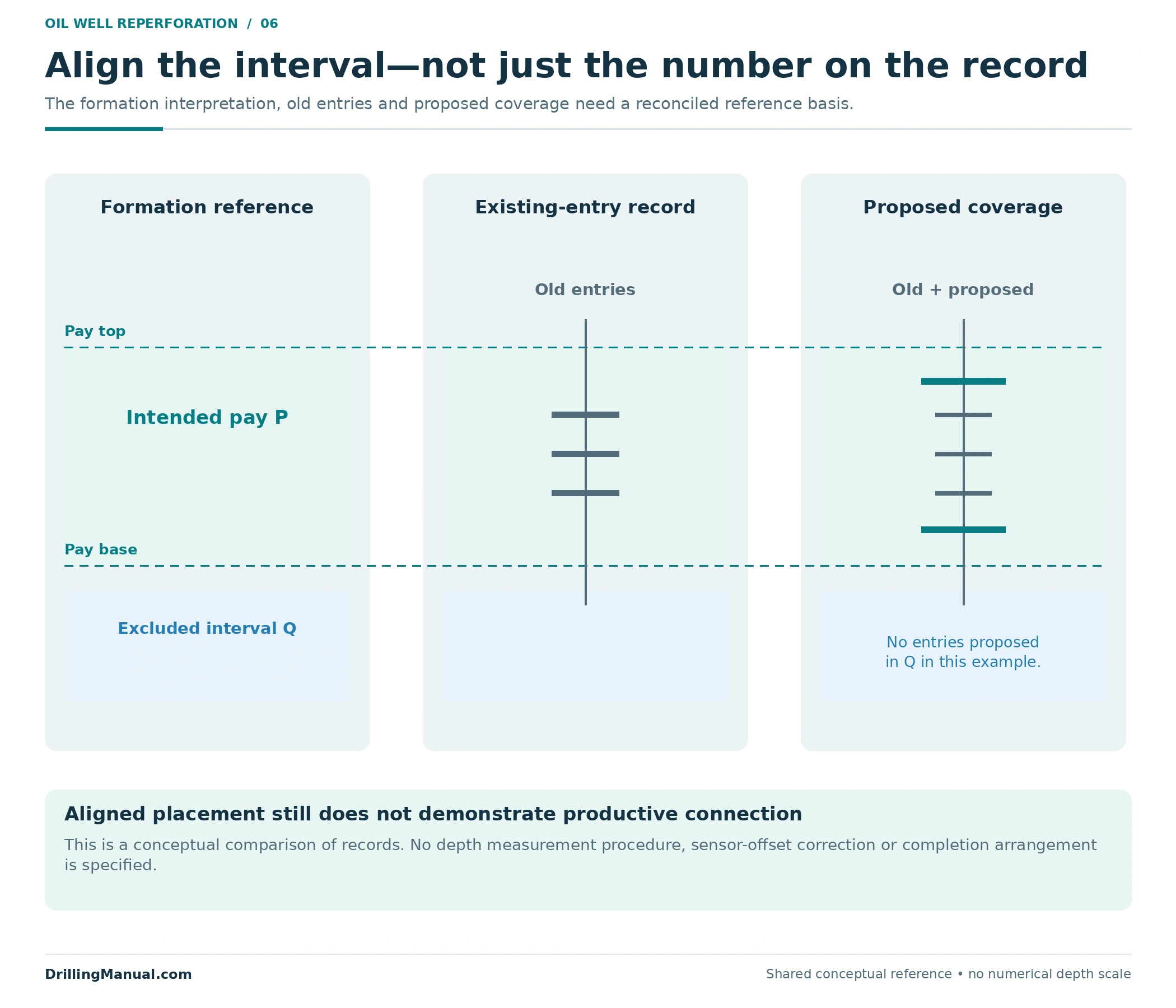
The candidate record should make the intended coverage, existing coverage and excluded intervals visible together. That allows the proposed change to be checked against its stated purpose. It also prevents a same-pay improvement from silently becoming a different-zone completion. The source treats access to a new reservoir as part of recompletion design, with isolation and installed equipment affecting the work. [2, p. 890]
Depth agreement is necessary for the proposed connection, but it does not establish that the connection will be productive. Placement, penetration, local formation condition and subsequent performance remain distinct questions. The diagram aligns conceptual records; it is not a correlation procedure or a substitute for the equipment-specific depth plan. [1, pp. 479–480, 489]
Oil well reperforation: the same proposal, different evidence
Consider three invented candidate descriptions, each beginning with a proposal to add entries in the existing pay. No rates, success percentages or treatment results are assumed. The comparison applies the book’s distinction between obstructed entries, damage reach and separate equipment problems. [1, pp. 478–480] [2, pp. 889–891]
| Hypothetical evidence | What it supports | What extra shots do not yet resolve |
|---|---|---|
| Evidence favors material restricting the old entries | Compare restoring those entries with providing additional connections | Whether the original restriction can be treated, and why new entries would remain useful |
| The impaired region may extend beyond the expected new tunnel reach | Review the damage estimate and actual connection design | Whether new holes would reach sufficiently effective rock |
| The identified limitation is in another completion component | Address the mechanism and service requirement for that component | Why changing formation entries would correct the separate limitation |
The decision changes because the supporting mechanism changes. These are alternative assessments, not a sequence of field actions. If essential evidence is absent, describe the candidate as conditional and state what would change the decision. This keeps an attractive equipment proposal from becoming a substitute for the diagnosis.
Suppose the first description has a credible record of entry impairment but no supported estimate of the new system’s reach in the actual formation. That evidence strengthens the case that a connection problem exists; it does not settle the choice between restoration and new entries. Conversely, a well-defined access route and available equipment do not supply missing evidence about useful pay. Each fact answers a limited question. The candidate becomes stronger when those answers agree, rather than when one favorable fact is used repeatedly to stand in for the others. [1, pp. 479–480] [3, pp. 12-34–12-36]

| Record needed for review | What it contributes | What it does not establish alone |
|---|---|---|
| Existing perforation and depth records | Intended interval and recorded coverage | The current condition or contribution of every entry |
| Formation and production interpretation | Evidence for useful pay and the suspected limitation | Physical access for the selected assembly |
| Current completion and equipment information | Restrictions, travel path and relevant operating environment | The production benefit of creating additional entries |
| Proposed connection and verification basis | The expected physical change and evidence needed to assess it | A guaranteed result before the job |
This review record applies the sources’ planning inputs to oil well reperforation. It should retain the origin and uncertainty of each input, including what changed since the original completion. It is a basis for examining a proposal, not an approved equipment configuration or a list of field execution steps. [1, pp. 479–480, 489] [3, pp. 12-34–12-37]
Verify the result of oil well reperforation
Define success against the original limitation. If the objective was better formation connection, the completed activity record is only part of the result. The source links perforation condition to pressure loss and IPR; a meaningful assessment must address that claimed improvement rather than relying on the fact that another intervention occurred. [2, p. 889]

Keep the production comparison consistent with the claim. A different operating condition can make a rate comparison misleading, so identify the conditions and interpretation behind the before-and-after result. The separate well productivity index article develops the matched pressure and phase-rate basis. This article does not infer a percentage gain from a shot count or supply a second PI exercise.

The final oil well reperforation review should connect the original evidence, the actual interval treated, the resulting completion configuration and the useful production observed. If the outcome differs from expectation, preserve which link remains uncertain. That record is more informative than labeling the job successful solely because the planned equipment was deployed.
Frequently asked questions
Does oil well reperforation mean cleaning the same holes?
Not necessarily. The scope here is additional perforating of the existing pay. Removing an obstruction from an old entry is a different physical objective and need not involve new perforations. The proposal should state which connection it intends to change. [1, p. 452] [2, p. 889]
Is adding another producing zone the same decision?
No. Bringing another reservoir interval into production adds isolation and access questions associated with recompletion. The current article concerns the connection to the existing pay, even when additional entries are proposed within it. [2, p. 890]
Does a higher shot count guarantee a higher oil rate?
No. The book distinguishes effective productive entries from nominal shot count and discusses formation properties, phasing and damage. Additional holes cannot be assigned a universal rate multiplier or success percentage. [1, pp. 478–480]
Can oil well reperforation leave the tubing installed?
It may, where the selected assembly, target and existing completion permit it. Actual restrictions, equipment locations, travel and recovery configuration must be reviewed. A through-tubing label alone does not establish access or suitability for the particular well. [3, pp. 12-34–12-37]
Why compare the old and new depth records?
The proposed entries must correspond to the intended formation and its depth reference. Correlation connects the formation interpretation to the cased-hole record; it does not independently prove that a correctly placed entry is productive. [1, pp. 480, 489] [3, p. 12-35]
What shot density or pressure condition should be used?
No generic value is supplied. The books identify formation, completion, equipment and target conditions as design inputs. Selection and execution require a well-specific engineered program; this article provides neither explosives instructions nor operating settings. [1, pp. 478–480] [3, pp. 12-34–12-37]
Book references
- James Barker and Phil Snider. “Perforating,” Chapter 10 in Petroleum Well Construction, edited by Michael J. Economides, Larry T. Watters and Shari Dunn-Norman. John Wiley & Sons; Halliburton educational copy. Visible document and physical PDF pp. 452, 478–480, 489.
- Shari Dunn-Norman and Clark Robison. “Designing Well Completions for the Life of the Field,” Chapter 18 in Petroleum Well Construction. Same editors and publisher. Visible document and physical PDF pp. 889–891.
- NOV CTES. Coiled Tubing Manual. Copyright 2007–2013; selected pages revised 27 June 2014. Chapter 12, “Mechanical Operations,” subsection “Perforating,” printed pp. 12-34–12-37 / physical PDF pp. 443–446. The candidate comparisons and diagrams are original conceptual applications of these sources, not reported field results or instructions for operating perforating equipment.