Drilling fluid companies supply mud systems, additives and technical support for well construction. Some provide the complete fluid programme and wellsite engineers; others manufacture specialty chemicals or distribute products. Halliburton Baroid, Baker Hughes, SLB/M-I SWACO, Weatherford, Newpark and several regional businesses provide starting points for a service shortlist.
This guide reviews 25 names from the existing directory, separates their roles and explains how to compare proposals. It is not a list of the 25 largest or best suppliers, and not every entry is a verified full-service mud company. Sources were checked on 22 October 2026; limited verification and changed business scope are identified rather than hidden.
Drilling Fluid Companies: Quick Comparison
Use the role column first, then open the company profile. The numbering preserves the directory’s existing sequence; it is not a ranking. A public service description does not establish local stock, contract coverage or availability of personnel.
| Company or business | Role in this guide | Scope or important qualification |
|---|---|---|
| 1. Halliburton Baroid | Fluid systems and services | Water-based, nonaqueous, reservoir and completion fluids. |
| 2. Baker Hughes | Fluid systems and services | Drilling-fluid systems; confirm the regional offering. |
| 3. SLB / M-I SWACO | Fluid systems and services | M-I SWACO is an SLB business, not a separate group. |
| 4. Weatherford | Fluid systems and services | Fluid systems, additives and related waste-management services. |
| 5. Newpark Fluids Systems | Fluid systems and services | Use the fluids business; distinguish its ownership history. |
| 6. Stellar Drilling Fluids | Fluid systems and services | US regional operations; verify the actual service area. |
| 7. Drilling Fluids Technology (DFT) | Adjacent services: check scope | Current site emphasizes production chemicals and services. |
| 8. HMC Fluids and Engineering — formerly Horizon Mud Company | Fluid services: route check | Rebranding confirmed by the company; website retrieval unconfirmed. |
| 9. NESR | Fluid systems and services | Drilling/completion fluids with laboratory and field support. |
| 10. Conquest Drilling Fluids | Fluid systems and services | Fluid engineering, project support and laboratory services. |
| 11. AES Drilling Fluids | Fluid systems and services | US business within CES Energy Solutions. |
| 12. M&D Industries of Louisiana | Specialty products and support | Additives, spacers and sealants; define field-service scope. |
| 13. Valence Drilling Fluids | Fluid systems and services | Fluid systems, engineering and laboratory support. |
| 14. Kraton | Specialty chemical manufacturer | Polymer and pine-chemical inputs for fluid formulations. |
| 15. BCS / Borehole Control | Fluid services: limited verification | Company profile available; official website retrieval failed. |
| 16. CHEMFOR | Fluid systems and services | Oilfield, geothermal and other drilling applications. |
| 17. Hamilton Technologies Limited | Fluid systems and services | Nigeria-focused mud engineering and supporting logistics. |
| 18. Dynamic Drilling Fluids | Fluid systems and services | Current company route differs from the older directory link. |
| 19. Ingevity — legacy additive-supplier entry | Product ownership: recheck | 2026 portfolio sale requires grade-specific supplier confirmation. |
| 20. Viking International / Viking Services | Fluid systems and services | Mud programmes, on-site engineering and product delivery. |
| 21. Impact Fluid Solutions | Specialty additive provider | Additives business within Dorf Ketal. |
| 22. Professional Fluid Services | Specialty products and support | Specialty fluid technologies; verify the contracted service package. |
| 23. Brenntag | Chemical distribution and support | Energy chemicals and supply-chain services. |
| 24. RichTerra | Adjacent services: check scope | Current page describes drilling, directional and mudlogging services. |
| 25. Global Drilling Fluids & Chemicals Limited | Additives manufacture and fluid services | Chemical products plus separately described testing and service options. |
Mud Service Company, Manufacturer or Distributor?
| Supplier role | Typical purchasing requirement | What must be explicit |
|---|---|---|
| Fluid-service provider | A designed system, material supply and agreed engineering support. | Who prepares the programme, performs tests and maintains wellsite coverage. |
| Additive manufacturer | A specified chemical grade or specialty treatment product. | Product qualification, formulation responsibility and available application support. |
| Chemical distributor | Sourcing, stockholding, packaging and delivery. | Manufacturer traceability, regional availability and any included technical service. |
| Adjacent oilfield business | A separate service such as mudlogging, production chemicals or drilling equipment. | Evidence that the requested drilling-fluid scope is actually offered. |
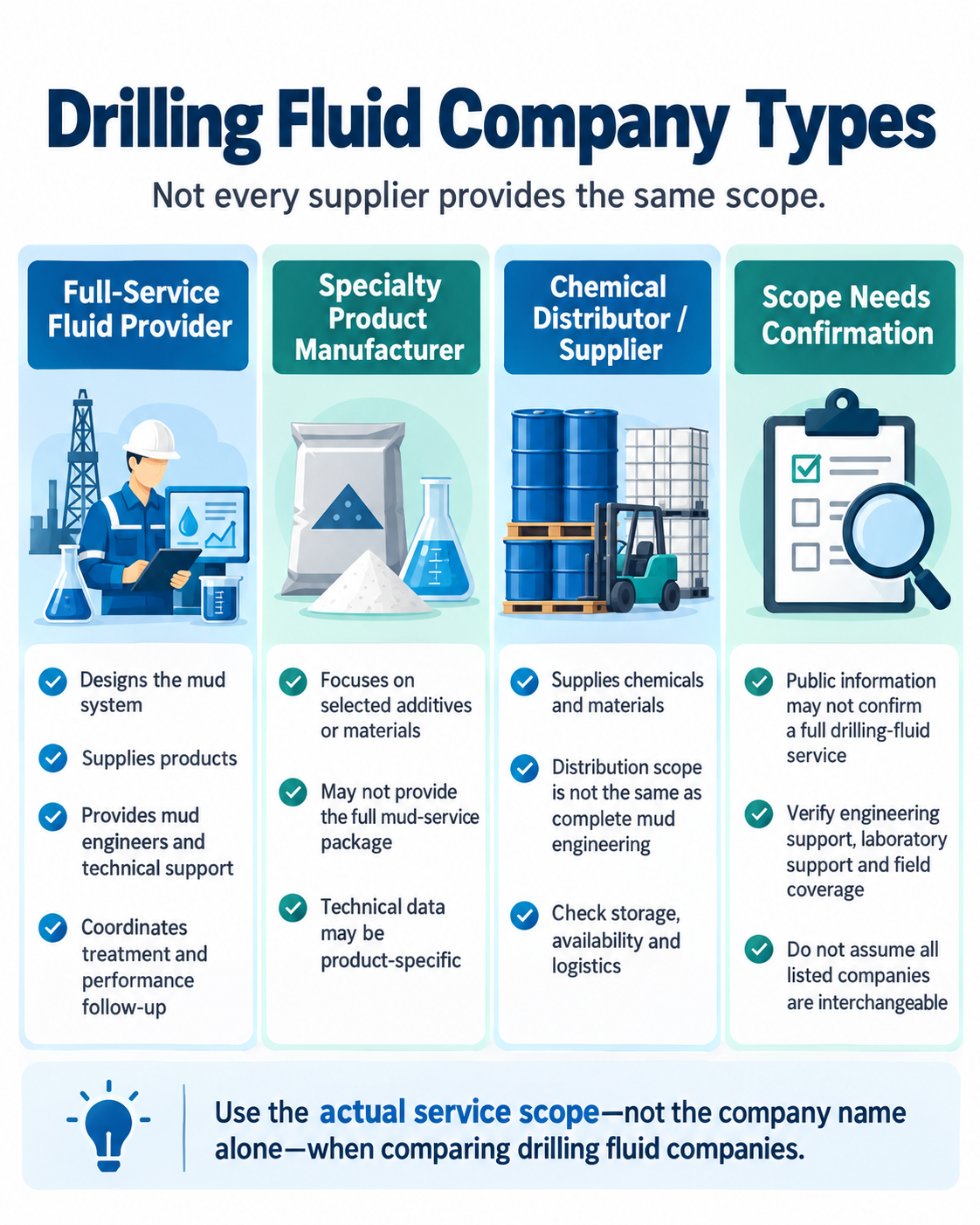
Define the duty before comparing brand names. Water-based mud and oil-based mud involve different formulation and handling questions. A completion brine, cement spacer or production chemical is not automatically a substitute for the circulating drilling fluid. For individual material functions, use the drilling-chemical overview as background, then check the selected product documentation.
Company Profiles and Official Starting Points
The links below lead to business descriptions or company-published evidence, not a promise of an open sales enquiry, vacancy or approved vendor status. Start from the current company navigation for regional contacts. The profile-specific caution matters where a website could not be retrieved or an old directory description no longer matches the published offering.
1. Halliburton Baroid
Halliburton’s Baroid business covers drilling-fluid systems, reservoir fluids and associated separation services. Its portfolio includes water-based and nonaqueous options; a trade name alone is not the fluid specification. For a tender, identify the proposed system for each hole section and whether engineering, solids-control equipment and waste handling are included in the same offer. Industrial drilling applications should be directed to the appropriate business rather than assumed equivalent to oilfield service.
Source / starting point: Halliburton drilling fluids.
2. Baker Hughes
Baker Hughes publishes a drilling-fluids portfolio, including water-based systems, within its drilling business. Use the relevant product and service team rather than the general equipment catalogue. The indexed official descriptions support inclusion here, but direct page retrieval was restricted during this review. Confirm the offered formulation, technical documentation and local delivery route directly; this directory does not reproduce an unverified current product list.
Source / starting point: Baker Hughes drilling fluids.
3. SLB / M-I SWACO
M-I SWACO is identified within SLB, with drilling fluids and additives forming part of its well-construction offering. Count the business once rather than listing SLB and M-I SWACO as unrelated competitors. The procurement question is which fluid system, engineering support and surface-processing scope the local team will supply. Historical brand recognition does not establish stock, staffing or readiness for a particular campaign.
Source / starting point: SLB’s M-I SWACO page.
4. Weatherford
Weatherford’s current drilling-fluid pages describe systems and additives alongside related waste-management offerings. They provide a better starting point than an old general corporate profile. Ask the proposed service team to distinguish the fluid supply from equipment, personnel and disposal responsibilities. A broad portfolio does not show that every component is available from the same operating base.
Source / starting point: Weatherford drilling-fluid solutions.
5. Newpark Fluids Systems
Newpark’s present portfolio covers drilling, drill-in and completion fluids, with laboratory, modelling and processing support. Its fluid business should not be described using a former parent’s access-matting activities. SCF’s acquisition announcement records the September 2024 purchase of Newpark Fluids Systems from Newpark Resources. Use the current fluids entity and the relevant regional team when requesting a proposal.
Source / starting point: Newpark Fluids Systems.
6. Stellar Drilling Fluids
Stellar describes water-based, oil-based and synthetic fluid capabilities and identifies US operating areas. It is a regional service candidate, not evidence of unrestricted worldwide coverage. Match the well location with the proposed mud plant, dispatch arrangements and engineer coverage. An inventory of fluid types is useful only when the supply and support can reach the rig on the required schedule.
Source / starting point: Stellar Drilling Fluids.
7. Drilling Fluids Technology (DFT)
DFT’s current website emphasizes production chemicals, fluid management, flowback, acidizing and laboratory services. That is a narrower evidential basis than the historical description of a complete drilling-mud provider. Retain the name as a potential specialist contact, but obtain explicit confirmation before treating it as a bidder for a whole-well mud-engineering contract. The company name alone is insufficient to establish that scope.
Source / starting point: DFT’s current services.
8. HMC Fluids and Engineering — formerly Horizon Mud Company
Horizon’s own announcement identifies the business as HMC Fluids and Engineering. Its company profile lists drilling fluids, completion fluids and engineering, and points to hmcusa.com. That website could not be retrieved in this review. The rebranding is supported; the current web contact route and project-specific availability still need confirmation. Avoid using an old Horizon description as a current staffing or facilities record.
Source / starting point: Horizon’s HMC announcement.
9. NESR
NESR’s drilling-fluids page combines chemicals and engineering with laboratory support. It also describes capabilities such as mud plants, filtration, solids control and waste management. Those adjacent services make the responsibility matrix important: specify what NESR supplies, what the rig contractor operates and what a separate waste contractor handles. Do not assume the entire listed portfolio is included in a basic fluid quotation.
Source / starting point: NESR drilling fluids.
10. Conquest Drilling Fluids
Conquest identifies engineering, project-management and laboratory capabilities alongside fluid supply. Its published scope includes water-based, oil-based and synthetic systems. For comparison, ask for the proposed fluid and supporting tests, not simply the widest advertised product range. The laboratory programme should answer the well’s expected conditions and contamination risks rather than repeat unrelated product demonstrations.
Source / starting point: Conquest Drilling Fluids.
11. AES Drilling Fluids
AES is a US drilling-fluids business within CES Energy Solutions. CES’s operations page identifies the operating names, while its fluids description connects well-specific programmes with field monitoring and technical support. For procurement, distinguish AES drilling-fluid services from other CES chemical or completion businesses. Confirm the contracting entity and local supply arrangement rather than treating every group brand as an independent mud company.
Source / starting point: AES Drilling Fluids.
12. M&D Industries of Louisiana
M&D describes development and manufacture of specialty fluid products, including additives, cement spacers and sealants, with technical support and training. This is a useful route for a defined treatment or product requirement. It does not by itself establish a complete continuous mud-engineering service for every project. Specify the product function, qualification work, application support and accountability in the purchase scope.
Source / starting point: M&D Industries.
13. Valence Drilling Fluids
Valence describes engineered water-based and nonaqueous fluids, laboratory work and planning support. These capabilities are relevant when comparing a complete service proposal rather than buying isolated additives. Request the proposed formulation and its test basis, then reconcile the supply plan with the actual operating area. Historical expansion plans and cumulative experience claims are not substitutes for a current facilities and staffing commitment.
Source / starting point: Valence Drilling Fluids.
14. Kraton
Kraton supplies specialty polymer and pine-chemical materials used in oilfield formulations, including components for nonaqueous drilling fluids. Its role is different from staffing a rig with mud engineers. A formulator or service company must establish the selected grade’s concentration, compatibility and performance in the complete blend. Purchasing an emulsifier or rheology-modifier ingredient does not purchase a qualified drilling-fluid system.
Source / starting point: Kraton oilfield chemicals.
15. BCS / Borehole Control
The company’s public profile describes drilling-fluid products, engineering and field services, including US Gulf Coast work. Its listed website, boreholecontrol.com, could not be retrieved during this review. This is a verification limitation, not a finding that the business has closed. Confirm the present legal name, contact details and offered services before relying on the entry for a tender.
Source / starting point: Borehole Control company profile.
16. CHEMFOR
CHEMFOR describes drilling fluids, engineering and solids-control or waste-management services across several drilling markets. Separate the oil-and-gas requirement from geothermal, salt, civil or trenchless work when making an enquiry. Experience in one application can be relevant, but the fluid, equipment and operating constraints still need to match the proposed well. Ask for an application-specific offer rather than a generic capability statement.
Source / starting point: CHEMFOR.
17. Hamilton Technologies Limited
Hamilton Technologies presents mud engineering, drilling and completion fluids, and supporting logistics within its Nigerian operations. For a regional shortlist, check the nominated laboratory, supply base and wellsite team together. Product access is only one part of readiness: transport, storage and the ability to respond to a change in the programme also belong in the agreed scope.
Source / starting point: Hamilton Technologies.
18. Dynamic Drilling Fluids
Dynamic’s current company site describes drilling-fluid engineering and identifies a Corpus Christi headquarters with additional locations. Use this route rather than assuming an older domain remains the best contact point. The company overview supports a service enquiry, but it does not establish the stock, equipment or people committed to a particular rig. Obtain those details in the project proposal.
Source / starting point: Dynamic Drilling Fluids.
19. Ingevity — legacy additive-supplier entry
Ingevity announced completion of the sale of its North Charleston crude-tall-oil refinery and most of its Industrial Specialties product line to Mainstream Pine Products in January 2026. Consequently, an old additive catalogue is not reliable evidence of the present selling entity. The announcement does not map every drilling-fluid grade. Verify the exact product, manufacturer, safety data sheet and technical-support route; do not transfer all historical oilfield products to one successor by assumption.
Source / starting point: Ingevity’s January 2026 sale announcement.
20. Viking International / Viking Services
Viking’s dedicated drilling-fluid page describes programme preparation, on-site engineering, product delivery and monitoring of solids-control systems. Its broader company also supplies other drilling services, which should not be confused with the fluids package. Confirm the required geography and staffing scope. This directory does not adopt the website’s historical well counts or a generic percentage of total well cost as a current procurement benchmark.
Source / starting point: Viking drilling-fluid services.
21. Impact Fluid Solutions
Impact focuses on specialty fluid additives rather than being interchangeable with every full-service mud contractor. Its company announcement identifies Dorf Ketal ownership. For a particular product, establish the application, test results and route to field support. Evaluate claims about stability or fluid-loss performance against the intended formulation and conditions, not as guarantees for every well.
Source / starting point: Impact Fluid Solutions.
22. Professional Fluid Services
Professional Fluid Services presents specialty technologies for drilling and completion applications, including loss-control and related fluid products. The product-led offering can suit a defined problem or treatment requirement. Clarify whether the purchase includes formulation work, laboratory testing and field personnel, or only material supply. Similar product terminology across suppliers does not establish interchangeable formulations or a shared corporate identity.
Source / starting point: Professional Fluid Services.
23. Brenntag
Brenntag’s energy-services offering includes chemicals for drilling and other oilfield activities, with distribution and technical-support functions. A distributor can be important to local availability and procurement, but distribution alone is not a whole-well mud-engineering contract. Identify the manufacturer and product grade, then specify packaging, delivery, documentation and any technical responsibilities that extend beyond supply.
Source / starting point: Brenntag energy services.
24. RichTerra
RichTerra’s retrieved page describes contract drilling, directional services, downhole tools and related operations. It does not provide enough specific evidence to classify the company as a complete drilling-fluid supplier. Mudlogging and mud engineering are different services. Retain this entry as a scope clarification, not as a verified substitute for a fluid-system, chemical-supply and mud-engineer package.
Source / starting point: RichTerra drilling and mudlogging page.
25. Global Drilling Fluids & Chemicals Limited
Global Drilling Fluids & Chemicals describes manufacture of drilling-fluid additives together with testing, mud-supply and related services. Separate a product order from a site-service contract when requesting prices. Confirm the actual manufacturing source, grade specification, batch documentation and support arrangement. This entry does not independently verify current certifications, factory counts or claims of market leadership.
Source / starting point: Global Drilling Fluids & Chemicals.
How to Select a Drilling-Fluid Service Company
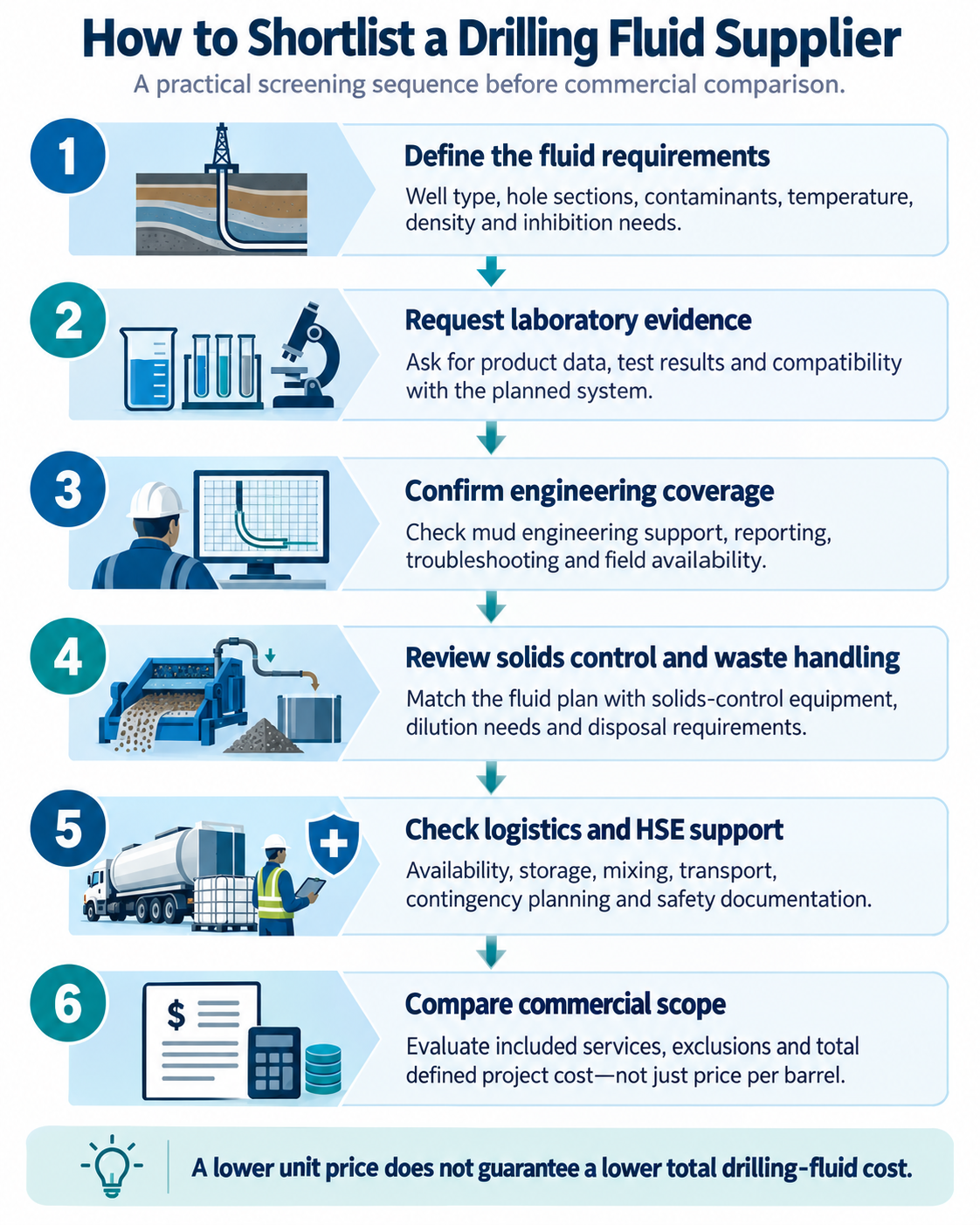
Begin with the approved drilling programme and the required service boundaries. Ask candidates to explain the proposed system by hole section and to identify unresolved assumptions. The following matrix is an editorial screening framework informed by the cited fluid-design principles [1, 2], not a universal specification or supplier approval.
| Question for the proposal | Evidence to request | Why it changes the comparison |
|---|---|---|
| What will the fluid encounter? | Section depths, pressure and temperature basis, expected formations, contamination and fluid transitions. | A successful application elsewhere may not represent this well. |
| What properties must the system maintain? | Proposed density, rheology and filtration targets with test conditions and agreed operating limits. | A product name or one viscosity reading is not a complete performance specification. |
| How will the formulation be evaluated? | A laboratory programme for the relevant aging, contamination and compatibility conditions, with acceptance criteria. | A fresh-fluid result may not represent the circulating, contaminated system. |
| Who supplies the field and office support? | Personnel coverage, reporting, review authority and escalation arrangements. | Material supply does not automatically include continuous engineering support. |
| How does the surface system fit? | Mixing, storage, solids-removal and waste-handling interfaces for the actual rig. | Equipment or logistics constraints can undermine an otherwise suitable formulation. |
| How will material quality and continuity be controlled? | Named grades, batch documentation, safety data sheets, stock plan, lead times and approved substitutions. | An apparently equivalent sack or shipment may not meet the agreed formulation. |
| What is included in the price? | A common volume basis, engineering scope, equipment, transport, waste charges and return-credit terms. | Unlike commercial scopes can make the lowest headline price misleading. |
Read the Test Conditions, Not Just the Result
SLB’s educational overview describes fluid design as an ongoing process, with measurements selected for the system in use [2]. A useful proposal therefore states the fluid composition, test temperature, aging and contamination basis alongside the reported properties. Compare equivalent test conditions and distinguish a laboratory demonstration from an operating limit.
Use the mud-testing guide and drilling-fluid properties guide to understand the requested measurements. The supplier should explain how its test programme addresses the actual well. The final acceptance criteria belong to the approved design, not a generic supplier table.
Include Solids Control and Waste Responsibilities
The IADC manual distinguishes useful commercial solids from drilled solids and explains how processing affects fluid condition and cost [1, FP-5–FP-6]. Buying more chemicals is not a substitute for resolving an inadequate solids-removal arrangement. Identify who selects, operates and maintains the solids-control equipment, and who tracks fluid losses and discarded volumes.
The same boundary check applies to handling and transport. Confirm storage and mixing capacity, replenishment arrangements and the waste route. For an offshore campaign, use the rig-selection guide to connect the fluid package with the installation. Chemical-handling controls and task planning must also fit the rig’s safety arrangements.
Compare Total Scope Cost, Not the Cheapest Barrel
IADC’s discussion of dilution identifies both replacement-fluid and disposal costs [1, FP-6]. The wider lesson is to compare the delivered service and forecast consumption, rather than one unit price. Add agreed treatment, support, equipment and logistics charges; distinguish returned or reusable fluid from chargeable purchases. A well-cost estimate must also account for consequences outside the fluids invoice.
Hypothetical commercial example. Assume two technically acceptable proposals for the same well interval and scope. The following rates, chargeable fluid quantities and waste volumes are invented planning assumptions—not market prices or supplier performance data. Fluid purchased and waste disposed are separate forecast quantities, not a closed material balance.
| Assumed item | Proposal A | Proposal B |
|---|---|---|
| Chargeable fluid volume | 1,500 bbl | 1,200 bbl |
| Fluid price | US$120/bbl | US$135/bbl |
| Fluid charge | US$180,000 | US$162,000 |
| Defined support allowance | US$30,000 | US$40,000 |
| Waste volume and disposal rate | 600 bbl × US$40/bbl | 350 bbl × US$40/bbl |
| Disposal charge | US$24,000 | US$14,000 |
| Comparison total | US$234,000 | US$216,000 |
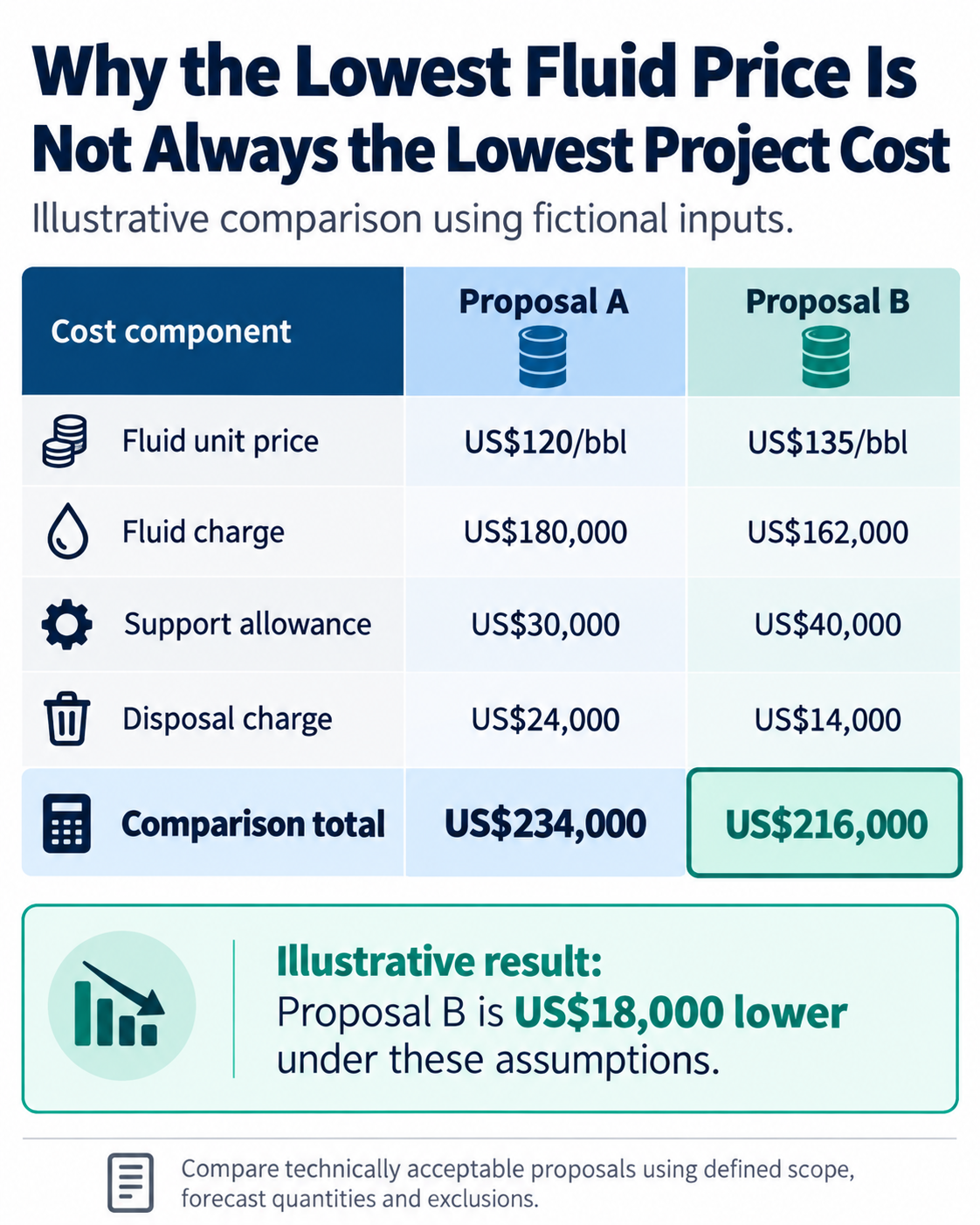
Proposal B has the higher fluid price but is US$18,000 lower on the stipulated quantities and scope. That result is only as credible as the forecasts. Before award, challenge the consumption and disposal assumptions, reconcile exclusions and examine sensitivity to additional volume. Rig time, taxes, financing and any unlisted services or credits are outside this small model; it is not a complete well budget.
Information to Send With a Fluid-Service Enquiry
Send a defined scope rather than “quote your best mud price.” Include the well location and schedule, hole sections and sizes, expected downhole conditions, available water or base fluid, contamination concerns, rig processing constraints and the desired engineering coverage. State which documents are preliminary and which requirements are fixed.
Request a named technical contact, the proposed formulation and test basis, supply and contingency plans, a responsibility matrix and a comparable price schedule. Keep a clear record of exclusions. For employment enquiries, use the company’s actual careers route; a commercial mud-supply address is not an HR application channel.
Drilling-Fluid Supplier Questions
Which drilling fluid company is best?
There is no defensible universal winner. Evaluate the proposed system, engineering support, local supply and complete price against the same well requirements. This directory identifies candidates and supplier roles; it does not rank safety, service quality or technical performance.
Are mud companies and chemical manufacturers the same?
Not necessarily. A material manufacturer can supply an ingredient without designing or maintaining the complete mud system. A service provider may combine several manufacturers’ products with its own engineering. Confirm both product traceability and responsibility for the finished formulation.
Does a synthetic-based label prove environmental acceptability?
No. Obtain the product and complete-fluid documentation, then verify the permitted use, handling and waste route for the project. A general marketing label is not evidence of site-specific acceptance. This guide does not determine a jurisdiction’s current discharge or disposal requirements.
Are all 25 entries verified full-service drilling-mud suppliers?
No. The table deliberately distinguishes fluid-service businesses from specialty manufacturers, distribution and adjacent services. DFT and RichTerra require a scope check; Ingevity requires product-owner verification. HMC and BCS have company-published profile evidence, but their listed websites could not be retrieved. Baker Hughes page access was restricted; indexed official descriptions were available.
Sources, Scope and Update Notes
[1] International Association of Drilling Contractors, IADC Drilling Manual, 12th edition, 2015, “Drilling Fluid Processing,” printed FP-1–FP-6 (physical pages 399–404 in the supplied copy). Used for processing, rheology and solids-control cost principles. Historical equipment limits, chemical treatments and price examples are not adopted as current requirements or quotations.
[2] SLB, The Defining Series: Drilling Fluid Basics, Oilfield Review, 2013. Used for the connection between well conditions, formulation, measurements and continuing fluid maintenance. This educational explanation is separate from current company-portfolio evidence.
Company evidence: sources are linked in each profile. They are company-reported descriptions, not independent performance audits. The procurement matrices and numerical example are original editorial applications of the cited principles. No proprietary book figures, operating tables or manufacturer recipes have been reproduced.
Review scope: checked 22 October 2026. The directory is selective and includes legacy names for continuity; it is not a census of independent corporate groups. Website access failures are disclosed rather than described as confirmed broken links. Current certifications, available stock, geographic coverage, hiring and suitability for a particular well require direct verification. Use the approved programme and product documentation for operations.
Nice to find this brief file about fluids companies
Ex-Baroid Engineer throughout Rocky Mtns. and Ca,Or,and Wa from ‘76 thru 2010’ish. Glad to see that the business is alive and well
Missing a couple of significant Canadian companies – Secure & CES (parent of AES)