Life on an offshore oil rig combines long work shifts, time living at the worksite and scheduled periods away from home. The routine revolves around the job, handover and recovery between shifts. A 12-hour shift is a useful example—not a universal schedule—and accommodation, communications, pay and leave depend on the assignment. [1, 2]
This guide explains the practical questions to ask before joining: how the rotation works, where you sleep, how you contact home, what training is needed and what a salary figure actually means. It focuses on offshore work; a land-rig job can have a different travel and accommodation arrangement. Use our offshore drilling companies directory to find official employer routes, not as proof of an available job.
Life on an Offshore Oil Platform: What to Expect
First establish where you will work. A drilling rig, a production installation and a platform-mounted drilling package are not the same assignment. Floating units also have marine personnel and systems alongside the drilling operation. The IADC manual emphasises the coordination needed between drilling crews, marine crews and visiting specialists. [1]
| Part of rig life | Practical expectation | Confirm before joining |
|---|---|---|
| Working day | A planned shift with defined duties, handover and relief. | Actual hours, day/night pattern and fatigue arrangements. |
| Rotation | A block at work followed by scheduled time away. | Whether travel, training or standby uses part of that time. |
| Accommodation | Living space associated with the offshore assignment. | Cabin sharing, bathroom arrangements and quiet periods. |
| Contact with home | Facilities and permitted personal-device use are site-specific. | Internet access, restrictions and an emergency contact route. |
| Pay and benefits | An employment package, not a single industry-wide rate. | Pay basis, leave treatment, allowances and benefit eligibility. |

Workload and Shifts: Separate the Shift from the Rotation
A shift is your working period within a day. A rotation, sometimes called a hitch or tour, describes the period on assignment and the time away afterward. The UK National Careers Service gives an example of 10–12-hour days over two weeks, followed by two weeks of leave. That is an example from a UK careers profile, not a worldwide entitlement. [2]
The rig can operate around the clock without one person working continuously. Read the roster together with the handover, relief and overtime arrangements. Ask whether your assignment stays on days or nights, changes shifts during the hitch, or includes an on-call duty. A roster label alone does not answer those questions. [1, 3]
What Do 14/14, 21/21 and 28/28 Mean?
| Illustrative roster notation | Meaning if stated as days on / days off | Total cycle |
|---|---|---|
| 14/14 | 14 days on assignment, followed by 14 days off. | 28 days |
| 21/21 | 21 days on assignment, followed by 21 days off. | 42 days |
| 28/28 | 28 days on assignment, followed by 28 days off. | 56 days |
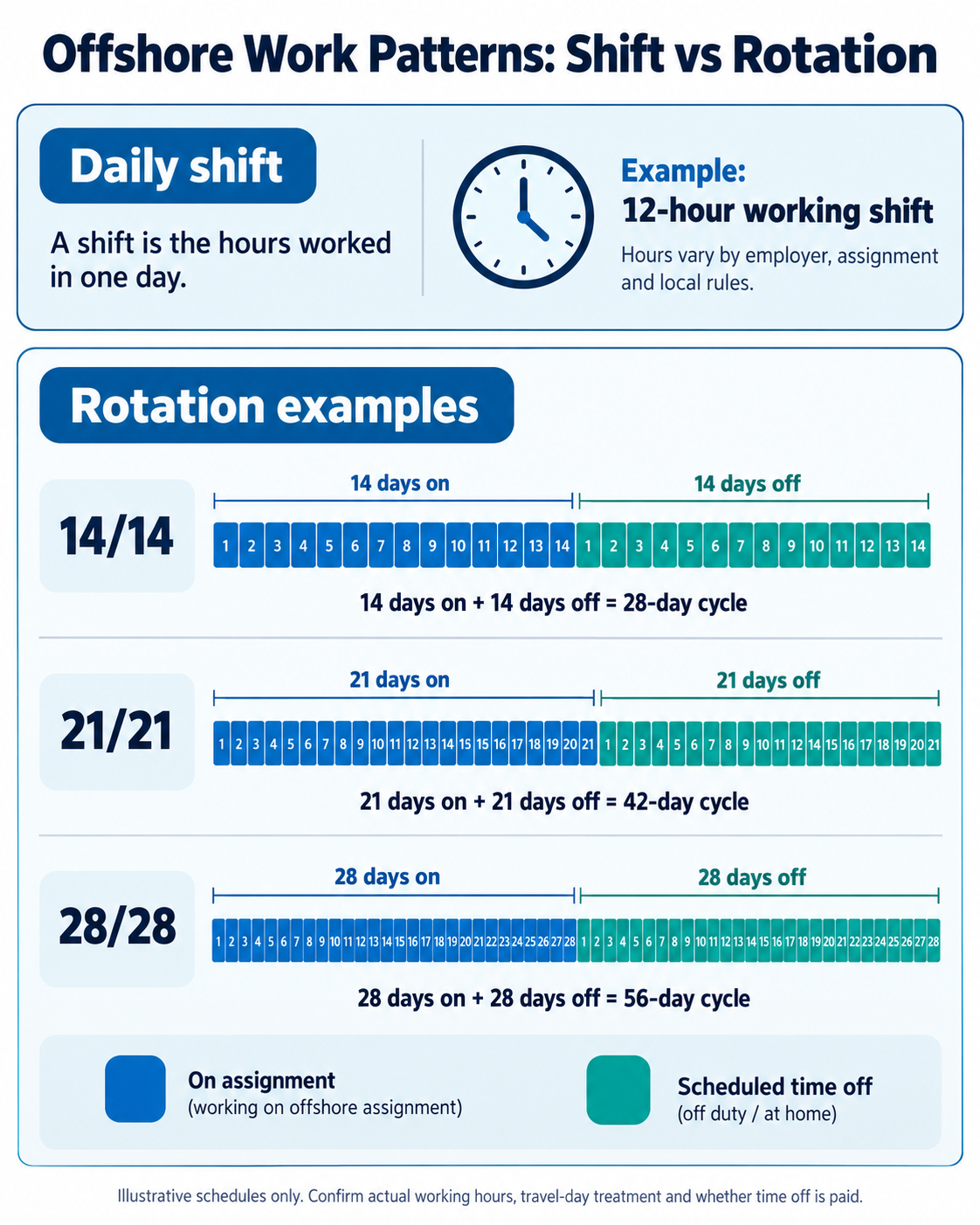
Ask how the employer counts the first and last day. For example, “14 days offshore” and “14 days away from home including travel” are different descriptions. A nominal equal-time rotation also does not tell you whether the off-period is paid. Get those definitions in the offer rather than annualising a day rate from the roster alone.
A Typical Day: Handover, Work and Recovery
The outline below shows the purpose of each part of a working day. It is an illustrative routine, not a mandatory clock-time schedule. A drilling shift, maintenance shift and catering shift will contain different tasks. [1, 4]
| Part of the day | What it is for | What matters |
|---|---|---|
| Before taking over | Receive the current task and equipment status. | Prepare questions; understand outstanding work and changes. |
| Work period | Carry out the assigned work under the applicable controls. | Know your responsibility, interfaces and reporting route. |
| Meal and rest relief | Take the relief arranged for the role. | Confirm the cover; do not assume a critical station can be left unattended. |
| End-of-shift handover | Transfer the status of work to the next person or crew. | Communicate unfinished tasks and relevant hazards, not just completed activity. |
| Off-duty period | Eat, wash, contact home and protect sleep. | Plan personal activities around the next duty period. |
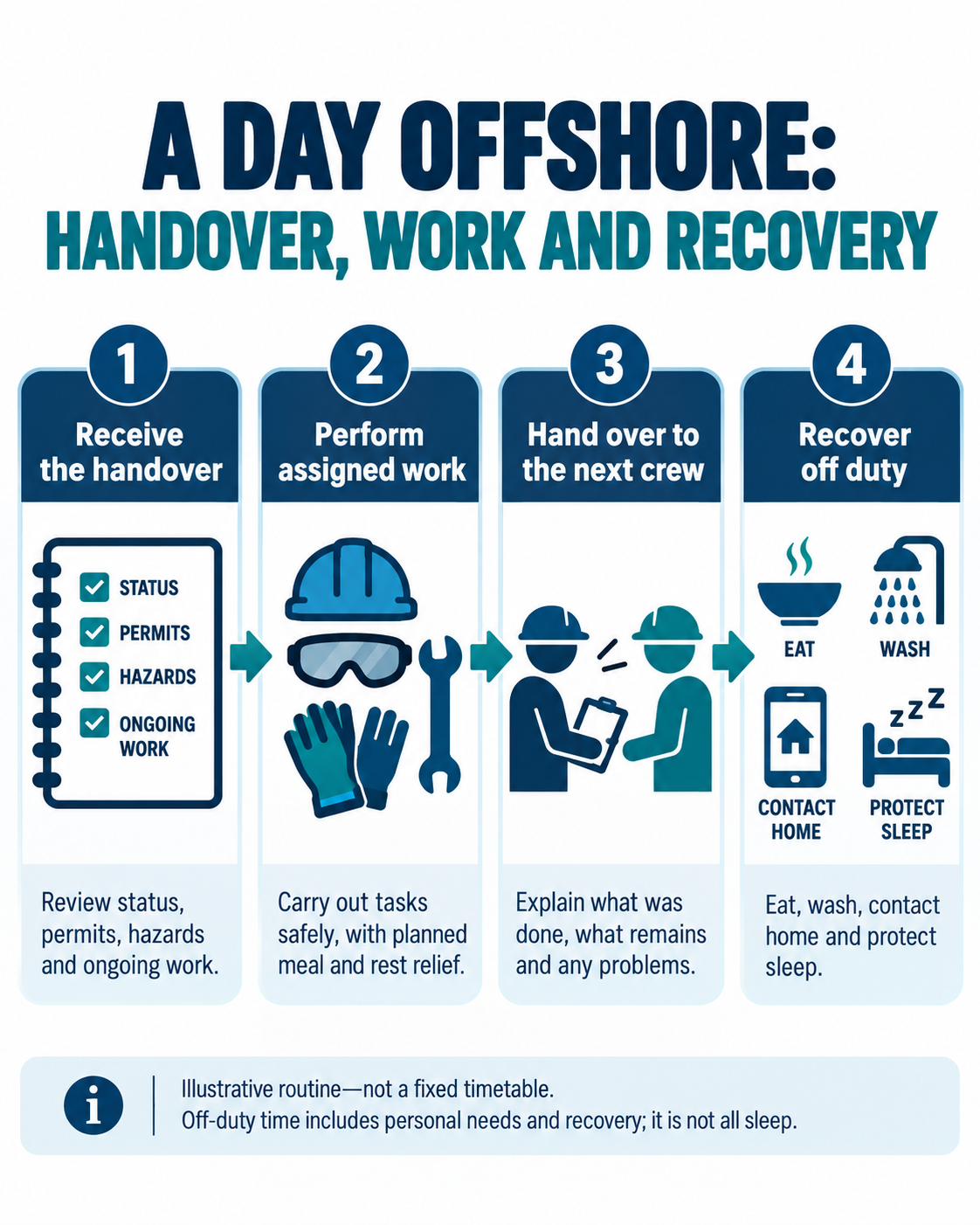
HSE describes handover as preparation, an exchange between outgoing and incoming personnel, and an incoming cross-check. Its guidance supports a two-way discussion backed by written information. Applied to rig life, that means making time for questions about changed conditions, unfinished maintenance and the status of relevant permits or isolations. It is not merely signing a log. [4]
Fatigue Is a Hazard, Not a Test of Commitment
HSE links fatigue risk to shift timing, duration, workload and recovery. Night work can make daytime sleep harder. Do not read a 12-hour roster as a promise of 12 hours of sleep: meals, washing, handover and personal activities also need time. Raise inadequate rest or an unsafe extension through the installation’s reporting arrangements rather than treating exhaustion as part of proving yourself. [3, 5]
Plan the journey home as well. HSE highlights driving after long or night shifts as a risk. Arrange suitable onward transport or rest instead of assuming that reaching the shore base makes fatigue disappear. [5]
Your Job Determines the Working Day
The rig crew organisation is a better guide to duties than the phrase “oil rig worker.” A driller, derrickman, subsea engineer and toolpusher have different responsibilities. Use those role guides for background, then check the actual job description and reporting line.
Marine operations, technical maintenance, medical support and administration also form part of offshore work. Seadrill’s own careers description separates these functions. That does not make every office-based role free from site rules or every technical role a day spent handling pipe. [12]
Accommodation: Cabins, Privacy and Quiet Time
Do not assume either a luxury private room or a fixed number of roommates. IADC’s floating-drilling chapter describes onboard accommodation, but its examples are not a cabin standard for every rig. Ask for the actual occupancy, bathroom arrangement and whether people sharing a cabin work different shifts. [1]
A useful accommodation enquiry is specific: Where will I store personal items? How is housekeeping timed around sleep? Who deals with a noisy or defective cabin? Can a problem be reported without waiting until the next crew change? The aim is to establish a workable rest environment, not simply collect a list of leisure facilities.
Food, Laundry and Off-Duty Facilities
Request the meal schedule for your shift, the process for dietary requirements or allergies, and the laundry arrangements before travelling. Ask what clothing and toiletries to bring and what the site supplies. Confirm any gym, television or recreation facilities rather than assuming an advertisement for one vessel describes your accommodation.
Communication with Home and Personal Devices
Internet and telephone access are not imaginary perks: Valaris describes phone and internet access for its offshore crews. However, that statement does not establish unlimited bandwidth, free international calls or unrestricted device use on every rig. Confirm your own access arrangements and where personal devices are permitted. [6]
Agree a realistic contact routine with family, including time-zone differences and an official route for urgent messages. Protect sleep when choosing call times. HSE’s shift-worker guidance supports discussing work patterns with family and reducing interruptions during rest. A missed routine call should have an agreed alternative, not depend on guessing why a connection failed. [5]
Weather, Vessel Motion and Delayed Crew Changes
Weather affects more than outdoor comfort. IADC describes how distance and poor sea or air conditions complicate offshore supply and personnel transport. It is therefore sensible to treat the planned crew-change date as a transport plan that can be disrupted, not an unconditional guarantee of arriving home at a particular hour. [1]
The offshore rig type also matters: a floating drilling unit responds to waves differently from a seabed-supported jackup. Ask about your actual assignment and its arrangements for adverse conditions. Do not assume that everyone works outdoors continuously, that all regions have the same weather, or that production targets override task-specific operating limits. [1]
Getting Offshore and the First Day on Board
Personnel may travel by helicopter or boat, depending on the installation and approved transport arrangements. IADC identifies these transfers as separate offshore safety challenges. Follow the joining instructions for the actual journey; another company’s baggage limit or check-in rule is not a substitute. [1]
Before departure, reconcile the required identification, medical acceptance, training records and travel booking with the employer’s instructions. Obtain the rules for medicines, batteries, baggage and issued equipment from the responsible travel or medical contact. This is a preparation prompt, not an exhaustive transport checklist.
On arrival, complete the installation’s induction and confirm how to recognise alarms, find the assigned muster point, contact the medic and report a concern. Offshore emergency training and drills support these arrangements, but do not replace learning the installation you have actually joined. [1, 10]
Heavy Equipment, Maintenance and Everyday Safety
Being offshore does not authorise a worker to repair any machine that stops. Stay within the assigned role, training and work controls. IADC connects task risk assessment with communication about simultaneous activities; one team’s maintenance or lifting work can affect another team nearby. Its principles are relevant to daily planning, not a generic repair procedure. [1]
PPE is one layer of protection. HSE’s PPE guidance places it alongside engineering controls and safe systems of work, with suitable selection and instruction. A hard hat does not make an uncontrolled lifting area safe. Use the oil rig hazards and safety guide for background, then follow the installation’s controls and stop/report arrangements. [7]
Medical Fitness, Onboard Care and Insurance Are Different
Fitness for the assignment: confirm which medical assessment and evidence the employer accepts. A training centre’s participation screening and approval to work offshore are separate questions. OPITO’s BOSIET standard has medical entry conditions for its practical exercises; it is not an employment insurance policy. [10]
Care while offshore: the IADC manual describes onboard medical facilities and the additional difficulty of arranging shore-based care or evacuation. Establish the actual reporting and support arrangements at induction. Do not assume an offshore medical room provides every service available in a hospital. [1]
Insurance and benefits: read the written package. Valaris explicitly states that benefits vary with region, work location and employment status. Ask about eligibility, dependants, employee contributions, exclusions and coverage during leave or travel. An employee and a subcontractor on the same rig should not assume they share the same benefits. [8]
Salary Expectations: Use the Right Comparison
There is no single reliable worldwide “oil rig salary.” As a dated US benchmark, the Bureau of Labor Statistics reports the following occupational medians for May 2025. These figures are not offshore-only salaries, entry-level offers or international contractor day rates. [9]
| US oil-and-gas occupation | Median annual wage, May 2025 | Comparison limit |
|---|---|---|
| Rotary drill operators | $67,890 | National occupation figure; not an offshore-only offer. |
| Derrick operators | $58,620 | National occupation figure; not an offshore-only offer. |
| Service unit operators | $58,160 | National occupation figure; not an offshore-only offer. |
| Roustabouts | $46,960 | National occupation figure; not an offshore-only offer. |
For your decision, compare like-for-like written offers: base pay, eligible overtime, paid or unpaid off-periods, travel days, allowances, training costs and benefit terms. Establish the currency and gross/net basis. Multiplying a daily figure by 365, or comparing a staff salary with a contractor’s invoice rate, can give a misleading result.
Training and Entry Requirements
A university degree is not a requirement for every offshore role. The UK National Careers Service describes several routes into drilling work, including relevant training, apprenticeships and direct applications based on suitable experience. A particular engineering, medical or marine position may have different qualification requirements. Apply against the actual role, not a general promise of “no experience needed.” [2]
BOSIET means Basic Offshore Safety Induction and Emergency Training. The OPITO BOSIET with CA-EBS standard covers offshore hazards and emergency-response skills, including helicopter emergencies, sea survival, first aid, firefighting and self-rescue. CA-EBS refers to a compressed-air emergency breathing system. This is safety training, not proof of competence to drill a well or maintain subsea equipment. [10]
Before paying for a course, ask the employer which product, medical evidence, training provider and refresher status are accepted for the location and journey. Do not treat a legitimate course certificate as a guarantee of a job, or purchase a different course simply because its name sounds similar.
Career Progression: Competence Before Promotion
Progression needs a development route, not just accumulated days offshore. Borr describes role-specific training and continuing competency assessment. This is a named employer example rather than a universal promotion timetable. Ask how performance is assessed, what evidence the next role requires and whether a suitable position exists. A qualification can support an application without creating a vacancy. [11]
Prohibitions and Site Rules
Read the joining instructions and induction rules for smoking or vaping areas, alcohol and drugs, personal electronics, photography and information sharing. Confirm how prescribed medicines must be declared through the approved medical process. Do not assume a phone permitted in accommodation is permitted in a work area.
The policy, employment terms and applicable jurisdiction determine the requirements and consequences. A general article cannot declare automatic dismissal for every incident or supply one worldwide rulebook. When a rule is unclear, obtain clarification before acting.
Questions to Ask Before Accepting an Offshore Assignment
| Ask about | Request a clear answer on | Why it matters |
|---|---|---|
| Role and employer | Employing entity, worksite, duties and reporting line. | The contractor name alone does not define the job. |
| Roster and travel | Shift pattern, rotation, travel-day treatment and delay arrangements. | Time offshore and total time away can differ. |
| Accommodation | Occupancy, rest conditions, food, laundry and facilities. | An attractive exterior photograph is not a living-conditions specification. |
| Pay | Rate basis, off-period pay, overtime and stated allowances. | A headline rate is not the full package. |
| Training and medicals | Accepted requirements, who arranges them and who pays. | Avoid buying unsuitable training or arriving without accepted evidence. |
| Support and benefits | Medical contacts, benefit eligibility and emergency family contact. | Site support and insurance coverage are different arrangements. |
| Employment status | Staff or contractor status, contract duration and review arrangements. | The same vessel can host workers on different terms. |
Use the company’s official recruitment route to verify the requisition and unexpected requests. Borr’s published fraud warning says it does not request recruitment payments and warns of impersonation. That is a reason to verify an offer independently, not to trust a copied logo or a message that creates urgency. [11]
Videos and Social-Media Accounts: Keep the Context
A tour or personal account can help you form questions, but does not establish conditions across a fleet. Check the date, employer, location and job behind the account. For a clearly attributed starting point, Seadrill’s offshore careers page includes an employer-produced day-in-the-life video. It is recruitment material from that company, not independent evidence of every worker’s experience. [12]
Oil Rig Life: Common Questions
Do you live on the rig during the rotation?
For an onboard offshore assignment, accommodation is part of the working arrangement. Verify the actual location and cabin allocation; the answer can differ for other offshore facilities or land-rig work. [1]
Can you call home or use the internet?
Some contractors describe these facilities, including Valaris. Access quality, permitted devices and usage rules still need checking for the particular installation. [6]
Are the days off automatically paid?
A rotation such as 14/14 specifies time, not pay. The offer or contract must explain remuneration during leave, travel and standby. Do not infer payment terms from the roster notation.
Is offshore safety training enough to get hired?
No. Safety training, role competence, medical acceptance and the employer’s recruitment decision are separate. Confirm the requirements for a real vacancy before spending money. [10, 12]
Is Oil Rig Life Right for You?
Assess the actual assignment against your ability to work shifts, share living space, follow controlled working practices and spend time away from family. The useful comparison is the complete arrangement—role, roster, recovery, support and remuneration—not a promise of high pay or a photograph of a comfortable cabin. Get unanswered questions resolved before accepting.
Offshore Life Video Overview
The video below is an additional overview. Its depicted setting and arrangements should not be treated as the joining instructions, safety rules or employment terms for your assignment.
References and Scope
[1] International Association of Drilling Contractors, IADC Drilling Manual, 12th edition, 2015, “Floating Drilling Equipment and Operations,” printed FD-2–FD-4 (physical PDF pages 598–600). Used for personnel, accommodation context, teamwork, weather/transport interfaces, task risk assessment, training and offshore medical-response constraints. Historical numerical examples are not current accommodation or staffing standards.
[2] UK National Careers Service: Offshore drilling worker. Used for an explicitly identified roster example and entry routes, not worldwide employment requirements.
[3]–[5] UK Health and Safety Executive: Fatigue, Shift handover and Hints and tips for shift-workers. Used for general risk-management and communication principles; UK legal provisions are not presented as global law.
[6]–[8] Valaris careers; HSE PPE overview; Valaris benefits overview. Linked where used. Employer statements describe that employer and do not establish amenities or entitlements for another installation.
[9] US Bureau of Labor Statistics, Oil and Gas Workers, Occupational Outlook Handbook, linked at the wage table. Wage observations are May 2025 national occupational medians.
[10]–[12] OPITO BOSIET with CA-EBS, product 5750; Borr careers and recruitment-fraud warning; Seadrill offshore careers. Linked in the relevant sections. These establish training scope or attributed employer information, not a vacancy guarantee.
Scope: public sources checked 21 October 2026. This guide combines the identified references with practical questions for evaluating an assignment. The roster arithmetic and routine/checklist tables are explanatory examples, not approved work schedules. Medical fitness, travel, safety and employment decisions require the responsible employer’s instructions and applicable requirements.